Why standardized tests in hiring matter: The HR leader's guide
Why standardized tests in hiring matter: The HR leader’s guide

Gut-feel hiring is expensive. When companies rely on unstructured interviews and resume reviews alone, intuitive hiring produces roughly 30% incompetent hires — a rate that drops to 10% with validated assessment tools. If you’re an HR leader at a mid-sized company wondering why standardized tests in hiring keep coming up in conversations about better recruitment, the answer is simple: they work where instinct fails. This guide walks you through the evidence, the legal requirements, and the practical steps to make standardized testing a reliable part of your hiring process.
Table of Contents
- The rationale behind standardized tests in hiring
- How structured and standardized assessments reduce bias and increase fairness
- Navigating legal compliance and adverse impact analysis in testing
- Implementing standardized tests effectively in mid-sized companies
- Balancing efficiency, candidate experience, and compliance risks
- Reconsidering hiring norms: Why standardized tests are a necessary baseline, not a luxury
- Enhance your hiring process with Testask standardized assessments
- Frequently asked questions
Key Takeaways
| Point | Details |
|---|---|
| Standardized tests boost accuracy | They improve hiring decisions by objectively measuring candidates’ abilities compared to unstructured methods. |
| Reduce bias and increase fairness | Standardized assessments and structured interviews minimize unconscious bias and demographic disparities. |
| Ensure legal compliance | Employers must perform adverse impact analysis and validate tests to avoid discrimination claims. |
| Practical for mid-sized firms | Validated off-the-shelf tests combined with monitoring offer an efficient path for mid-sized companies. |
| Balance efficiency and experience | Accommodations and fair practices ensure tests comply with ADA while maintaining candidate engagement. |
The rationale behind standardized tests in hiring
Traditional hiring methods carry a fundamental flaw: they measure how well a candidate presents, not how well they perform. A polished resume signals effort in formatting. A confident interview signals comfort under social pressure. Neither reliably predicts job performance. Standardized tests change that equation by measuring actual cognitive ability, job-relevant skills, and behavioral tendencies under equal conditions.
The business case is well established. Organizations using validated aptitude tests report lower turnover, higher productivity, and reduced training costs compared to those relying solely on interviews and resume reviews. These aren’t marginal gains. When you reduce mis-hires, you cut onboarding costs, preserve team morale, and protect manager time.
Here’s what makes standardized tests particularly valuable in practice:
- Predictive power. Cognitive ability tests are among the strongest predictors of job performance across roles and industries, outperforming interviews alone.
- Objectivity at scale. When you’re screening 200 applicants for 5 openings, a scored assessment gives every candidate an equal shot based on the same criteria.
- Speed without sacrifice. Tests can filter large applicant pools in hours, not weeks, without lowering evaluation quality.
- Consistency. Every candidate faces the same questions, the same time constraints, and the same scoring logic, removing evaluator variance from early screening.
“The best hiring decisions are data-driven, not impression-driven. Standardized tests give HR leaders a repeatable, defensible process that interviews alone simply cannot provide.”
If you want a practical starting point, this step-by-step guide to pre-employment tests covers how to select, administer, and interpret assessments within your existing workflow.
How structured and standardized assessments reduce bias and increase fairness
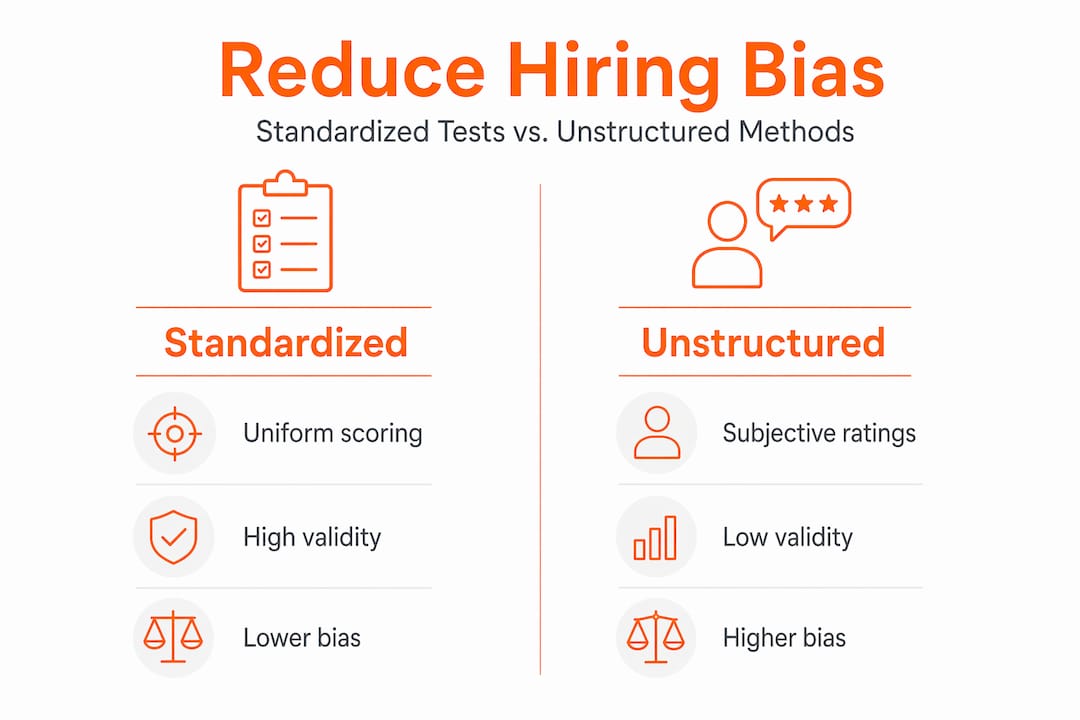
Bias in hiring isn’t always intentional. Evaluators favor candidates who mirror their communication style, educational background, or even physical appearance. Standardized tests don’t eliminate bias entirely, but they reduce its influence significantly by making the first screening layer merit-based rather than impression-based.
Structured assessments increase predictive validity and reduce demographic differences compared to unstructured methods. When you pair standardized tests with structured interviews using consistent questions and scoring rubrics, you get both data and dialogue that are comparable across candidates. That combination is measurably fairer.
| Method | Predictive validity | Bias risk | Consistency |
|---|---|---|---|
| Unstructured interview | Low | High | Low |
| Resume review only | Very low | High | Very low |
| Structured interview | Moderate | Moderate | High |
| Standardized test + structured interview | High | Low | High |
Here are the core practices that drive fairness in structured assessment:
- Use the same test version for every candidate applying to the same role.
- Score assessments with defined rubrics before reviewing resumes to avoid anchoring bias.
- Train all evaluators on how to interpret scores consistently.
- Document decisions at each stage to create an auditable hiring record.
Pro Tip: Run a quick correlation check after each hiring cohort. Compare assessment scores to 90-day performance ratings. Over time, this tells you which tests are actually predicting success in your specific context, not just in research papers.
For a deeper look at removing bias throughout the process, review these bias-free recruitment assessment steps and employment assessment best practices that HR teams at mid-sized companies are already applying.
Navigating legal compliance and adverse impact analysis in testing
Standardized tests are powerful, but they carry legal responsibility. Using an unvalidated test that disproportionately screens out candidates from a protected group exposes your company to EEOC complaints and litigation. Understanding the rules before you roll out any assessment is not optional.
The foundational standard is the Four-Fifths Rule. If any group’s selection rate falls below 80% of the highest-performing group’s rate, that triggers a finding of adverse impact, which requires you to demonstrate the test is job-related and consistent with business necessity.
Here’s how to stay compliant from day one:
- Choose validated tests. Validation types include criterion-related (the test predicts performance), content (the test reflects actual job tasks), and construct (the test measures a relevant trait like reasoning ability).
- Collect applicant flow data. Track demographic information voluntarily and separately from scoring, then run subgroup analysis before and after full rollout.
- Document everything. Keep records of test selection rationale, validation evidence, adverse impact analyses, and any adjustments made.
- Set a review cadence. Reanalyze subgroup differences annually or when your applicant pool composition changes significantly.
Employers must monitor subgroup differences to comply with EEOC audits and document alternative approaches if disparities surface. That monitoring isn’t a one-time task. It’s an ongoing operational responsibility.
| Validation type | What it proves | Best used for |
|---|---|---|
| Criterion-related | Test scores predict job performance | Roles with measurable output |
| Content validity | Test mirrors actual job tasks | Technical or trade roles |
| Construct validity | Test measures a relevant trait | Cognitive or personality assessments |
Pro Tip: Before purchasing any third-party test, ask the vendor directly for their adverse impact data across demographic groups. A reputable vendor will provide this readily. If they hesitate, that’s a signal worth heeding.
Your screening process best practices should include a legal compliance checkpoint at the test selection stage, not as an afterthought after deployment.
Implementing standardized tests effectively in mid-sized companies
Mid-sized companies face a specific challenge: they rarely have the psychometric research budget of a Fortune 500 firm, but they still carry the same legal and operational risks. The good news is that the path to effective standardized testing doesn’t require building everything from scratch.

Mid-sized companies should start with validated GMA tests (general mental ability tests) and conduct adverse impact analysis before full rollout. Off-the-shelf validated tools give you immediate access to established psychometric evidence without commissioning a custom validation study.
Here’s a practical implementation path:
- Start narrow. Pilot testing for one role category (customer service, software engineering, operations) before expanding company-wide.
- Run the 80% rule check early. Use your applicant flow data from the pilot to calculate selection rates by demographic group before scaling.
- Pair tests with work samples. For skilled roles, cognitive tests predict potential, but work samples demonstrate applied ability. Use both.
- Set a clear cutoff policy. Decide in advance whether test scores are used to rank, screen, or inform, not after results come in.
- Communicate the process to candidates. Clear instructions and fair timing windows improve candidate experience and reduce noise in results.
For roles that require demonstrated skill rather than pure cognitive ability, pairing GMA tests with task-based assessments adds significant predictive power. Learn more about building efficient predictive hiring systems and review this practical job assessment guide for role-specific approaches.
Balancing efficiency, candidate experience, and compliance risks
Even a well-designed standardized test can create legal and operational problems if administration isn’t handled carefully. Two areas where mid-sized companies frequently stumble are ADA accommodations and candidate communication.
The Americans with Disabilities Act requires reasonable accommodations during testing. That might mean extended time for candidates with documented disabilities, alternative formats for those with visual impairments, or assistive technology access for online assessments. Without ADA compliance checks, standardized tests risk lawsuits, and accommodations may impact validity in ways that require psychometric and legal analysis.
Here’s how to build an accommodation process that works:
- Include an accommodation request option in every testing invitation.
- Establish a clear internal review process for evaluating accommodation requests consistently.
- Document the accommodation provided and note it during score interpretation.
- Consult legal counsel or a psychometrician when accommodations materially change testing conditions.
Beyond legal compliance, candidate experience directly affects your employer brand and offer acceptance rates. Consider these practices:
- Send test instructions at least 48 hours in advance, not the morning of.
- Keep assessments under 45 minutes for early-stage screening.
- Provide score feedback where legally and practically feasible.
- Respond promptly to questions about the testing process.
Train your hiring team on both the legal and human sides of test administration. A recruiter who understands why accommodations matter and how to discuss the process confidently makes a significant difference. Review AI candidate screening pitfalls to understand where automated and standardized tools commonly go wrong, and how to guard against those failures.
Reconsidering hiring norms: Why standardized tests are a necessary baseline, not a luxury
Here’s a position worth defending: standardized tests are not a premium add-on for well-resourced HR teams. They’re the floor, not the ceiling, of responsible hiring practice.
The emergence of AI interview tools, personality analytics, and video-based behavioral assessments has given some companies the impression that they’ve moved beyond traditional testing. They haven’t. Most of these newer tools lack the validation depth of established cognitive and skill assessments. They’re layering complexity on top of an unstable foundation.
Standardized cognitive tests remain superior to unstructured interviews and questionable psychometrics, reducing incompetent hires from 30% to 10%. That evidence is decades deep. The newer AI tools can complement a validated testing system, but they don’t replace it.
The companies that skip standardized testing in favor of “culture fit” conversations and gut checks are not being more human. They’re being less accountable. They’re also more likely to hire people who interview well rather than people who perform well, which is an expensive distinction to learn after the fact.
For mid-sized companies especially, treating standardized tests as optional is a false economy. The cost of a bad hire at the manager level alone often exceeds the annual investment in a full testing program. The math doesn’t require debate. What it requires is commitment to evidence over comfort. Explore how AI strategies in recruitment can work alongside validated testing rather than instead of it.
Enhance your hiring process with Testask standardized assessments
You now have a clear picture of why standardized tests in hiring matter and how to implement them responsibly. The next question is execution.
Testask is an AI-powered recruitment assessment platform built for HR teams that want to evaluate candidates on actual skills, not impressions. You can generate tailored test tasks for any role, review candidate submissions with AI-assisted analysis, and collaborate with your hiring team on a single platform. Testask supports compliance-conscious workflows, making it easier to document decisions, track performance, and scale your assessment process without adding administrative burden. If you’re ready to move from intuition-based to evidence-based hiring, explore Testask’s assessment tools and see how quickly your team can get a structured process in place.
Frequently asked questions
What are standardized tests in hiring?
Pre-employment testing refers to any standardized assessment instrument used for candidate selection, meaning all applicants complete the same evaluation under the same conditions. These tools objectively measure skills, cognitive ability, or job-relevant knowledge.
How do standardized tests reduce bias in hiring?
They apply identical questions and scoring criteria to every candidate, which limits the influence of subjective judgment or unconscious preference. Structured assessments increase predictive validity and reduce demographic differences compared to unstructured evaluation methods.
What is adverse impact in hiring tests?
Adverse impact occurs when a selection tool produces a selection rate for a protected group that is less than 80% of the highest-selected group’s rate, creating legal exposure. The Four-Fifths rule flags this threshold as the trigger point requiring the employer to demonstrate business necessity.
Can mid-sized companies easily implement standardized tests?
Yes. Starting with validated GMA tests and running adverse impact analysis before full rollout gives mid-sized companies a legally defensible and practically manageable entry point into standardized assessment without requiring a custom validation study.
Recommended
- Pre-employment tests: A step-by-step hiring guide | Testask Blog | testask
- Hiring process best practices: proven steps for better talent | Testask Blog | testask
- Employment assessment best practices that elevate hiring results | Testask Blog | testask
- Build an effective recruitment checklist for HR success | Testask Blog | testask