Employment assessment best practices that elevate hiring results
Employment assessment best practices that elevate hiring results

Despite having access to more hiring tools than ever, many organizations still struggle with mismatched hires. 76% of large organizations use pre-employment assessments, yet costly hiring errors persist. The gap between using assessments and using them well is significant. Effective employment assessments require more than picking a test and sending it out. They demand a clear framework built on legal compliance, validated design, and a positive candidate experience. This guide walks HR professionals and hiring managers through proven best practices, from establishing solid criteria to continuously improving your process, so your assessments actually predict performance.
Table of Contents
- Establishing effective assessment criteria
- Types of employment assessments and their strengths
- Best practice: Combine assessments with interviews and references
- Ensuring fairness, legal compliance, and candidate experience
- Adapting and improving your employment assessments
- A pragmatic perspective: Beyond one-size-fits-all assessments
- Streamline your hiring with AI-powered assessments
- Frequently asked questions
Key Takeaways
| Point | Details |
|---|---|
| Validate and standardize | All employment assessments must be job-related, validated, and consistently applied to ensure compliance and efficacy. |
| Blend multiple methods | Combine skills tests, interviews, and reference checks for a holistic and predictive hiring process. |
| Prioritize fairness | Monitor for bias, accommodate disabilities, and follow EEOC and ADA guidelines in every assessment. |
| Continuous improvement | Regularly review and update assessments as job roles and hiring technologies evolve. |
Establishing effective assessment criteria
Before selecting any assessment tool, you need a clear set of criteria that every evaluation must meet. Skipping this step is where most hiring programs go wrong. Criteria anchor your entire process and protect your organization legally and operationally.
The foundation is job-relatedness. Every assessment must directly measure skills, knowledge, or abilities required for the specific role. Tests must be job-related, validated, and administered consistently to every candidate in the same role. Consistency matters because inconsistency introduces bias and legal exposure.
Legal compliance is non-negotiable. EEOC guidelines require employers to accommodate candidates with disabilities and actively assess for adverse impact, which means measuring whether a test disproportionately screens out protected groups. If adverse impact is found, you must seek alternatives.
Here are the core criteria every effective assessment program should meet:
- Job-relatedness: The assessment must map directly to role requirements
- Validation: Use content, criterion, or construct validity evidence
- Consistency: Administer the same test under the same conditions for all candidates
- ADA accommodation: Provide reasonable adjustments for candidates with disabilities
- Adverse impact monitoring: Regularly check pass rates across demographic groups
- Ongoing review: Revalidate assessments as job requirements evolve
Pro Tip: Before finalizing any assessment, conduct a job analysis to document the specific competencies being measured. This documentation is your first line of defense in any legal challenge.
Building your assessment program on comprehensive assessment tools that already incorporate these criteria saves significant time and reduces compliance risk from day one.
Types of employment assessments and their strengths
With solid criteria established, the next step is choosing the right assessment format. No single type works for every role or organization. Understanding each format’s strengths and limitations helps you make smarter selections.
Skills assessments and work samples ask candidates to demonstrate actual job tasks. Skills-based assessments reduce bias and broaden talent pools by focusing on what candidates can do rather than where they went to school. These are highly effective for technical, creative, and operational roles.

Cognitive ability tests measure problem-solving, reasoning, and learning speed. They predict performance across many roles but carry a higher risk of adverse impact if not carefully validated.
Situational judgment tests (SJTs) present realistic workplace scenarios and ask candidates how they would respond. They are strong predictors of behavioral competencies.
Personality assessments evaluate traits like conscientiousness or openness. They work best as one input among many, not as standalone filters.
AI-powered and automated screening tools can process large candidate volumes quickly. However, they require careful monitoring for AI algorithm adverse impact before deployment.
| Assessment type | Best use case | Key strength | Key risk |
|---|---|---|---|
| Skills/work sample | Technical, creative roles | High predictive validity | Time-intensive to design |
| Cognitive ability | Complex problem-solving roles | Strong predictor | Adverse impact risk |
| Situational judgment | Leadership, customer-facing | Measures real behavior | Fakeable by savvy candidates |
| Personality | Culture and team fit | Broad behavioral insight | Low standalone validity |
| AI-powered screening | High-volume hiring | Speed and scalability | Bias if unmonitored |
Review SHRM’s pre-employment testing checklist to verify your chosen format meets legal and validity standards before rollout.
Pro Tip: Simulations and blind skill evaluations consistently show the highest predictive validity for most roles. If you can only invest in one format, start there.
Best practice: Combine assessments with interviews and references
No single assessment, no matter how well designed, should drive a hiring decision on its own. The strongest hiring programs blend multiple evaluation methods to build a complete picture of each candidate.
Do not rely solely on tests. Combine them with structured interviews and reference checks to reduce the risk of costly mis-hires. This blended approach is not just best practice, it is what separates high-performing talent teams from average ones.
Here is a practical integration sequence:
- Screen with assessments first. Use skills tests or cognitive assessments to filter the initial applicant pool efficiently.
- Follow with structured interviews. Use standardized questions tied to the same competencies your assessment measured.
- Check references with purpose. Ask specific questions about past performance in areas the assessment flagged as potential gaps.
- Calibrate across evaluators. Hold a structured debrief where interviewers and reviewers align on evidence before making a decision.
- Document every step. Maintain records of assessment scores, interview notes, and reference feedback for compliance purposes.
Organizations that use a blended approach combining validated assessments, structured interviews, and reference checks can reduce mis-hires by up to 90%, dramatically lowering the cost and disruption of turnover.
Pro Tip: Keep total assessment and interview time under three hours per candidate. Excessive time requirements increase candidate drop-off and signal poor process design, especially for senior talent.
Exploring combining assessment methods in a single platform makes this integration far easier to manage at scale.
Ensuring fairness, legal compliance, and candidate experience
A technically valid assessment that creates a poor candidate experience or violates legal standards is a liability, not an asset. Fairness and compliance must be built into every layer of your process.
Key EEOC and ADA requirements every HR team must address:
- Adverse impact analysis: Assess for adverse impact by comparing pass rates across race, gender, and other protected groups using the four-fifths rule
- Reasonable accommodation: Offer alternative formats or extended time for candidates with documented disabilities
- Consistent application: Apply the same assessment standards to every candidate for a given role
- Transparency: Inform candidates what the assessment measures and how results will be used
- Data security: Store assessment data securely and limit access to authorized reviewers
Edge cases require specific attention. Medical and drug tests post-offer are permitted but must be applied consistently to all candidates in the same role category. AI screening tools need regular adverse impact audits before and after deployment.
| Requirement | Action required | Who is responsible |
|---|---|---|
| EEOC adverse impact | Run four-fifths analysis quarterly | HR compliance team |
| ADA accommodation | Document and fulfill requests promptly | Recruiting and HR |
| AI tool bias monitoring | Audit algorithm outputs regularly | HR and IT or vendor |
| Candidate communication | Notify candidates of assessment purpose | Recruiting team |
A positive candidate experience also matters for your employer brand. Communicate timelines clearly, provide instructions in plain language, and follow up promptly after assessments are completed.
Adapting and improving your employment assessments
The best assessment programs are never static. Job roles evolve, labor markets shift, and legal requirements update. Building a continuous improvement loop into your process protects both quality and compliance over time.
Monitor validity as jobs evolve and update assessments consistently to reflect current role requirements. An assessment built for a role three years ago may no longer predict success in that same role today.
Key metrics to track regularly:
- Screen pass rates: What percentage of candidates pass each assessment stage?
- Adverse impact rates: Are any demographic groups passing at significantly lower rates?
- New hire performance correlation: Are high assessment scorers performing better on the job?
- Time-to-hire impact: Is the assessment process speeding up or slowing down hiring?
- Candidate completion rates: Are candidates dropping out before finishing assessments?
Soliciting candidate feedback is underused and highly valuable. A short post-assessment survey asking about clarity, fairness, and relevance gives you actionable data most competitors ignore.
Steps to build a feedback loop with hiring managers:
- Schedule quarterly reviews of assessment outcomes versus 90-day performance reviews
- Ask hiring managers to flag any patterns where assessment scores did not predict actual performance
- Update scoring rubrics and question banks based on findings
- Document all changes with dates for compliance and audit purposes
- Share improvement results with leadership to maintain program investment
Continuous improvement is what separates assessment programs that deliver long-term value from those that quietly become outdated and ineffective.
A pragmatic perspective: Beyond one-size-fits-all assessments
Most expert advice on employment assessments focuses on compliance and validity, and rightly so. But there is something important that often gets left out: context matters as much as methodology.
We have seen organizations copy assessment frameworks from industry leaders and get poor results because the approach did not fit their culture, hiring volume, or talent market. A 10-person startup and a 10,000-person enterprise need fundamentally different assessment strategies, even if the legal requirements are identical.
The uncomfortable truth is that agility beats perfection in assessment design. A well-validated assessment that takes six months to build and deploy may cost you more in lost candidates than a faster, simpler evaluation that you iterate on quickly. Legal and validity rules are the floor, not the ceiling.
The organizations that hire best are those that treat their assessment process as a living system, not a compliance checkbox. They combine rigorous standards with practical flexibility, adjusting as their business grows, their roles change, and their candidate pools shift. Build for where you are now, with room to evolve.
Streamline your hiring with AI-powered assessments
Implementing these best practices manually across a large hiring operation is a real challenge. The criteria, the blended methods, the compliance monitoring, and the continuous improvement all require coordination and consistency that is hard to maintain at scale.
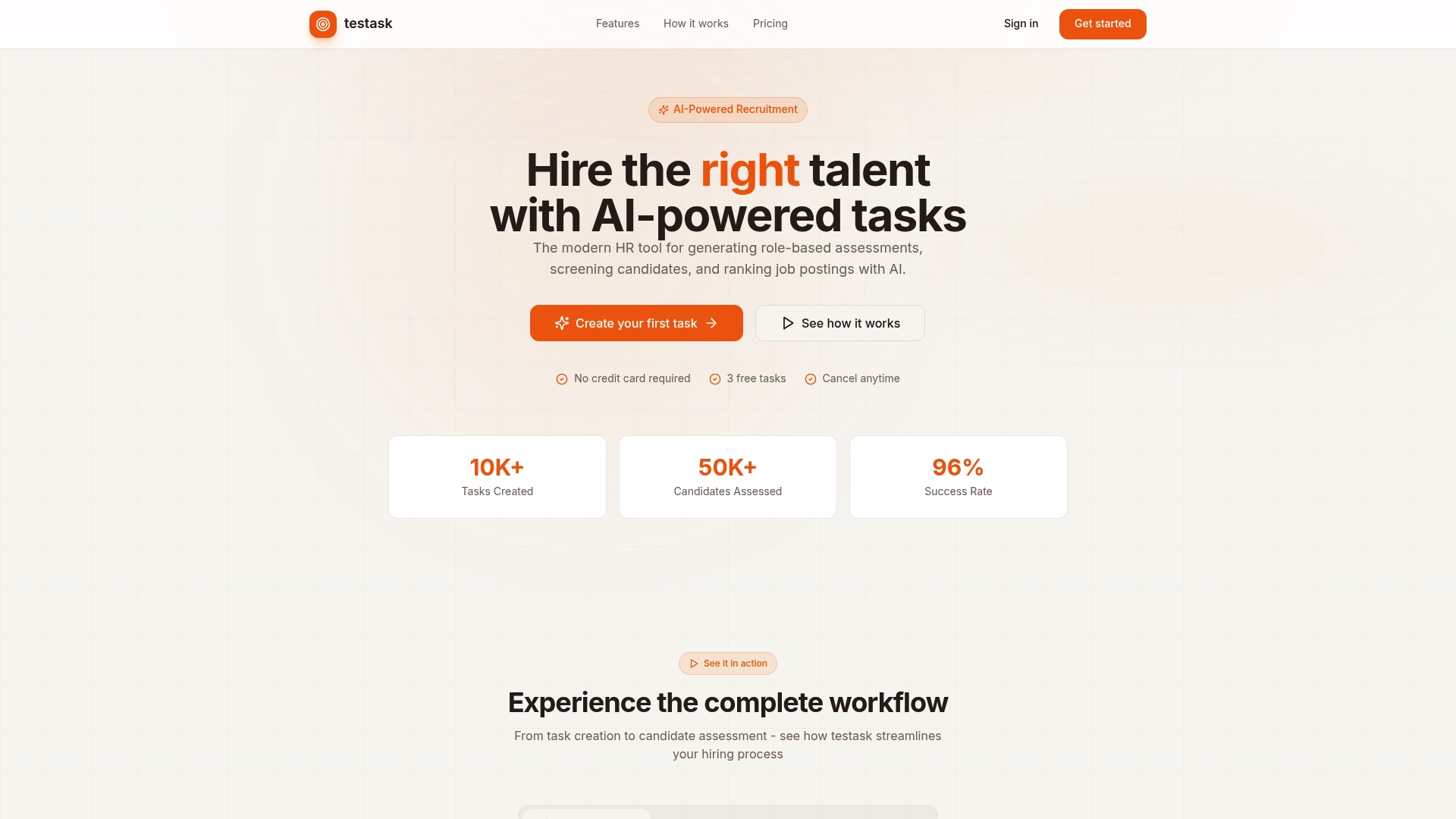
Testask’s assessment platform is built to operationalize exactly these practices. You can generate tailored test tasks for any role, evaluate submissions with AI-assisted analysis, and collaborate with your team on candidate reviews, all in one place. Testask helps you stay compliant, reduce bias, and deliver a professional candidate experience without adding workload to your HR team. If you want to assess skills faster and make better hiring decisions, Testask gives you the tools to do it.
Frequently asked questions
What makes an employment assessment fair and legal?
An assessment is fair and legal if it is job-related, validated and consistent for all applicants, and includes reasonable accommodations for candidates with disabilities.
How do skills-based assessments reduce hiring bias?
Skills-based assessments focus on demonstrated ability rather than credentials. Skills-based hiring widens the talent pool and reduces reliance on proxies like degrees that can introduce socioeconomic bias.
What are common mistakes in employment assessments?
Over-testing, using non-validated tools, and failing to monitor for adverse impact are frequent errors. Do not rely solely on tests and always combine them with structured interviews and reference checks.
How often should assessments be reviewed?
Assessments should be reviewed at least annually or whenever a role changes significantly. Monitor and update validity to ensure your tools still reflect current job requirements.
Can AI assessment tools lead to discrimination?
Yes, if not properly monitored. AI tools need adverse impact checks before and after deployment to ensure they do not disproportionately screen out protected groups.