Hiring process best practices: proven steps for better talent
Hiring process best practices: proven steps for better talent

A bad hire costs more than most leaders realize. The financial hit alone can reach 30% of the role’s annual salary, and that figure doesn’t capture the team friction, lost productivity, or the months spent starting the search all over. The real problem isn’t a lack of candidates. It’s a lack of a consistent, evidence-based process for evaluating them. Structured interviews with standardized scoring predict job performance at r=0.51 validity, nearly twice that of informal conversations, yet many teams still rely on gut feel. This article walks you through proven, practical steps to change that.
Table of Contents
- Define clear criteria and align hiring needs
- Embrace skills-based hiring over credentials
- Use structured interviews to boost decision quality
- Implement strategic sourcing and Talent Architects
- A fresh look at hiring: What most leaders miss
- Ready to transform your hiring process?
- Frequently asked questions
Key Takeaways
| Point | Details |
|---|---|
| Start with alignment | Clear criteria and stakeholder agreement prevent mis-hires and wasted effort. |
| Prioritize skills, not résumés | Assess for core competencies rather than relying solely on education or credentials. |
| Standardize your interviews | Use structured questions and scoring rubrics to improve decision quality and fairness. |
| Adopt strategic sourcing | Leverage Talent Architects and proactive sourcing to boost fit and reduce turnover. |
| Pay attention to candidate experience | Small changes like having managers deliver offers can set your organization apart. |
Define clear criteria and align hiring needs
Once you recognize the risks of poor hiring decisions, the first step is to set the right foundation. Most mis-hires don’t start in the interview room. They start weeks earlier, when the hiring team never agreed on what success in the role actually looks like. A structured intake meeting fixes that before it becomes a problem.
According to SHRM’s guidance on business-driven recruiting, effective intake meetings should cover five core areas. Here’s how to structure yours:
- Define job success. What does a high performer in this role accomplish in the first 90 days? Ask the hiring manager to describe outcomes, not tasks.
- Map your sourcing strategy. Where do the best candidates for this role spend their time? Job boards, professional communities, referrals, internal mobility?
- Build a candidate profile. Which skills and behaviors are non-negotiable versus nice to have? Rank them so the team can make consistent trade-offs later.
- Set a realistic timeline. Align on screening stages, interview rounds, and a target offer date. Vague timelines cause bottlenecks and candidate drop-off.
- Agree on metrics. How will you measure whether the process worked? Time-to-fill, offer acceptance rate, and 90-day retention are solid starting points.
This upfront alignment prevents the two most common failures: teams evaluating candidates on different, unspoken criteria, and hiring managers changing requirements mid-search. When everyone enters the process with the same picture of success, screening becomes faster and decisions become easier.
Pro Tip: Before the intake meeting, send the hiring manager a one-page template asking them to rank the top five must-have competencies. This surfaces disagreements before the first resume lands in your inbox. For a deeper look at structuring this stage, the candidate screening process guide covers screening frameworks that reinforce this foundation.
Collaboration with key stakeholders isn’t optional. Recruiting is a team sport. When department leads, team members who will work alongside the new hire, and HR all contribute to the criteria, you get a richer, more accurate definition of the ideal candidate. You also get broader buy-in, which speeds up approvals when the right person appears.
Embrace skills-based hiring over credentials
With clear criteria set, it’s time to rethink what truly predicts performance: skills, not just résumés. Degree requirements made sense when formal education was the primary pathway into most professions. That’s no longer true. Today, bootcamps, online programs, portfolio work, and on-the-job learning produce highly capable professionals who may never have set foot in a traditional university, at least not in a relevant field.
Skills-based hiring requires four core elements to work well:
- Define competencies first. Before writing a job description, identify the two or three skills that directly drive results in the role. A content marketer needs editorial judgment and data literacy. A backend developer needs system design thinking and debugging discipline. Be specific.
- Create a skills blueprint. Map those competencies to your business growth plan. Are you scaling fast? Prioritize people who thrive in ambiguity. Entering a regulated market? Add compliance awareness to the list.
- Build transparency into every assessment. Candidates perform better and feel more respected when they understand what is being measured and why. Share the criteria upfront.
- Avoid testing overload. Every unnecessary assessment you add increases candidate drop-off. Only test for skills that are genuinely predictive of success in the role.
“The most effective skills-based hiring programs are intentional, not exhaustive. The goal is signal, not volume.” This mindset separates teams that assess well from those that simply assess a lot.
When should you skip a formal skills assessment entirely? If the role involves highly observable past work, a portfolio review or work sample conversation may give you more signal than a timed test. If the competency is primarily behavioral, a well-designed interview question may be sufficient. See assessment best practices for a full framework on choosing the right evaluation method.
Pro Tip: Keep skills assessments to 45 minutes or less for early-stage screening. Research consistently shows that longer assessments don’t produce meaningfully better predictions but do drive away strong candidates who are already employed and time-constrained.
The shift to skills-based hiring also has equity benefits. When you evaluate what candidates can actually do rather than where they went to school, you open the door to talent pools that were previously invisible to your organization. That’s not just good ethics. It’s competitive advantage.

Use structured interviews to boost decision quality
After establishing what to assess, effective evaluation is built on rigor, specifically, structured interviews. The difference between a structured and an unstructured interview isn’t just formality. It’s the difference between a reliable measurement tool and an improvised conversation that feels productive but produces inconsistent data.
| Feature | Structured interview | Unstructured interview |
|---|---|---|
| Questions | Standardized across all candidates | Varies by interviewer |
| Scoring | Defined rubrics applied consistently | Subjective impression |
| Predictive validity | r=0.51 | r=0.38 |
| Bias risk | Lower | Higher |
| Legal defensibility | Stronger | Weaker |
The validity advantage of structured interviews is not marginal. At r=0.51 versus r=0.38, you are significantly improving the accuracy of every hiring decision you make, multiplied across dozens or hundreds of hires per year.
Here’s how to implement structured interviews effectively:
- Derive questions from job analysis. Every question should connect directly to a competency from your intake meeting. If you can’t trace the question back to a job requirement, cut it.
- Use a mix of behavioral and situational questions. Behavioral questions surface past performance (“Tell me about a time you…”). Situational questions test future judgment (“What would you do if…”). Both formats have strong predictive validity.
- Conduct panel interviews where possible. Multiple evaluators rating the same candidate independently reduces individual bias and increases scoring reliability.
- Aggregate scores before discussing. Have each interviewer submit their ratings independently before the debrief. Group discussion before scoring creates anchoring bias, where the first strong opinion shapes everyone else’s view.
- Calibrate your rubric regularly. Review scoring patterns quarterly. If one interviewer consistently rates all candidates higher or lower than the rest, you have a calibration issue, not just a style difference.
For teams running high volumes of interviews, streamlined candidate evaluation frameworks can help you maintain rigor without slowing down your process. Structured interviews scale well when the system is set up correctly from the start.
Implement strategic sourcing and Talent Architects
Even with the best interview and skills frameworks, tapping the right talent pools makes all the difference. Where you find candidates is just as important as how you evaluate them. This is where strategic sourcing and what SHRM now calls Talent Architects come in.
Talent Architects are specialized recruiters who go beyond filling requisitions. They understand the business, anticipate hiring needs before they become urgent, and build proactive pipelines. The results are measurable: 63% of organizations already prioritize critical talent sourcing strategies, and organizations using Talent Architects report lower turnover and better organizational fit.
| Sourcing approach | Key benefit | Best use case |
|---|---|---|
| Internal mobility | Fast, high retention | Leadership, specialist roles |
| Employee referrals | Strong cultural fit | High-trust team environments |
| Proactive pipelining | Reduces time-to-fill | Hard-to-fill or niche roles |
| Talent communities | Warm candidate base | Recurring or seasonal hiring |
| Strategic partnerships | Specialized talent access | Technical or regulated fields |
“Organizations that treat sourcing as a continuous function, not a reactive one, consistently outperform those that only activate their pipeline when a seat opens up.”
Here are the sourcing practices that consistently produce strong results:
- Prioritize internal mobility. Your best hire might already work for you. Promote internal job visibility and create clear growth pathways so high performers don’t leave to advance.
- Leverage structured referral programs. Employee referrals outperform most other channels for retention, but only when the referral process is organized and the criteria are clearly communicated. Random referrals without screening don’t move the needle.
- Build talent communities before you need them. Engage passive candidates through newsletters, webinars, and community platforms so you have a warm list ready when roles open.
- Use data to guide sourcing investment. Track source-of-hire by quality, not just quantity. A channel that produces 50 applicants but one good hire is less valuable than one that produces 10 applicants and three.
For a structured view of talent acquisition strategies and how AI talent matching can accelerate the sourcing process, these resources offer practical implementation guidance for modern hiring teams.
A fresh look at hiring: What most leaders miss
Most hiring improvement efforts focus on adding things: more interview rounds, more assessments, more stakeholders in the decision. But in practice, the teams that hire best tend to do fewer things, just more consistently.
Here’s the uncomfortable truth: overengineering your hiring process creates its own set of problems. When you have six interview rounds, three separate assessments, and five decision-makers, you slow down your timeline, frustrate strong candidates who have other offers, and introduce so much data that the signal gets lost in the noise. Complexity is not the same as rigor.
The other common failure mode is the opposite: trusting gut feel too much. Experienced hiring managers sometimes believe their instincts are reliable because they’ve made some good hires. But research on screening efficiency consistently shows that informal judgment degrades in quality as the candidate pool grows. What feels like insight is often pattern matching to surface-level familiarity.
What actually moves the needle is clarity on the buyer side. Candidates want to know what success looks like, what the evaluation process involves, and what happens next. When you communicate those things clearly and follow through consistently, you build trust. That trust affects offer acceptance rates more than most compensation adjustments.
One specific practice that’s widely overlooked: hiring managers personally delivering job offers rather than delegating to recruiters. It signals that the candidate is valued at the leadership level. It creates a memorable moment. It dramatically improves acceptance rates. It’s simple, costs nothing, and most teams still don’t do it.
The simplest framework that works is also the most durable: define what you need, assess it directly, make a decision with multiple perspectives, and communicate clearly at every step. A few core steps, rigorously applied, consistently beat complex and inconsistent systems.
Ready to transform your hiring process?
Implementing these best practices doesn’t have to be daunting. The frameworks in this article work, but they work even faster when you have tools built to support them.
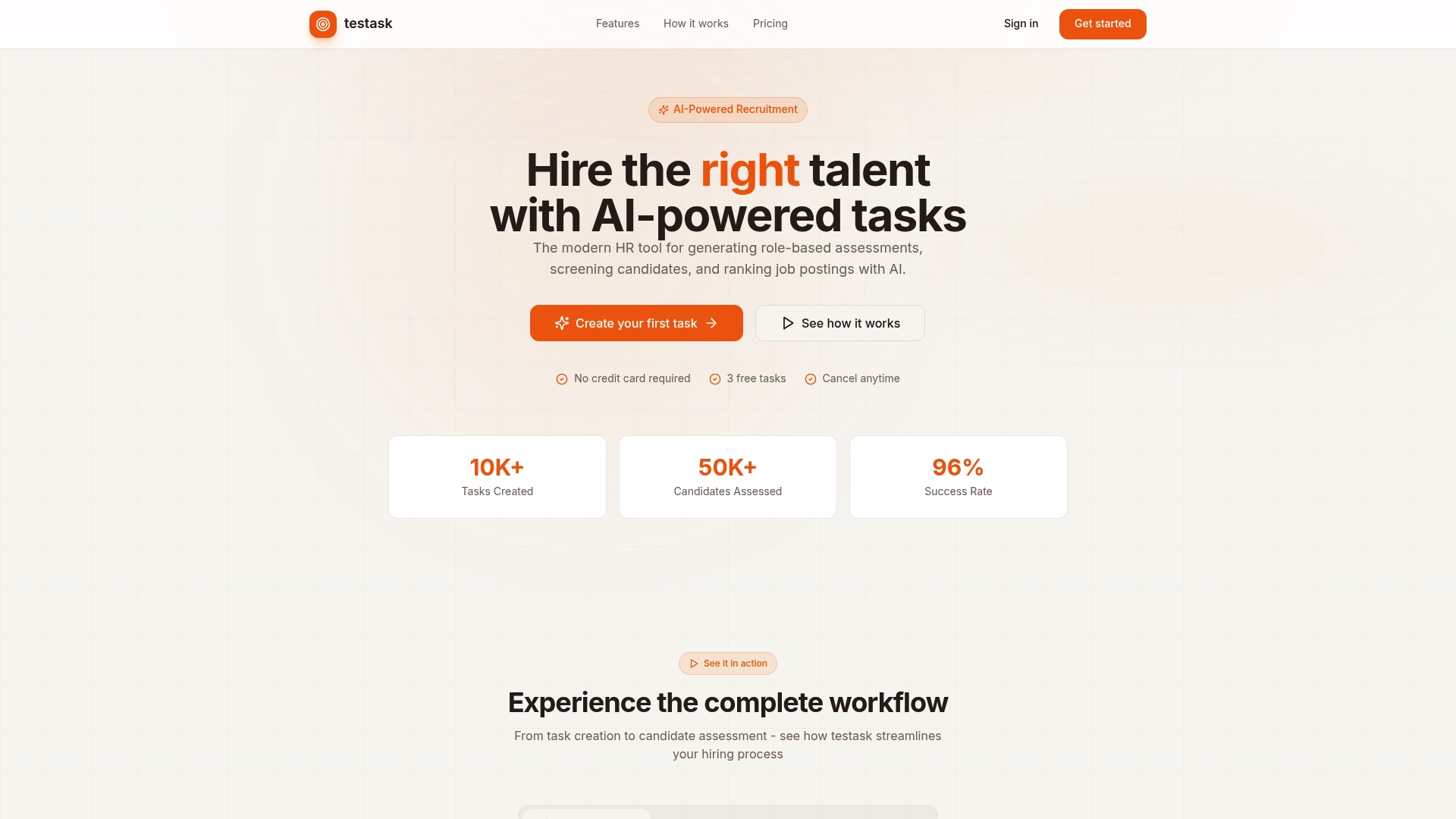
Testask is an AI-powered recruitment assessment platform designed specifically for HR teams and hiring managers who want to assess skills faster, collaborate on reviews, and make better decisions with AI-assisted analysis. You can generate tailored test tasks, evaluate candidate submissions with structured rubrics, and streamline every stage of your screening process. Whether you’re building a skills-based hiring program from scratch or adding structure to an existing process, Testask gives your team the infrastructure to do it consistently and at scale.
Frequently asked questions
What makes structured interviews more effective than unstructured ones?
Structured interviews use standardized questions and scoring rubrics applied consistently across all candidates, which doubles predictive validity compared to informal conversations (r=0.51 vs. r=0.38). This consistency also reduces individual bias and strengthens legal defensibility.
How do you implement skills-based hiring in practice?
Start by defining the two or three competencies that directly drive results in the role, then build role-relevant assessments around those competencies. Skills-based hiring works best when criteria are transparent to candidates and assessments are intentionally scoped to avoid overloading applicants.
What is the role of Talent Architects in the hiring process?
Talent Architects are strategic recruiters who build proactive sourcing pipelines aligned to business goals rather than simply filling open roles reactively. Organizations using this model report lower turnover and stronger organizational fit, with 63% of companies already prioritizing critical talent sourcing strategies.
Why should hiring managers deliver job offers personally?
Hiring managers delivering offers personally signals that the candidate is valued at the leadership level and creates a positive, memorable experience that meaningfully improves offer acceptance rates. It’s a simple, high-impact practice that most teams still underuse.
Recommended
- Streamline candidate evaluation: proven steps for better hiring | Testask Blog | testask
- Candidate Screening Process Guide: Streamlined Hiring Steps | Testask Blog | testask
- Build an effective recruitment checklist for HR success | Testask Blog | testask
- testask - AI-Powered Recruitment Assessment Platform