Screening process best practices: smarter, fairer hiring steps
Screening process best practices: smarter, fairer hiring steps

Consistent, unbiased candidate screening has never been more difficult. HR teams face growing applicant volumes, mounting compliance obligations, and pressure to adopt AI tools that promise speed but can introduce new risks if used carelessly. A best-practice screening process starts with clear evaluation criteria aligned to the job description and uses structured, repeatable methods. Getting there requires more than good intentions — it takes documented workflows, responsible AI adoption, and ongoing improvement cycles. This article walks you through each step.
Table of Contents
- Define and align your evaluation criteria
- Implement structured, repeatable screening methods
- Leverage AI responsibly for screening — without losing human oversight
- Ensure compliance and manage risks: documentation, audits, and legal defensibility
- Test and improve for edge cases and fairness
- Our take: why real rigor trumps surface improvements
- Ready to transform your screening process?
- Frequently asked questions
Key Takeaways
| Point | Details |
|---|---|
| Align criteria early | Structured, transparent evaluation criteria drive consistent and fair screening decisions. |
| Standardize your process | Use repeatable workflows and documentation tools like matrices and scoring rubrics for reliable outcomes. |
| AI requires oversight | Human review, monitoring, and transparency remain vital when automating with AI screening tools. |
| Audit and document for compliance | Maintain audit-ready records and follow legal guidance to reduce risks, especially when using advanced tech. |
| Test for edge cases | Actively seek process blind spots by stress-testing with non-standard applications and candidate profiles. |
Define and align your evaluation criteria
Before you screen a single resume, you need to know exactly what you are looking for. Clear evaluation criteria aligned to the job description are the foundation of every fair, defensible screening process. Without them, different reviewers apply different standards, and bias creeps in unintentionally.
Start by translating each core requirement from the job description into a specific, measurable criterion. Instead of “strong communicator,” write “can produce clear written project summaries at a professional level.” This specificity protects you during audits and gives candidates a fair shot regardless of who reviews their application.
Your screening process guide should document every criterion before the role opens. Key elements to define include:
- Must-have skills: Technical qualifications, required licenses, or minimum experience levels that are non-negotiable.
- Nice-to-have skills: Competencies that add value but are not disqualifying if absent.
- Red flags: Patterns or gaps that warrant further review, documented so reviewers apply them consistently.
- Screening stage: Note which criteria can be confirmed from application materials versus which require a skills assessment or interview.
Communicate the criteria to your entire hiring team before screening begins. A shared recruitment checklist keeps reviewers aligned and reduces back-and-forth during the review cycle.
Pro Tip: Review and update criteria with each new role opening. Job requirements shift as teams evolve, and using last quarter’s criteria for a different position is a common and costly shortcut.
A well-documented screening matrix also makes your process legally defensible. If a candidate disputes a rejection, you can point to specific, pre-defined criteria applied uniformly across all applicants. That consistency is what separates a fair process from an arbitrary one.
Implement structured, repeatable screening methods
With clear criteria in place, you can build the repeatable systems that actually deliver consistent results. Applicants are assessed most consistently with structured, repeatable methods — meaning every reviewer follows the same steps, uses the same scoring rubric, and documents decisions the same way.
Here is a practical sequence for rolling out a new screening rubric:
- Draft the rubric based on your documented criteria. Assign a point value or rating scale (e.g., 1 to 4) for each criterion.
- Calibrate with your team. Review two to three sample applications together and align on how each criterion should be scored.
- Assign reviewers and clarify roles. Decide who has the final decision and who provides secondary review.
- Set review checkpoints. Schedule a mid-cycle sync to catch scoring drift before the shortlist is finalized.
- Document every decision with structured notes, not just a score. Notes improve recall during debrief and create an audit trail.
The table below summarizes the tradeoffs between manual and automated screening matrices, so you can choose the approach that fits your team’s capacity and compliance requirements.
| Method | Pros | Cons |
|---|---|---|
| Manual matrix | Full transparency, easy to customize | Time-intensive, prone to reviewer fatigue |
| Automated scoring | Fast at scale, consistent application of rules | Risk of bias in training data, less explainable |
| Hybrid (AI-assisted, human-reviewed) | Balances speed with oversight | Requires calibration, clear escalation rules |
Explore streamlined candidate evaluation steps to see how teams are combining these methods effectively.

Pro Tip: Use structured notes to describe why a candidate scores a certain way, not just the number. This improves recall during hiring team debriefs and dramatically strengthens legal defensibility if a decision is ever challenged.
Leverage AI responsibly for screening — without losing human oversight
AI screening tools can process applications at a pace no human team can match. That speed is genuinely valuable. But speed without oversight is how bias scales faster than fairness. AI resume screeners should be used with human oversight and with ongoing monitoring of outcomes to reduce bias.
A responsible AI implementation checklist for HR teams includes the following:
- Human review at decision points: No AI tool should make a final hiring decision without a qualified human reviewing the output.
- Explainability requirements: Your team should be able to explain why the AI ranked or filtered a candidate. If the vendor cannot provide that explanation, that is a red flag.
- Candidate communication: Candidates should know if AI is being used in their evaluation. Transparency builds trust and, in some jurisdictions, it is legally required.
- Regular outcome monitoring: Track demographic patterns in shortlists. If certain groups are consistently filtered out at higher rates, that signals a potential bias problem.
- Defined override protocols: Reviewers need a clear, easy process for flagging and overriding AI recommendations that seem incorrect or unfair.
Passive reliance on AI is one of the most common mistakes hiring teams make. A model that worked well six months ago may have drifted because the applicant pool changed, the role evolved, or the training data no longer reflects current hiring goals. Without active monitoring, you will not catch that drift until the damage is done.
“Organizations that succeed with AI screening treat the technology as one input among many, not as the decision-maker. The human judgment layer is what keeps the process fair and legally defensible.” — Recruitment compliance practitioner
Review AI candidate screening methods for a detailed breakdown of where AI adds genuine value and where it creates risk. You can also find a practical AI-powered hiring guide with implementation frameworks tailored to HR teams.
Pro Tip: Schedule quarterly bias audits as a standing calendar event for your HR team. Treat them the same way you treat quarterly financial reviews. Fairness requires the same discipline as compliance.
Ensure compliance and manage risks: documentation, audits, and legal defensibility
Alignment and automation only hold value if your process can survive scrutiny. Legal defensibility and risk management require an AI compliance program that inventories selection procedures and addresses bias-audit obligations. This applies whether you use AI tools, manual scoring, or a combination.
The compliance workload breaks down into two categories: documents you must have and documents that strengthen your position.
| Document | Required or Recommended | Purpose |
|---|---|---|
| Screening criteria documentation | Required | Proves criteria were set before screening began |
| Bias audit records | Required (with AI) | Demonstrates ongoing monitoring and corrective action |
| Reviewer calibration notes | Recommended | Shows consistent application of criteria |
| AI vendor assessments | Required (with AI) | Documents due diligence on tool selection |
| Candidate recourse logs | Required (with AI, varies by jurisdiction) | Records how candidates can contest decisions |
| Decision override documentation | Recommended | Shows human oversight is active, not just nominal |
An audit-ready HR team treats documentation as a continuous practice, not something assembled after a complaint arrives. Build the habit of recording decisions in real time, not retrospectively.
Your audit-readiness checklist should include:
- Confirmed that screening criteria were documented before the role opened.
- Verified that all reviewers used the same rubric and scoring method.
- Confirmed that AI tools in use have been inventoried and assessed.
- Reviewed demographic outcome data for the last screening cycle.
- Validated that candidate-facing communications accurately describe the process.
- Confirmed that override and escalation protocols are documented and followed.
Explore the AI screening compliance guide for step-by-step implementation guidance, and see why improving screening efficiency starts with process governance, not just tool selection.
Audit-ready records are now a core HR competency. Organizations that build compliance into their workflow rather than treating it as a reaction to risk are far better positioned as regulations around AI in hiring continue to tighten in 2026 and beyond.
Test and improve for edge cases and fairness
Even a well-designed screening process can fail in predictable ways. Non-traditional resumes, employment gaps, career changers, and candidates with international credentials frequently fall outside the assumptions built into scoring rubrics and AI models. Edge-case handling in screening should include explicit testing of unusual inputs and boundary scenarios to prevent unfair or missed evaluations.
Why does this matter so much? Because edge cases are not rare anomalies. They often represent candidates who bring genuine value but do not fit the standard mold your process was calibrated around. Systematically filtering them out is both a fairness problem and a talent loss.
Here is a practical sequence for building edge-case testing into your workflow:
- Identify your baseline assumptions. What does a “standard” application look like in your current system? Document those assumptions explicitly.
- Generate test scenarios. Create fictional application profiles that deliberately break those assumptions: a resume with a two-year career gap, a candidate with only self-directed project experience, a highly qualified applicant with an international degree structure.
- Run test applications through your screening process. Include both manual and AI-assisted steps.
- Review the outputs with your hiring team. Did the process flag these applicants fairly? Were any incorrectly filtered out?
- Update your rubric and AI configuration based on what you find. Document the change and the reason.
- Repeat the test cycle after any significant change to the role, the applicant pool, or the screening tools in use.
Pro Tip: Collect structured feedback from rejected candidates who reached the interview stage. Ask what they noticed about the process. Their responses often reveal blind spots in screening criteria that internal review misses entirely.
Addressing recruitment challenges with AI requires this kind of proactive stress-testing. The goal is a process that performs fairly across the full range of real candidates, not just the ones your training data imagined.
Our take: why real rigor trumps surface improvements
Adding AI to your screening workflow or adopting a new checklist is not the same as actually improving your hiring process. The organizations that see lasting gains are the ones that commit to genuine process rigor — measurement, honest evaluation, and the willingness to change when something is not working.
Surface-level changes feel productive. You integrate a new tool, adopt a new template, and the team feels like progress has been made. But if the criteria are still vague, the reviewers are still misaligned, and no one is checking outcomes, the new tool will simply execute the old problems faster.
Real rigor looks different. It means reviewing your screening outcomes after every major hiring cycle, asking whether the candidates who made it through actually performed well in the role, and being honest when the data says your process missed something. That kind of retrospective is uncomfortable. It is also the only thing that produces genuine improvement over time.
“What you measure, you can improve; what you outsource blindly, you risk repeating.” That principle applies directly to AI in screening. Every automated decision is a hypothesis about what makes a good candidate. You need to test that hypothesis constantly.
The organizations that treat every process step, from tool selection to edge-case testing to quarterly audits, as a learning opportunity will build a screening function that becomes a real competitive advantage. Those that treat these steps as boxes to check will keep cycling through the same problems in different forms.
Review assessment best practices to see how high-performing HR teams structure their ongoing improvement cycles. The difference between good and excellent hiring is almost always in the iteration, not the initial setup.
Ready to transform your screening process?
Applying these best practices takes more than good intentions — it takes the right tools, structured workflows, and AI capabilities designed for how HR teams actually work.
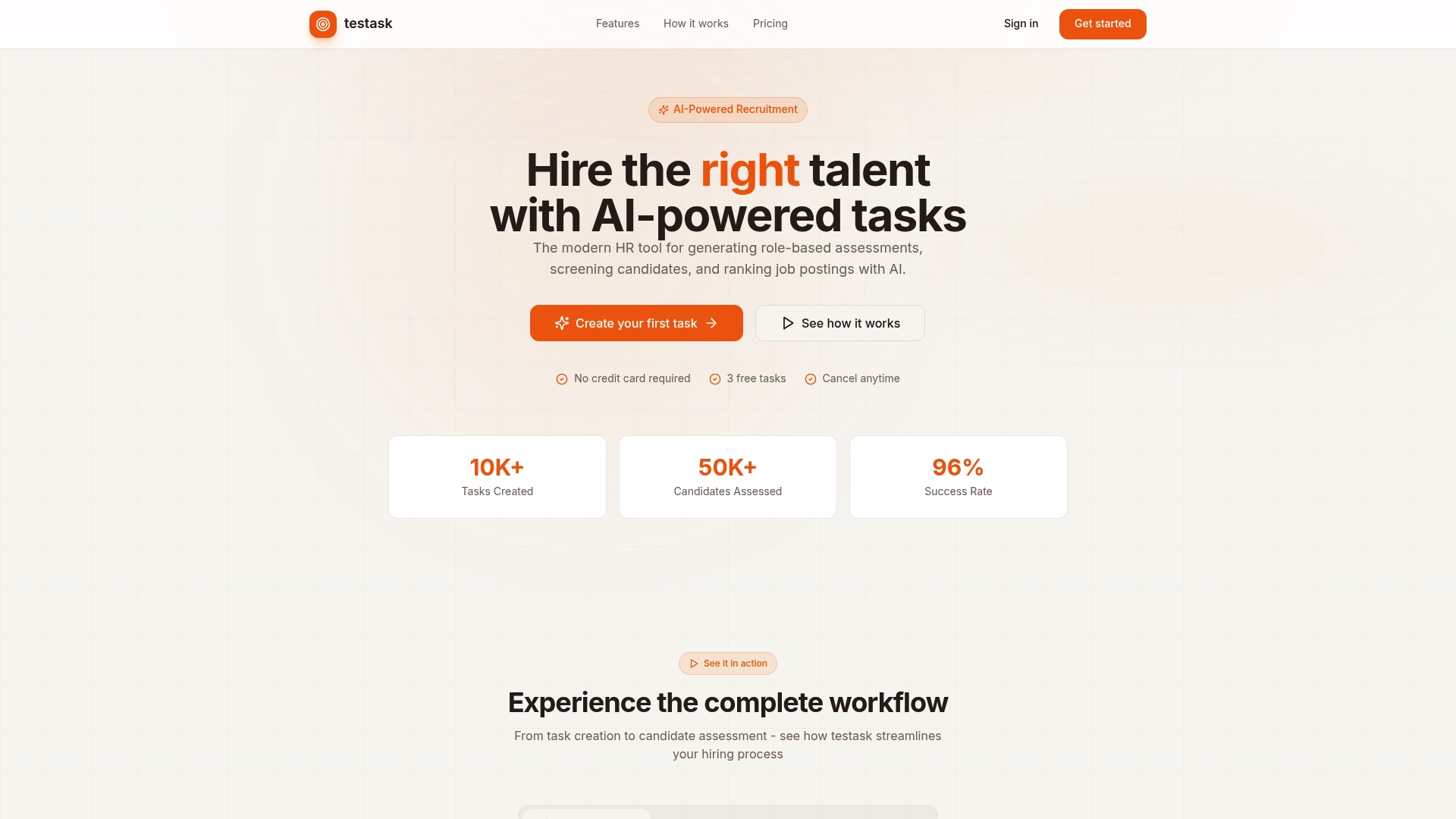
testask is an AI-powered screening solution built specifically for HR leaders and hiring managers who need to evaluate candidates faster, more consistently, and with full compliance in mind. With testask, you can generate tailored test tasks, score submissions with AI assistance, collaborate with your hiring team in real time, and maintain the audit-ready records your compliance process demands. From criteria definition to final decision, testask supports every step covered in this article. If you are ready to move from reactive to proactive screening, explore how testask can help your team do it right.
Frequently asked questions
What is a screening matrix and why is it important?
A screening matrix is a structured tool for rating candidates against pre-defined criteria, ensuring every applicant is evaluated consistently and fairly. Decisions should be recorded using a screening matrix to create a clear, defensible record of how each hiring choice was made.
How can I legally use AI for resume screening?
Implement an AI compliance program, inventory all selection procedures, and conduct regular bias audits to meet legal standards in your jurisdiction. Legal defensibility requires an AI compliance program that specifically addresses bias-audit obligations and candidate recourse procedures.
Why is human oversight still required with AI screening tools?
Human oversight catches errors, edge cases, and biases that automated systems are not designed to handle on their own. AI resume screeners should be used with human oversight at every meaningful decision point to maintain fairness and legal accountability.
What are edge cases and why are they relevant to screening?
Edge cases are unusual application scenarios, such as career gaps or non-traditional credentials, that fall outside the assumptions built into your screening rubric or AI model. Edge-case handling should include explicit testing of unusual inputs to prevent qualified candidates from being unfairly filtered out.
How often should bias audits be performed on AI screening systems?
Bias audits should be conducted at least quarterly to catch and correct emerging disparities before they compound. Regular bias audits and outcome monitoring are essential for identifying and addressing disparities that develop as applicant pools and role requirements evolve.
Recommended
- Candidate Screening Process Guide: Streamlined Hiring Steps | Testask Blog | testask
- Why improve candidate screening? Efficiency, quality, AI | Testask Blog | testask
- Streamline candidate evaluation: proven steps for better hiring | Testask Blog | testask
- Improve candidate screening: expert guide to AI-powered hiring | Testask Blog | testask