Build an effective recruitment checklist for HR success
Build an effective recruitment checklist for HR success

Hiring pressure is real. When you’re managing multiple open roles, coordinating interview panels, and fielding candidate questions, a disorganized screening process doesn’t just slow you down. It costs you top talent. Research consistently shows that strong candidates stay on the market for fewer than 10 days before accepting an offer, which means every unnecessary delay in your pipeline is a direct risk to hiring quality. A structured, actionable recruitment checklist keeps your team aligned, reduces bias, and ensures no critical step gets skipped, regardless of how many roles you’re filling at once.
Table of Contents
- Establish recruitment criteria and goals
- Choose the right screening method: Manual, AI, or RPO
- Structure your screening process: Steps for consistent results
- Balance speed and quality for the best hires
- A smarter recruitment checklist: What most teams overlook
- Take your recruitment checklist to the next level
- Frequently asked questions
Key Takeaways
| Point | Details |
|---|---|
| Define clear recruitment goals | Set precise hiring criteria and benchmarks to align your checklist with business objectives. |
| Select the optimal screening method | Choose manual, AI, or RPO methods based on role, volume, and organizational needs. |
| Standardize each process step | Follow a consistent, step-by-step screening process to ensure quality and fairness. |
| Balance speed and thoroughness | Optimize your process so hiring is both timely and maintains candidate quality. |
| Regularly review and improve | Update your recruitment checklist every quarter and gather team feedback for continuous improvement. |
Establish recruitment criteria and goals
Knowing why a checklist is vital, the first step is to ensure your foundation is solid. Before you post a job description or review a single resume, you need to define exactly what success looks like for the role and for your organization.
Start by documenting the core requirements for the position. This means going beyond a generic list of responsibilities. Work with the hiring manager to identify the specific technical skills, experience levels, and behavioral traits that predict strong performance. Separate your “must-haves” from your “nice-to-haves” so reviewers can make consistent decisions without debating the same edge cases repeatedly.

Cultural fit deserves equal attention. A candidate who checks every technical box but clashes with your team’s working style creates problems that are expensive to fix. Define what your culture actually looks like in practice, not just in a mission statement. Does your team value independent problem-solving over collaborative decision-making? Is async communication the norm? These specifics help evaluators assess fit with confidence rather than gut feeling.
Set quantifiable objectives for the recruitment process itself. Key metrics to track include:
- Time-to-hire: The number of days from job posting to accepted offer
- Time-to-fill: Days from the role opening to a candidate starting
- Candidate quality ratio: The percentage of screened candidates who advance to final rounds
- Offer acceptance rate: How often your top candidates say yes
- Diversity benchmarks: Representation goals at each stage of the funnel
Benchmarks vary by source, with SHRM citing 44 days and SmartRecruiters reporting 35 days as the average time to hire. Knowing where your process stands relative to these numbers helps you identify bottlenecks quickly.
Align your criteria with your company’s broader HR recruitment process and departmental goals. A sales team hiring for quota-driven roles has different success indicators than an engineering team hiring for long-term product ownership. Tailoring your checklist to these differences makes it genuinely useful rather than a box-ticking exercise.
A strong HR strategy for hiring also ensures your recruitment criteria map directly to business outcomes, not just immediate role needs. Think about what this hire needs to accomplish in 90 days, 6 months, and a year. That forward-looking perspective shapes better job descriptions and more relevant screening questions from the start.
Pro Tip: Review your role criteria with at least two people who have direct knowledge of the position, ideally a current team member and the hiring manager. This cross-check surfaces blind spots and prevents criteria from drifting toward a single person’s preferences.
Choose the right screening method: Manual, AI, or RPO
Once your criteria and goals are clear, selecting the best screening method is critical. There is no single right answer here. The best method depends on your volume, internal capacity, and the complexity of the role.
Manual screening involves your HR team or hiring managers reviewing each application individually. This approach allows for nuanced judgment, catching candidates whose non-traditional backgrounds might make them look weak on paper but strong in practice. The downside is significant: manual review is slow, expensive at scale, and highly susceptible to unconscious bias. Two reviewers looking at the same resume can reach very different conclusions based on factors that have nothing to do with job performance.
AI-driven screening uses algorithms to parse resumes, rank candidates, and flag applications that match your defined criteria. The speed advantage is substantial. An AI recruitment platform can process hundreds of applications in the time it takes a human reviewer to read ten. AI also applies criteria consistently, removing the variability that comes with human fatigue or mood. However, AI tools trained on historical data can replicate existing biases, and they often struggle to evaluate soft skills, career pivots, or unconventional experience.
Recruitment process outsourcing (RPO) means contracting an external provider to manage part or all of your hiring process. RPO providers bring specialized expertise and can handle high-volume surges without straining your internal team. The trade-off is reduced control and a potential disconnect between the external team’s judgment and your company’s specific culture. RPO benefits for HR teams are most pronounced when internal capacity is genuinely stretched thin.
Here’s a quick comparison to help you decide:
| Method | Speed | Scalability | Bias risk | Cost | Best for |
|---|---|---|---|---|---|
| Manual | Slow | Low | High | High per hire | Niche or senior roles |
| AI-assisted | Fast | Very high | Medium | Low per hire | High-volume screening |
| RPO | Medium | High | Medium | Variable | Surge hiring |
As AI in HR screening continues to evolve, many teams are finding that a hybrid approach works best. Use AI to handle initial resume filtering and skills matching, then apply human judgment at the interview and evaluation stages.
“Manual screening risks inconsistency and bias but allows for nuance; AI automates but may miss context; RPO offers scale but less control.” This trade-off is the central tension every HR team needs to resolve for their specific context.
The smartest teams don’t pick one method and commit to it forever. They audit their process regularly and adjust based on what the data shows. If your AI tool is consistently filtering out candidates who later perform well in interviews, that’s a signal to recalibrate your screening criteria or switch tools.
Structure your screening process: Steps for consistent results
With your preferred approach chosen, a consistent structure keeps evaluations fair and efficient. Without a defined sequence of steps, screening becomes reactive. Different reviewers apply different standards, timelines slip, and candidates fall through the gaps.
Here is a proven sequence for structuring your recruitment screening steps:
-
Standardize your application review. Use a scoring rubric tied directly to your defined criteria. Each reviewer should evaluate the same attributes using the same scale, whether that’s a 1 to 5 rating or a pass/hold/reject system.
-
Conduct initial screening calls. A 15 to 20 minute phone or video call helps you verify basic qualifications, assess communication skills, and gauge cultural alignment before investing more time. Keep these calls structured with consistent questions across all candidates.
-
Assign a skills assessment or test task. This is where you get objective, role-specific evidence of a candidate’s abilities. A well-designed task reveals how someone actually thinks and works, not just how well they interview.
-
Schedule structured interviews. Structured interviews are preferred over unstructured ones because they improve validity and reduce bias. Every candidate answers the same core questions, making direct comparison far more reliable.
-
Facilitate panel review and scoring. After interviews, gather input from all evaluators using a shared scoring framework. Avoid group discussions before individual scores are submitted to prevent anchoring bias.
-
Make a data-informed decision. Combine assessment scores, interview ratings, and recruiter notes to build a complete picture. Flag any significant discrepancies between evaluators for discussion.
-
Track against your benchmarks. Measure each stage’s duration against your time-to-hire targets. If a stage consistently runs long, investigate whether it’s a capacity issue, a criteria issue, or a process issue.
Pro Tip: Automate your scheduling and status update emails. Candidates who receive timely communication are significantly more likely to stay engaged throughout the process. A simple automated message confirming receipt of an application or scheduling a call takes seconds to set up and meaningfully improves candidate experience.
Exploring candidate evaluation techniques used by high-performing recruiting teams can also surface ideas for refining your structured interview questions and scoring rubrics.
Key stat: Companies that use structured interviews report up to 26% higher predictive validity compared to unstructured conversations. That means better hires, fewer early departures, and lower replacement costs over time.
Balance speed and quality for the best hires
After structuring your process, it’s vital to ensure efficiency doesn’t sacrifice candidate quality. Speed matters, but a fast hire who leaves in 90 days costs you more than a slightly slower hire who stays for three years.
The speed vs. quality trade-off is real: faster screening improves candidate experience but risks errors in evaluation. The goal is to move quickly through low-stakes steps while protecting the integrity of high-stakes ones.
Here’s how to think about which steps to optimize:
| Process stage | Optimize for speed? | Why |
|---|---|---|
| Application review | Yes | AI or rubric-based filtering is fast and consistent |
| Initial screening call | Moderate | Automate scheduling, keep calls short and structured |
| Skills assessment | No | Accuracy matters more than speed here |
| Structured interview | No | Quality of judgment is the priority |
| Reference checks | Yes | Standardized questions speed up this step |
| Offer and negotiation | Yes | Delays here lose candidates to competing offers |
Candidate engagement is a key variable that many teams underestimate. When candidates go silent for a week between stages, they assume the worst and keep interviewing elsewhere. Maintain momentum with proactive communication at every handoff.
“The best candidates aren’t waiting. They’re evaluating you as much as you’re evaluating them. Every unnecessary delay sends a signal about how your organization operates.”
Set internal service level agreements (SLAs) for each stage. For example, commit to reviewing all applications within 48 hours, scheduling screening calls within three business days, and delivering interview feedback within 24 hours of the final round. These SLAs create accountability and give candidates a predictable experience.
Review your outcomes regularly. After every significant hire, ask: Which stage took the longest? Where did strong candidates drop out? What did our best hires have in common that our screening criteria captured or missed? This feedback loop is what separates a living checklist from a static document.
Leveraging HR strategies in hiring from tech-forward organizations can give you a practical model for balancing these trade-offs. Many of these teams run quarterly retrospectives on their recruitment data to identify patterns and adjust their process before small inefficiencies become costly habits.
Key actions to maintain both speed and quality include:
- Automate application acknowledgment and status updates
- Use async video or written assessments to reduce scheduling friction
- Set clear internal deadlines for each review stage
- Review recruitment speed vs quality metrics monthly, not just at year-end
- Collect candidate feedback post-process to identify experience gaps
A smarter recruitment checklist: What most teams overlook
The standard checklist approach works. But most teams treat their recruitment checklist as a finished product rather than a living tool. That’s where the real opportunity gets missed.
The most effective HR teams we see review and update their checklists every quarter. Roles evolve, team needs shift, and the labor market changes. A checklist built for last year’s hiring environment may be actively working against you today.
Candidate experience is still an afterthought in most checklists. Speed and quality metrics get tracked obsessively, but few teams measure how candidates actually feel about the process. A poor experience doesn’t just lose you one candidate. It shapes your employer brand through reviews, referrals, and word of mouth.
Build feedback loops into your process. After every significant hire, debrief with the hiring manager and at least one interviewer. What worked? What felt redundant? Where did the process create friction? These conversations surface small tweaks that compound into meaningful improvements over time. Tracking this through your continuous improvement in HR practices ensures your checklist stays sharp and relevant.
Small changes, applied consistently, outperform large overhauls every time.
Take your recruitment checklist to the next level
If you’re ready to implement or upgrade your recruitment checklist, streamlined technology can accelerate your results. Building a consistent, high-quality screening process is significantly easier when you have the right tools supporting each step.
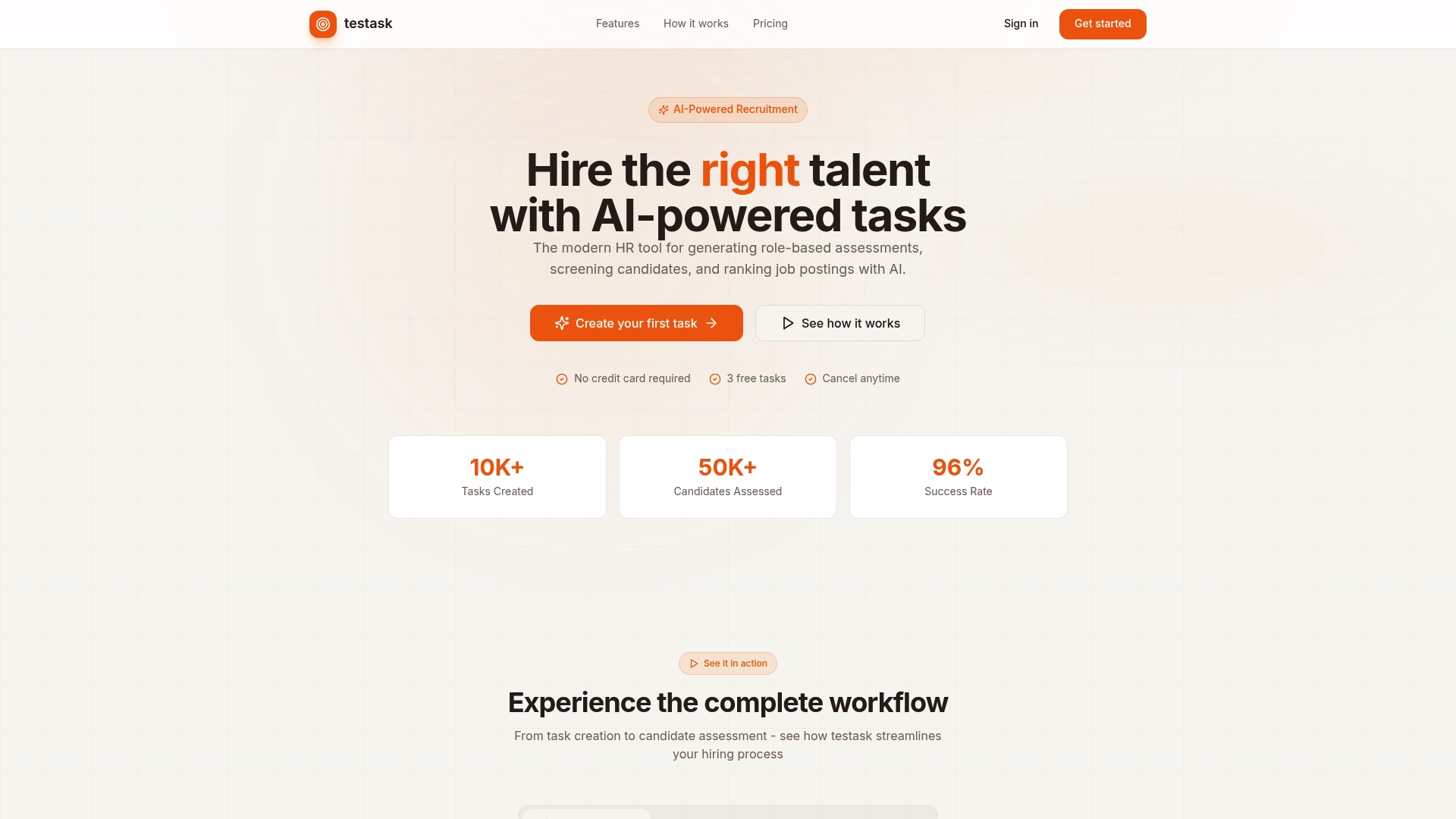
testask is an AI-powered recruitment assessment platform built specifically for HR teams and hiring managers who want to screen candidates faster without sacrificing accuracy. You can generate tailored test tasks for any role, evaluate submissions with AI-assisted analysis, and collaborate with your team on reviews, all in one place. Whether you’re optimizing a single role or scaling across departments, testask helps you move from criteria to confident hiring decision with less friction. Explore AI recruitment solutions or review platform subscription options to find the right fit for your team.
Frequently asked questions
What are the essential items on an HR recruitment checklist?
Key items include defining job requirements, crafting clear job ads, screening for qualifications, scheduling interviews, and using structured evaluations to compare candidates fairly and consistently.
How can HR balance speed with quality when screening candidates?
Use AI to automate routine steps like application filtering and scheduling, while reserving interviews and final decisions for human judgment where speed risks errors in evaluation.
What is the average time to fill a mid-level position in HR?
Industry benchmarks suggest it takes between 35 and 44 days, though this varies significantly by company size, industry, and the efficiency of your internal process.
Why should structured interviews be part of the checklist?
Structured interviews improve fairness and predictive validity compared to unstructured conversations, making it easier to compare candidates on the same criteria and reduce interviewer bias.