Talent Assessment: Build Efficient, Predictive Hiring Systems
Talent Assessment: Build Efficient, Predictive Hiring Systems

Talent assessment is widely misunderstood. Most HR leaders treat it as a checklist item, a quick skills test, or a personality quiz dropped into the middle of an application flow. That framing is costly. The best-performing organizations treat talent assessment as a structured, evidence-driven selection system designed to predict job fit, minimize bias, and produce hiring decisions that hold up under scrutiny. This guide covers what talent assessment actually is, how to build a defensible framework, how to reduce bias, how to navigate AI responsibly, and how to apply these principles in your hiring operations starting now.
Table of Contents
- What is talent assessment? Clear definitions for HR leaders
- Building a rigorous talent assessment framework
- Unbiased talent assessment: What works (and what doesn’t)
- AI in talent assessment: Promise, pitfalls, and required safeguards
- Why most definitions of talent assessment are too narrow
- Streamline your hiring with a proven, defensible assessment system
- Frequently asked questions
Key Takeaways
| Point | Details |
|---|---|
| Assessment is a system | Effective talent assessment requires structured frameworks, not simply ad-hoc testing. |
| Bias reduction tools vary | Blind evaluations can help reduce bias, but organizations must monitor outcomes and pools for real diversity improvements. |
| AI requires validation | AI-based assessments must meet stringent validation, fairness, and documentation standards. |
| Scientific rigor matters | Choose assessment methods for predictive power and scalability, not just trendiness or tech claims. |
| Documentation is critical | Proper record-keeping enables audit readiness and defensibility for your hiring decisions. |
What is talent assessment? Clear definitions for HR leaders
Talent assessment is not a single tool. It is a coordinated system that connects job analysis, measurement instruments, and scoring rules into a repeatable process for predicting who will succeed in a role. When HR leaders treat it as a one-off activity, they lose the benefits that come from consistency and structure.
A rigorous talent assessment system is typically implemented as a framework that begins with job analysis, defines the knowledge, skills, abilities, and other characteristics (called KSAOs) required for success, maps those criteria to validated assessment instruments, and predefines scoring and aggregation rules, including weighting models. This structured approach makes the process repeatable and defensible across candidates and hiring cycles.
The core components of a well-designed talent assessment system include:
- Job analysis: Identifying the specific competencies and performance criteria tied to success in the role
- Evidence-producing instruments: Structured interviews, work sample tests, cognitive ability measures, and job knowledge assessments
- Calibrated scoring rubrics: Scales defined before any evaluation begins, not improvised during review
- Aggregation rules: Pre-set formulas that determine how scores across instruments are combined to support a final decision
“A practical way to define talent assessment for decision-makers is as a repeatable selection and prediction system: define role competencies, choose evidence-producing instruments, calibrate scoring rubrics ahead of time, and aggregate scores with pre-set rules to support consistency and defensibility.”
What separates strong assessment from weak assessment is repeatability. Any two reviewers, following the same rubric for the same candidate, should reach comparable conclusions. If they don’t, your system has a consistency problem, which translates into a fairness and legal risk problem. A solid job assessment guide can help you structure this baseline before you add complexity.

Building a rigorous talent assessment framework
Knowing what talent assessment is gets you halfway there. The other half is implementing it with enough structure to produce reliable, auditable results. Frameworks that work follow a clear sequence and resist shortcuts.
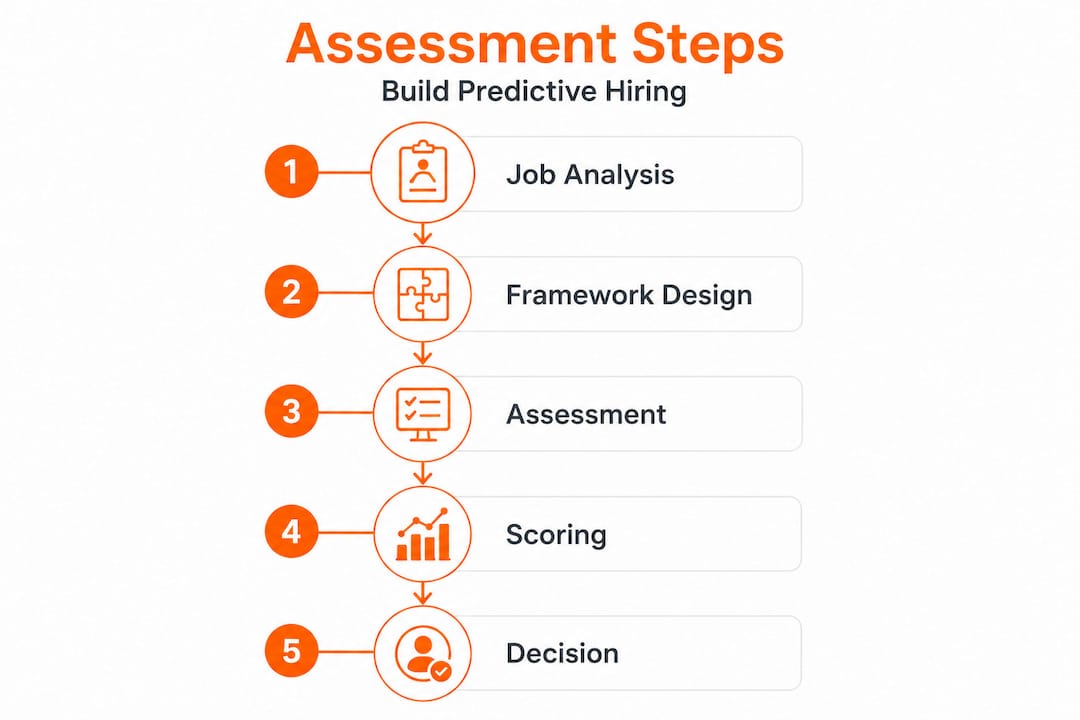
Here are the four essential steps to building a defensible talent assessment framework:
-
Conduct job analysis: Interview current high performers, review the role’s performance expectations, and document the KSAOs required. This step is not optional. Every downstream decision depends on it.
-
Map criteria to instruments: Once you know what competencies you’re measuring, choose instruments that have documented validity for those specific competencies. A structured interview works for communication and problem-solving. A work sample test works for technical execution. Match the tool to the trait.
-
Calibrate scoring rubrics before evaluation begins: Define what a strong response looks like, what a weak one looks like, and how reviewers should distinguish between them. This removes retroactive rationalization from the process.
-
Set aggregation rules in advance: Decide how scores will be combined. Will all dimensions be weighted equally? Will candidates need to meet a minimum threshold on certain dimensions before advancing? This is where you choose your scoring model.
The three most widely used scoring models each serve different hiring scenarios:
| Scoring model | How it works | Best for |
|---|---|---|
| Unit weighting | Each dimension carries equal weight | Early-stage screening or entry-level roles |
| Compensatory | High scores on some dimensions can offset low scores on others | Complex roles with multiple competencies |
| Multiple hurdle | Candidates must meet minimum scores on each stage before advancing | High-stakes or safety-critical positions |
A practical recruitment checklist can help you sequence these steps and confirm nothing is missed before your process goes live. You can also review proven candidate evaluation steps to see how leading teams operationalize this sequence in real hiring cycles.
Pro Tip: Document your framework in writing before the first candidate is evaluated. A documented rubric is your best defense in an audit or legal challenge. It also forces clarity before the pressure of an open role kicks in.
The frameworks that break down are almost always missing one of these steps. Organizations skip job analysis because it takes time. They improvise rubrics in the moment. They let hiring managers weight dimensions differently for each candidate. Each shortcut adds noise to the system and erodes the predictive value you’re trying to build.
Unbiased talent assessment: What works (and what doesn’t)
Bias reduction is one of the most discussed topics in talent assessment, and also one of the most oversimplified. A few practices do reduce bias in measurable ways. Others promise more than they deliver. Knowing the difference lets you invest in strategies that actually improve equity.
Skills-first hiring combined with blind evaluations can reduce bias by focusing on abilities rather than identity-related information. But it is not a universal solution and does not guarantee a more diverse candidate pool on its own. If your sourcing channels are homogeneous, blind evaluations cannot fix that.
Here is how blind evaluation compares to traditional CV screening in practice:
| Dimension | Blind evaluation | Traditional CV screening |
|---|---|---|
| Reduces name-based bias | Yes | No |
| Reduces institution prestige bias | Partially | No |
| Improves pool diversity | Not by itself | No |
| Requires additional process steps | Yes | No |
| Legally defensible | Stronger | Weaker |
The bias-reduction strategies that consistently produce results include:
- Structured scoring rubrics applied before review begins, so reviewers aren’t making up criteria on the fly
- Panel review with multiple evaluators assessing the same submission independently before discussing
- Skills-based work samples that require candidates to demonstrate ability directly, rather than claiming it on a resume
- Removing demographic signals from early-stage screening materials where feasible
- Ongoing monitoring of pass rates and outcomes across demographic groups to catch patterns the system didn’t intend to create
“Even science-based strategies have limitations. Blind assessments reduce certain types of bias but cannot solve structural sourcing problems or eliminate all forms of evaluator subjectivity.”
For guidance on reducing hiring bias in structured review, the key principle is consistency. Bias tends to enter the process wherever subjectivity enters the process. Standardize more, and bias has fewer openings. You can also explore leadership hiring best practices for frameworks that senior hiring teams have applied to high-stakes roles where bias reduction is especially critical.
The most important thing to understand is that no single tactic solves bias. You need a layered approach: sourcing strategy, instrument design, structured review, and outcome monitoring working together.
AI in talent assessment: Promise, pitfalls, and required safeguards
AI-powered tools have significantly expanded what’s possible in talent assessment. They can generate tailored assessments, analyze written responses at scale, flag patterns across large candidate pools, and reduce time-to-decision. But adopting AI without understanding its requirements introduces risk.
AI-based assessments should meet the same core validation and fairness expectations as traditional employment tests. Organizations must document steps for auditability. That standard applies whether you’re using an AI scoring tool, an automated interview platform, or a machine learning model to rank candidates. Treat AI output as a formal employment test result, not a black box recommendation.
Here is how to implement AI-powered assessment responsibly:
-
Require validation documentation from vendors: Ask for evidence that the tool has been validated for your specific role types and candidate populations. Generic validation claims are not sufficient.
-
Test for adverse impact before deployment: Run the tool on historical data or a pilot group and analyze whether it produces disparate results across demographic groups before using it in live hiring.
-
Define how AI scores will be used: AI output should inform human judgment, not replace it. Pre-define what triggers human review and what happens when AI scores conflict with other signals.
-
Document every step: Maintain records of which tools were used, how scores were generated, and how decisions were made. This is your audit trail.
-
Reassess regularly: AI tools should be reviewed for continued validity and fairness at defined intervals, not just at initial implementation.
On the question of what AI can actually predict: there are important validity concerns in personnel selection research. Meta-analytic validity estimates can be inflated by statistical corrections and design differences, so practitioners should not treat generalized validity numbers as universally portable without understanding the context behind them. Cognitive ability, for example, shows a validity estimate around r = .31, which is moderate, not definitive.
Pro Tip: Vet every AI assessment vendor with the same rigor you’d apply to a new hire. Ask for their validation studies, their fairness testing results, and their documentation protocols. If they can’t produce those, that tells you what you need to know.
You can explore how AI recruitment matching works in practice, review assessment best practices for structuring AI-assisted evaluation, and see how teams are improving candidate screening with AI without sacrificing fairness or compliance.
Why most definitions of talent assessment are too narrow
Here is the uncomfortable truth most vendors won’t say out loud: the talent assessment industry has a definition problem. Most organizations define talent assessment by the tools they use, not by the system those tools are supposed to serve. They adopt an AI platform, add a personality test, run a coding challenge, and call it an assessment strategy. It isn’t.
Assessment remains probabilistic regardless of technological advances. Organizations should move beyond adopting marginally better methods and focus on methods grounded in scientific rigor and scalability. That reframes the definition not just as choosing tools but ensuring those tools are meaningfully predictive for the specific roles and contexts you’re hiring for.
The system view changes how you make decisions. When you understand assessment as a prediction system, you stop asking “is this test good?” and start asking “does this test improve our ability to predict performance for this role in this context?” Those are different questions, and the second one leads to better outcomes.
Data analytics in hiring should be part of that loop. Track assessment outcomes against actual job performance. Audit your instruments annually. Retire tools that don’t demonstrate predictive value for your specific population. This is how smarter talent acquisition works in practice: not by chasing innovation, but by building systems that learn from evidence.
The organizations that consistently hire well are not running the most sophisticated assessments. They are running the most consistent ones. They have documented frameworks, validated instruments, structured reviews, and outcome monitoring in place. That infrastructure outperforms any single clever tool.
Treat every assessment outcome as a data point, not a verdict. The best hiring decisions come from triangulating multiple evidence sources within a system designed to surface signal, not just scores.
Streamline your hiring with a proven, defensible assessment system
With these evidence-backed principles in mind, here’s how you can take the next step to operationalize efficient, unbiased talent assessment in your organization.
testask is an AI-powered assessment platform built for HR teams that need to move fast without cutting corners. You can generate tailored test tasks, evaluate candidate submissions with AI-assisted analysis, and collaborate with your hiring team on structured reviews, all within a single workflow. The platform supports documentation standards that keep your process audit-ready from day one. For a detailed look at how to align your process with industry standards, the assessment best practices guide is a strong starting point. Building a defensible, predictive hiring system doesn’t require months of consulting work. It requires the right tools, the right structure, and a commitment to consistency.
Frequently asked questions
How can HR leaders ensure a talent assessment is legally defensible?
Document every step of your assessment process, use validated instruments, and maintain records for auditing. AI-based assessments specifically require documented steps for verification and auditability under professional standards.
Do skills-first assessments guarantee diversity improvements?
No. Blind evaluations cannot ensure diversity of the candidate pool. Skills-based hiring reduces certain types of bias but must be paired with intentional sourcing strategies to meaningfully improve representation.
What’s the most predictive assessment method for job performance?
Structured interviews rank among the strongest predictors in current research. Cognitive ability measures show moderate validity at approximately r = .31, meaning no single method is definitive on its own.
What makes AI-powered assessments compliant and fair?
AI assessment tools must be validated, consistent, and fair across demographic groups, with documented processes for auditability. Vendor-provided validation studies and ongoing adverse impact monitoring are both required.
How do you select the right assessment instruments for each role?
Start with thorough job analysis to define key competencies. Then map those competencies to validated tools that can objectively measure them. A framework built on job analysis ensures every instrument has a documented rationale tied to role-specific criteria.
Recommended
- Employment assessment best practices that elevate hiring results | Testask Blog | testask
- Why improve candidate screening? Efficiency, quality, AI | Testask Blog | testask
- Streamline candidate evaluation: proven steps for better hiring | Testask Blog | testask
- Top talent acquisition tips for smarter hiring in 2026 | Testask Blog | testask
- AI Resume Templates — ATS-Ready, Built in Under 5 Minutes | Prezumi