Remote Hiring in 2026: The Complete Guide for HR Teams
Remote Hiring in 2026: The Complete Guide for HR Teams

Remote hiring is the practice of recruiting, evaluating, and onboarding employees who work outside a traditional office, using digital tools and structured workflows designed specifically for distributed teams. It is not simply “regular hiring on Zoom.” The process requires its own discipline, its own technology stack, and its own compliance framework.
Here is what defines remote hiring at its core:
- Digital-first sourcing: Job postings target global or national talent pools through remote-specific boards and professional networks.
- Asynchronous communication: Screening, assessments, and early interviews happen on candidates’ own schedules, reducing scheduling friction.
- Remote readiness assessment: Candidates are evaluated not just on technical skills but on self-management, written communication, and documentation habits.
- Structured evaluation: Standardized scoring rubrics and task-based assessments replace informal, in-person impressions.
- Compliance awareness: Multi-state or cross-border hiring introduces tax, payroll, and worker classification obligations that traditional hiring rarely triggers.
- Virtual onboarding: New hires are integrated through documented plans, digital culture resources, and dedicated onboarding buddies rather than office walk-arounds.
When these elements work together, remote hiring becomes a genuine competitive advantage. When they are missing, it becomes expensive and slow.
Table of Contents
- How remote hiring differs from traditional in-person hiring
- What are the real benefits of hiring remote employees?
- Step-by-step remote hiring process for HR teams
- Legal, compliance, and payroll considerations for US remote hiring
- Expert best practices for mastering digital remote hiring
- Application and interviewing considerations for remote candidates
- Strategies to assess remote work skills and cultural fit
- Common challenges in remote hiring and how to overcome them
- Metrics to measure the success of remote hiring
- Building and maintaining remote team engagement after hiring
- Job posting tips for remote roles
- Which tools actually support a remote hiring process?
- Testask makes remote skills assessment faster and more accurate
- Key Takeaways
How remote hiring differs from traditional in-person hiring
The gap between remote and in-person hiring is wider than most HR teams expect before they experience it firsthand. Traditional hiring relies heavily on ambient signals: body language during a handshake, how a candidate interacts with the receptionist, the energy in a conference room. Remote hiring strips all of that away and replaces it with structured data, which is actually more reliable, but only if you build the structure deliberately.
Several specific differences create real operational challenges:
- No nonverbal context: Video calls capture a fraction of the body language available in person. Both sides make decisions with less intuitive data, which increases the risk of bias filling the gap.
- Application volume: Remote roles attract significantly more applications than equivalent in-person roles, making early-stage screening a logistical challenge without automation.
- Time zone complexity: Scheduling live interviews across multiple time zones compounds delays at every stage of the funnel.
- Cultural fit is harder to gauge: Candidates cannot tour the office, meet the team informally, or absorb the company’s atmosphere. Hiring managers face the same blind spot in reverse.
- Candidate fatigue is real: Back-to-back virtual interviews exhaust candidates, and many report feeling like they are “talking into a void.” Dropout rates climb when the process drags.
- Bias risks shift: Without in-person rapport, evaluators can default to communication style or presentation polish as proxies for competence, which disadvantages strong candidates who are not naturally charismatic on camera.
- Compliance complexity: Hiring across state lines or internationally introduces legal obligations that simply do not exist when everyone works from the same office.
The organizations that handle these differences well treat remote hiring as its own discipline, not an adaptation of what already worked on-site.

What are the real benefits of hiring remote employees?
The case for remote hiring goes well beyond cost savings, though the cost savings are real. Access to talent is the primary driver for most US companies that commit to it seriously.
- Larger talent pool: Geographic constraints disappear. A company in Des Moines can hire the best UX researcher in Austin, a senior data engineer in Atlanta, or a compliance specialist in Boston without relocation packages or local market limitations.
- Workforce diversity: Broader sourcing naturally produces more diverse candidate slates, which research consistently links to stronger team decision-making.
- Reduced overhead: Office space, utilities, and facilities costs drop when headcount is distributed. For growing teams, this can be a meaningful budget shift.
- Higher retention potential: Employees who work remotely report higher job satisfaction on average, and well-structured remote onboarding programs produce significantly higher retention over three years compared to companies without them.
- Faster hiring cycles: When you are not constrained to candidates within commuting distance, qualified applicants appear faster, especially for specialized roles.
- Resilience: Distributed teams are less vulnerable to local disruptions, whether that is a regional weather event, a facility issue, or a public health situation.
- Employer brand signal: Offering remote work signals trust and flexibility, which matters to candidates evaluating multiple offers simultaneously.
None of these benefits arrive automatically. They are the result of building the right process, which is what the rest of this guide covers.
Step-by-step remote hiring process for HR teams
A reliable remote hiring process follows a clear sequence. Skipping steps or improvising at any stage is where mis-hires and candidate drop-off happen.
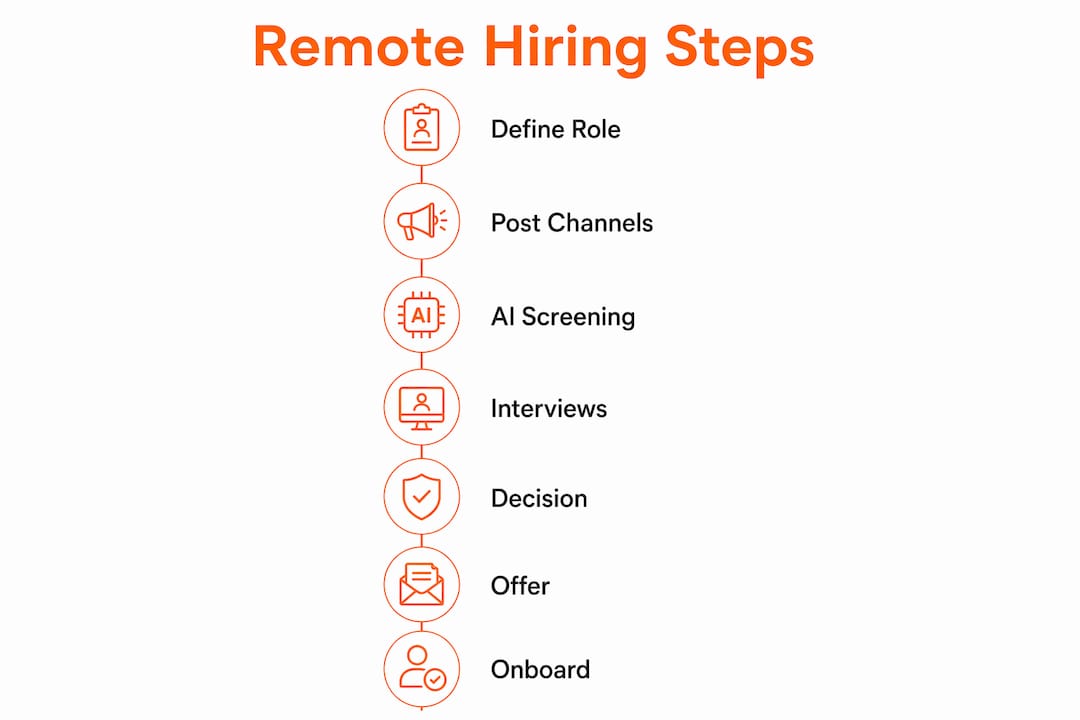
1. Define the role with remote specifics
Write a job description that goes beyond responsibilities and qualifications. State explicitly whether the role is fully remote or hybrid, which time zones are required for overlap, and what tools the candidate must be comfortable using. Vague job descriptions attract mismatched applicants and waste screening time.
2. Post on the right channels
General job boards work for broad roles, but remote-specific platforms and professional networks reach candidates who are actively looking for distributed work. LinkedIn, remote-focused job boards, and niche communities for your industry all belong in the mix. For tips on writing postings that convert, strong job descriptions are the foundation of any effective funnel.
3. Screen with AI-assisted tools and structured assessments
With application volume running 3–7 times higher than in-person roles, manual resume review at scale is not practical. Use an Applicant Tracking System (ATS) to filter by defined criteria, then deploy task-based assessments early to separate qualified candidates from keyword-matched ones. Platforms like Testask let you generate role-specific test tasks and evaluate submissions with AI-assisted analysis, so your team reviews only the candidates who have already demonstrated relevant skills.
4. Conduct structured asynchronous and live interviews
Run a two-phase interview process. The first phase uses asynchronous video responses or written tasks to assess communication quality and remote readiness without scheduling pressure. Reserve live video interviews for the second phase, focused on technical depth and team fit. Use a standardized scoring rubric for every evaluator before interviews begin.
5. Make objective, panel-based decisions
Gather structured feedback from every interviewer using the same criteria. Panel input reduces individual bias and produces more defensible hiring decisions. Avoid letting a single strong impression from one interviewer override a pattern of mixed signals from the rest.
6. Extend offers with pre-offer intent conversations
Before sending a formal offer, have a direct conversation about salary expectations, competing offers, and start date. This is an information-gathering call, not a negotiation. Pre-offer intent conversations reduce offer rejection and Day 1 no-shows by surfacing misalignments before they become costly.
7. Onboard with a structured 30-60-90 day plan
Remote onboarding cannot rely on osmosis. Every piece of context a new hire needs must be deliberately delivered: a documented first-week schedule, a written repository of team norms and workflows (Notion and Confluence both work well), a dedicated onboarding buddy separate from the manager, and clear 30-60-90 day milestones. Pre-boarding should begin at least one week before the start date.
Checklist for the remote hiring process:
- [ ] Job description includes remote-specific requirements and time zone expectations
- [ ] Postings live on remote-focused channels and relevant professional networks
- [ ] ATS configured with defined screening criteria
- [ ] Task-based assessment deployed at early screening stage
- [ ] Asynchronous interview phase completed before live interviews
- [ ] Standardized scoring rubric distributed to all interviewers
- [ ] Panel feedback collected and documented
- [ ] Pre-offer intent conversation completed
- [ ] Offer letter includes remote work agreement terms
- [ ] Pre-boarding materials sent at least one week before start date
- [ ] 30-60-90 day onboarding plan documented and shared
Pro Tip: Send a detailed role context document to candidates before the first live call. It eliminates repetitive back-and-forth, signals organizational clarity, and gives candidates the information they need to show up prepared.
Legal, compliance, and payroll considerations for US remote hiring
Hiring remote employees across state lines introduces obligations that catch many HR teams off guard. The legal landscape for distributed US teams is more complex than most hiring managers realize until they face an audit or a penalty.
- Worker classification: Misclassifying an employee as an independent contractor exposes your company to back taxes, penalties, and benefits liability. The IRS and state labor agencies apply their own tests, and they do not always align. When in doubt, classify as an employee.
- Multi-state tax obligations: Hiring in a new state can create payroll tax nexus, requiring registration with that state’s tax authority, withholding state income tax, and complying with local employment laws. Each state has its own rules on paid leave, overtime, and termination.
- Remote work agreements: Every remote hire should sign a written agreement covering work location, equipment policy, data security expectations, and expense reimbursement. This document protects both parties and establishes clear accountability.
- Payroll compliance: Running payroll for employees in multiple states requires either a multi-state payroll system or a payroll provider with multi-jurisdiction capability. Errors in withholding or filing create compounding liability.
- Employer of Record (EOR) services: For companies hiring in states where they lack a registered entity, or for international hires, EOR platforms employ workers on your behalf and handle local payroll, compliance, and benefits administration. This is the most practical solution for companies scaling quickly across jurisdictions.
- International hiring: If you hire outside the US, the complexity multiplies. Each country has its own employment law, mandatory benefits, and termination requirements. An EOR is almost always the right infrastructure choice for international remote hires.
- Data privacy: Remote employees handling sensitive data may trigger state-level privacy regulations (California’s CPRA, for example) or sector-specific rules. Your remote work agreement and IT policy should address data handling explicitly.
The legal risks of worker misclassification and payroll non-compliance are not theoretical. They result in real penalties, and they are disproportionately triggered by remote hiring because of the multi-jurisdictional nature of distributed teams.
Expert best practices for mastering digital remote hiring
The companies that consistently hire well remotely share a set of habits that go beyond using the right tools. Their processes are designed around remote realities from the first job posting to the 90-day check-in.
- Design async-first workflows: Synchronous time is expensive and creates scheduling delays that compound across a search. Reserve live calls for technical depth and offer conversations. Use asynchronous video responses, written tasks, and structured questionnaires for everything else. Async-first hiring reduces scheduling delays and lowers candidate dropout rates.
- Use standardized interview kits: Every interviewer should work from the same question set and scoring rubric. Informal interviews default to charisma and verbal fluency, which correlate with confidence, not competence. Structured assessments reduce bias and produce more consistent, defensible decisions.
- Run pre-offer intent conversations: Before extending a formal offer, surface competing offers, unresolved concerns, and genuine interest level. This single practice prevents most offer rejections and Day 1 no-shows. Treat it as a standard step, not an exception.
- Avoid the osmosis trap: In a physical office, culture and accountability develop partly through proximity. Remote environments have no equivalent. Hiring managers must embed cultural criteria and accountability expectations explicitly into scoring rubrics rather than assuming they will develop naturally.
- Assess remote readiness directly: Ask candidates for specific examples of documenting decisions, managing blocked tasks without a manager nearby, and delivering work across time zones. How a candidate communicates during your hiring process is itself a signal. Prompt, clear responses during outreach tell you something real about how they will operate on the job.
- Use AI-assisted screening to protect recruiter bandwidth: High-volume applications require early-stage filtering that does not consume your team’s time. Platforms like Testask generate tailored test tasks, evaluate submissions with AI analysis, and surface the strongest candidates for human review. This keeps bias-free hiring at the center of your process without adding manual work.
- Communicate proactively throughout: Candidates who feel ignored disengage and accept other offers. Automated status updates, clear timelines shared at the start, and fast feedback loops all reduce ghosting. For practical guidance on keeping candidates engaged, candidate feedback practices make a measurable difference in offer acceptance rates.
Pro Tip: Send candidates a short async task before the first live call, not after. It filters out low-effort applicants, gives you a concrete work sample to discuss in the live interview, and signals to strong candidates that your process is serious and well-organized.
Application and interviewing considerations for remote candidates
The application and interview experience shapes how candidates perceive your company before they ever meet the team. For remote roles, that experience is entirely digital, which means every friction point is amplified.
Start by making the application itself remote-friendly. Long, multi-step application forms with redundant fields drive drop-off, especially among experienced candidates who have options. Ask only for what you need at the screening stage and save detailed questions for later rounds.
For interviews, structure matters more than format. A well-designed video interview with clear questions and a defined scoring rubric produces better data than an unstructured conversation, regardless of whether it is live or asynchronous. Give candidates clear instructions before each interview stage: what platform you will use, how long it will take, and what you are looking for. Candidates who know what to expect perform better and feel more confident, which gives you a more accurate read on their actual capabilities.
Panel interviews work well for the final stage, but keep them focused. Three interviewers with distinct evaluation areas produce more useful signal than five people asking overlapping questions. Debrief immediately after while impressions are fresh, and document scores before the group discussion to prevent anchoring bias.
Strategies to assess remote work skills and cultural fit
Technical skills are table stakes. The candidates who succeed in remote roles are the ones who can manage ambiguity, communicate clearly in writing, and stay accountable without daily check-ins. Assessing those qualities requires deliberate methods.
For remote readiness, evaluate:
- Written communication quality: clarity, conciseness, and how well the candidate explains complex ideas without verbal cues
- Self-management: ask for specific examples of managing competing priorities without direct supervision
- Documentation habits: how they have shared decisions, blockers, or project updates with distributed teammates in past roles
- Async responsiveness: how they handle the hiring process itself is a live demonstration of their remote work behavior
For cultural fit, go explicit:
Cultural fit in a remote context cannot be assessed through gut feeling or office tour impressions. Build it into your scoring rubric as a named criterion with defined indicators. Ask behavioral questions tied to your actual team norms: how does the candidate handle disagreement in writing? How do they give feedback asynchronously? What does accountability look like to them when no one is watching?
Task-based hiring is the most reliable method for both skill and fit assessment. A short, paid work sample relevant to the actual role reveals more than any interview question. It also gives the candidate a realistic preview of the work, which reduces early attrition. For structured assessment practices that hold up at scale, the methodology matters as much as the tools.
Common challenges in remote hiring and how to overcome them
Every HR team running a remote hiring process hits the same set of obstacles. Knowing them in advance lets you build around them rather than react to them.
| Challenge | Solution |
|---|---|
| Application overload | Deploy ATS filtering and task-based assessments at the screening stage |
| Time zone scheduling friction | Default to async for early rounds; reserve live calls for final stages |
| Candidate ghosting | Send proactive status updates; run pre-offer intent conversations |
| Bias in virtual interviews | Use standardized scoring rubrics; document scores before group debrief |
| Weak cultural fit signals | Embed culture criteria explicitly in rubrics; use behavioral questions |
| Compliance across states | Register for payroll in each state; use EOR services where needed |
| Poor onboarding retention | Build a documented 30-60-90 day plan; assign a dedicated onboarding buddy |
| Interview fraud | Use live technical assessments and work samples to verify claimed skills |

The types of remote team hiring challenges that derail processes most often are not the obvious ones. Offer rejection rates for remote roles run 18–25% higher than for on-site positions, largely because candidates run parallel processes and have no in-person relationship with your team to anchor their commitment. Pre-offer intent conversations and fast, clear communication throughout the funnel are the most direct fixes.
Avoiding common hiring mistakes in remote contexts often comes down to one thing: treating the process as a system, not a series of ad hoc decisions.
Metrics to measure the success of remote hiring
You cannot improve what you do not measure. Remote hiring introduces a few metrics that matter more than they do in traditional hiring, and some traditional metrics that become less meaningful.
Track these consistently:
- Time-to-hire: Measured from job posting to accepted offer. Remote hiring should be faster than in-person hiring when async processes are working correctly.
- Quality of hire: Assessed at 30, 60, and 90 days using manager ratings, performance against onboarding milestones, and retention. This is the metric that tells you whether your screening is working.
- Offer acceptance rate: A declining rate signals either a compensation problem or a process problem. Pre-offer intent conversations directly improve this number.
- Candidate drop-off rate by stage: Where are candidates leaving your funnel? High drop-off at the application stage suggests a friction problem. High drop-off after the first interview suggests a communication or expectation problem.
- 90-day retention: The clearest signal of onboarding quality. Given that strong onboarding programs produce significantly higher retention over three years, this metric has direct financial implications.
- Sourcing channel effectiveness: Which channels produce candidates who reach the final stage and accept offers? Allocate sourcing budget based on actual conversion, not application volume.
- Interviewer time per hire: Remote hiring can consume engineering or management time quickly if screening is not filtered early. Track this to protect your team’s capacity.
Review these metrics quarterly and connect them to process changes. If offer acceptance drops after you add an interview stage, that stage may be creating friction without adding signal.
Building and maintaining remote team engagement after hiring
Hiring the right person is only half the job. Keeping them engaged in a remote environment requires deliberate effort that most companies underestimate until they see attrition numbers.
The first 90 days are the highest-risk period. Remote new hires who do not feel connected to their team or clear on their role are far more likely to disengage quietly and start looking elsewhere. A structured onboarding plan with weekly check-ins, clear milestones, and an assigned onboarding buddy addresses this directly.
Beyond onboarding, remote team engagement depends on a few consistent practices:
- Documented team norms: Write down how your team communicates, makes decisions, and handles conflict. New hires cannot absorb this through proximity, so it has to be explicit.
- Regular async touchpoints: Weekly written updates, shared project boards, and documented decisions keep distributed team members informed without requiring constant meetings.
- Intentional social connection: Schedule optional virtual social time, recognize contributions publicly in team channels, and create space for informal conversation. These are not luxuries; they are the remote equivalent of hallway interactions.
- Manager check-ins with structure: One-on-ones should cover not just work progress but how the employee is feeling about their role, their workload, and their connection to the team. Remote employees who feel seen stay longer.
- Career development visibility: Remote employees can feel invisible when it comes to promotions and growth opportunities. Make development conversations explicit and regular.
Engagement is not a culture initiative. It is an operational outcome of consistent, deliberate communication practices built into how your team works every day.
Job posting tips for remote roles
A job posting for a remote role needs to do more work than a standard listing. Candidates evaluating remote positions have specific questions that generic postings do not answer, and unanswered questions produce either mismatched applications or no applications at all.
Write postings that answer these questions upfront:
- Is this role fully remote, hybrid, or remote with occasional travel?
- Which time zones are required for core working hours?
- Which country or states are eligible? (Many “remote” postings are actually US-only or exclude certain states.)
- What tools and communication platforms does the team use?
- How is performance measured? By hours, by output, or by milestones?
Beyond logistics, the best remote job postings signal what it is actually like to work on the team. A sentence about how your team communicates, what a typical week looks like, or what the onboarding experience involves gives candidates the context they need to self-select accurately. That reduces mismatched applications and improves the quality of your funnel from the first day the posting goes live.
For candidates evaluating your posting alongside others, current job search strategies show that specificity and transparency in job descriptions are among the top factors that drive strong candidates to apply. Write for the candidate you want, not the broadest possible audience.
Which tools actually support a remote hiring process?
The right technology stack makes the difference between a remote hiring process that scales and one that collapses under application volume or scheduling complexity. No single platform does everything, but a focused set of tools covers the full funnel.
Core categories and what they do:
- Applicant Tracking Systems (ATS): Manage job postings, track candidates through stages, and centralize communication. Greenhouse and SmartRecruiters are widely used enterprise options; both support collaborative hiring workflows and integrate with video and assessment tools.
- Skills assessment platforms: Testask generates tailored test tasks for specific roles, evaluates submissions with AI-assisted analysis, and enables collaborative review across your hiring team. This is where early-stage screening becomes both faster and more objective.
- Asynchronous video interview tools: One-way video platforms let candidates record responses on their own schedule, eliminating the back-and-forth of live scheduling for early rounds.
- Video conferencing: Zoom and Google Meet handle live interviews. The platform matters less than the structure of the interview itself.
- Collaboration and communication: Slack organizes hiring team communication by candidate or stage, keeping feedback searchable and decisions documented.
- Payroll and compliance: Rippling combines HR, IT, and payroll in one platform and handles multi-state compliance. For international hires, an EOR service handles local employment law and payroll.
- Documentation and onboarding: Notion and Confluence work well for building the written repositories that remote onboarding depends on: team norms, decision logs, workflow guides, and 30-60-90 day plans.
The best tools for remote hiring are the ones your team will actually use consistently. A well-configured ATS with a reliable assessment layer and a clear async interview process covers most of what a US-based HR team needs to run a high-quality remote hiring funnel. For guidance on how job search tools are evolving from the candidate side, what gets candidates hired in 2026 offers useful context for calibrating your process to candidate expectations.
Testask makes remote skills assessment faster and more accurate
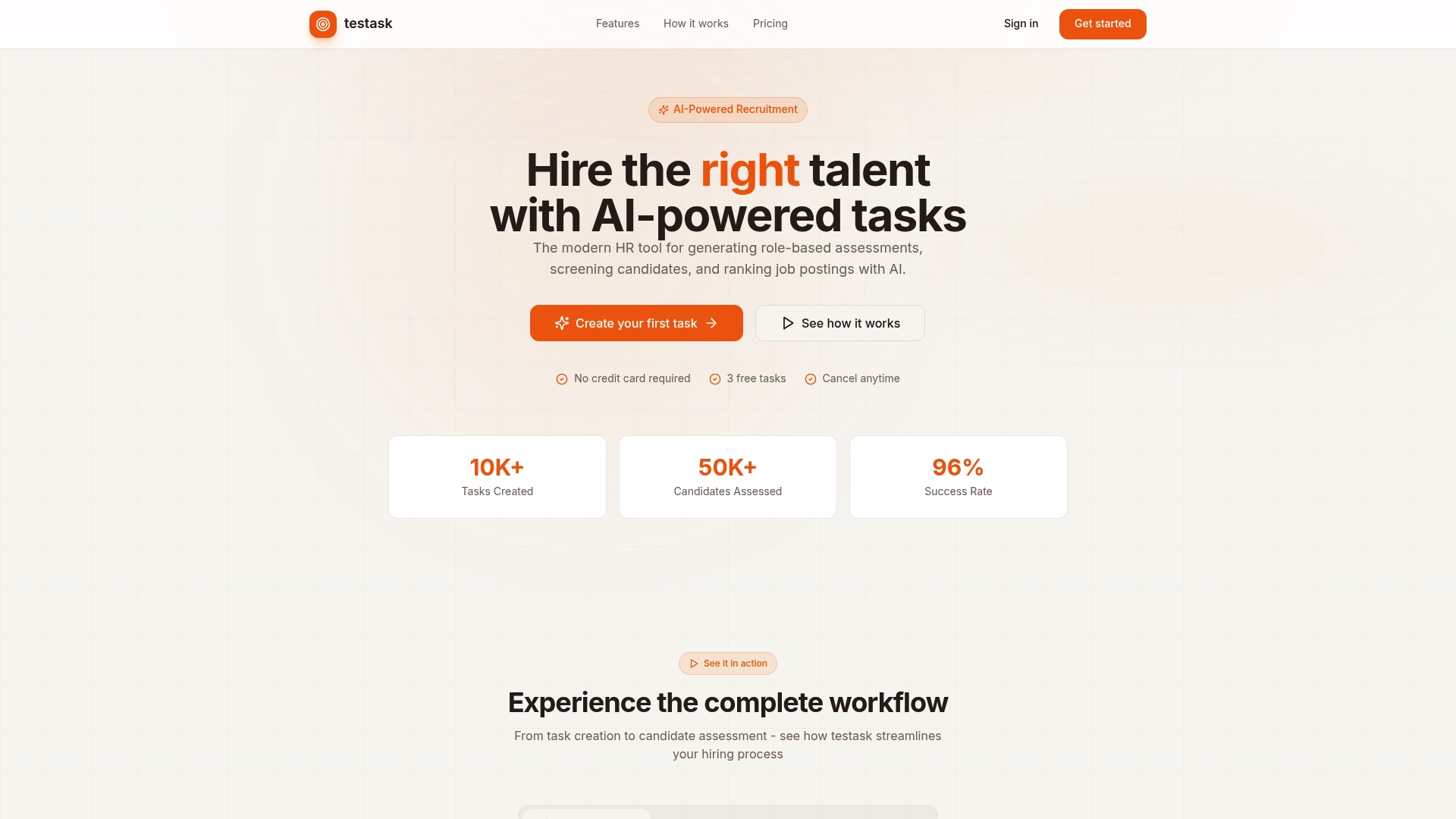
Remote hiring works best when your screening process produces real signal, not just a ranked list of resumes. Testask is an AI-powered recruitment assessment platform built for exactly this. You generate tailored test tasks for any role, candidates complete them on their own schedule, and Testask’s AI analysis surfaces the strongest submissions for your team to review.
The result: your hiring managers spend time on candidates who have already demonstrated relevant skills, not on filtering applications manually. Collaborative review tools let your team align on evaluations without endless email threads, and every assessment is documented for defensible, bias-aware decision-making.
Start assessing candidates with Testask and build a remote hiring process that scales without sacrificing quality.
Key Takeaways
Remote hiring requires purpose-built processes, not adapted versions of in-person workflows, to consistently produce quality hires at scale.
| Point | Details |
|---|---|
| Remote hiring is a distinct discipline | Treat it as its own system, not traditional hiring moved online. |
| Application volume demands early filtering | Remote roles attract 3–7 times more applications than in-person roles; deploy ATS and task-based assessments at the screening stage. |
| Onboarding drives long-term retention | Structured onboarding programs produce 58% higher retention over three years compared to unstructured approaches. |
| Pre-offer conversations prevent drop-off | Run intent conversations before extending offers to surface competing offers and reduce rejection rates. |
| Compliance is infrastructure | Multi-state hiring triggers payroll and tax obligations; use EOR services for jurisdictions where you lack a registered entity. |
Recommended
- Best Hiring Practices 2026: What HR Teams Need to Know | Testask Blog | testask
- Digital Hiring Explained: Strategies and Trends for 2026 | Testask Blog | testask
- Recruitment Trends in 2026: What HR Leaders Must Know | Testask Blog | testask
- Top talent acquisition tips for smarter hiring in 2026 | Testask Blog | testask