Digital Hiring Explained: Strategies and Trends for 2026
Digital Hiring Explained: Strategies and Trends for 2026

What is digital hiring, and why does it matter now?
Digital hiring is the end-to-end use of technology to manage every stage of recruitment, from posting a job to onboarding a new employee. Also called e-recruitment or online recruitment, it replaces manual, paper-based workflows with connected digital systems that source, screen, evaluate, and engage candidates at scale. The core components include:
- Applicant Tracking Systems (ATS): Centralize candidate data, automate resume filtering, and track applicants through each hiring stage.
- AI-powered screening tools: Parse resumes, score candidates against job criteria, and flag top matches without manual review.
- Online job boards and social media platforms: Expand reach to active and passive candidates across LinkedIn, Indeed, and niche job sites.
- Virtual interview platforms: Enable structured video interviews, on-demand recordings, and self-scheduling for candidates and hiring teams.
- Digital assessments: Deliver standardized skills tests, cognitive evaluations, and work-sample tasks that produce objective, comparable scores.
- Digital onboarding modules: Automate document collection, compliance steps, and new-hire orientation to reduce first-day friction.
True digital hiring goes further than digitizing old paper steps. It re-engineers the process to be technology-native, using competency-based scoring and structured data to make decisions that are faster, fairer, and more defensible than subjective judgment alone.
Key benefits of digital hiring for HR teams
The case for digital recruitment is operational as much as strategic. When you automate repetitive tasks, your team reclaims hours that would otherwise go to scheduling emails and manual resume stacks.
- Reduced time-to-hire: Research shows that digital tools cut time-to-hire significantly across multi-sector HR settings, with AI-driven screening and scheduling removing bottlenecks that once took days.
- Lower administrative overhead: ATS software reduces manual recruiter workload by automating resume filtering, interview scheduling, and applicant communications.
- Improved screening accuracy: Structured, criteria-based digital scoring produces more consistent candidate comparisons than unguided human review.
- Better candidate experience: Automated status updates, self-scheduling tools, and mobile-friendly applications keep candidates informed and engaged throughout the process.
- Bias reduction through standardization: Digital audit trails and standardized screening criteria limit discretionary judgment at early stages, reducing the influence of unconscious bias.
- Scalability: Digital processes handle high-volume hiring without proportional increases in recruiter headcount, making them practical for seasonal surges or rapid growth.
- Recruiter focus on high-value work: By automating routine tasks, digital hiring empowers HR professionals to spend more time on candidate engagement, culture assessment, and strategic workforce planning.
Cost savings compound over time. Faster fills mean fewer days of lost productivity, and better screening accuracy reduces costly mis-hires. For HR teams competing for top talent in tight labor markets, those gains translate directly into organizational performance.
Digital recruitment strategies that actually work
Effective digital recruitment is not about deploying every available tool. It is about selecting the right combination and running it with clear process discipline.
Targeted job advertising uses programmatic platforms to place ads in front of candidates who match your ideal profile, rather than broadcasting to everyone. This cuts application volume while improving quality.
Social media recruiting on LinkedIn, X (formerly Twitter), and niche communities lets you reach passive candidates who are not actively searching job boards. Employer brand content, employee stories, and targeted outreach all contribute to a warmer candidate pipeline.
AI-driven resume parsing and ranking scores incoming applications against defined competencies automatically. The key is configuring criteria carefully. Poorly tuned algorithms can filter out qualified candidates through rigid keyword matching, so human review of edge cases remains necessary.
Skills-based assessments replace credential proxies with direct evidence of ability. Work-sample tasks, coding challenges, and situational judgment tests give hiring managers concrete data to evaluate. Platforms like Testask let you create tailored test tasks and use AI-assisted analysis to evaluate submissions consistently across your team.
- ATS integration: Connect your assessment and interview tools to your ATS so candidate scores trigger automatic stage progression, reducing manual handoffs.
- Chatbots for candidate engagement: Automated messaging answers common questions, collects application materials, and keeps candidates moving through the funnel without recruiter intervention.
- Talent pools: Maintain searchable databases of past applicants and interested candidates to fill future roles faster, reducing sourcing costs.
- Collaborative review workflows: Centralized platforms let recruiters and hiring managers review candidate data, leave structured feedback, and reach decisions together, without email chains or disconnected spreadsheets.
The best approach combines automation for speed with human judgment for final decisions. Hybrid human-AI models consistently outperform either purely automated or purely manual processes on both quality of hire and candidate satisfaction.
What the future of digital hiring looks like

The direction is clear: more AI, more personalization, and more accountability. Several trends are reshaping how HR teams will hire through 2026 and beyond.

Predictive analytics for sourcing moves beyond reactive job posting. AI models analyze historical hiring data to identify which sourcing channels, candidate profiles, and assessment scores correlate with long-term performance, letting recruiters invest budget where it produces results.
Skills-based hiring is displacing degree and credential requirements across sectors. Digital assessments make it practical to evaluate what candidates can actually do, opening talent pools that traditional screening would have excluded.
Candidate personalization is rising as a differentiator. Self-service scheduling, real-time application status, and tailored employer brand content create experiences that candidates compare to consumer apps. Organizations that deliver friction-free processes attract better applicants.
Regulatory and ethical scrutiny is intensifying. Several U.S. states have enacted or proposed rules governing AI use in hiring decisions, requiring transparency, bias audits, and human oversight. HR teams adopting AI tools need governance frameworks, not just software licenses.
Empowering recruiters, not replacing them, remains the guiding principle for sustainable digital transformation. The goal is a joined-up workflow where technology handles volume and consistency while humans handle judgment and relationship-building. Teams that get this balance right consistently outperform those that automate indiscriminately.
Staying current on 2026 recruitment trends is no longer optional for HR leaders who want to compete for top talent.
How the digital recruitment process works, step by step
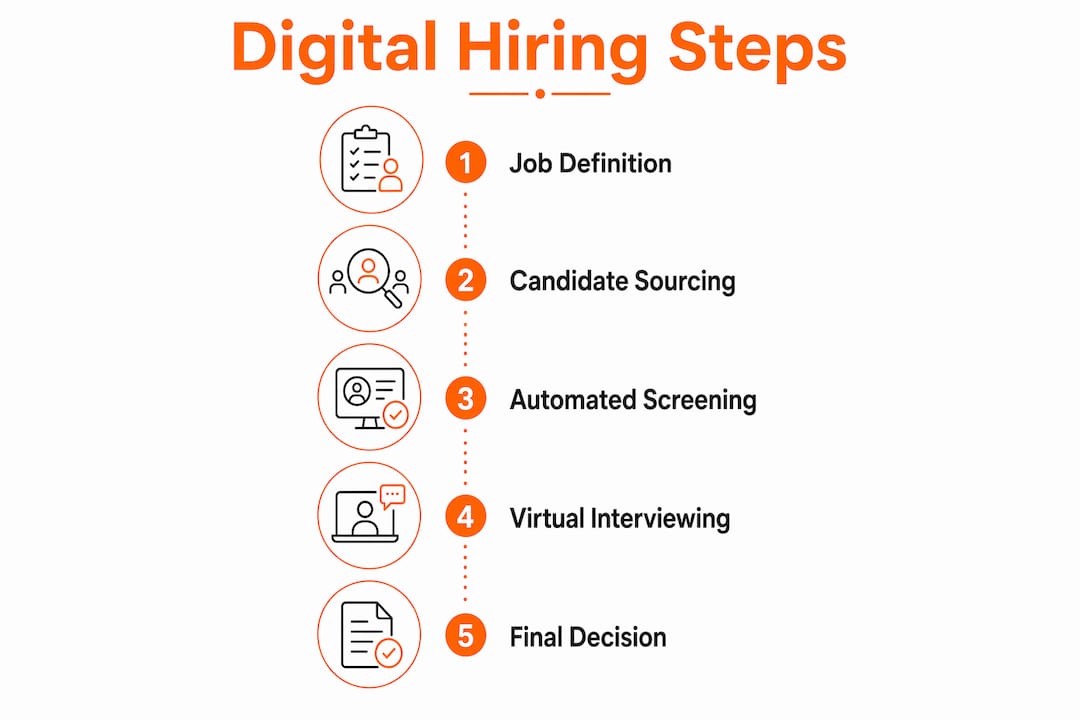
The digital recruitment lifecycle follows six defined stages. Understanding each one helps you identify where your current process has gaps and where technology adds the most value.
1. Job definition and role scoping Before posting anything, define the role using structured competency frameworks rather than generic job descriptions. Clear criteria at this stage drive better filtering downstream and reduce the risk of evaluating candidates against vague or inconsistent standards.
2. Online candidate sourcing Post to targeted job boards, activate programmatic advertising, and engage your existing talent pool. Social media outreach and employee referral programs run in parallel to maximize reach. Digital sourcing expands your candidate pool well beyond local geography, including remote workers and passive candidates.
3. Automated screening and assessment Your ATS filters applications against defined criteria. AI-powered resume parsers rank candidates by relevance. Skills assessments, like those you can build and deploy through Testask, provide objective, scored evidence of ability before any human review begins. This stage is where AI improves efficiency most measurably, reducing time-to-hire and increasing screening accuracy.
4. Virtual interviewing Structured video interviews, on-demand recordings, and self-scheduling tools replace the coordination overhead of in-person scheduling. Interviewers use standardized question sets and scoring rubrics to keep evaluations consistent across candidates.
5. Data-informed hiring decisions Hiring managers review consolidated candidate profiles: assessment scores, interview ratings, and structured feedback from the team. Digital data replaces gut feel as the primary input, though human judgment on culture fit and team dynamics remains the final call.
6. Digital onboarding Offer letters, compliance documents, and orientation materials are delivered and signed digitally. Automated workflows guide new hires through their first steps before day one, reducing administrative burden on HR and improving new-hire confidence.
Key finding: A quantitative study of 423 HR professionals found that AI tools significantly improved recruitment efficiency and contributed to more structured candidate experiences, though bias mitigation showed only modest effects without deliberate human oversight.
Pro Tip: Never hand final hiring decisions entirely to an algorithm. AI tools are most effective when they surface and rank candidates, while a trained recruiter or hiring manager makes the final call with full visibility into the data. This hybrid approach satisfies both performance and compliance requirements.
Successful digital hiring also depends on socio-technical alignment: skilled HR users, a culture that trusts data-driven processes, and governance policies that define how automated decisions are reviewed and audited. Technology alone does not produce better hires. The people using it, and the processes around it, determine the outcome.
For teams looking to strengthen their AI-driven screening at the assessment stage, structured test tasks with AI-assisted evaluation close the gap between fast screening and high-quality selection.
Key Takeaways
Digital hiring delivers measurable gains in speed, accuracy, and candidate experience, but only when AI tools are paired with structured human oversight and clear governance.
| Point | Details |
|---|---|
| Digital hiring covers the full cycle | It spans job posting, sourcing, screening, virtual interviews, decisions, and onboarding using connected technology. |
| AI improves efficiency, not fairness alone | A study of 423 HR professionals found AI significantly improved recruitment efficiency, but bias mitigation effects were modest without human checks. |
| Hybrid models outperform pure automation | Combining AI-enabled tools with human judgment for final selection produces better quality-of-hire and candidate satisfaction. |
| Governance is non-optional | Digital audit trails and standardized criteria reduce bias, but only when backed by clear policies and regular audits. |
| Skills-based assessment closes the gap | Work-sample tasks and structured scoring give hiring teams objective evidence that credential-based screening cannot provide. |
Recommended
- Best Hiring Practices 2026: What HR Teams Need to Know | Testask Blog | testask
- What Is Predictive Hiring? A 2026 Guide for HR Teams | Testask Blog | testask
- Harnessing data analytics to transform hiring decisions | Testask Blog | testask
- Recruitment Trends in 2026: What HR Leaders Must Know | Testask Blog | testask