Top talent acquisition tips for smarter hiring in 2026
Top talent acquisition tips for smarter hiring in 2026

Hiring has never been more competitive. Organizations across every industry are fighting for a shrinking pool of qualified candidates while simultaneously managing ghosting, budget pressure, and rising expectations from job seekers. 69% of organizations report difficulty filling open roles due to low applicant numbers, fierce competition, and candidates who simply disappear mid-process. The good news: a combination of evidence-based methods, smart AI adoption, and targeted strategies for niche roles gives HR leaders and hiring managers a real edge. This article covers the most effective, research-backed talent acquisition tips you can implement right now.
Table of Contents
- Understand the new talent landscape
- Leverage evidence-based recruitment tactics
- Harness AI and automation for better results
- Strategize for hard-to-fill and niche roles
- Why relentless optimization beats old-school playbooks
- Ready to transform your talent acquisition strategy?
- Frequently asked questions
Key Takeaways
| Point | Details |
|---|---|
| Evidence beats tradition | Data-driven assessments and structured interviews outperform outdated hiring methods. |
| AI elevates recruiting | AI tools dramatically increase efficiency but require oversight to minimize bias. |
| Adapt for niche roles | Special tactics like talent mapping and upskilling drive results in hard-to-fill positions. |
| Optimize continuously | Success comes from ongoing tuning of strategy, process, and technology—not silver bullets. |
Understand the new talent landscape
Before you can fix your hiring process, you need a clear picture of what you are working against. The talent market in 2026 looks fundamentally different from even three years ago. Candidate expectations have shifted, competition for skilled workers is intense across sectors, and traditional sourcing channels are producing fewer results.
The three biggest challenges HR teams report are:
- Low applicant volume: Many roles, especially technical and specialized positions, attract far fewer qualified candidates than they did in previous years. Posting on a single job board and waiting is no longer a viable strategy.
- Intense competition: Even mid-sized companies now compete with global remote-first employers for the same talent pools. A candidate in Austin or Atlanta can receive an offer from a company headquartered in London or Berlin.
- Candidate ghosting: This is a growing and frustrating reality. Candidates accept offers, complete interviews, or confirm start dates and then simply stop responding. Research shows 69% of organizations continue to struggle with exactly these issues.
Understanding these realities is not just context. It directly shapes which strategies you should prioritize. If your primary challenge is low applicant volume, your energy belongs in proactive sourcing and employer branding. If ghosting is the bigger issue, faster processes and stronger candidate communication will move the needle more than any new job board.
HR leaders who acknowledge these market conditions can stop trying to apply 2018 playbooks to 2026 problems. The hiring landscape rewards organizations that adapt quickly, test new approaches, and measure what actually works. Those who treat every unfilled role as an isolated problem rather than a symptom of broader market dynamics will keep struggling.
One practical shift is to audit your sourcing data quarterly. Track where your best hires originate, how long each stage takes, and where candidates drop off. This hiring trends data at the macro level mirrors what your own pipeline data will show at the micro level. Use both to make smarter decisions about where to invest your recruiting resources.
Leverage evidence-based recruitment tactics
Once you understand the market, the next question is which evaluation methods actually predict whether someone will succeed in the role. The answer from decades of research is clear: most traditional hiring practices are poor predictors of job performance.
Years of experience and educational credentials, two of the most commonly used screening filters, have surprisingly low predictive validity. Structured interviews, work samples, and cognitive assessments consistently outperform them. According to predictive validity research, structured behavioral interviews carry a validity coefficient of 0.51, work samples reach 0.54, and cognitive ability tests score 0.51. These numbers matter because they represent the strength of the correlation between your hiring method and actual on-the-job performance.

Comparison: Effectiveness of common hiring methods
| Method | Predictive Validity | Notes |
|---|---|---|
| Work sample tests | 0.54 | Directly mirrors job tasks |
| Structured interviews | 0.51 | Consistent questions, scored criteria |
| Cognitive ability tests | 0.51 | Strong predictor across roles |
| Unstructured interviews | 0.38 | Prone to bias and inconsistency |
| Years of experience | 0.18 | Weak predictor of performance |
| Educational credentials | 0.10 | Lowest validity across studies |
The data is striking. Yet many organizations still default to unstructured interviews and credential checks because they feel familiar and fast. Switching to structured methods requires upfront investment but pays off in better hires and reduced turnover.
Three evidence-based interview tactics to implement now:
- Behavioral questions with a scoring rubric: Ask candidates to describe specific past situations relevant to the role. Use a 1 to 5 scoring rubric so every interviewer evaluates responses against the same standard. This removes subjectivity and makes panel calibration much easier.
- Work sample tasks: Give candidates a realistic, role-relevant task to complete. A content marketer might draft a short article. A data analyst might interpret a sample dataset. These tasks reveal actual capability, not just the ability to talk about capability.
- Structured debrief sessions: After interviews, hold a structured debrief where each interviewer shares scores before open discussion begins. This prevents the loudest voice in the room from anchoring everyone else’s judgment.
Pro Tip: Build a simple scorecard for every role before interviews begin. Define three to five core competencies, assign each a weight, and require every interviewer to complete it independently. This single habit dramatically reduces bias and improves consistency across your hiring team.
Harness AI and automation for better results
Strong foundational methods create the base. AI and automation then help you execute those methods at scale without burning out your recruiting team. Adoption is accelerating fast. AI adoption in HR has doubled to 43% in 2025, with organizations using it for resume screening, chatbots, and interview scheduling. The efficiency gains are substantial: 89.6% of adopters report improved efficiency, 85.3% report time savings, and 77.9% report cost savings.
The impact on core metrics is equally significant. AI-assisted screening reduces time-to-hire by 25 to 55%, cuts cost-per-hire by 20 to 50%, and boosts recruiter capacity by two to ten times. That last point is especially important for lean HR teams managing high-volume hiring.
Key AI outcomes for recruiting teams
| Outcome | Improvement Range | Primary Use Case |
|---|---|---|
| Time-to-hire reduction | 25 to 55% | Automated resume screening |
| Cost-per-hire reduction | 20 to 50% | Reduced manual review hours |
| Recruiter capacity increase | 2 to 10x | Chatbots, scheduling, follow-ups |
| Efficiency improvement | 89.6% of adopters | End-to-end workflow automation |
Where AI adds the most immediate value:
- Resume screening: AI tools can filter hundreds of applications against defined criteria in minutes, surfacing the strongest candidates without manual review of every submission.
- Candidate communication: Automated chatbots handle initial inquiries, schedule interviews, and send status updates. This reduces ghosting because candidates receive faster responses and feel less ignored.
- Assessment scoring: AI can analyze written responses, coding submissions, or recorded video interviews to generate initial scores that recruiters then review.
- Scheduling automation: Eliminating the back-and-forth of interview scheduling saves recruiters hours each week and creates a smoother candidate experience.
Two critical considerations deserve attention. First, human oversight remains essential. AI tools can perpetuate bias if trained on historical data that reflects past inequities. Audit your AI tools regularly for disparate impact across demographic groups. Second, do not automate away the human moments that candidates value. A recruiter who follows up personally after a final interview creates a connection that no chatbot replicates.
AI-powered recruiting tools work best when they handle repetitive, high-volume tasks while your team focuses on relationship building, complex evaluation, and final decision-making.
Pro Tip: Start your AI adoption with one specific workflow, either resume screening or interview scheduling, before expanding. Measure the time savings and quality impact over 60 days. A focused pilot generates the data you need to justify broader investment and helps your team build confidence with the technology before scaling.
Strategize for hard-to-fill and niche roles
Even the best AI tools and structured processes will not fill a role if the talent simply does not exist in your current sourcing channels. Niche and scarce roles require a fundamentally different approach. The standard post-and-pray method fails here. You need proactive, targeted strategies built around the reality of limited supply.
Solutions for niche hiring consistently point to three core tactics: talent mapping, internal upskilling, and accelerated decision-making. Each addresses a different constraint in the niche hiring equation.
Key strategies for hard-to-fill roles:
- Talent mapping: Build a living database of potential candidates before you have an open role. Follow relevant professionals on LinkedIn, engage with niche communities, attend industry events, and maintain warm relationships over time. When a role opens, you already have a shortlist rather than starting from zero.
- Internal upskilling: The fastest path to filling a niche role is sometimes already inside your organization. Identify employees with adjacent skills and invest in targeted training to bridge the gap. This approach builds loyalty, reduces time-to-fill, and often produces better cultural fit than external hires.
- Speed over perfection: In scarce talent markets, slow processes kill offers. Top niche candidates often hold multiple offers simultaneously. Streamline your process to move from first contact to offer in days, not weeks.
“Over-specifying job requirements is one of the most common and costly mistakes in niche hiring. When you require ten years of experience in a technology that has only existed for six years, you eliminate every qualified candidate before the process begins. Define what is truly core to success and treat everything else as trainable.”
The core versus trainable skills framework is practical and powerful. Before writing a job description, separate requirements into two categories. Core skills are non-negotiable capabilities the person must have on day one. Trainable skills are things a motivated, capable person can learn within three to six months with proper support. Most job descriptions blur these categories, creating an impossible standard that eliminates strong candidates and extends time-to-fill unnecessarily.
Apply this framework to your last three unfilled roles. You will almost certainly find requirements in the “must have” column that belong in the “nice to have” column. Removing them opens your candidate pool significantly without compromising the quality of your eventual hire.
Why relentless optimization beats old-school playbooks
Here is something most recruiting articles will not tell you: copying a competitor’s hiring strategy is one of the most reliable ways to stay mediocre. Every organization has a different talent brand, different role mix, different candidate audience, and different internal culture. What works brilliantly at a fast-growing tech startup may produce poor results at a regional healthcare system.
The organizations that consistently win at hiring are not the ones who adopted the latest trend fastest. They are the ones who build a habit of measurement, reflection, and adjustment. They track time-to-hire, quality-of-hire, retention at 12 months, diversity pass-through rates, and candidate NPS (Net Promoter Score, a measure of how likely candidates are to recommend your process to others). Then they actually use that data to change something.
Most teams collect metrics but do not act on them. That gap between measurement and action is where hiring quality stagnates. Evidence-based recruiting methods consistently outperform traditional proxies like experience or credentials, but only when aligned with specific business goals through workforce planning. Generic optimization produces generic results.
Our perspective: build a quarterly hiring audit into your team’s calendar. Review every metric, identify the one process change most likely to improve your weakest number, implement it, and measure again. This cycle of continuous improvement compounds over time. After four quarters, your process looks nothing like it did at the start, and your results reflect that.
Ready to transform your talent acquisition strategy?
The research is clear: structured assessments, AI-assisted screening, and skills-based evaluation produce better hires faster and at lower cost. Putting these methods into practice requires the right tools.
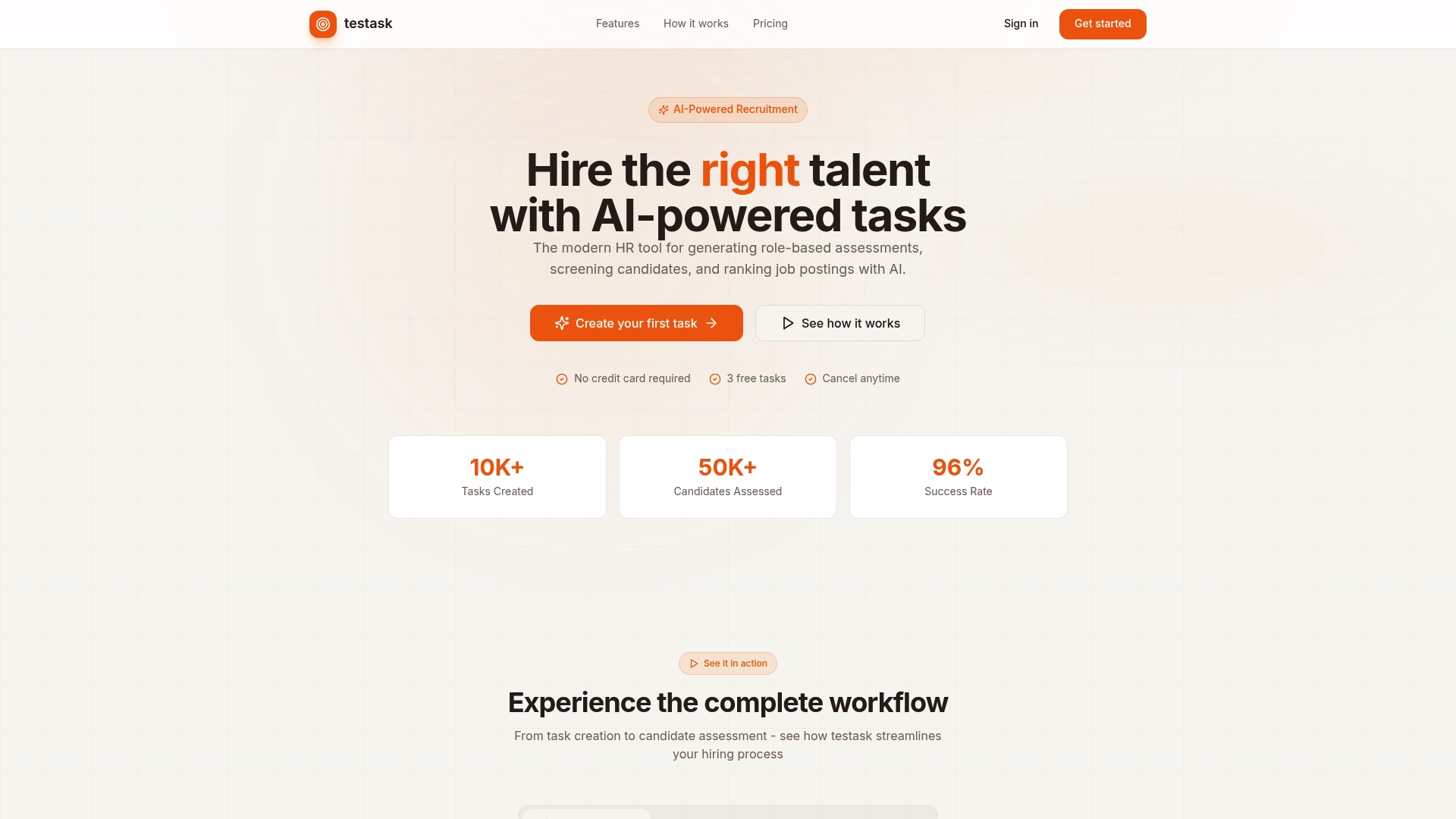
testask is an AI-powered recruitment platform built specifically to help HR teams and hiring managers implement these evidence-based methods at scale. You can generate tailored test tasks for any role, evaluate candidate submissions with AI-assisted analysis, and collaborate with your team on structured reviews, all in one place. testask turns the research-backed tactics covered in this article into a daily workflow your team can actually sustain. See how it works and start building smarter, faster, fairer hiring processes today.
Frequently asked questions
What are the most effective talent acquisition techniques in 2026?
Structured behavioral interviews and work samples have the highest predictive validity, making them the strongest foundation for any hiring process, especially when combined with AI-assisted screening for efficiency.
How does AI improve the recruitment process?
AI accelerates screening, reduces cost-per-hire, and multiplies recruiter capacity, with AI adoption in HR delivering 89.6% efficiency improvements and 85.3% time savings among adopters, though human oversight remains critical to ensure fairness.
How should you address hiring for scarce or niche roles?
Talent mapping, internal upskilling, and avoiding over-specification are the most effective approaches, combined with faster decision-making to compete in markets where top candidates hold multiple offers simultaneously.
What metrics should HR teams use to measure recruitment success?
Time-to-hire, quality-of-hire, retention rates, diversity pass-through, and candidate NPS together provide a holistic view of hiring performance that no single metric can capture on its own.
Recommended
- testask - AI-Powered Recruitment Assessment Platform
- Employee Retention Solutions, Lower Turnover | OpenElevator