Best Hiring Practices 2026: What HR Teams Need to Know
Best Hiring Practices 2026: What HR Teams Need to Know

The best hiring practices in 2026 combine structured interviews, AI-powered assessments with compliance safeguards, skills-based evaluation, and optimized candidate experiences to produce fair, efficient, and defensible recruitment outcomes. HR teams that treat these elements as an integrated system, rather than isolated tactics, consistently outperform those relying on intuition or outdated credential screening. Platforms like Testask, along with frameworks from EEOC and NACE, give hiring managers the tools to measure and improve every stage of the process. Benchmarks like time-to-fill and cost-per-hire are no longer optional reporting metrics. They are the scoreboard for your entire talent acquisition strategy.
1. Structured interviews as the foundation of best hiring practices 2026
Structured interviews use standardized questions and anchored scoring rubrics to reduce bias and improve the predictive accuracy of hiring decisions. Every candidate answers the same questions in the same order, and interviewers score responses against a defined 1-5 rubric before discussing results. This consistency removes the conversational drift that makes unstructured interviews unreliable.

The evidence is decisive. Structured interviews carry a predictive validity of .51 compared to .38 for unstructured formats, meaning they are roughly twice as predictive of actual job performance. That gap translates directly into fewer mis-hires and lower turnover costs. For roles where a bad hire costs six to nine months of salary, the math is straightforward.
Practical implementation requires three things:
- Standardized question sets tied to specific competencies for the role, written before the first interview begins
- Anchored scoring rubrics that define what a 1, 3, and 5 response looks like for each question, so two interviewers score the same answer consistently
- Structured note-taking during the interview, with scores submitted independently before any panel discussion
Pro Tip: Build your question bank around behavioral and situational prompts. “Tell me about a time when…” questions tied to your competency model outperform hypothetical questions in predictive accuracy.
Structured interview scorecards also provide legal defensibility. If a candidate challenges a hiring decision, documented scores against job-relevant criteria are far stronger evidence than interview notes that say “great culture fit.”
2. Integrating AI hiring tools responsibly and compliantly
AI-powered hiring tools accelerate screening and reduce manual workload, but they carry legal obligations that HR teams must manage proactively. The EEOC confirms that employers remain liable for disparate impact caused by AI tools, even when those tools are built and maintained by third-party vendors. Delegating to a vendor does not transfer legal responsibility.
Four compliance obligations apply to most U.S. employers using automated employment decision tools (AEDTs):
- Title VII validation. Every AI screening tool must be validated as job-related and consistent with business necessity. If the tool produces adverse impact against a protected class, you must demonstrate it predicts job performance and that no less discriminatory alternative exists.
- ADA accessibility. The ADA requires that hiring technologies do not screen out qualified candidates with disabilities. You must verify that assessments measure only job-relevant skills and provide accessible alternatives when a candidate requests accommodation.
- NYC Local Law 144 compliance. If you use AEDTs to evaluate candidates or employees in New York City, you must conduct annual bias audits, post public summaries, notify candidates before use, and offer opt-out options. Non-compliance penalties reach $1,500 per day.
- Emerging state and federal rules. Illinois, Colorado, and the EU AI Act each impose additional requirements. Governance rhythms, meaning scheduled audit cycles and documented compliance reviews, keep you ahead of evolving obligations.
Disparate impact risks persist with AI tools even when the intent is neutral. Active mitigation and validation remain employer responsibilities regardless of how sophisticated the automation becomes.
Pro Tip: Create a compliance calendar with quarterly audit checkpoints. Treat bias audits and candidate notice workflows as standard operating procedures, not annual fire drills.
Embedding compliance into daily hiring workflows, rather than treating it as a legal review at year-end, is the operational standard that separates high-performing HR teams from those facing regulatory exposure.
3. Skills-based hiring and assessment in 2026 recruitment
Skills-based hiring is defined as evaluating candidates on demonstrated, job-relevant abilities rather than proxy credentials like degree requirements or years of experience. The shift matters because credentials correlate weakly with actual performance on most roles, while verified skills correlate directly. Skills-based hiring adoption reached 70% across organizations in 2026, making it the dominant screening philosophy rather than an emerging trend.
The practical difference between credential-based and skills-based screening shows up at the top of the funnel. A credential filter removes candidates before any evaluation of actual ability. A skills filter surfaces candidates who can do the work, regardless of how they acquired the capability. That distinction expands your talent pool and reduces the demographic skew that degree requirements often introduce.
Effective skills-based hiring in 2026 combines three components:
- Pre-screen assessments that test specific technical or cognitive skills relevant to the role, administered before the first interview
- Structured interview questions mapped to behavioral competencies, scored against anchored rubrics as covered in section one
- Work sample tasks or job-relevant test assignments that simulate actual role responsibilities, which tools like Testask are built to deliver and evaluate at scale
Pro Tip: Map every assessment to a specific job requirement in your job description. If you cannot draw a direct line from the test to the role, the assessment creates legal exposure and adds no predictive value.
The combination of pre-screen skills tests and structured interviews is more predictive than either method alone. NACE 2026 data confirms that organizations using both at the interview stage report higher quality-of-hire scores and lower first-year turnover. You can explore interview assessment examples to see how this combination works in practice across different role types.
4. Optimizing the candidate experience for better recruitment outcomes
Candidate experience is defined as the sum of every interaction a job seeker has with your organization from first job posting to final decision. Poor candidate experience costs employers directly: rejected candidates share negative experiences publicly, and strong candidates withdraw from slow or opaque processes. Structured hiring processes correlate with 21% higher fairness ratings from candidates, which directly supports employer brand perception.
Reducing friction at the application stage is the highest-leverage starting point. Long application forms, redundant data entry, and unclear next steps cause qualified candidates to abandon the process before you ever evaluate them. Audit your application funnel the same way a product team audits a checkout flow.
Key practices for a stronger candidate experience:
- Clear job postings that describe the actual skills required, the assessment process, and the expected timeline
- Proactive communication at every stage, including automated confirmations, status updates, and rejection notices with timelines
- Transparent tool disclosure telling candidates when AI or automated tools are used in screening, what data is collected, and how to request accommodations
- Consistent feedback loops so interviewers complete scorecards within 24 hours and hiring decisions are communicated promptly
Pro Tip: Send candidates a one-paragraph overview of your hiring process before their first interview. Candidates who understand the process report higher satisfaction scores regardless of the outcome.
Treating candidates like customers is not a soft HR concept. It is a talent acquisition strategy. Organizations with strong employer brands attract more applicants per role, which improves the quality of the pool you are selecting from.
5. Key hiring benchmarks to measure success in 2026
Hiring benchmarks are the quantitative standards that tell you whether your recruitment process is performing, stalling, or failing. Without them, process improvements are guesswork. The median time-to-fill in 2026 is approximately 45 days, with cost-per-hire averaging $1,200 for non-executive roles and $10,625 for executive positions. Those numbers give you a baseline to evaluate your own performance against.
| Metric | 2026 Benchmark | What It Signals |
|---|---|---|
| Time-to-fill | ~45 days | Measures process speed from job open to offer accepted |
| Cost-per-hire (non-executive) | ~$1,200 | Tracks total recruiting spend per filled role |
| Cost-per-hire (executive) | ~$10,625 | Reflects sourcing, assessment, and onboarding investment |
| First-year turnover | Below 20% | Indicates quality-of-hire and onboarding effectiveness |
| Offer acceptance rate | Above 85% | Reflects compensation competitiveness and candidate experience |
Top-decile recruiting teams achieve significantly better metrics than median performers, which means the benchmark is a floor, not a ceiling. The gap between median and top performers is almost always explained by process quality: structured evaluation, faster decision cycles, and better candidate communication.
Metrics to track routinely include:
- Time-to-fill broken down by department and role level to identify bottlenecks
- Cost-per-hire segmented by sourcing channel to optimize spend allocation
- Quality-of-hire measured through 90-day and one-year performance reviews of new hires
- Candidate drop-off rate at each funnel stage to identify where strong candidates are leaving
Building a recruitment checklist that incorporates these metrics as review gates, rather than end-of-quarter reports, keeps your process accountable in real time.
Key takeaways
The best hiring practices in 2026 require structured interviews, validated AI tools, skills-based assessment, and consistent metric tracking to produce fair and defensible hiring decisions.
| Point | Details |
|---|---|
| Structured interviews double predictive validity | Use standardized questions and anchored rubrics to score every candidate consistently. |
| AI compliance is an employer responsibility | Validate tools for job-relevance, conduct bias audits, and embed candidate notices into your workflow. |
| Skills-based hiring expands talent pools | Evaluate demonstrated ability over credentials to reduce bias and improve quality-of-hire. |
| Candidate experience affects talent supply | Transparent, frictionless processes improve employer brand and increase qualified applicant volume. |
| Benchmarks drive process improvement | Track time-to-fill, cost-per-hire, and first-year turnover to identify and fix bottlenecks. |
What I’ve learned about hiring right in 2026
The biggest mistake I see HR teams make is treating structured interviews and AI tools as separate workstreams. One team owns the interview process. Another team manages the technology vendor. Nobody owns the integration. The result is a hiring process that looks modern on paper but produces the same inconsistent decisions it always did.
The compliance piece has also shifted from a legal department concern to an operational one. When NYC Local Law 144 penalties can reach $1,500 per day, bias audits and candidate notices are not annual checkboxes. They are recurring workflow steps that belong in your ATS and your hiring manager training. I have seen organizations scramble to retrofit compliance after a regulatory inquiry. It is far more expensive than building it in from the start.
The metric I find most underused is quality-of-hire. Time-to-fill gets obsessive attention because it is easy to measure. But a fast hire who leaves in six months costs more than a 60-day search that produces a two-year contributor. Tracking 90-day and one-year performance scores for new hires, and connecting those scores back to the assessment methods used, is how you actually improve your process over time. Most teams collect this data. Almost none of them close the feedback loop.
My honest recommendation: pick one metric, one process improvement, and one compliance gap to address this quarter. Incremental, documented progress beats ambitious overhauls that stall in committee. The teams winning at talent acquisition in 2026 are not the ones with the most sophisticated tech stack. They are the ones who execute the basics with discipline and measure everything.
— Pavel
See how Testask fits into your 2026 hiring process
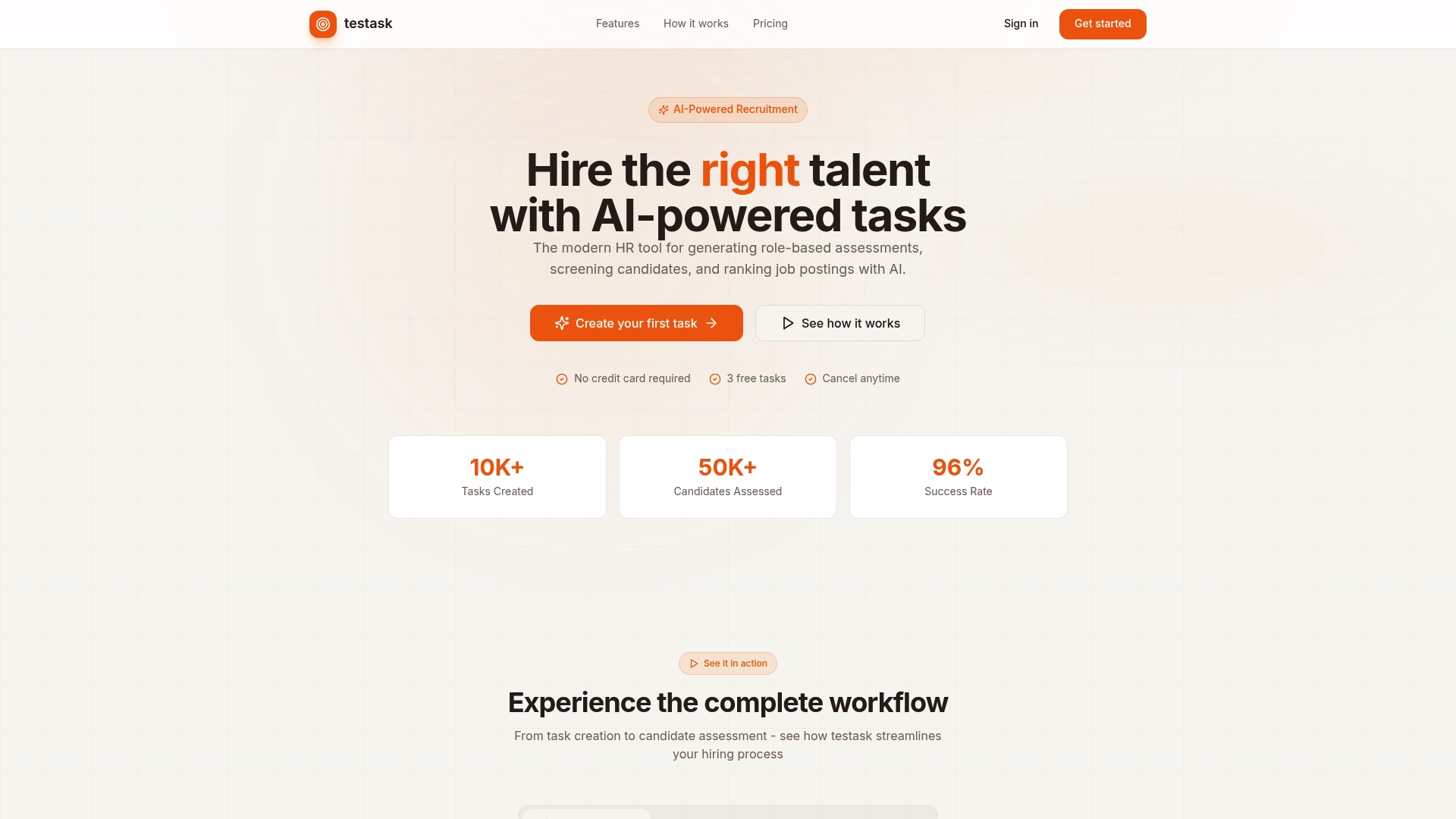
Testask is an AI-powered recruitment assessment platform built for HR teams that want to move faster without sacrificing evaluation quality. You can generate tailored test tasks for any role, score candidate submissions with AI-assisted analysis, and collaborate with your hiring team on structured reviews, all in one place. The platform is designed to support the skills-based and structured interview workflows described in this article, with features that help you document decisions and maintain consistency across every candidate. If you are ready to see how AI-assisted screening fits your current process, explore Testask and request a demo to get started.
FAQ
What makes a hiring practice “structured” in 2026?
A structured hiring practice uses standardized questions, consistent evaluation criteria, and anchored scoring rubrics applied equally to every candidate. Structured interviews have roughly twice the predictive validity of unstructured conversations, making them the most reliable format for fair hiring decisions.
How do I stay compliant when using AI in hiring?
Validate every AI tool for job-relevance, conduct annual bias audits, and provide candidate notices before using automated decision tools. NYC Local Law 144 and EEOC Title VII guidance both place compliance responsibility on the employer, not the vendor.
What is the average time-to-fill in 2026?
The median time-to-fill is approximately 45 days in 2026. Top-performing recruiting teams consistently beat this benchmark through structured processes, faster decision cycles, and reduced interview stages.
Why is skills-based hiring growing so fast?
Skills-based hiring reached 70% adoption in 2026 because it expands talent pools, reduces credential bias, and produces stronger quality-of-hire outcomes when combined with structured assessment methods. Degree requirements often exclude qualified candidates without improving predictive accuracy.
What is the best way to measure hiring quality?
Track quality-of-hire by reviewing 90-day and one-year performance scores for new hires and connecting those results back to the assessment methods used during screening. This feedback loop is what separates teams that improve over time from those that repeat the same hiring mistakes.
Recommended
- Top talent acquisition tips for smarter hiring in 2026 | Testask Blog | testask
- Hiring process best practices: proven steps for better talent | Testask Blog | testask
- Talent acquisition strategies for smarter hiring in 2026 | Testask Blog | testask
- Build an effective recruitment checklist for HR success | Testask Blog | testask