Common Hiring Mistakes HR Teams Must Avoid in 2026
Common Hiring Mistakes HR Teams Must Avoid in 2026

What are the most common hiring mistakes, and why do they matter?
Rushed timelines, vague job posts, and gut-feel interviews are the most common hiring mistakes costing U.S. companies real money and real talent. Organizations that optimize purely for speed see a higher rate of hiring errors on average, and research from Harvard Business Review found that a large majority of employee turnover traces back to bad hiring decisions. These aren’t isolated judgment calls. They’re process failures that stack on each other.
The core mistakes fall into predictable patterns:
- Unclear role briefs that send recruiters sourcing against the wrong criteria from day one
- Unstructured interviews that introduce bias and reduce predictive accuracy
- Skipped reference checks that leave critical behavioral data on the table
- Vague job descriptions that repel qualified candidates before they even apply
- No diversity strategy in sourcing, which narrows the talent pool unnecessarily
- Poor candidate communication that damages employer brand at scale
- Overemphasis on credentials over demonstrated skills and capability
Most of these errors share two root causes: the hiring brief is unclear, and the interview process isn’t structured. Fix those two things, and the rest become detectable and correctable.

1. Skipping or rushing reference checks
Reference checks are the most skipped step in the hiring process, and the consequences show up fast. Failing to conduct at least two thorough reference checks per finalist significantly increases the risk of a bad hire. Generic questions like “Would you hire this person again?” produce almost no useful signal. You need behavioral specifics.
Best practices for reference verification:
- Require a minimum of two references per finalist, ideally direct managers rather than peers or colleagues the candidate selected strategically
- Ask behavioral questions tied to the role’s core competencies, such as how the candidate handled conflict, missed deadlines, or ambiguous direction
- Listen for hesitation and omission as much as what’s said directly; a reference who struggles to name a specific strength is telling you something
- Verify employment dates and titles independently, since resume falsifications are more common than most hiring managers expect
Reference checks reveal patterns that interviews simply cannot: reliability under pressure, collaboration habits, and how someone actually behaves when no one is evaluating them.
2. Writing vague or unrealistic job descriptions
A poorly written job post is a self-inflicted wound. Candidates scan postings in seconds, and if the requirements look bloated, the title is unsearchable, or the salary is missing, qualified people leave before reading the second paragraph. Listing unrealistic must-have qualifications doesn’t just reduce application volume. It signals to experienced candidates that the company doesn’t understand the role it’s trying to fill.
Job descriptions that consistently underperform share these traits:
- Missing salary ranges, which increase candidate drop-off and reduce applicant trust before the first conversation
- Internal job titles that don’t match how candidates actually search (e.g., “Growth Operations Lead” when candidates search “Marketing Operations Manager”)
- Credential-heavy requirements for roles where hands-on capability matters far more than where someone studied
- Dense formatting with long paragraphs that create friction on mobile, where most passive candidates browse first
Treat every job post as a marketing asset. Write for the candidate you want to attract, not for internal compliance. Clear, concise descriptions with realistic qualifications and transparent compensation consistently outperform wish-list postings. For a deeper look at skills-based job framing, the shift away from credential-heavy requirements is well-documented and worth building into your posting template.

3. Relying on first impressions and gut feeling
Gut-feel hiring is one of the most persistent and damaging interviewing errors in the industry. Unstructured interviews are approximately 50% less predictive of a candidate’s future job performance compared to structured ones. Yet many hiring managers still run conversations that drift based on rapport, shared backgrounds, or how confident a candidate sounds in the first five minutes.
The halo effect is the most common bias in unstructured interviews. A strong opening answer colors every subsequent response, regardless of actual competency.
The fix is structural, not motivational:
- Use standardized question sets tied to specific competencies for every candidate at each stage
- Require an evidence quote per scorecard rating so interviewers must cite a specific moment, not a general impression
- Apply behavioral anchors to each competency so scores mean the same thing across different interviewers
- Capture interview notes in real time rather than relying on memory after a full day of back-to-back conversations
Evidence-based scoring removes the “I just had a good feeling” problem by requiring interviewers to show their work. If a moment can’t be cited, it doesn’t count toward the score.
4. Failing to build a diverse candidate slate
Limiting where and how you source candidates produces a narrow pipeline, and a narrow pipeline produces homogeneous hires. This isn’t just an equity issue. Diverse teams consistently produce better decisions, and the research on this is well established. Common recruiter behaviors that restrict diversity include sourcing only from familiar job boards, writing job descriptions with exclusionary language, and defaulting to referrals from existing employees.
Practical steps to broaden your candidate pool:
- Audit job description language for terms that statistically discourage applications from underrepresented groups
- Expand sourcing channels beyond LinkedIn and Indeed to include professional associations, HBCUs, community colleges, and industry-specific networks
- Implement a diverse slate policy that requires at least one underrepresented candidate to advance to the final round before a decision is made
- Remove pedigree filters from early screening stages, since overweighting university prestige limits diversity and has weak correlation with job performance
Broadening your sourcing strategy isn’t about lowering standards. It’s about removing the artificial filters that were never predictive of success in the first place. Cornerstone’s startup hiring framework offers a useful lens on how unrealistic criteria damage both diversity and employer reputation simultaneously.
5. Neglecting to showcase company culture and benefits
Candidates evaluate employers as carefully as employers evaluate candidates. When job postings and interview conversations say nothing meaningful about culture, values, or day-to-day work experience, qualified candidates fill the gap with assumptions, and those assumptions are rarely favorable. Transparency about what it’s actually like to work at your company is one of the most underused tools in recruitment.
What candidates want to see, and rarely get:
- Concrete descriptions of team culture, not generic phrases like “collaborative environment” or “fast-paced culture”
- Specific benefits and perks listed clearly, including remote or hybrid flexibility, professional development budgets, and health coverage details
- Employee value proposition language that explains why someone would choose your company over a competitor offering similar compensation
- Authentic employer brand content such as team spotlights, day-in-the-life posts, or Glassdoor responses that show the company engages with feedback
Omitting this information doesn’t protect you from scrutiny. It just moves the scrutiny to Glassdoor and LinkedIn, where you have less control over the narrative.
6. Operating with murky or inconsistent hiring policies
Unclear hiring processes create delays, misaligned expectations, and decisions that vary wildly depending on which hiring manager is involved. When recruiters don’t have a structured intake call before sourcing begins, they often source against the wrong criteria for weeks before the first rejection reveals the mismatch. A captured intake call is the single most effective fix for misaligned sourcing.
Signs your hiring process has structural problems:
- Feedback takes more than 48 hours after each interview stage, causing candidates to disengage or accept competing offers
- Multiple decision-makers disagree on the role’s requirements because no one aligned on a written brief before sourcing started
- Scorecards are vague or optional, leaving hiring decisions to whoever argues most confidently in the debrief
- No defined SLA for each stage, so candidates experience wildly different timelines with no communication about what to expect
Standardizing your process doesn’t mean slowing it down. A clear decision framework, a written intake brief, and pre-populated scorecards actually accelerate hiring by removing the back-and-forth that stalls most searches. The hiring process best practices Testask outlines cover exactly this kind of structural fix.
7. Ignoring social media and modern recruiting tools
Recruiters who rely exclusively on traditional job boards miss a substantial portion of the qualified candidate market, particularly passive candidates who aren’t actively searching but would consider the right opportunity. Social media platforms and AI-powered tools have changed how top talent discovers and evaluates employers, and ignoring that shift has a direct cost.
Where modern recruiting falls short without digital tools:
- No employer brand presence on LinkedIn or Instagram means candidates can’t find authentic content about your company before deciding whether to apply
- Manual resume screening at high volume introduces inconsistency and takes time that structured assessment tools can dramatically reduce
- No skills-based pre-screening means hiring teams spend interview time on candidates who could have been filtered earlier with a well-designed task or assessment
- Slow screening cycles caused by manual processes push candidates toward faster-moving employers
AI-powered recruitment platforms like Testask help HR teams generate tailored assessment tasks, evaluate submissions with AI-assisted analysis, and collaborate on candidate reviews in a fraction of the time manual screening requires. The speed advantage alone reduces the risk of losing qualified candidates to a competitor who moved faster. For a broader look at modern recruiting tools, the technology landscape has shifted significantly in the past two years.
8. Why structured interviews and skills-based hiring produce better results
The evidence for structured interviewing is consistent and strong. Standardized, competency-linked question sets improve prediction accuracy and reduce the bias that informal conversations introduce. Yet many organizations still treat the interview as a conversation rather than an evaluation, which means scores reflect personality fit more than job-relevant capability.
Key practices that improve hire quality:
- Map every interview question to a specific competency so interviewers know exactly what they’re measuring and why
- Use work-sample assessments for roles where output quality matters more than credentials, since testing the actual work predicts performance far better than asking about it
- Conduct a mandatory debrief within 24 hours of the final round so high-conviction observations from one interviewer don’t get lost before the decision is made
- Review hires at 6 and 12 months against the original hiring criteria to identify where your process is working and where it’s producing mismatches
Platforms like Testask support this approach directly, letting hiring teams build structured candidate scoring frameworks and assess submissions against defined competency rubrics. Retrospective hire reviews, as noted in research on improving future recruitment decisions, significantly sharpen the criteria teams use in subsequent searches.
Pro Tip: Run a 12-month retrospective on your last 10 hires. Compare their actual performance ratings against the competencies you scored them on during the interview. The gaps will tell you exactly where your evaluation process needs recalibration.
9. Leaving candidates without clear communication
Poor candidate communication is one of the fastest ways to damage your employer brand, and it’s almost entirely preventable. Candidates who go through multiple interview rounds and then receive silence, vague timelines, or a form rejection with no context don’t just move on. They share the experience. On Glassdoor, LinkedIn, and in professional networks, the story of a disorganized hiring process travels further than most HR teams realize.
The communication failures that hurt most:
- No timeline shared at the start of the process, leaving candidates to guess when they’ll hear back
- Silence after final-round interviews, which candidates consistently rate as the most damaging experience in a hiring process
- Generic rejection emails that offer no feedback, making it impossible for candidates to understand what happened
- Inconsistent messaging from different interviewers about role requirements, team structure, or next steps
A simple fix: define communication touchpoints at each stage and assign ownership. Candidates should know within 48 hours of each interview what the next step is and when to expect it.
10. Failing to verify employment history
Employment history verification is a step that many hiring teams skip under time pressure, and it’s a gap that candidates with falsified resumes exploit regularly. The consequences range from a poor cultural fit to outright fraud, depending on the role. Verification takes less time than a second interview and provides information that no amount of conversation can replace.
What to verify and how:
- Confirm employment dates and titles directly with HR departments or through a background check provider, since discrepancies between a resume and official records are common
- Check for gaps or overlaps in employment history that weren’t mentioned during the interview process
- Verify claimed credentials and certifications for roles where those qualifications are legally or operationally required
- Cross-reference LinkedIn profiles against the resume, since inconsistencies between the two often surface embellishments that neither document alone would reveal
Skipping this step to save a few days in the hiring timeline is a false economy. A mis-hire in a senior or specialized role costs far more in time, money, and team disruption than the verification process ever would.
11. Making hiring decisions without multiple stakeholders
Single-decision-maker hiring produces narrower, more biased outcomes than panel-based evaluation. When one person controls the hiring decision, their blind spots become the organization’s blind spots. Involving multiple stakeholders, including the hiring manager, a peer from the team, and occasionally a cross-functional partner, produces more complete candidate assessments and stronger buy-in once someone is hired.
How to involve stakeholders without slowing the process:
- Assign each interviewer a specific competency area so the panel covers different dimensions rather than asking the same questions five times
- Use a shared scorecard that aggregates ratings across interviewers and surfaces disagreements before the debrief, not during it
- Include a peer-level interviewer who can assess cultural contribution and team dynamics from a different vantage point than the hiring manager
- Set a clear decision owner who synthesizes panel input and makes the final call, so stakeholder involvement doesn’t collapse into decision paralysis
The goal is calibrated input, not consensus. Structured interview assessment frameworks make it easier to aggregate multi-stakeholder scores objectively and move to a decision without endless back-and-forth.
Key Takeaways
Avoiding common hiring mistakes requires structured processes, clear role briefs, and evidence-based evaluation at every stage of the recruitment cycle.
| Point | Details |
|---|---|
| Structured interviews outperform gut feel | Unstructured interviews are significantly less predictive of job performance than structured ones. |
| Reference checks are non-negotiable | Require at least two behavioral reference checks per finalist, as failing to do so significantly increases the risk of a bad hire. |
| Job descriptions are marketing assets | Missing salary ranges and unrealistic requirements increase candidate drop-off and reduce application quality. |
| Speed without structure increases errors | Organizations optimizing purely for time-to-fill see an 11% higher rate of hiring mistakes on average. |
| Retrospective reviews sharpen future hiring | Reviewing hire performance at 6 and 12 months aligns future evaluation criteria with actual job success. |
How Testask helps you avoid these hiring pitfalls
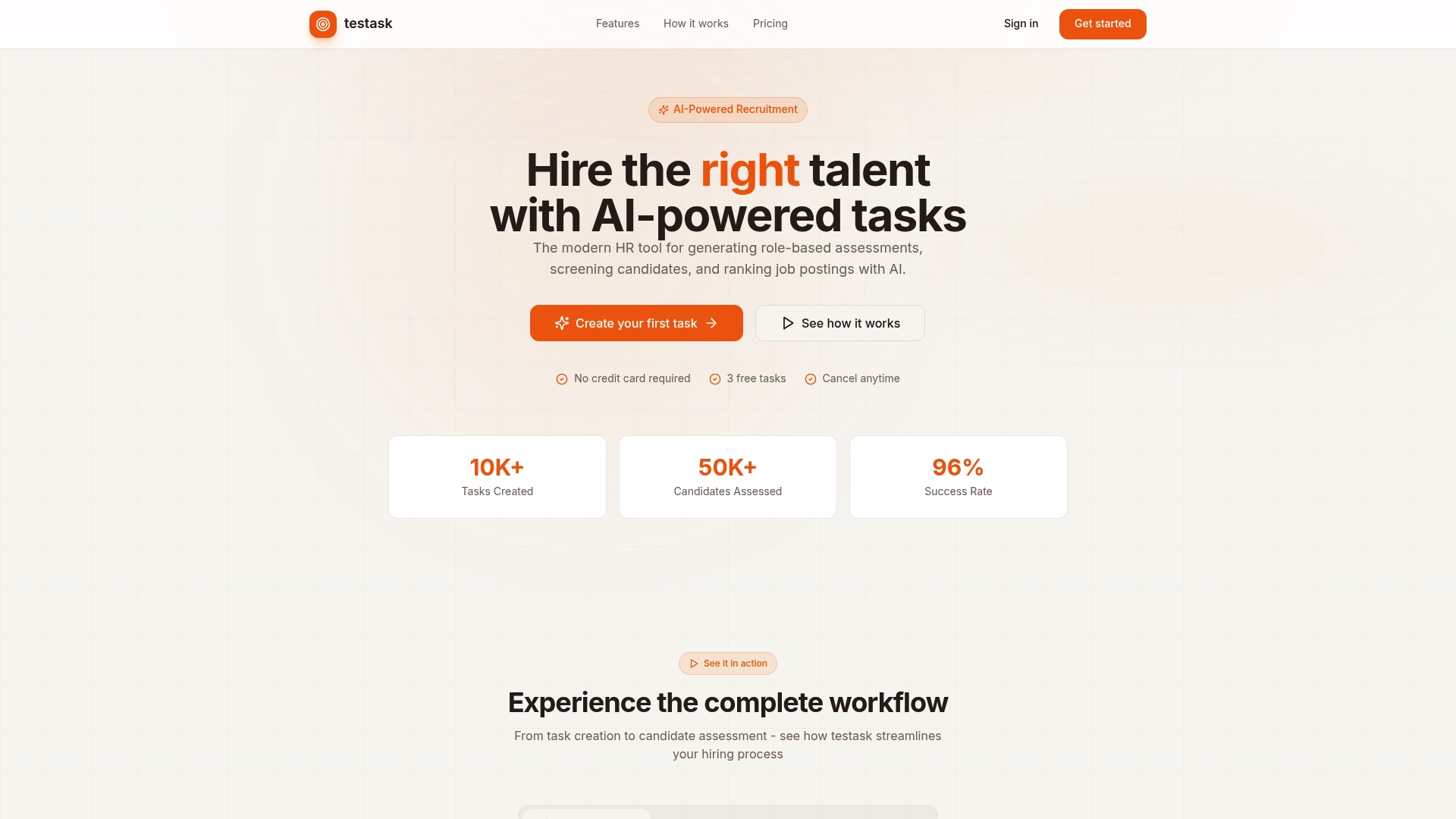
Most of the mistakes covered here share a common thread: they happen when evaluation is informal, inconsistent, or rushed. Testask gives HR teams and hiring managers the tools to build structured, skills-based assessments that replace guesswork with evidence. Generate tailored test tasks for any role, review candidate submissions with AI-assisted analysis, and collaborate on scoring through a shared platform that keeps every evaluator aligned.
Whether you’re screening for technical skills, communication ability, or role-specific judgment, Testask makes it faster to identify the right candidates and easier to defend the decision. Start building better assessments with Testask and bring structure to every stage of your hiring process.
Recommended
- Best Hiring Practices 2026: What HR Teams Need to Know | Testask Blog | testask
- Recruitment Trends in 2026: What HR Leaders Must Know | Testask Blog | testask
- Top talent acquisition tips for smarter hiring in 2026 | Testask Blog | testask
- Explaining Hiring Metrics: A 2026 Guide for HR Teams | Testask Blog | testask