Recruitment Trends in 2026: What HR Leaders Must Know
Recruitment Trends in 2026: What HR Leaders Must Know

Recruitment trends in 2026 are defined by three forces reshaping every hiring team: AI-powered workflow automation, skills-based hiring as a mandatory standard, and an urgent battle against candidate fraud and recruiter burnout. The talent acquisition strategies that worked in 2023 are now baseline minimums, not differentiators. HR professionals who understand the bifurcated tech job market, the rise of agentic AI, and the collapse of resume-based screening will hire faster and better than those still running 2022 playbooks. This article breaks down the eight trends you need to act on now.
1. Agentic AI is running end-to-end recruiting workflows
More than half of talent leaders will add autonomous AI agents to their hiring teams in 2026, enabling end-to-end recruiting from sourcing to scheduling without human intervention at every step. This is not AI as a helper tool. This is AI as a team member with a defined scope of work.

Agentic AI platforms like Beamery, Eightfold AI, and Paradox’s Olivia now handle multi-step workflows: parsing job requirements, identifying matched candidates, sending outreach sequences, and booking interviews. Metaview transcribes and analyzes interview conversations in real time. Textio audits job descriptions for bias before they go live. Each tool handles a discrete function, and together they form a recruiting stack that operates around the clock.
The recruiter’s role shifts as a result. Your value is no longer in processing applications. It is in building candidate relationships, calibrating AI outputs, and making the final hiring call with context no algorithm can replicate.
- Sourcing: AI agents scan LinkedIn, GitHub, and niche talent databases to build shortlists based on structured skill taxonomies
- Screening: Automated assessments and async video tools filter candidates before a human reviews a single profile
- Scheduling: Conversational AI like Olivia coordinates interview times across time zones without recruiter involvement
- Analysis: Tools like Metaview surface patterns across interviews to support structured, consistent evaluation
Pro Tip: Designate one recruiter as your “agent manager” whose job is to audit AI outputs daily, flag bias patterns, and retrain prompts. AI agents require daily calibration the same way a junior recruiter needs coaching, and skipping this step is where quality breaks down.
2. Skills-based hiring is now the operational baseline
85% of employers require skills-based hiring as of mid-2026, up from 56% in 2022. That four-year jump represents a structural shift, not a trend cycle. Degree requirements are disappearing from job postings at Fortune 500 companies including IBM, Google, and Delta Air Lines, replaced by demonstrated competency frameworks.
The practical implication is that your screening process must now generate evidence, not impressions. Work-sample assessments, coding challenges, and structured case studies have replaced the resume review as the first real filter. Platforms built for skills-based candidate evaluation give hiring teams the ability to assess candidates on actual job tasks before a single interview is scheduled.
“Skills-based hiring is not a philosophy anymore. It is an operational requirement. Companies that still screen by pedigree are filtering out the candidates who can actually do the work.” — Borderless Talent Acquisition Playbook, 2026
The technology layer matters here. Structured skill taxonomies aligned with workforce planning allow you to build assessments that map directly to role requirements. This removes subjectivity from early-stage screening and gives every candidate a fair, evidence-based shot regardless of their educational background.
- Build role-specific skill taxonomies before writing job descriptions
- Replace GPA and degree filters with scored work-sample tasks
- Use performance-based interviewing methods, such as the Lou Adler approach, to demand granular examples of past work rather than hypothetical answers
- Align assessment criteria with long-term workforce planning, not just the immediate role
3. The tech talent market is bifurcated: AI/ML vs. general engineering
The 2026 job market predictions for technology hiring tell two completely different stories depending on which role you are filling. AI/ML talent demand rose 59% with compensation premiums of 18 to 25%, while demand for general software engineering roles dropped 36 to 49%, creating a clear buyer’s market for those positions. This split requires two entirely different hiring strategies running in parallel.
| Role Category | Demand Trend | Compensation Impact | Time-to-Fill Target |
|---|---|---|---|
| AI/ML Engineers | +59% demand | 18–25% premium | 3–5 weeks |
| General Software Engineers | Down 36–49% | Flat or declining | 6–10 weeks |
| Data Scientists | Moderate increase | 10–15% premium | 4–6 weeks |
| Frontend/Backend Generalists | Oversupplied | Flat | Flexible |
For AI/ML roles, speed is the competitive advantage. The best candidates in this category receive multiple offers within days of becoming available. A 3 to 5 week time-to-fill is the target, and anything longer means you are losing talent to faster-moving competitors. AI-aided sourcing tools that identify passive candidates before they enter the active market are no longer optional for this segment.
For general engineering roles, the dynamic reverses. You have more qualified applicants than you can efficiently process, which is exactly where AI screening tools earn their keep. Use AI-driven recruitment efficiencies to manage volume without adding headcount to your talent acquisition team.
Pro Tip: Build two separate interview pipelines with different velocity targets. Your AI/ML pipeline should have no more than three stages and a 48-hour turnaround between each. Your general engineering pipeline can afford a more thorough multi-stage process given the available supply.
4. Recruiter burnout is a retention crisis, not a morale issue
41% of talent acquisition professionals are considering leaving recruiting entirely due to increasing pressure and AI-driven application volumes. This is not a wellness problem. It is a structural capacity problem that requires an organizational response.
The root cause is volume without infrastructure. AI tools have made it trivially easy for candidates to apply to hundreds of roles simultaneously, flooding inboxes with applications that look polished but require human judgment to evaluate. Recruiters absorb this volume without proportional support, and the result is burnout at scale.
Here are four structural fixes that leading talent acquisition teams are implementing:
- Segment recruiter roles. Split sourcing and closing into separate functions. Sourcers identify and engage candidates; closers manage the offer and onboarding process. This prevents one person from carrying the full cognitive load of the hiring cycle.
- Automate top-of-funnel screening. Use AI to handle the first filter: skills assessments, async video screens, and automated scheduling. Recruiters should only engage candidates who have already cleared a baseline threshold.
- Hire recruitment operations professionals. RecOps specialists handle reporting, system administration, and process documentation, freeing recruiters to focus on candidate relationships.
- Set application volume limits. Some teams now cap applications per role and use skills assessments as the gate, which reduces noise and signals to candidates that the process is merit-based.
Pro Tip: Firms that build proactive hiring infrastructure pay 25 to 40% less per hire than those reacting to open roles. The cost of preventing burnout through better systems is far lower than the cost of replacing an experienced recruiter.
5. Candidate authenticity is the new screening challenge
Candidate fraud has risen sharply with AI-generated resumes, AI-polished portfolios, and deepfake video interviews now challenging every traditional verification method. 95% of executives report concern about the accuracy of candidate skill data, yet only 5% have made meaningful progress on improving data trustworthiness. The gap between concern and action is where fraud thrives.
Traditional resume screening has lost its signal value. A resume today reflects what an AI can generate, not necessarily what a candidate can do. The response from experienced hiring teams is to move verification earlier and make it harder to fake.
- Work-sample assessments placed before the first interview force candidates to demonstrate skills in context, not describe them
- Live performance interviews using the Lou Adler method ask for granular, specific career struggle examples that AI cannot convincingly fabricate
- Structured reference calls with scripted behavioral questions surface discrepancies between claimed and actual performance
- AI-powered identity verification tools cross-reference candidate identity across documents and video to flag inconsistencies before an offer is extended
| Verification Method | AI Fraud Resistance | Implementation Speed | Cost |
|---|---|---|---|
| Work-sample assessment | High | Fast | Low |
| Live performance interview | High | Medium | Low |
| AI identity verification | Very high | Fast | Medium |
| Generic resume review | Very low | Fast | Very low |
Niche community sourcing from private Slack servers, Discord groups, and specialized subreddits is replacing generic job boards for high-signal talent identification. Candidates who are active in these communities carry a built-in credibility signal that a cold application cannot replicate.
6. Personalized outreach outperforms automated volume sequences
Recruiters who write personalized, high-context outreach messages consistently outperform those relying on automated volume sequences in 2026. This finding runs counter to the instinct to automate everything, and it is one of the most practically useful insights for talent acquisition teams right now.
The reason is simple: candidates receive dozens of automated messages per week. A message that references a specific project, a recent publication, or a niche community contribution cuts through the noise because it signals that a real person did real research. The response rate difference is significant enough that top-performing sourcers now treat personalization as a non-negotiable standard, not a nice-to-have.
AI can support this process without replacing it. Use AI tools to research candidates at scale, surface relevant talking points, and draft message frameworks. Then have a human add the specific, contextual detail that makes the message feel genuine. This hybrid approach captures the efficiency of automation while preserving the response rates that personalization delivers.
The AI-human balance in recruitment is not about choosing one over the other. It is about using AI to handle the repeatable, data-intensive work so that humans can focus on the high-judgment, relationship-driven work where they create irreplaceable value.
7. Recruitment technology advancements require deliberate governance
Recruitment technology advancements in 2026 are moving faster than most HR teams can govern. New AI tools launch monthly, each promising to solve a different piece of the hiring puzzle. Without a deliberate evaluation framework, teams end up with a fragmented stack of overlapping tools that create more complexity than they resolve.
The most effective approach is to map your recruiting workflow first, identify the three to five highest-friction points, and then evaluate tools specifically against those friction points. Beamery and Eightfold AI address talent intelligence and pipeline management. Paradox’s Olivia addresses scheduling and candidate communication. Metaview addresses interview quality and consistency. Each solves a defined problem. Buying tools without a defined problem is where technology budgets disappear.
Governance also means bias auditing. Every AI tool that touches candidate evaluation must be audited regularly for demographic bias in its outputs. Designating an agent manager, as discussed in the agentic AI section, is the operational mechanism for this. AI screening best practices require ongoing human oversight, not a one-time setup and deployment.
Key takeaways
The most effective talent acquisition strategy in 2026 combines agentic AI for workflow automation, skills-based assessment for candidate evaluation, and deliberate human oversight to maintain quality and prevent fraud.
| Point | Details |
|---|---|
| Skills-based hiring is mandatory | 85% of employers now require it; degree filters are actively reducing your qualified candidate pool. |
| AI agents need daily human oversight | Appoint an agent manager to calibrate AI outputs and prevent bias from compounding over time. |
| Tech hiring is split in two | AI/ML roles demand speed and premium compensation; general engineering roles require volume management. |
| Recruiter burnout is structural | Segment roles, automate top-of-funnel, and hire RecOps professionals before you lose experienced talent. |
| Authenticity verification is now a core skill | Work-sample assessments and live performance interviews are the most fraud-resistant screening methods available. |
Why I think most teams are automating the wrong things
I have watched a lot of hiring teams adopt AI tools with genuine enthusiasm, then quietly struggle six months later because their candidate experience got worse, not better. The pattern is consistent: they automated the parts of recruiting that candidates actually value, specifically the human touchpoints, and left the genuinely tedious administrative work for humans to handle manually.
The instinct to automate outreach first is understandable. It is high-volume and time-consuming. But it is also the moment a candidate forms their first impression of your company. When that message reads like a template, the signal you send is that your company does not pay attention to detail. For competitive roles, that impression costs you candidates before the process even starts.
What I would automate first is everything after the candidate says yes to an initial conversation: scheduling, assessment delivery, status updates, and document collection. These are the steps where delays create frustration and where AI genuinely removes friction without removing the human relationship.
The teams I have seen thrive in 2026 treat AI as infrastructure, not as a replacement for recruiter judgment. They use AI talent matching to surface candidates faster, but they invest the time saved into better conversations, not more volume. That is the balance worth building toward.
— Pavel
See how Testask fits into your 2026 hiring strategy
Skills-based hiring only works when your assessment process can keep up with hiring volume. Testask is an AI-powered recruitment assessment platform that lets you create tailored test tasks for any role, evaluate candidate submissions with AI-assisted analysis, and collaborate with your hiring team on reviews in one place.
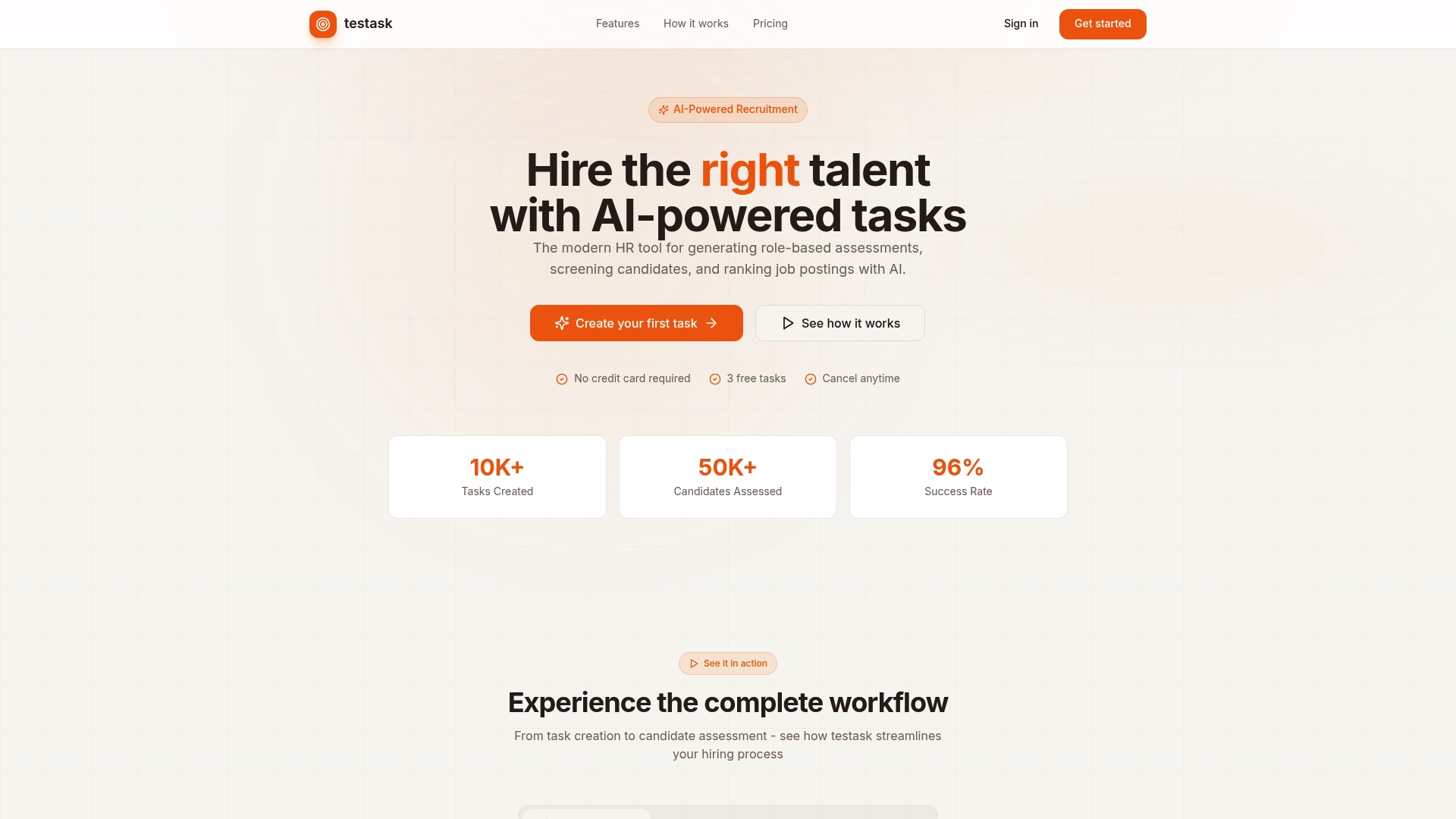
HR teams using Testask move from job posting to qualified shortlist faster because every candidate is evaluated on actual job performance, not polished self-presentation. If your current screening process cannot distinguish a genuine skill from an AI-generated answer, Testask gives you the tools to close that gap. Start building assessments that match the way work actually gets done in 2026.
FAQ
What is the biggest recruitment trend in 2026?
Skills-based hiring is the most widespread shift, with 85% of employers now requiring it as a standard practice, up from 56% in 2022. Agentic AI managing end-to-end workflows runs a close second in terms of operational impact.
How do you prevent candidate fraud in AI-assisted hiring?
Work-sample assessments and live performance interviews are the most effective fraud-resistant methods because they require candidates to demonstrate skills in real time rather than describe them. AI-powered identity verification tools add an additional layer for high-stakes roles.
Why are so many recruiters considering leaving the profession?
41% of talent acquisition professionals cite AI-driven application volume and increasing pressure as the primary reasons. Structural fixes like role segmentation and top-of-funnel automation reduce the workload without reducing hiring quality.
How fast should you fill AI/ML roles in 2026?
A 3 to 5 week time-to-fill is the competitive target for AI/ML positions given the 59% demand increase and 18 to 25% compensation premiums in that segment. Longer pipelines lose candidates to faster-moving competitors.
Does personalized outreach still matter when AI can automate messaging?
Personalized outreach consistently outperforms automated volume sequences in candidate response rates. Use AI to research candidates and draft frameworks, then add specific contextual detail before sending to preserve the engagement advantage that personalization delivers.