AI talent matching: revolutionize recruitment in 2026
AI talent matching: revolutionize recruitment in 2026

Even the most experienced HR teams lose hours every week sorting through résumés, only to discover that a seemingly perfect candidate exits within six months. The real problem is not volume. It is fit. Most traditional screening methods focus narrowly on skills and job titles, missing the deeper alignment that actually predicts long-term performance. Talent matching powered by AI changes that equation. In this article, you will learn exactly what talent matching means in a modern recruitment context, how AI-driven platforms make the process faster and more objective, and which best practices help HR professionals at mid-sized to large companies get the most from these solutions.
Table of Contents
- What is talent matching?
- How does talent matching work?
- AI-powered talent matching solutions
- Challenges and best practices in talent matching
- Our unique take: what most HR teams overlook in talent matching
- Empower your hiring: AI-powered talent matching with testask
- Frequently asked questions
Key Takeaways
| Point | Details |
|---|---|
| Beyond skill matching | Talent matching aligns values and culture for better long-term fit. |
| AI boosts efficiency | AI-powered platforms quickly match top candidates to roles, saving time. |
| Avoiding bias | Effective talent matching requires careful oversight to ensure fairness. |
| Practical adoption | HR teams should integrate AI solutions with best practices for optimal results. |
What is talent matching?
Talent matching is the process of aligning candidates with open roles based on more than just hard skills. It factors in values, soft skills, communication style, learning potential, and cultural fit within the organization. This broader view separates it sharply from simple keyword or skill matching, which only checks whether a résumé contains the right terms.
Many HR teams still treat talent matching as a synonym for résumé screening. That is a costly misconception. A candidate can possess every required technical skill and still underperform if their working style conflicts with the team, or if their values are misaligned with the company’s mission. Talent matching aligns values, culture, and potential alongside skills to create a more complete picture of every candidate.
Why does this matter so much for recruitment outcomes? Because hiring the wrong person is expensive. Research consistently puts the cost of a bad hire at anywhere from 30% to 200% of that employee’s annual salary, depending on seniority. Talent matching reduces that risk by evaluating candidates against a richer, more accurate profile of what success looks like in a given role.
Here are the key benefits HR teams gain from a rigorous talent matching approach:
- Improved retention: Candidates matched on culture and values tend to stay longer.
- Faster decision-making: Structured matching criteria reduce back-and-forth between hiring managers.
- Reduced unconscious bias: Objective criteria replace gut-feel judgments.
- Better performance prediction: Assessments capture potential, not just past experience.
- Stronger employer brand: Candidates who fit well become advocates for the company.
“The best hiring decisions combine data-driven assessment with a deep understanding of role requirements and team dynamics. Skills get someone in the door; fit keeps them there.”
Using AI recruitment assessment tools makes this broader evaluation scalable, even across high-volume hiring pipelines.

How does talent matching work?
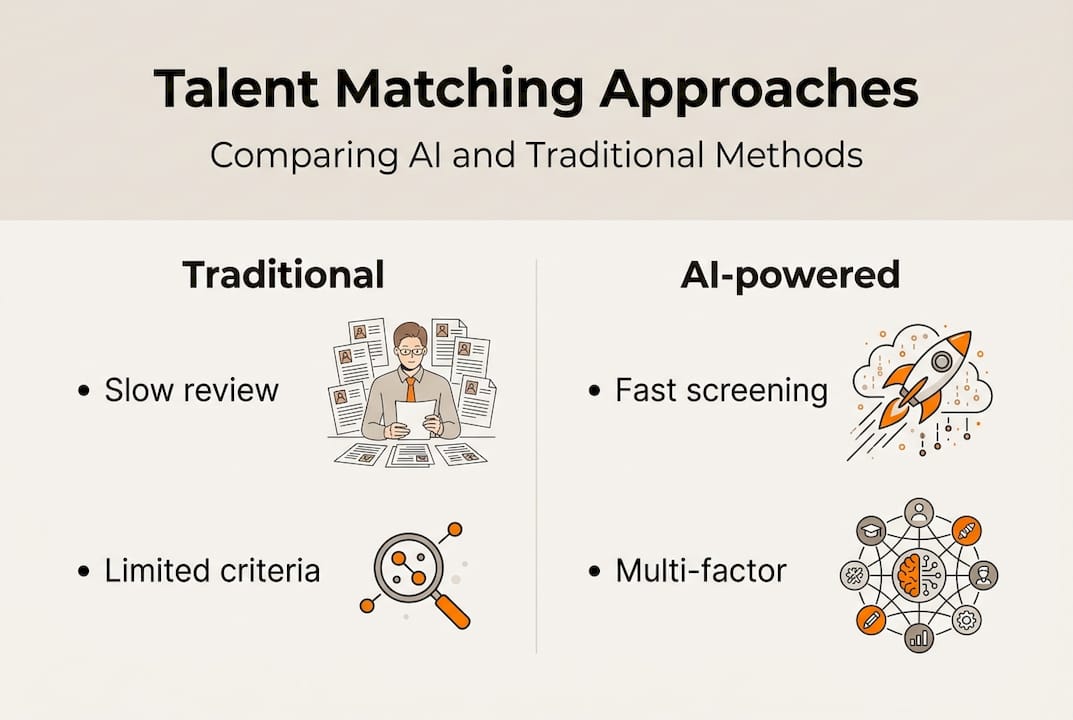
The mechanics of talent matching have changed dramatically over the past decade. Traditional methods relied on manual résumé review, unstructured interviews, and subjective scoring. Modern platforms automate, standardize, and accelerate every step.
Here is how a structured talent matching process typically works:
- Define the success profile. Start by identifying the skills, competencies, values, and behaviors that predict high performance in the role. Involve current top performers when building this profile.
- Build or import a candidate pool. Collect applications through your ATS (applicant tracking system) or sourcing channels.
- Administer standardized assessments. Use skill tests, situational judgment tasks, or work-sample exercises to generate objective data on each candidate.
- Score and rank candidates. Compare each candidate’s results against the success profile using weighted criteria.
- Collaborate on shortlists. Share scores and notes with hiring managers to align on top candidates before interviews.
- Iterate and improve. Track post-hire performance and feed data back into the matching criteria over time.
AI-powered assessments automate significant parts of this workflow, reducing manual review time and improving consistency across evaluators.
Traditional vs. AI-enhanced talent matching
| Factor | Traditional approach | AI-enhanced approach |
|---|---|---|
| Speed | Days to weeks | Hours to days |
| Accuracy | Subjective, variable | Data-driven, consistent |
| Bias risk | High (human judgment) | Lower (structured criteria) |
| Scalability | Limited | High |
| Feedback loop | Slow or absent | Continuous and automated |
Pro Tip: When building your candidate success profile, include input from both the hiring manager and at least two high-performing employees in similar roles. This reduces the risk of defining the role based on one person’s preferences and creates a more balanced benchmark for matching.
AI assessment solutions make it easier to run this process consistently, even when your team is evaluating hundreds of candidates for multiple roles simultaneously.
AI-powered talent matching solutions
AI has moved from a buzzword to a practical recruitment tool. Modern AI recruitment platform features now include natural language processing to parse résumés, machine learning models to predict candidate success, and automated scoring of work-sample tasks. The result is a measurably more efficient process.
Here is a comparison of core features across AI talent matching capabilities:
| Feature | What it does | HR benefit |
|---|---|---|
| Automated skill assessment | Tests candidates on real tasks | Reduces time-to-screen by up to 60% |
| Predictive scoring | Ranks candidates by fit probability | Surfaces top talent faster |
| Bias detection | Flags inconsistent scoring patterns | Supports fairer, more compliant hiring |
| Collaboration tools | Shared dashboards for review | Aligns hiring teams quickly |
| Performance analytics | Tracks post-hire outcomes | Improves future matching accuracy |
AI platforms increase recruitment efficiency and predictive accuracy, which translates directly into better quality-of-hire and lower attrition rates. Companies using AI-driven matching report reductions in time-to-hire of 30% to 50%, with measurable improvements in first-year retention.
Before adopting an AI talent matching platform, HR teams should evaluate:
- Integration compatibility: Does the platform connect with your existing ATS and HRIS?
- Assessment customization: Can you build role-specific tasks rather than relying on generic tests?
- Data privacy compliance: Does the vendor meet GDPR, CCPA, or other applicable regulations?
- Explainability: Can the platform show why a candidate was ranked a certain way?
- Vendor support: Is there a dedicated onboarding and support team for enterprise rollouts?
These considerations matter because adopting the wrong platform creates new problems rather than solving existing ones. Take the time to run a pilot with a single role or department before scaling organization-wide.
Challenges and best practices in talent matching
AI talent matching is powerful, but it is not plug-and-play. Every organization that has scaled these systems has encountered friction points. Knowing what to expect helps you plan for success rather than react to problems.
The most common challenges include:
- Algorithmic bias: AI models trained on historical hiring data can replicate existing biases if the data is not carefully reviewed and corrected.
- Data privacy risks: Collecting detailed candidate data creates legal obligations that vary by region and industry.
- Integration complexity: Connecting a new AI platform with legacy HR systems often requires technical resources and extended timelines.
- Stakeholder resistance: Hiring managers may distrust or resist AI-generated recommendations if they do not understand how the scores are calculated.
- Over-reliance on automation: Using AI scores as the sole decision factor removes the human judgment that catches edge cases.
Even AI systems require calibration and ongoing oversight to ensure they remain fair and accurate. Best practices for successful talent matching at scale include:
- Audit your training data before building or buying an AI model to identify and remove biased patterns.
- Set clear compliance policies covering how long candidate data is retained and who can access it.
- Train hiring managers on how to interpret AI scores and when to apply their own judgment.
- Run regular accuracy checks by comparing AI recommendations against actual post-hire performance data.
- Create a feedback loop where recruitment outcomes continuously inform and improve the matching criteria.
Pro Tip: Mid-sized to large companies should assign a dedicated talent analytics owner, someone who monitors model performance, flags anomalies, and coordinates with legal on compliance. This role prevents the platform from drifting out of alignment as your workforce and hiring needs evolve.
Reading digital talent matching reviews from companies in your industry can also surface practical lessons that vendor case studies often gloss over.
Our unique take: what most HR teams overlook in talent matching
Most guides focus on technology features and workflow efficiency. That is useful, but it misses the harder question: what actually makes a talent matching strategy succeed long-term?
The honest answer is human judgment paired with continuous learning. Even the most advanced AI platform will plateau if your success profiles are never updated. Roles evolve. Teams change. What predicted high performance two years ago may be irrelevant today.
We also see many organizations fixate on cultural fit in a way that becomes counterproductive. Fit should never mean hiring people who are identical to your current team. The most effective matching strategies balance alignment on values with diversity of perspective and experience. That tension is intentional, and it takes skilled HR leadership to manage it.
Using AI tools for HR works best when the technology amplifies human insight rather than replaces it. The teams that get the most from AI talent matching are the ones that treat it as a living system, not a one-time implementation.
Empower your hiring: AI-powered talent matching with testask
If you are ready to move beyond résumé screening and build a structured, data-driven talent matching process, testask is built for exactly that. HR teams at growing companies use testask to generate tailored skill assessments, evaluate candidate submissions with AI-assisted scoring, and collaborate with hiring managers on shortlists in one centralized platform.
With testask AI recruitment assessments, you can reduce manual screening time, improve hiring consistency, and make faster decisions backed by objective data. Whether you are hiring for technical roles, leadership positions, or high-volume pipelines, testask adapts to your requirements and scales with your team. Explore the platform and see how AI-powered talent matching can improve your next hire.
Frequently asked questions
How does AI improve talent matching accuracy?
AI-powered assessments increase accuracy by analyzing multiple candidate factors, including skills, cultural alignment, and behavioral indicators, which reduces reliance on subjective judgment and surfaces stronger candidates faster.
What are the main benefits of talent matching for companies?
Talent matching enhances efficiency and employee success by improving retention, reducing time-to-hire, and creating better alignment between candidates and organizational culture from day one.
Are there risks or challenges with AI-powered talent matching?
Even AI systems require oversight to ensure fairness. Without proper calibration, auditing, and compliance policies, AI models can replicate bias or create data privacy exposure.
Can talent matching be used for executive or high-level hiring?
AI platforms assess leadership and cultural fit for executive hiring, making talent matching effective for senior roles where soft skills, strategic thinking, and organizational alignment are critical.