Harnessing data analytics to transform hiring decisions
Harnessing data analytics to transform hiring decisions

AI already outperforms human recruiters when predicting which candidates will succeed on the job, scoring women and minorities higher and reducing bias in ways most traditional processes simply cannot match. Yet most mid-sized HR teams still rely heavily on intuition when evaluating candidates. The cost of that reliance is real: bad hires, extended vacancies, and legal exposure. Data analytics changes the equation. This article walks you through the core concepts, the metrics that matter, the role of AI and automation, and the practical steps your team can take to hire with confidence and consistency.
Table of Contents
- How data reshapes hiring: Moving beyond gut feel
- Key recruitment metrics: Why they matter
- AI and automation in hiring: Opportunities and challenges
- Making data work: Practical steps for HR
- What most HR professionals overlook about data-driven hiring
- Next steps: Leverage AI-powered assessment platforms
- Frequently asked questions
Key Takeaways
| Point | Details |
|---|---|
| Structured interviews excel | Data-backed structured interviews and behavioral metrics predict top talent more accurately than intuition. |
| Metrics shape candidate experience | Recruitment metrics explain most candidate experiences and link directly to your employer brand. |
| AI reduces bias | AI analytics can outperform human recruiters and minimize bias, but must be deployed ethically. |
| Regulation is tightening | State-level regulations now require non-discriminatory AI hiring tools, demanding higher HR vigilance. |
| Practical integration needed | Make data work for you by validating models, tracking key metrics, and using platforms for process improvement. |
How data reshapes hiring: Moving beyond gut feel
With the drawbacks of intuition clear, let’s examine the practical advantages of structured, data-driven hiring.
Intuition has long been the default tool in recruitment. A candidate “feels right.” Their handshake is firm, their energy is good, and the interviewer connects with their story. The problem is that these signals are unreliable. Research consistently shows that unstructured impressions introduce confirmation bias, affinity bias, and proximity bias into decisions that shape entire teams. You may end up hiring people who remind you of yourself, not people who will perform best in the role.
Structured approaches fix this. Structured interviews and behavioral data predict top talent up to 80% of the time, compared to far lower accuracy rates from gut feel alone. When every candidate answers the same questions and is scored against the same criteria, the process becomes defensible, repeatable, and far more predictive.

Data-driven hiring also strengthens your employer brand in recruitment. Candidates who experience a structured, professional process walk away with a better perception of your company, even if they do not get the job. That perception spreads. In a tight labor market, reputation matters.
Here is a direct comparison of intuition-based versus data-driven hiring:
| Dimension | Intuition-based hiring | Data-driven hiring |
|---|---|---|
| Bias risk | High | Reduced with structured criteria |
| Prediction accuracy | Low to moderate | Up to 80% with behavioral data |
| Consistency across interviewers | Low | High |
| Candidate experience | Variable | Standardized and fair |
| Legal defensibility | Weak | Strong |
| Scalability | Poor | Excellent |
“The shift from gut feel to structured data is not just about accuracy. It is about building a hiring process that is fair, scalable, and worth defending in front of a regulator or a rejected candidate.”
Key advantages of structured, data-driven hiring include:
- Reduced bias: Standardized questions and scoring rubrics limit the influence of irrelevant personal factors.
- Faster decisions: Clear data points accelerate consensus among hiring managers.
- Better retention: Candidates hired through validated methods tend to stay longer and perform better.
- Consistent candidate experience: Every applicant is treated fairly, regardless of who conducts the interview.
You can find additional hiring metrics insights that support this shift on the Testask blog, and explore how minimizing bias with data can be built directly into your screening workflow.
Key recruitment metrics: Why they matter
Understanding the data-driven approach, it is crucial to know which metrics matter most.
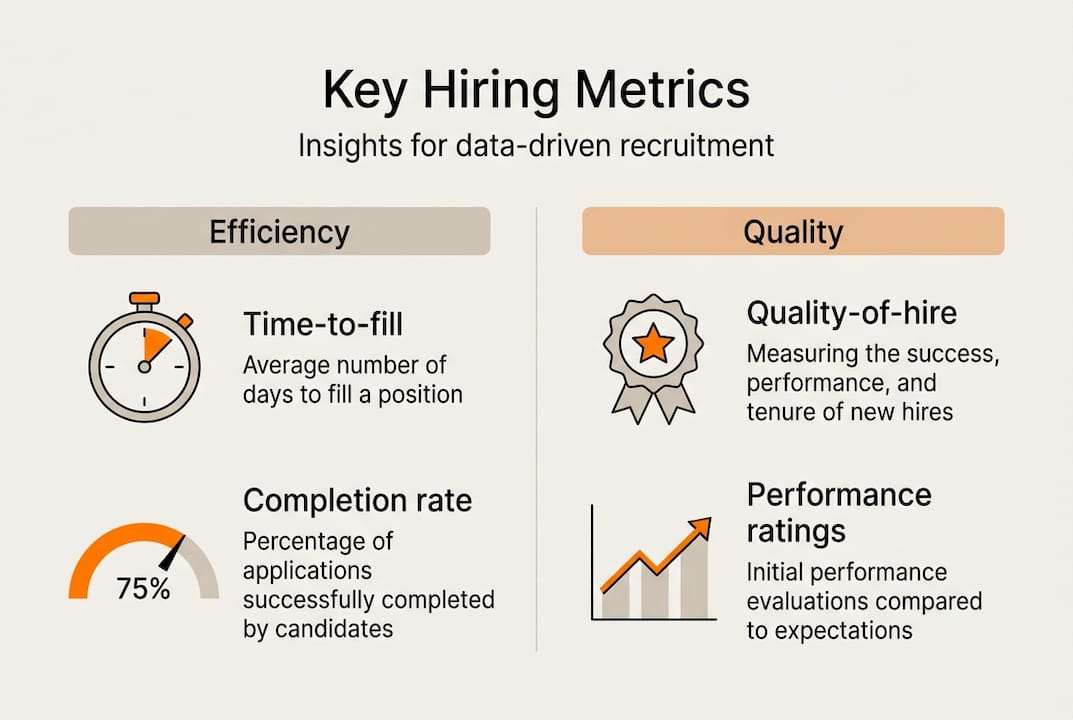
Not all data is created equal. The metrics you track determine the quality of the insights you generate. For HR teams in mid-sized companies, the most impactful recruitment metrics fall into three categories: speed, quality, and experience.
Time-to-fill measures how many days pass between opening a role and accepting an offer. A long time-to-fill signals bottlenecks in your pipeline, whether in sourcing, screening, or decision-making. Tracking this consistently helps you pinpoint where candidates drop off or decisions stall.
Quality-of-hire is harder to quantify but far more valuable. It typically combines performance ratings at 30, 60, and 90 days post-hire with retention data and manager feedback. When you tie quality-of-hire back to specific sourcing channels or interview formats, you learn which inputs produce the best outcomes.
Application completion rate is often underestimated. Metrics like time-to-fill and application completion explain 66% of variance in candidate experience. That is a substantial share. If your application process is long, confusing, or poorly optimized for mobile, you are losing strong candidates before they even reach your screening stage.
Here is a summary of the most critical recruitment metrics and what they reveal:
| Metric | What it measures | Why it matters |
|---|---|---|
| Time-to-fill | Days from job opening to offer accepted | Identifies pipeline bottlenecks |
| Quality-of-hire | Post-hire performance and retention | Links process inputs to outcomes |
| Application completion rate | Percentage who finish the application | Signals UX and process friction |
| Offer acceptance rate | Percentage of offers accepted | Reflects employer brand strength |
| Source-to-hire ratio | Which channels produce successful hires | Optimizes recruiting spend |
| Interview-to-offer ratio | How many interviews lead to offers | Reveals screening efficiency |
Statistic callout: Recruitment metrics like time-to-fill and application completion explain 66% of variance in candidate experience, which in turn mediates employer brand perception.
These metrics are not just operational statistics. They tell the story of your hiring process from the candidate’s point of view. An applicant who struggles through a 45-minute application form or waits three weeks for feedback will share that experience. Tracking metrics for employer brand impact helps you understand how your process looks from the outside.
Key benefits of tracking these metrics consistently:
- You identify friction points before they cost you top candidates.
- You build a business case for process improvements backed by real numbers.
- You create accountability within hiring teams and reduce ad hoc decision-making.
- You generate a feedback loop that makes each hiring cycle smarter than the last.
For a broader framework on connecting metrics to your talent brand, the recruitment branding guide offers useful strategic context.
AI and automation in hiring: Opportunities and challenges
Metrics give clarity, but harnessing AI and automation introduces new challenges and opportunities.
AI is reshaping what HR teams can accomplish in a single workday. Resume screening that once took hours now takes seconds. Scheduling that required back-and-forth emails now happens automatically. Candidate ranking that depended on individual judgment now follows a validated algorithm. These gains are real, but they come with responsibilities your team cannot afford to ignore.
Here is a structured breakdown of how to approach AI adoption in your hiring process:
-
Audit your current data sources. Before you automate anything, understand what data you have and where it comes from. Incomplete or biased historical data will produce biased automated outputs. Your AI is only as fair as the data it trains on.
-
Choose tools built for transparency. Look for platforms that explain how they score candidates, not just what score they assign. Black-box AI creates compliance risk. Transparency allows you to defend decisions and correct errors.
-
Monitor outcomes for disparate impact. Run regular checks to ensure your AI-assisted process does not disproportionately screen out candidates from protected groups. This is not just ethical guidance; it is increasingly a legal requirement.
-
Maintain human oversight at key stages. AI should support decisions, not replace them entirely. Hiring managers must stay accountable for final calls, especially for senior or complex roles.
-
Test before scaling. Pilot your AI tools on a single role or department before rolling them out company-wide. Validate results against actual performance data before expanding.
The regulatory environment is tightening fast. State regulations on AI tools now prohibit discriminatory automated systems in states including California, New Jersey, and Illinois, filling a gap left by federal inaction. At the same time, roughly 90% of employers now use AI for resume screening. The technology is mainstream, but the governance frameworks are still catching up.
There is also a nuanced fairness issue that many teams miss. Async interview formats can deter applicants, particularly women, even when the AI scoring within those formats is more equitable than human review. The format itself becomes a barrier. AI may predict employment success better than humans, but if qualified candidates opt out of the process entirely, your prediction model never gets to evaluate them.
“The most dangerous assumption in AI-assisted hiring is that automation automatically means fairness. It means consistency, which is only fair if your inputs and design choices are fair.”
Pro Tip: Use data analytics for compliance auditing to run quarterly bias checks on your AI-assisted screening outputs. Look at pass rates by gender, age, and ethnicity. If disparities appear, investigate the source before the next hiring cycle.
Making data work: Practical steps for HR
To empower your HR team, turn these learnings into action with practical steps.
Reading about data-driven hiring is one thing. Building it into your daily workflow is another. These steps give you a structured path forward without requiring a dedicated data science team.
-
Assess your data quality first. Before running any analysis, evaluate whether your current applicant tracking system (ATS) captures the right data at the right points. Validation per role family matters because what predicts success in a customer-facing role differs significantly from what predicts success in an engineering role. Generic models applied across all roles will underperform.
-
Standardize your interview questions and scoring rubrics. Create a question bank aligned to each competency your role requires. Score each answer on a consistent 1-5 scale. Multiple interviewers reviewing the same rubric produce far more reliable aggregate scores than individual impressions.
-
Validate your predictive models regularly. Set a schedule, quarterly at minimum, to compare predicted candidate success scores against actual 90-day performance reviews. If the correlation is weak, adjust the model inputs. Data quality issues can and do impact outcomes, so build validation into your calendar, not just your intentions.
-
Integrate skill assessments into early screening. Structured test tasks placed early in the funnel give you objective performance data before you invest interview time. This is especially valuable for roles where technical skill or creative output can be evaluated directly.
-
Build a feedback loop between HR and hiring managers. Hiring managers hold outcome data that HR often never sees. Create a shared dashboard where both teams input and review quality-of-hire data. This collaboration improves the predictive models over time and aligns both teams on what good actually looks like.
-
Track process metrics alongside outcome metrics. Do not only measure who you hired. Measure how long it took, where candidates dropped off, and which sourcing channels produced your best performers. This full-picture view is what separates reactive HR from strategic talent acquisition.
Pro Tip: Start with one role family and one set of structured questions. Build your rubric, run the process for two hiring cycles, and then review your quality-of-hire data. That pilot gives you a real evidence base to expand the approach across your organization, rather than asking leadership to approve a company-wide change on theory alone.
What most HR professionals overlook about data-driven hiring
Here is what most articles and HR teams miss about truly leveraging data.
Data-driven hiring is often presented as a clean, objective upgrade to messy human judgment. The reality is more complicated. Data is not neutral. It reflects the decisions made during collection, the populations it was gathered from, and the assumptions baked into the models that interpret it. When those inputs are flawed, the outputs are flawed too, but with the appearance of objectivity that makes them harder to question.
What most teams underestimate is that even well-designed AI can inadvertently discourage diverse candidates if the process format is not accessible or if role metadata does not reflect the actual requirements of the job. A technically fair algorithm applied through an inaccessible format produces unfair outcomes in practice.
The best hiring teams treat data as a tool for minimizing bias, not eliminating human judgment entirely. Analytics should inform decisions, surface patterns, and flag inconsistencies. Humans must still exercise ethical oversight, especially when edge cases arise that the data cannot adequately capture.
Constant validation is the discipline that separates effective data-driven teams from those who simply installed new software. If you are not regularly checking your models against real outcomes, you are running on assumptions, not data.
Next steps: Leverage AI-powered assessment platforms
Putting these practices in place requires tools built specifically for structured, data-informed hiring. Testask is an AI-powered hiring platform designed for exactly this work. It helps your team create tailored test tasks, evaluate candidate submissions with AI-assisted analysis, and collaborate on scoring through a shared review workflow.
Rather than building assessment infrastructure from scratch, Testask gives HR professionals a ready-made system to standardize evaluations, track performance data, and reduce the manual effort that slows down screening. Explore platform subscription options to find the plan that fits your team size and hiring volume. The faster you standardize your process, the sooner your data starts working for you.
Frequently asked questions
Which recruitment metrics best predict candidate success?
Structured interviews combined with behavioral data predict top talent up to 80% of the time, far outperforming unstructured gut-feel assessments and reducing bias through standardized scoring criteria.
How do AI tools impact diversity in hiring?
AI often scores women and minorities more favorably than human reviewers, but async interview formats can cause a drop in continuation rates, particularly among women, meaning the format design matters as much as the scoring model.
Are AI-powered hiring tools regulated in the US?
Yes. Several states including California, New Jersey, and Illinois have introduced regulations on AI hiring tools prohibiting discriminatory automated systems, even as roughly 90% of employers now use AI for resume screening.
How does application completion rate affect employer brand?
Application completion rates account for two-thirds of variance in candidate experience, which then directly mediates how candidates perceive your employer brand, making UX optimization a strategic priority, not just a technical one.
What is the biggest pitfall in using data for hiring?
Poor data quality and insufficient model validation per role family are the leading causes of bias and missed talent in data-driven hiring, making ongoing evaluation and structured audits non-negotiable parts of the process.