Talent acquisition strategies for smarter hiring in 2026
Talent acquisition strategies for smarter hiring in 2026

Over 70% of companies report real difficulty filling roles effectively, yet most HR teams still rely on the same fragmented processes they used a decade ago. The gap between traditional recruitment and modern talent acquisition is widening fast. This article cuts through the confusion, defines what talent acquisition actually means, and delivers evidence-based strategies you can apply right now. Whether you’re scaling a professional services firm or managing high-volume hiring in tech, you’ll find actionable frameworks and a clear-eyed look at what AI can and can’t do for your team.
Table of Contents
- What is talent acquisition?
- Key benchmarks and challenges in talent acquisition
- Technology and AI: Transforming talent acquisition
- Strategies for effective talent acquisition
- Our perspective: Where talent acquisition is headed in 2026
- Take your talent acquisition to the next level
- Frequently asked questions
Key Takeaways
| Point | Details |
|---|---|
| Talent acquisition defined | It is a strategic process of attracting and retaining skilled employees beyond basic recruitment. |
| AI enhances but needs oversight | AI can speed up hiring and offer better matches, but human oversight is essential to avoid bias. |
| Benchmarks reveal challenges | Most companies struggle with recruiting, and executive hiring costs are rising rapidly. |
| Effective strategies combine tools | Integrated tech platforms and well-designed processes maximize success in talent acquisition. |
| Human touch remains vital | Ethical standards and personal evaluation must accompany high-tech hiring practices. |
What is talent acquisition?
Talent acquisition (TA) is a strategic, ongoing organizational function. It covers everything from employer branding and workforce planning to sourcing, assessing, hiring, and onboarding candidates. Unlike a one-time transaction, it is a continuous cycle designed to build a pipeline of qualified talent before you need it.
Recruitment, by contrast, is reactive. It kicks in when a vacancy appears and ends when the role is filled. Talent acquisition starts earlier and lasts longer. Think of recruitment as a single sprint inside a much longer marathon.
“Talent acquisition is not just about filling seats. It’s about building the organizational capability to attract and retain the people who will drive future growth.” This distinction matters because it shifts your team from a cost center mindset to a strategic partner role within the business.
Understanding what TA is requires knowing how it is measured. Key recruitment analytics help teams track progress and identify bottlenecks across each stage. According to current 2025 recruiting benchmarking data, the most commonly tracked metrics are:
- Time-to-fill (used by 59% of organizations): the number of days from job opening to accepted offer
- Retention rate (tracked by 55%): whether new hires stay past 90 days, six months, or one year
- Quality-of-hire (measured by 44%): a composite score reflecting new hire performance, ramp time, and manager satisfaction
These three metrics sit at the foundation of any serious TA function. If you are not tracking them, you are flying blind.
The key stages of a complete talent acquisition process typically include:
- Workforce planning: identifying future skill gaps before they become urgent vacancies
- Employer branding: shaping how candidates perceive your organization as a place to work
- Sourcing: proactively building talent pools through job boards, social media, referrals, and events
- Screening and assessment: evaluating candidates against role requirements using structured methods
- Interviewing and selection: applying consistent, objective criteria to choose the best fit
- Offer management and onboarding: converting accepted offers into engaged, productive employees
Each stage feeds the next. Weakness in any one area compounds downstream. That is why effective hiring strategies treat TA as an integrated system rather than a checklist of isolated tasks.
The holistic nature of talent acquisition means your team is always operating on two timelines at once: filling today’s open roles while building tomorrow’s pipeline. This dual focus is what separates high-performing TA functions from teams that are perpetually behind.
Key benchmarks and challenges in talent acquisition
Now that we have defined talent acquisition, let’s look at its measurable benchmarks and the common hurdles that slow teams down.
The numbers tell a clear story. Current benchmarking data shows that the average time-to-hire sits at approximately 45 days across industries. For executive roles, the cost-per-hire has climbed by 113% since 2017. These are not abstract figures. They translate directly to lost productivity, team strain, and competitive disadvantage.
| Metric | Current benchmark | Change vs. prior years |
|---|---|---|
| Average time-to-hire | ~45 days | Relatively stable, rising for specialized roles |
| Cost-per-hire (executive) | Up 113% since 2017 | Significant escalation |
| Time-to-fill tracking | 59% of organizations | Most common TA metric |
| Retention rate tracking | 55% of organizations | Second most tracked metric |
| Quality-of-hire tracking | 44% of organizations | Growing in adoption |
Why are so many companies struggling? Several factors compound the challenge:
- Candidate expectations have shifted. Job seekers now expect fast, personalized, and transparent hiring experiences. Long, opaque processes drive top candidates to competitors.
- Skill sets are evolving faster than job descriptions. Roles in data, AI, and digital transformation require skills that traditional assessment methods struggle to evaluate accurately.
- Hiring manager availability is a bottleneck. When hiring managers are unavailable for timely feedback or interviews, streamlined candidate screening becomes essential to keep the process moving.
- Misaligned incentives between TA and the business. TA teams are often measured on speed while hiring managers prioritize quality. This tension creates friction and inconsistency.
For executive hires, the stakes are even higher. Executive hiring benchmarks show that search timelines can exceed six months and that a failed C-suite hire can cost up to 213% of annual salary when you factor in recruitment fees, onboarding, lost productivity, and organizational disruption.
The hidden cost of inefficiency compounds over time. When your screening process is manual, you spend hours reviewing resumes that should be filtered automatically. When your interview process lacks structure, you introduce subjectivity and increase the risk of a bad hire. Each inefficiency adds days to your time-to-fill and dollars to your cost-per-hire.
The organizations that outperform on TA benchmarks share a common approach: they treat process design as seriously as candidate sourcing. They map every step, identify where time is lost, and invest in tools that reduce administrative burden without sacrificing assessment quality.
Technology and AI: Transforming talent acquisition
Understanding the hurdles, we can now explore how modern technology reshapes talent acquisition from the ground up.
AI and recruitment technology are no longer optional enhancements. They are fast becoming table stakes for competitive hiring. The evidence is clear: TA leaders who integrate five or more tools are 13 times more likely to do so than average teams, and they report three times better hiring capabilities overall. That is a substantial performance gap driven directly by technology adoption.
The tools transforming TA today include:
- Applicant tracking systems (ATS): centralize candidate data, automate status updates, and reduce administrative overhead
- AI-powered screening platforms: analyze candidate profiles and submissions against role criteria, ranking applicants by fit
- Video interviewing tools: enable asynchronous screening, reducing scheduling delays by days
- Skills assessment platforms: deliver structured, role-specific tasks that measure actual capability rather than credentials
- Predictive analytics tools: forecast candidate success based on historical performance patterns
AI’s core advantages are speed, accuracy at scale, and consistency. A well-configured AI screening tool can evaluate hundreds of submissions in the time it takes a recruiter to review ten manually. It applies the same criteria every time, removing the mood variability that affects human reviewers after hours of repetitive review. You can learn more about how AI talent matching is changing the sourcing equation for modern TA teams.

However, the risks are real and should not be minimized. AI systems learn from historical data, which means they can encode and amplify existing bias. If your past hires skewed toward a particular demographic due to unexamined preferences, an AI trained on that data will replicate those preferences at scale. The impact of AI on talent acquisition includes both powerful efficiency gains and serious ethical risks that demand active management.
There is also the question of candidate experience. Automated rejection emails, chatbot interactions, and algorithmic screening can feel impersonal. Top candidates, who have multiple options, notice when a process feels cold. Impersonality is a real cost. Thoughtful AI candidate screening balances automation with human touchpoints at key moments.
Pro Tip: Audit your AI tools annually for bias. Ask your vendor how their model was trained, what data it uses, and how it handles edge cases. Human reviewers should always make final decisions on shortlisted candidates, especially for senior or specialized roles.
Strategies for effective talent acquisition
Equipped with an understanding of technology’s role, let’s focus on concrete strategies for building a modern, high-performing TA function.
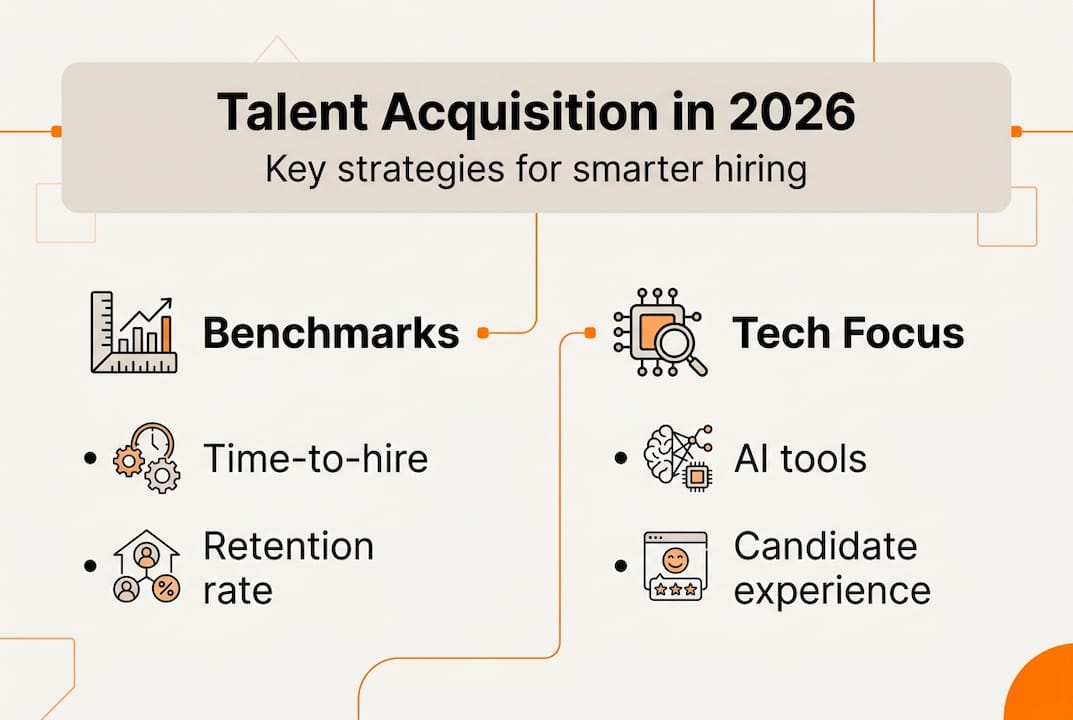
The contrast between traditional and AI-driven approaches is stark:
| Dimension | Traditional TA | AI-driven TA |
|---|---|---|
| Candidate sourcing | Reactive, job boards only | Proactive, multi-channel, predictive |
| Screening | Manual resume review | Automated skills and fit analysis |
| Assessment | Unstructured interviews | Structured tasks, standardized scoring |
| Decision-making | Subjective, intuition-based | Data-informed, criteria-driven |
| Candidate experience | Slow, inconsistent | Fast, personalized at scale |
| Outcome tracking | Anecdotal | Metrics-driven, continuously optimized |
The organizations that lead on TA outcomes use a deliberate, step-by-step approach to optimize each stage. Here is a proven sequence you can adapt to your own context:
-
Audit your current process. Map every step from job requisition to offer acceptance. Identify where time is lost and where candidate drop-off is highest. Most teams discover two or three critical bottlenecks they never formally tracked.
-
Define your success metrics. Commit to tracking time-to-fill, quality-of-hire, and retention at minimum. Add cost-per-hire if your budget management is tight. Without baselines, you cannot measure improvement.
-
Strengthen your employer brand. Candidates research employers before applying. Invest in honest, specific content about your culture, team, and growth opportunities. Authentic employee stories outperform polished corporate messaging every time.
-
Implement structured assessments. Replace unstructured interviews with role-specific test tasks and standardized scoring rubrics. This reduces bias and improves predictive validity, meaning your hires actually perform as expected. Explore assessment best practices to design tasks that reveal real skills.
-
Integrate technology thoughtfully. Introduce tools one at a time, train your team properly, and measure impact before adding the next layer. Rushing integration leads to tool sprawl without ROI. TA leaders who integrate five or more tools do so strategically, not all at once.
-
Keep humans central to key decisions. Use AI to filter and rank. Use people to evaluate, engage, and decide. This balance protects candidate experience and hiring quality simultaneously.
-
Review your recruitment checklist regularly. Processes drift over time. A quarterly review ensures your checklist reflects current role requirements, regulatory changes, and team feedback.
Pro Tip: Prioritize candidate experience even when automating. Send timely status updates, personalize rejection messages, and ensure every candidate who completes an assessment receives meaningful feedback. Candidates who have a positive experience, even without an offer, become brand ambassadors. Those who feel ignored share that experience publicly.
For professional services firms competing for specialized talent, TA strategies that attract technical professionals often center on demonstrating genuine role complexity and growth opportunity early in the process. Generic job descriptions and slow follow-up are the two fastest ways to lose the candidates you most want to hire.
Browse top talent acquisition tips for a broader set of tactics tailored specifically to 2026’s competitive hiring environment.
Our perspective: Where talent acquisition is headed in 2026
After exploring practical strategies, here is our take on the future of talent acquisition and what it means for your team.
The loudest voices in HR tech right now argue that AI will solve hiring. We disagree. AI will accelerate hiring. It will surface candidates faster, score submissions more consistently, and reduce administrative drag. But it will not replace the judgment needed to evaluate how a candidate will navigate ambiguity, build relationships, or lead through conflict.
AI revolutionizes TA but risks bias amplification and impersonality, and it requires ethical management and a human touch for nuanced assessment. The organizations that will win in 2026 are not the ones that automate the most. They are the ones that automate the right things and protect human judgment where it matters most.
Speed and quality are often presented as a tradeoff. We think that framing is wrong. A well-designed process, supported by the right tools, delivers both. The key is being deliberate about where AI operates and where people take over. Use a structured recruitment checklist to formalize those boundaries across your team. Hiring well is not about going faster or slower. It is about going smarter.
Take your talent acquisition to the next level
The strategies in this article work best when supported by tools designed specifically for modern hiring workflows. If your team is still relying on manual resume reviews and informal interview notes, you are leaving quality and efficiency on the table.
testask is an AI-powered recruitment platform built to help HR teams and hiring managers generate tailored test tasks, evaluate candidate submissions with AI-assisted analysis, and collaborate on hiring decisions with speed and confidence. You do not need to overhaul your entire process overnight. Start with one role, run a structured skills assessment, and see the difference structured data makes. Explore top TA tips alongside the platform to build a hiring process that scales with your organization.
Frequently asked questions
What is the difference between talent acquisition and recruitment?
Talent acquisition is a strategic, ongoing process of finding, attracting, and retaining talent aligned with future business needs, while recruitment is the immediate, reactive act of filling a specific vacancy. Organizations tracking retention and quality-of-hire are typically operating at the talent acquisition level, not just recruitment.
How does AI improve talent acquisition?
AI improves talent acquisition by automating candidate screening, reducing time-to-hire, and increasing the consistency of candidate evaluation at scale. However, teams integrating five or more tools see the greatest gains only when they pair AI efficiency with human oversight to prevent bias and preserve candidate experience.
What are the most important talent acquisition metrics?
The three most critical metrics are time-to-fill, retention rate, and quality-of-hire. Current benchmarking data shows these are the most widely tracked, and together they give you a complete picture of both process speed and hiring outcome quality.
Are there risks with using AI in hiring?
Yes. AI can amplify existing bias in your historical data and reduce the personal quality of the candidate experience if deployed without human oversight. AI in TA needs ethical management and regular auditing to ensure it supports fair, high-quality hiring decisions rather than undermining them.