How to Shortlist Applicants: A Recruiter's Playbook
How to Shortlist Applicants: A Recruiter’s Playbook

Shortlisting applicants means applying pre-defined mandatory and preferred criteria through a scorecard, running a fast skim-and-sort pass, then doing a focused detailed review to move top scorers into interviews or targeted assessments. That’s the whole process. Everything else is execution.
Before you open a single resume, confirm three things:
- Set mandatory criteria first. Pull them directly from the job description: required certifications, work authorization, minimum years of experience in a specific function.
- Build a scorecard. Assign weights to mandatory, preferred, and desirable criteria so every reviewer uses the same scale.
- Commit to a two-stage review. Stage one is a fast skim to sort applications into buckets. Stage two is a detailed read of your “Yes” pile only.
Open the job description right now and write your mandatory criteria before you continue.
Table of Contents
- What is shortlisting and why does it affect hire quality?
- How many candidates should you actually shortlist?
- How do you keep shortlisting fair and bias-free?
- How do you decide which criteria to score?
- What does an efficient two-stage review look like?
- Which screening tools should you use and when?
- How do you build a shortlisting matrix that actually works?
- What happens after shortlisting? Timeline and candidate communications
- When should you use test tasks to validate shortlist decisions?
- Key Takeaways
- A recruiter’s perspective: the shortlisting mistakes that cost you the best candidates
- Testask makes skills-first shortlisting faster and more consistent
- Useful sources and templates for your shortlisting workflow
What is shortlisting and why does it affect hire quality?
Shortlisting is the process of reviewing job applications and selecting candidates best suited for a role using predetermined criteria to produce a shorter list for interviews. It sits at the second stage of the selection funnel: application → screening/shortlisting → interview → assessment → background checks → decision → offer.
A well-run shortlist does three things well:
- Fairness: Every applicant is measured against the same criteria, reducing the influence of gut feel.
- Hire-quality signal: You surface candidates whose documented skills and experience match the role’s actual demands.
- Time efficiency: Reviewers spend focused effort only on viable candidates, cutting wasted interview hours.
The selection process is a funnel, and shortlisting is where the funnel narrows most sharply. Getting it wrong at this stage means either interviewing too many weak candidates or, worse, screening out strong ones before they ever get a conversation.

How many candidates should you actually shortlist?
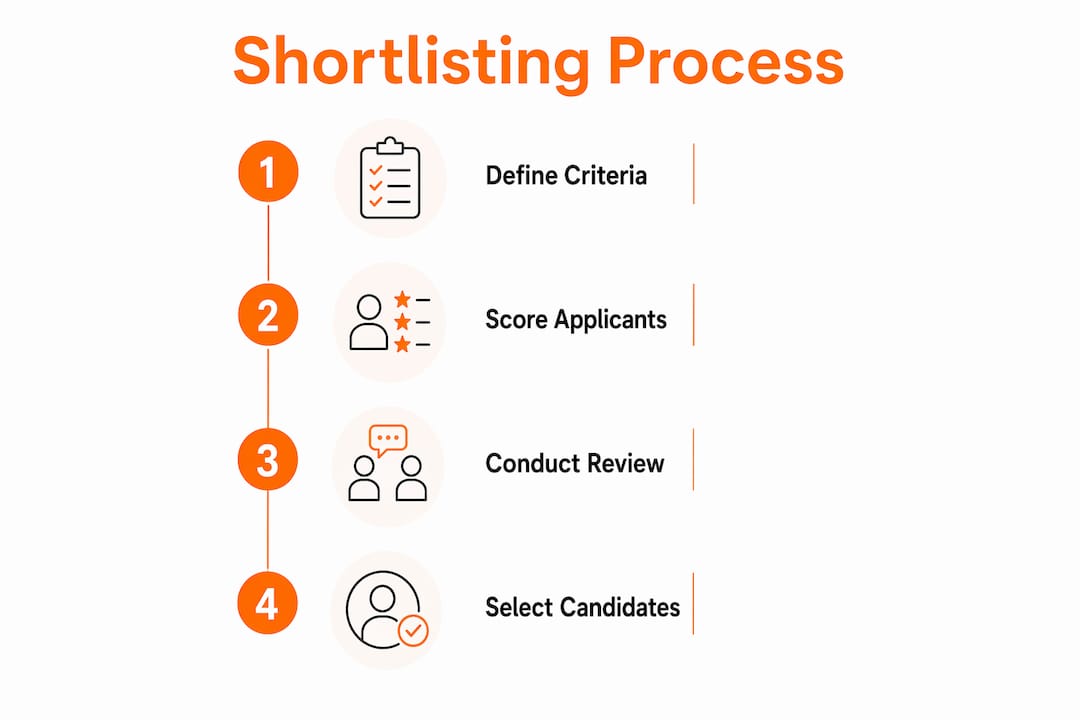
A commonly cited benchmark puts applicant-to-interview conversion at approximately one in seven. For a role that draws many applications, a proportionate number of candidates move to interview — a reasonable starting point, though your actual number depends on two variables: hiring bandwidth and role seniority.
Rules of thumb:
- Entry-level or high-volume roles: 10–20% of applicants, capped by your interview panel’s weekly capacity.
- Mid-level specialist roles: 8–12 candidates is a workable interview pool for most hiring teams.
- Senior or executive roles: 4–6 candidates, with more rigorous pre-interview assessment to compensate for the smaller pool.
Worked example: 100 applications come in for a mid-level marketing manager role. Your panel can conduct six interviews per week and wants to finish in two weeks. That’s 12 interview slots. Apply the 15% benchmark and you get 15 candidates — slightly over capacity. Run a brief phone screen with those 15 to cut to 12, or tighten your mandatory criteria to reduce the initial shortlist.
For high-volume hiring efficiency, combining an ATS filter for hard requirements with a short automated assessment can cut that 100-application pool to a manageable number before any human reviewer touches a resume.

How do you keep shortlisting fair and bias-free?
Bias in shortlisting tends to be structural, not malicious. The fix is equally structural: standardize the process so individual reviewers have less room to deviate.
Concrete controls that work:
- Structured criteria written before review begins. Criteria set after reading resumes are unconsciously shaped by the first few applications you read.
- Blind screening for the initial skim. Remove names, graduation years, and addresses from resumes before the first-pass sort. This is most practical when your ATS supports anonymization or when a coordinator strips the fields manually.
- Multiple reviewers on the detailed-review stage. At least two people should score the “Yes” pile independently before comparing notes.
- Calibrated rubrics. Run a 15-minute calibration session where reviewers score the same two or three sample applications before the live review begins. Disagreements surface scoring drift early.
Fair shortlisting checklist:
- [ ] Criteria documented and shared with all reviewers before review starts
- [ ] Scoring rubric agreed and calibrated across the panel
- [ ] No demographic identifiers visible during the skim phase
- [ ] At least two independent scores on every shortlisted candidate
- [ ] Decisions recorded with criterion-level notes, not summary impressions
U.S. employers must conduct applicant screening in compliance with Title VII of the Civil Rights Act and EEOC guidelines, which prohibit selection criteria that create unlawful disparate impact on protected classes.
Pro Tip: Use anonymized CVs for the initial skim phase when you’re hiring for roles where name-based or institution-based bias is a documented risk — but re-attach full details before the detailed review so interviewers have complete context. Anonymization at the skim stage, not throughout, is the practical balance. See the blind recruitment guide for a step-by-step setup.
How do you decide which criteria to score?
Split every criterion into one of three tiers before you start reviewing. This prevents “nice-to-have” factors from eliminating candidates who meet the actual job requirements.
Mandatory: Non-negotiable. A candidate who doesn’t meet these is screened out immediately. Examples: active CPA license for a controller role, 3+ years of Python development, U.S. work authorization.
Preferred: Meaningful differentiators. Candidates who meet these score higher but aren’t eliminated without them. Examples: experience with a specific CRM, prior team leadership, industry-specific domain knowledge.
Desirable: Bonus signals. They break ties but carry low weight. Examples: a relevant side project, bilingual fluency, a published portfolio.
Rather than looking for a “perfect” candidate at the shortlisting stage, focus on elements of potential that justify further assessment. A candidate who meets all mandatory criteria and shows two or three strong preferred signals is worth interviewing even if they don’t check every box.
Criteria decision table:
| Criterion | Why it matters | Evidence to look for |
|---|---|---|
| Required certification or license | Legal or functional prerequisite | Listed credential with issuing body and date |
| Years of relevant experience | Baseline competency signal | Job titles, tenure, scope of responsibility |
| Measurable achievement in core skill | Predicts on-the-job output | Quantified results (“grew pipeline 40%”) |
| Culture fit indicators | Retention and team cohesion | Language around collaboration, ownership, feedback |
| Work authorization | Legal requirement | Explicit statement or visa status |
Weight criteria relative to role impact: a sales role should weight revenue-generating experience heavily; an operations role should weight process ownership and cross-functional coordination. For a deeper look at weighting methods, the candidate scoring guide covers normalization and weighted scoring in detail.
What does an efficient two-stage review look like?
The two-stage workflow separates speed from depth. Stage one is about sorting, not deciding. Stage two is where real evaluation happens.
Stage 1: Skim and sort (30–60 seconds per application)
- Check mandatory criteria only. Does the application meet every hard requirement? If no, move to Reject.
- Scan for preferred criteria signals. Do you see two or more? Move to “Detailed Review.”
- Everything else goes to “Hold” — candidates who meet mandatory criteria but show weak preferred signals.
What to ignore in Stage 1: formatting, font choices, photo presence, school prestige, and job title seniority at previous employers (title inflation is widespread).
Stage 2: Detailed review (5–10 minutes per application)
- Read the full work history for scope, progression, and measurable results.
- Check the cover letter or application statement for role-specific reasoning.
- Score against your rubric. Record criterion-level notes, not just a total score.
- Assign a final bucket: Reject / Hold / Phone Screen / Shortlist.
Bucket definitions:
- Reject: Does not meet mandatory criteria.
- Hold: Meets mandatory criteria; weak on preferred. Revisit if the shortlist is too small.
- Phone Screen: Meets mandatory and some preferred criteria; one or two questions need clarification before committing to a full interview slot.
- Shortlist: Meets mandatory criteria and scores well on preferred; ready for interview scheduling.
Who does which stage? A recruiter or HR coordinator handles Stage 1. The hiring manager or a senior team member joins for Stage 2 on the “Detailed Review” pile. Keeping Stage 1 with a single reviewer and Stage 2 with multiple reviewers balances speed and consistency.
Which screening tools should you use and when?
No single tool works for every role or volume. The right mix depends on two variables: how many applications you’re handling and how complex the role is.
Tool categories and when to use them:
- ATS keyword filters: Best for high-volume, clearly defined roles. Fast and consistent, but they miss candidates who describe the same skill differently. Always audit filter logic before a campaign goes live.
- Structured phone screens (15–20 minutes): Useful when written applications leave ambiguity about a key mandatory criterion. Low cost, high signal for communication skills.
- Pre-employment skills assessments: Work-sample tests and targeted assessments are strong predictors of job performance and surface practical skills that resumes can’t show. Deploy after Stage 1 to reduce the pool before detailed review.
- Asynchronous video answers: Good for roles where communication style matters (client-facing, sales, teaching). Candidates record responses to set questions; reviewers watch at their own pace.
- Work samples and project briefs: Highest signal for creative, technical, and strategic roles. Scope them carefully — a task that takes more than 30 minutes risks deterring strong candidates who are already employed.
AI-assisted screening can process large volumes quickly and flag keyword matches or scoring anomalies. The main pitfalls: AI tools trained on historical hiring data can encode past biases, and they can’t assess judgment, communication nuance, or cultural fit. Use AI to triage volume, not to make final shortlist decisions. The AI candidate screening guide covers the key risk controls in detail.
Pro Tip: When bandwidth is limited, combine an ATS filter for hard requirements with a single, focused work-sample question. That two-layer approach cuts volume without sacrificing quality signal — and it’s far faster than reading every resume in full.
How do you build a shortlisting matrix that actually works?
A shortlisting matrix turns subjective impressions into a defensible, comparable score. Here’s how to build one in four steps.
Step 1: List your criteria (use the mandatory/preferred/desirable tiers from the previous section). Step 2: Assign weights. Mandatory criteria get the highest weight (e.g., 40% of total score combined). Preferred criteria share the middle band (e.g., 45%). Desirable criteria take the remainder (e.g., 15%). Step 3: Score each criterion on a 1–5 scale per candidate. Step 4: Multiply raw score by weight to get a weighted score. Sum for a total.
Scoring matrix template (filled example — Candidate A, Marketing Manager role):
| Criterion | Tier | Weight | Raw Score (1–5) | Weighted Score |
|---|---|---|---|---|
| 3+ years B2B marketing experience | Mandatory | 20% | 5 | — |
| Proven campaign ROI results | Mandatory | 20% | 4 | — |
| CRM platform experience | Preferred | 20% | 3 | — |
| Team leadership experience | Preferred | 15% | 4 | — |
| Content strategy background | Preferred | 10% | 2 | — |
| Relevant industry certification | Desirable | 15% | 1 | — |
| Total | 100% | — |
Tie-breaker rules: When two candidates score within 0.2 points of each other, move both to the Phone Screen bucket and use a structured 15-minute call to differentiate. Don’t arbitrarily cut one based on total score alone.
Scorecards increase objectivity but should be used flexibly. If many candidates exceed your threshold, consider expanding the interview pool rather than capping it artificially. A calibration session before scoring begins — where all reviewers score the same two sample applications — prevents scoring drift across a panel.
What happens after shortlisting? Timeline and candidate communications
A realistic shortlisting timeline for a mid-level role with 80–120 applications:
- Day 1–2: ATS filter runs; Stage 1 skim completed by recruiter.
- Day 3–4: Stage 2 detailed review with hiring manager; matrix scores finalized.
- Day 5: Phone screens with “Phone Screen” bucket candidates (if applicable).
- Day 6–7: Final shortlist confirmed; interview invitations sent.
- Day 8–10: Rejection communications sent to non-shortlisted applicants.
When a shortlist is too large after Stage 2, add a brief phone screen or short skills test to filter further before committing interview slots.
Sample message — shortlisted candidate: “Hi [Name], thank you for applying for [Role] at [Company]. We’ve reviewed your application and would like to invite you to a [format] interview on [date/time options]. Please reply to confirm your availability.”
Sample message — non-shortlisted candidate: “Hi [Name], thank you for your interest in [Role] at [Company]. After careful review, we won’t be moving your application forward at this time. We’ll keep your details on file and encourage you to apply for future openings that match your background.”
U.S. employers should maintain consistent, documented selection criteria and retain application records in line with EEOC record-keeping requirements — typically one year from the date of the hiring decision.
Rejected candidates who received a positive experience during the process are more likely to reapply and to recommend your company to others. A prompt, respectful rejection message is worth the two minutes it takes.
When should you use test tasks to validate shortlist decisions?
Early, role-aligned work samples are among the strongest predictors of on-the-job performance and reduce the risk of “resume-only” false positives. Deploy them after Stage 1 — once you’ve confirmed mandatory criteria are met — to differentiate candidates in your “Phone Screen” or “Shortlist” buckets.
Task examples by role type:
- Software engineer: A 20-minute coding task in the primary language used on the team, scored on correctness, readability, and approach.
- Content writer: A 300-word writing sample on a provided brief, scored on clarity, structure, and on-brand tone.
- Marketing manager: A one-page campaign brief for a fictional product launch, scored on strategic thinking and channel selection rationale.
- Customer success manager: A written response to a sample client escalation email, scored on empathy, problem-solving, and professionalism.
Rubric template for any task:
| Dimension | Weight | Score (1–5) | Notes |
|---|---|---|---|
| Quality of reasoning or approach | 30% | ||
| Communication clarity | 20% | ||
| Alignment to role requirements | 15% |
Pro Tip: Design test tasks to take 15–30 minutes and align them closely to day-one job tasks. A task that’s too long signals disrespect for candidate time; one that’s too abstract produces low-signal responses. The sweet spot is a task a strong candidate can complete well in under 30 minutes.
Key Takeaways
A reliable shortlist comes from defined criteria, a weighted scorecard, and a two-stage review — applied consistently before any resume is opened.
| Point | Details |
|---|---|
| Set criteria before reviewing | Write mandatory, preferred, and desirable criteria from the job description before opening any application. |
| Size the shortlist to capacity | Use the 15% applicant-to-interview benchmark as a starting point, then adjust based on your interview panel’s bandwidth and the role’s seniority. |
| Run a two-stage review | Stage 1 sorts by mandatory criteria in 30–60 seconds per application; Stage 2 scores the “Yes” pile with a weighted matrix. |
| Control for bias structurally | Use anonymized CVs for the skim phase, calibrate reviewers before scoring, and require criterion-level notes on every decision. |
| Testask for assessment-led shortlisting | Testask’s tailored test tasks, centralized submissions, and AI-assisted scoring integrate directly into the shortlisting matrix workflow. |
A recruiter’s perspective: the shortlisting mistakes that cost you the best candidates
The most damaging shortlisting error isn’t bias or bad criteria. It’s rushing the skim phase and letting pattern-matching substitute for actual evaluation.
Here’s what that looks like in practice: a recruiter working through 120 applications in a single afternoon starts unconsciously anchoring on the first strong resume they read. Every subsequent application gets compared to that anchor, not to the job criteria. By application 80, fatigue has set in and the skim has become a scan for familiar company names and recognizable job titles. High-potential candidates from non-traditional backgrounds get sorted to “Hold” or “Reject” not because they fail the criteria but because they don’t match the mental template that formed in the first 20 minutes.
The fix is structural. Cap skim sessions at 40–50 applications before taking a break. Use the scorecard as a physical checklist, not a mental one. And treat the “Hold” bucket seriously — revisit it before finalizing the shortlist, because that’s where missed candidates tend to accumulate.
Stakeholder disagreement is the other common failure point. When a hiring manager and a recruiter score the same candidate differently, the instinct is to average the scores and move on. A better approach: treat the disagreement as a calibration signal. Walk through the specific criterion where scores diverged, agree on what evidence would justify a 4 versus a 3, and update the rubric. That 10-minute conversation prevents the same disagreement from recurring across every candidate in the pool.
One more thing worth saying directly: over-reliance on job titles is a persistent problem. A “Senior Manager” at a 12-person startup and a “Senior Manager” at a Fortune 500 company represent very different scopes of responsibility. Score the evidence — team size managed, budget owned, outcomes delivered — not the label. That shift alone will surface candidates your competitors are overlooking.
For a broader look at where screening processes break down, the common hiring mistakes guide covers the patterns that show up most often across hiring teams.
Testask makes skills-first shortlisting faster and more consistent
Shortlisting on resume signals alone leaves too much to chance. Testask gives your team a faster, more reliable path from application to confident shortlist decision.
With Testask, you can generate tailored test tasks matched to your role’s actual day-one requirements, collect candidate submissions in one centralized workspace, and use AI-assisted scoring to apply your rubric consistently across every response. Three use cases where this makes a direct difference:
- High-volume screening: Deploy a short, role-aligned task after Stage 1 to cut a 100-application pool to a focused shortlist without adding reviewer hours.
- Skills-first hiring: Replace title-based filtering with scored work samples, so candidates from non-traditional backgrounds get evaluated on what they can actually do.
- Collaborative scoring: Multiple reviewers score submissions independently inside Testask, then compare results — the same calibration workflow described in this article, built into the platform.
Start a free trial and run your next shortlisting round with structured assessments and AI-assisted analysis from day one.
Useful sources and templates for your shortlisting workflow
These resources support the frameworks covered in this article. Use them to build or refine your shortlisting process:
- Testask assessment platform: Tailored test task generation, centralized submission review, and AI-assisted scoring. Best for skills-first and high-volume shortlisting scenarios.
- Candidate screening process guide: A stepwise walkthrough of the full screening and selection workflow, with templates for each stage.
- Recruitment checklist builder: Practical checklist templates you can adapt for high-volume, executive search, or early-career hiring.
- AIHR selection process guide: Evidence-based overview of the full seven-stage selection funnel, with best-practice notes at each stage.
- DavidsonMorris shortlisting guide: Covers legal considerations and practical tactics for U.S. and UK hiring teams, including record-keeping requirements.
- Indeed candidate shortlist guide: Practical advice on shortlist sizing and criteria-setting, updated for current hiring conditions.
For high-volume roles, start with the Testask assessment platform and the screening process guide. For executive search, the AIHR and DavidsonMorris guides provide the depth on structured evaluation and documentation that senior-level hiring requires. Early-career hiring benefits most from the recruitment checklist builder, where standardized criteria prevent the inconsistency that tends to creep into entry-level screening.
This article provides general guidance on hiring best practices and is not legal advice. Confirm your shortlisting process complies with applicable federal and state employment laws, including EEOC requirements, with a qualified HR or legal professional.
Recommended
- Build an effective recruitment checklist for HR success | Testask Blog | testask
- Candidate Screening Process Guide: Streamlined Hiring Steps | Testask Blog | testask
- How to improve recruitment: proven steps for better hiring | Testask Blog | testask
- Hiring process best practices: proven steps for better talent | Testask Blog | testask