Explaining Blind Recruitment: A Practical HR Guide
Explaining Blind Recruitment: A Practical HR Guide

Blind recruitment is defined as the practice of anonymizing candidate information during hiring to reduce unconscious bias and focus evaluation on skills and qualifications alone. The method draws its strongest evidence from Goldin and Rouse’s landmark study of orchestra auditions, where blind auditions increased the probability of women advancing past preliminary rounds by about 50%. Female representation in orchestras rose from 10% to 35% between 1970 and the mid-1990s as a result. That single finding reshaped how HR professionals think about identity cues in evaluation, and it remains the most cited proof point for understanding blind hiring today.
What is blind recruitment and how does it work?
Blind recruitment, also called blind hiring, is the structured removal of personal identity cues from candidate materials before any evaluator reviews them. Those cues include names, photos, home addresses, graduation years, and university or employer names. Removing this information shifts evaluator attention from demographic signals to demonstrated skills and relevant experience.
The psychological mechanism is straightforward. Unconscious bias operates when the brain uses shortcuts to fill in gaps. When a reviewer sees a name associated with a particular gender or ethnicity, that association activates stereotypes before any conscious judgment occurs. Anonymization interrupts that process at the source.

Goldin and Rouse’s research confirmed that reducing identity cues changes selection outcomes even when evaluators use the same performance signals. The implication for HR teams is direct: the problem is not evaluator intent. The problem is information architecture. Blind recruitment fixes the architecture.
| Feature | Blind recruitment | Conventional hiring |
|---|---|---|
| Name visible to reviewer | No | Yes |
| Photo included | No | Often yes |
| University name shown | Redacted | Visible |
| Evaluation focus | Skills and experience | Full profile |
| Bias interruption point | Before first review | Rarely addressed |
Pro Tip: Define your evaluation rubric before any application enters the review queue. Criteria set after seeing candidate materials are far more likely to drift toward confirming existing impressions.
What are the key benefits of blind recruitment?
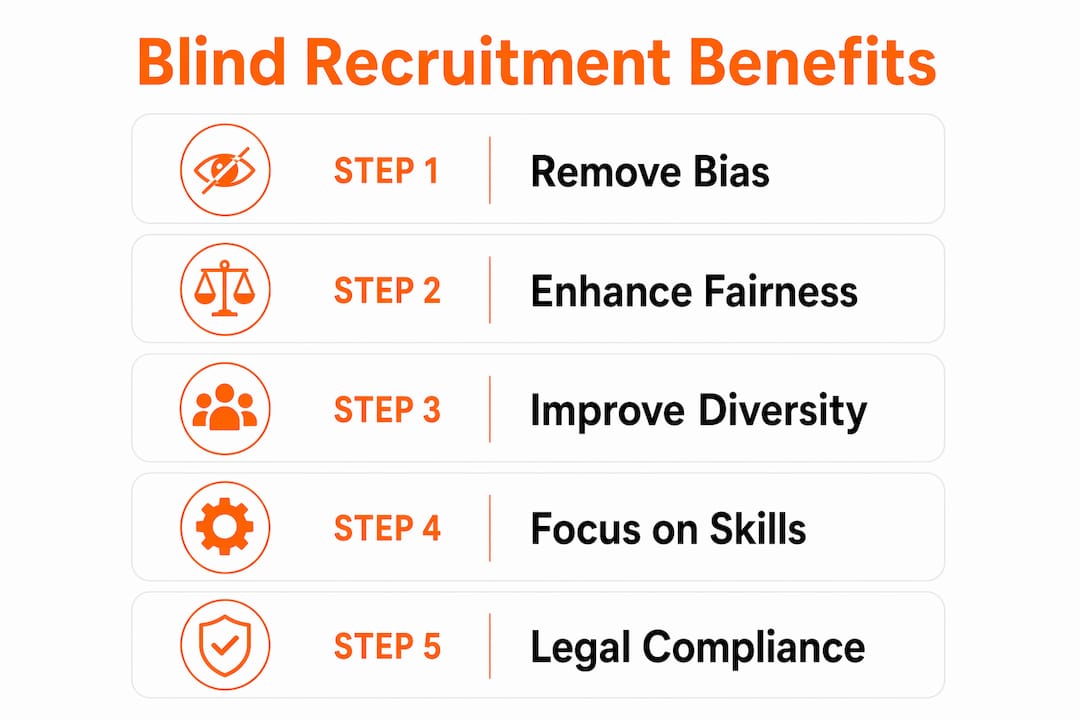
Blind recruitment improves fairness, diversity, and legal compliance while also building candidate confidence in your process. Each benefit reinforces the others, which is why organizations that adopt blind hiring tend to see compounding returns over time.
- Stronger workforce diversity. Removing demographic signals gives candidates from underrepresented groups a fair shot based on merit, not background.
- Legal compliance. The UK Equality Act 2010 requires documented, non-discriminatory hiring processes. Blind recruitment creates a clear audit trail.
- Higher candidate trust. Applicants who know their identity will not influence early screening are more likely to complete applications and engage honestly.
- Faster screening decisions. Evaluators focus on a smaller, more relevant set of signals, which reduces decision fatigue and speeds up shortlisting.
- Broader talent discovery. Pedigree bias, the tendency to favor candidates from elite universities or well-known employers, is neutralized when those names are redacted.
Pro Tip: Communicate your blind hiring process in the job posting itself. Candidates who see it listed report higher confidence in the fairness of your organization, and that perception affects offer acceptance rates.
How to implement blind recruitment: step-by-step
Implementation quality determines whether blind recruitment actually reduces bias or simply adds process overhead. Follow these steps to build a process that holds up at scale.
- Define role criteria and scoring rubrics first. Document the competencies, experience levels, and skills required before any application arrives. This prevents criteria drift, the risk that evaluation standards shift after reviewers see candidate profiles.
- Redact identity information from all applications. Remove names, photos, addresses, graduation years, and institution names. For low volumes, a manual review by a neutral party works. For higher volumes, use an applicant tracking system with a built-in blind review module or a dedicated anonymization tool.
- Conduct structured blind resume review. Each reviewer scores applications against the predefined rubric independently. Avoid group review at this stage, since social influence can reintroduce bias through discussion.
- Shortlist based on scores alone. Compile shortlists using aggregated rubric scores before any identity information is revealed. This keeps the first cut genuinely merit-based.
- Reintroduce identity information at the interview stage. Most organizations reveal candidate details before live interviews, since full anonymization at that stage is impractical. The key is that the shortlist was built without those details.
- Use structured interviews to maintain consistency. Structured interviews have twice the predictive validity of unstructured ones. Pair them with blind screening to carry bias reduction through the full hiring funnel.
- Audit outcomes regularly. Track demographic data on who advances at each stage. If a particular group consistently drops off after identity is revealed, that signals bias in later stages that blind screening alone cannot fix.
A bias-free hiring guide from Testask covers these steps in detail for HR teams working across professional services and consulting sectors. For teams building out their process documentation, a structured recruitment checklist helps standardize each stage.
What are the common pitfalls in blind recruitment?
Blind recruitment fails most often not because the concept is flawed, but because implementation is incomplete. These are the risks HR teams encounter most frequently.
- Criteria drift. This is the most damaging risk. Roles, competencies, and rubrics must be documented before blind review begins. When criteria are set or adjusted after reviewers see applications, the process reintroduces exactly the bias it was designed to prevent.
- Incomplete anonymization. Redacting a name but leaving a graduation year or a distinctive employer name still exposes demographic signals. A systematic checklist for every field is non-negotiable.
- Manual redaction at scale. Manual anonymization becomes unmanageable at high application volumes. Organizations that rely on manual processes see errors, inconsistency, and staff burnout. Automated tooling is the practical solution above a few dozen applications per role.
- Bias in later stages. Blind screening protects the resume review stage. It does not protect against bias in interviews, reference checks, or offer negotiations. Teams that treat blind screening as a complete solution miss the majority of the hiring funnel.
- Evaluator calibration gaps. Reviewers who have not been trained on the rubric apply it inconsistently. Regular calibration sessions, where reviewers score the same sample application and compare results, close that gap quickly.
UK trials of blind CV screening show mixed results when implementation quality is low. The evidence is clear: the process works when it is executed properly, and it fails when shortcuts are taken.
How does blind recruitment compare to other bias-reduction strategies?
Blind recruitment is one tool in a broader set of bias-mitigation approaches. No single method eliminates bias across the full hiring process, and the strongest programs combine multiple techniques.
| Strategy | Bias reduction impact | Ease of implementation | Stage covered |
|---|---|---|---|
| Blind recruitment | High at screening stage | Moderate | Resume review |
| Structured interviews | High across interviews | Moderate | Interview stage |
| Diverse hiring panels | Moderate | Low to moderate | Interview stage |
| Unconscious bias training | Low to moderate | High | All stages |
| Sponsorship programs | Moderate | Low | Post-hire |
Structured interviews are the most natural complement to blind recruitment. Meta-analysis confirms they double the predictive validity of unstructured conversations, and they apply consistent criteria at the stage where blind screening ends. Diverse hiring panels add a different kind of protection: they reduce the risk that a single evaluator’s perspective dominates the final decision.
Unconscious bias training is widely used but produces the weakest standalone results. It raises awareness without changing the information architecture that drives biased decisions. Blind recruitment changes the architecture directly, which is why it outperforms training as a standalone intervention.
The most effective programs layer blind screening at the resume stage, structured interviews at the assessment stage, and diverse panels at the final decision stage. Each method covers a gap the others leave open.
Key Takeaways
Blind recruitment works because it removes identity cues before evaluation begins, and that structural change produces measurably fairer outcomes than awareness training alone.
| Point | Details |
|---|---|
| Define criteria first | Document competencies and rubrics before any application enters review to prevent criteria drift. |
| Automate redaction at scale | Manual anonymization fails above low volumes; use an ATS or dedicated tool for consistency. |
| Pair with structured interviews | Structured interviews double predictive validity and extend bias reduction past the screening stage. |
| Audit outcomes by stage | Track demographic drop-off at each hiring stage to identify where bias re-enters the process. |
| Combine methods for full coverage | No single strategy covers the full hiring funnel; blind screening, structured interviews, and diverse panels work best together. |
What I’ve learned from watching blind recruitment succeed and fail
Blind recruitment is one of the few hiring interventions with genuine experimental evidence behind it. The Goldin and Rouse orchestra study is not a survey or a self-reported outcome. It is a natural experiment with measurable results. That evidence base is why I take this method seriously.
What I have seen in practice is that the teams who get the most out of blind hiring are the ones who treat it as a process design problem, not a policy checkbox. They predefine criteria obsessively. They audit outcomes quarterly. They do not declare success after implementing redaction software.
The teams that struggle are the ones who implement blind screening at the resume stage and then run completely unstructured interviews. They have protected one gate and left every other gate wide open. The bias they removed at screening comes back in the first five minutes of an interview.
My honest recommendation: start with a pilot on one role or one department. Measure who advances before and after. If the demographic composition of your shortlists does not change, your anonymization is incomplete or your criteria are drifting. Fix the process before scaling it. Blind recruitment is not a one-time implementation. It is a continuous improvement practice, and the organizations that treat it that way are the ones that see lasting results.
— Pavel
Testask supports fair, skills-based hiring
Blind recruitment requires consistent processes, structured evaluation, and the right tools to work at scale. Testask is an AI-powered recruitment assessment platform that helps HR teams build exactly that.
With Testask, you can create tailored test tasks that evaluate candidates on actual job-relevant skills, run structured blind reviews with collaborative scoring, and use AI-assisted analysis to make faster, more consistent decisions. The platform supports AI candidate screening best practices and gives your team the structure needed to reduce bias across the full hiring funnel. Visit Testask to see how skills-based assessment fits into your blind hiring process.
FAQ
What is blind recruitment?
Blind recruitment is the practice of removing personal identity information from candidate applications before evaluation. It reduces unconscious bias by keeping evaluators focused on skills and qualifications rather than demographic signals.
Does blind recruitment actually work?
The evidence is strong at the screening stage. Goldin and Rouse found that blind auditions raised female representation in orchestras from 10% to 35%, confirming that removing identity cues changes selection outcomes.
What information is removed in blind recruitment?
Blind resume review removes names, photos, home addresses, graduation years, and university or employer names. Any field that could signal gender, ethnicity, age, or socioeconomic background is redacted.
What is criteria drift and why does it matter?
Criteria drift occurs when evaluation standards shift after reviewers see candidate information, which reintroduces the bias blind recruitment was designed to prevent. Documenting rubrics before review begins is the only reliable way to prevent it.
How does blind recruitment support legal compliance?
The UK Equality Act 2010 requires documented, non-discriminatory hiring processes. Blind recruitment creates a clear, auditable record showing that early screening decisions were based on merit rather than protected characteristics.