Screening Efficiency Tips for Smarter Hiring in 2026
Screening Efficiency Tips for Smarter Hiring in 2026

Screening efficiency refers to maximizing the accuracy and speed of candidate evaluation through deliberate process adjustments and technology integration. HR professionals who apply structured screening efficiency tips consistently reduce time-to-hire without sacrificing evaluation quality. The core methods covered here include feed rate management, AI triage workflows, active learning prioritization, and tiered review design. Each technique addresses a specific bottleneck that slows hiring teams down and erodes decision quality over time.
1. Screening efficiency tips start with controlling candidate feed rate
Feed rate is the volume of candidates entering your screening process per unit of time. When feed rate is too high, reviewers spend less time per candidate, and evaluation quality drops. When it is too low, throughput suffers and hiring timelines stretch unnecessarily.
The principle comes directly from physical screening systems: slower feed rate increases residence time on the screening surface, which improves sorting quality. Applied to hiring, this means batching applications rather than reviewing them as they arrive. Reviewing 20 candidates in a focused two-hour block produces more consistent judgments than reviewing 60 candidates across a scattered workday.
Practical ways to control feed rate without slowing your pipeline:
- Set a fixed review window each day (for example, 9:00 AM to 11:00 AM) rather than reviewing applications on demand.
- Use application scoring to pre-sort candidates before human review begins.
- Cap the number of active requisitions a single reviewer handles at one time.
- Stagger job posting dates so applications arrive in manageable waves.
Pro Tip: Batch your application reviews into dedicated blocks. Cognitive research consistently shows that decision quality declines after extended periods of repetitive judgment tasks. Shorter, focused sessions protect accuracy.
2. How de-blinding aids prevent screening bottlenecks

De-blinding in candidate screening means removing the barriers that cause a reviewer to get stuck, skip candidates, or lose track of where they are in the process. These barriers create backlogs and slow the entire workflow.
Common de-blinding aids include:
- AI pre-sorting tools that flag incomplete applications before human review.
- Structured scoring rubrics that give reviewers a clear decision framework for each candidate.
- Candidate pre-sorting by role fit score, so reviewers start with the most relevant profiles.
- Software dashboards that show queue depth and flag stalled reviews.
Technology integration with human teams is the key factor here. AI tools handle the mechanical triage work, such as checking for required qualifications or flagging missing documents. Human reviewers then focus on judgment calls that require context and nuance. This division of labor keeps the workflow moving without creating a backlog at either stage. For a deeper look at designing efficient workflows, structured frameworks make the biggest difference in sustained throughput.
3. How human-AI collaboration improves candidate screening accuracy
Human-AI collaboration is the most research-supported method for improving screening accuracy in 2026. The evidence is specific: AI-assisted screening accuracy improves from 71.1% to 76.5%, a gain of 5.4 percentage points. That improvement comes without adding review time, with average time per review holding steady at approximately 37.4 to 37.8 minutes.
The accuracy gain matters more than it might appear. A 5.4% improvement in screening accuracy across hundreds of candidates translates directly into fewer wrong hires and fewer qualified candidates incorrectly rejected.
AI triage workflows add a second layer of benefit. AI-powered triage models reduce human workload by 19–31% by routing clear-negative cases away from human reviewers entirely. Reviewers then focus only on ambiguous or high-potential candidates. This is the tiered review model in practice.
“AI workflows that triage negatives and prioritize case review can substantially reduce human workload while improving detection rates. The efficiency gain comes not from reviewing faster, but from reviewing less of the wrong material.”
One critical caution: automation bias. When reviewers trust AI outputs without independent verification, accuracy gains erode. Manual verification remains essential even in AI-assisted workflows. The best approach is to treat AI output as a first-pass recommendation, not a final decision.
Pro Tip: Set a policy requiring human reviewers to document their reasoning on any candidate where they override an AI recommendation. This creates a feedback loop that improves both the AI model and reviewer calibration over time.
4. Prioritization strategies that reduce unnecessary screening volume
Not every candidate requires the same depth of evaluation. The “not all” framework captures this directly: not all candidates are equal, not all roles require the same screening depth, and not all tools fit every workflow. Applying this framework means designing screening depth based on role criticality and candidate profile, not applying a uniform process to every application.
Active learning methods take this further. The SAFE procedure with active learning reduces screening workload by 89–90% while maintaining near-complete recall of relevant candidates. The method works by training a model on a small labeled subset, then using that model to prioritize which remaining candidates are worth reviewing. Reviewers screen only 10–11% of the total candidate pool to identify all relevant profiles.
Here is how to apply prioritization in a practical hiring workflow:
- Define role tiers. Classify open roles by business impact: critical, standard, and high-volume. Apply deeper screening to critical roles.
- Label a training set. Select a representative sample of past hires and rejections. Use full application data, not just resumes, for labeling. Full-text labeling identifies relevant candidates by screening 7–11% of datasets versus up to 27% for abstract-only labels.
- Train a prioritization model. Use the labeled set to rank incoming candidates by predicted fit. Review high-ranked candidates first.
- Set a stopping rule. Once the model predicts low probability of finding additional qualified candidates, stop reviewing and move to the next stage.
- Audit quarterly. Compare model predictions against actual hire outcomes and retrain on updated data.
Pro Tip: Training active learning models on a small, high-quality labeled subset consistently outperforms training on large, noisy datasets. Quality of labels matters more than quantity.
5. What are best practices for screening process design?
Sustained screening efficiency depends on process design, not just individual technique choices. The table below compares two common screening design approaches across key performance dimensions.
| Design dimension | Single-stage screening | Tiered multi-stage screening |
|---|---|---|
| Speed | Fast initial sort | Slower overall but more accurate |
| Accuracy | Lower for complex roles | Higher, especially for senior roles |
| Reviewer workload | High per reviewer | Distributed across stages |
| Feedback loop | Difficult to build | Built into stage transitions |
| Best fit | High-volume, entry-level roles | Critical or specialized roles |
Screening best practices consistently point to four process design principles that sustain efficiency over time.
Set clear thresholds. Define what a passing score looks like before reviewing begins. Reviewers who set thresholds in advance make faster, more consistent decisions than those who calibrate as they go.
Standardize criteria. Every reviewer on a team should use the same rubric for the same role. Inconsistent criteria create inter-rater variability that slows consensus and increases re-review rates.
Build feedback loops. Track which screened-in candidates advance through later hiring stages and which do not. Use that data to adjust screening criteria quarterly. Without feedback loops, screening criteria drift away from what actually predicts job success.
Review screening metrics regularly. Monitor time-to-screen, pass-through rate, and reviewer agreement rate. If pass-through rate climbs above 40%, your criteria are too loose. If it drops below 10%, your criteria may be filtering out qualified candidates.
Key takeaways
Effective screening efficiency combines feed rate control, AI-assisted triage, active learning prioritization, and tiered process design to increase accuracy and reduce unnecessary reviewer workload.
| Point | Details |
|---|---|
| Control feed rate | Batch application reviews into fixed time blocks to protect decision quality. |
| Use AI triage | AI-assisted workflows reduce human workload by up to 31% while improving accuracy. |
| Apply prioritization | Active learning methods can reduce screening volume by up to 90% without missing qualified candidates. |
| Standardize criteria | Consistent rubrics across reviewers reduce re-review rates and speed up consensus. |
| Build feedback loops | Track screened-in candidates through later stages and adjust criteria quarterly. |
What I’ve learned about screening efficiency that most guides skip
Most articles on improving screening processes focus on tools. Buy this platform, add that integration, automate this step. The tools matter, but they are not the constraint most hiring teams actually face.
The real constraint is labeling quality. Every AI model, every prioritization framework, every active learning system depends on the quality of the decisions humans made in the past. If your historical hiring data reflects inconsistent criteria, the model you train on that data will replicate those inconsistencies at scale. I have seen teams invest heavily in AI-powered screening tools and get worse results than their manual process because the training data was noisy.
The second thing most guides miss is the automation bias problem. Reviewers who use AI recommendations without independent judgment do not save time. They spend the same amount of time reviewing, but they defer to the AI on close calls. That deference eliminates the accuracy benefit of having a human in the loop at all. The balance between AI and human judgment is not a philosophical question. It is a process design question with measurable consequences.
My practical recommendation: before adopting any new screening technology, audit your existing labeled data. If your past hiring decisions were inconsistent, clean the data first. A well-designed screening process with clean historical data will outperform an AI-powered process built on noisy inputs every time.
— Pavel
How Testask supports faster, more accurate candidate screening
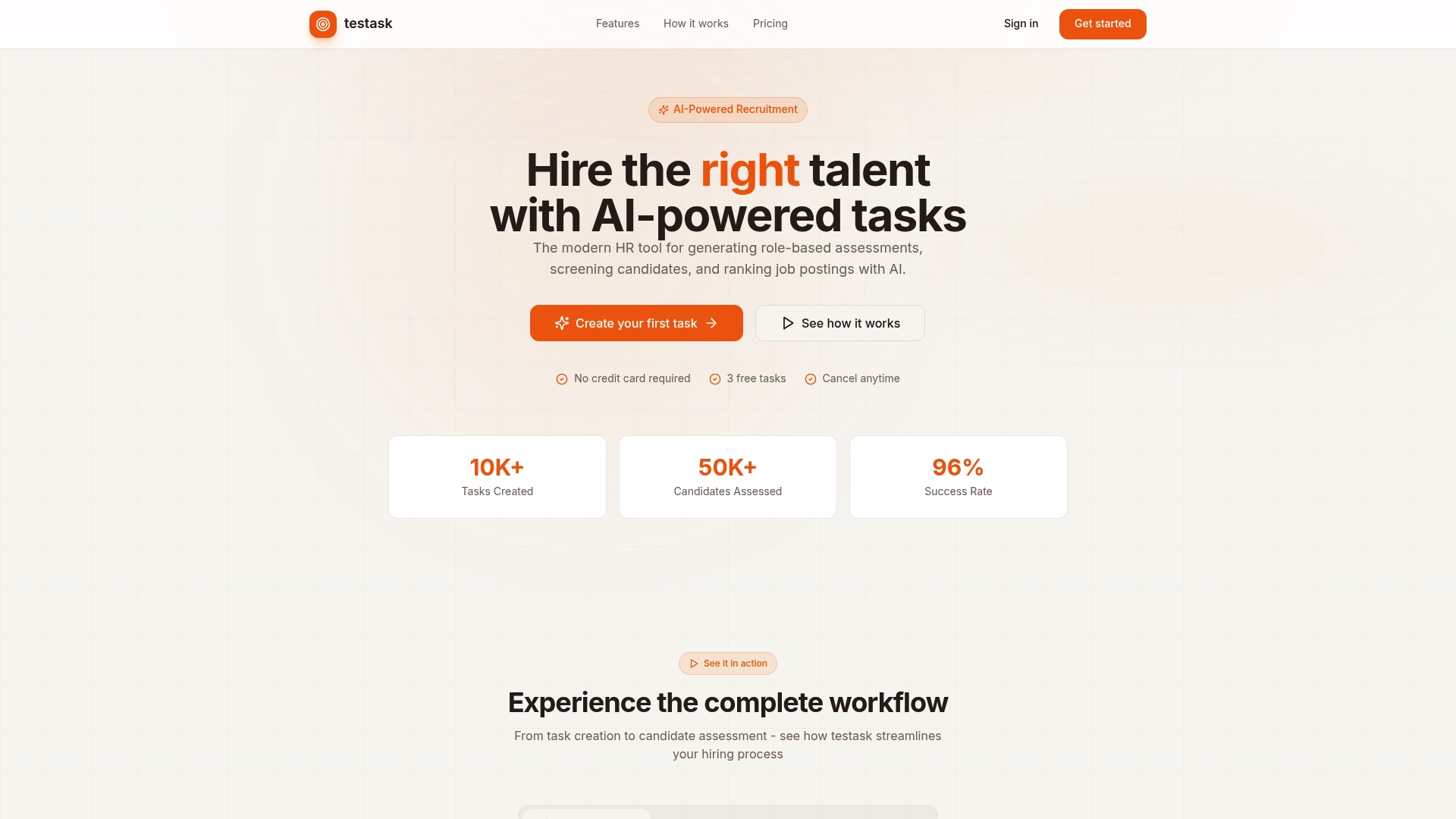
Testask is an AI-powered recruitment assessment platform built for HR teams who need to evaluate candidates faster without cutting corners on quality. The platform lets you create tailored test tasks for any role, review candidate submissions with AI-assisted analysis, and collaborate with your team on hiring decisions in one place. Testask’s triage and prioritization features align directly with the active learning and tiered review methods covered in this article. If you want to put these screening efficiency methods into practice without building the infrastructure from scratch, Testask gives your team the tools to do it. You can also explore how AI-optimized candidate profiles from SparkCV integrate with structured screening workflows to improve the quality of incoming applications before review even begins.
FAQ
What is screening efficiency in hiring?
Screening efficiency is the measure of how accurately and quickly a hiring team identifies qualified candidates from a larger applicant pool. It improves when teams apply structured criteria, control review volume, and use AI-assisted triage.
How much can AI reduce screening workload?
AI triage workflows reduce human screening workload by 19–31%, depending on the consensus method used. Reviewers focus only on ambiguous or high-potential candidates rather than the full applicant pool.
What is active learning in candidate screening?
Active learning is a method where a model trains on a small labeled dataset and then prioritizes which remaining candidates are worth reviewing. It can reduce total screening volume by up to 90% while maintaining near-complete recall of qualified candidates.
Why does labeling quality matter for AI-assisted screening?
AI screening models trained on high-quality labeled data consistently outperform those trained on large, noisy datasets. Full-text labeling identifies relevant candidates by reviewing just 7–11% of a dataset, compared to up to 27% for abstract-only labels.
How often should screening criteria be reviewed?
Screening criteria should be reviewed at least quarterly. Track which screened-in candidates advance through later hiring stages and use that data to adjust thresholds and rubrics.
Recommended
- Screening process best practices: smarter, fairer hiring steps | Testask Blog | testask
- Screening Checklist Guide for Smarter Hiring in 2026 | Testask Blog | testask
- Screening tools in hiring: Transform your recruitment efficiency | Testask Blog | testask
- Candidate Screening Process Guide: Streamlined Hiring Steps | Testask Blog | testask