Candidate Scoring Methods: A 2026 Hiring Guide
Candidate Scoring Methods: A 2026 Hiring Guide

Candidate scoring methods are systematic frameworks that convert qualitative and quantitative candidate data into objective scores, enabling evidence-based hiring decisions. The industry recognizes these frameworks under the broader term structured candidate evaluation, which covers everything from numerical rating scales and behaviorally anchored rubrics to AI-assisted scoring tools. Used correctly, candidate scoring methods reduce unconscious bias, create a defensible record of every hiring decision, and give your team a consistent basis for comparing applicants across roles. This guide covers the core components, a step-by-step implementation process, a comparison of the most common approaches, and the technology that makes it all faster.
What are the essential components of candidate scoring methods?
A well-built scoring system starts with clearly defined selection criteria. A well-rounded system typically includes 6 to 10 structured criteria, beginning with non-negotiable requirements and followed by desirable qualities. That range is deliberate. Fewer than six criteria often miss important competencies. More than ten creates scoring fatigue and dilutes focus.
The core building blocks of any effective scoring system are:
- Defined competencies. Each criterion maps to a specific skill, behavior, or qualification relevant to the role.
- A standardized scoring scale. The industry-standard scale as of 2026 is 1–5, with a clearly defined meaning for each number to reduce subjective interpretation.
- Scoring rubrics with examples. Rubrics must provide specific illustrative examples for each level so interviewers agree on what “poor” versus “outstanding” actually looks like in practice.
- Evidence-linked evaluation. Every score ties back to a specific candidate quote, transcript excerpt, or documented observation. Linking scores to explicit evidence significantly improves legal defensibility and scoring reproducibility.
- Interviewer calibration. Before scoring begins, interviewers align on how to apply the rubric. After scoring, they compare results to catch discrepancies.
Pro Tip: Run a short calibration exercise before your first interview round. Have two interviewers independently score the same sample response, then compare. Gaps above one point on a 1–5 scale signal that your rubric needs sharper definitions.
Calibration is not a bureaucratic step. It is the mechanism that turns a good rubric into a consistent one.

How to implement candidate scoring methods step by step
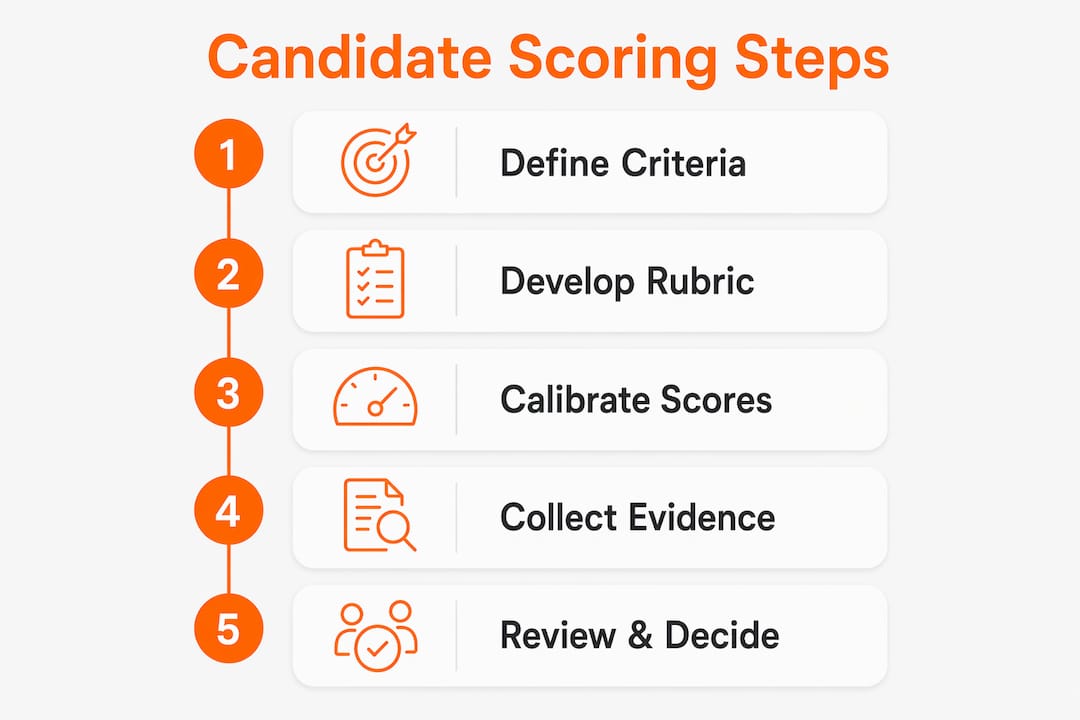
Adopting a structured scoring process does not require a complete overhaul of your hiring workflow. It requires discipline at each stage. Here is the sequence that works.
- Define job-relevant criteria and competencies. Start with the hiring manager. Identify the 6–10 skills and behaviors that predict success in the role. Separate must-haves from nice-to-haves.
- Develop standardized scoring rubrics. For each criterion, write a description of what a score of 1, 3, and 5 looks like. Use real examples from past interviews when possible.
- Train interviewers on scoring and evidence collection. Interviewers need to know how to take notes that capture specific candidate statements, not general impressions. This is the step most teams skip, and it is the one that causes the most problems later.
- Conduct structured interviews using scorecards. Every interviewer uses the same scorecard for every candidate. Questions are standardized. This is what makes structured interviewing more predictive and fair than unstructured conversations.
- Collect detailed notes and evidence during interviews. Notes should capture direct quotes or paraphrased responses tied to specific questions. Vague notes like “seemed confident” are not evidence.
- Assign scores tied to specific responses. After each interview, score each criterion based on the notes. Do not score from memory alone.
- Run calibration sessions to align scores. Calibration sessions help uncover biases and improve consistency. The goal is not to force agreement but to understand why scores differ.
- Aggregate scores and prioritize candidates. Total scores give you a ranked list. Use that list as a starting point for discussion, not as a final verdict.
Pro Tip: Build your scorecard in a shared document or ATS before the first interview goes live. Waiting until after interviews to create scoring criteria introduces post-hoc bias, where interviewers unconsciously reverse-engineer criteria to favor a candidate they already liked.
The sequence matters. Skipping step three or seven is the most common reason scoring systems fail in practice.
Comparing common candidate evaluation techniques
Not all job applicant assessment methods carry the same weight. Each approach trades off accuracy, ease of use, and legal defensibility differently.
| Method | Accuracy | Bias risk | Ease of use | Legal defensibility |
|---|---|---|---|---|
| Numeric scale (1–5) with rubric | High | Low | Moderate | High |
| Categorical rating (yes/no, qualified/not qualified) | Moderate | Moderate | High | Moderate |
| Behaviorally anchored rating scales (BARS) | Very high | Very low | Low | Very high |
| Impression-based scoring | Low | High | High | Low |
| AI-assisted scoring with human review | High | Low | High | High |
A few points stand out from this comparison.
Behaviorally anchored rating scales, known as BARS, deliver the highest accuracy and the lowest bias risk. They require the most upfront work to build, but that investment pays off in consistency. Impression-based scoring, where an interviewer assigns a gut-feel number without a rubric, is the most common method and the least defensible. It is also the easiest to challenge legally.
AI-assisted scoring sits in a strong position across all four dimensions, provided a human reviews every output. AI-assisted tools can automate evidence extraction while maintaining auditability and reproducibility, but final decisions remain human. That distinction matters both ethically and legally.
The right method depends on your hiring volume and role complexity. High-volume roles benefit from categorical screening followed by BARS for final-round interviews. Specialized roles warrant BARS from the first round.
What mistakes undermine candidate scoring systems?
The most common failure in interview scoring systems is not a bad rubric. It is inconsistent application of a good one. These are the errors that most frequently compromise scoring integrity.
- Vague criteria. A criterion like “good communicator” means different things to different interviewers. Criteria must describe observable behaviors.
- Scores without evidence. A score of 4 with no supporting notes is not a score. It is an opinion. Without detailed contemporaneous notes, evidence-linked scoring risks unverifiable evidence that weakens defensibility and reliability.
- Skipping calibration. Teams that score independently and never compare results accumulate hidden bias over time. Two interviewers scoring the same candidate a 2 and a 5 on the same criterion is a system problem, not a personal one.
- Over-reliance on first impressions. Research consistently shows that interviewers form opinions within the first few minutes and then seek confirming evidence. Structured rubrics counteract this directly.
- Ignoring legal exposure. Non-defensible scoring creates real legal risk. If a rejected candidate requests documentation of the hiring decision, impression-based notes do not hold up.
“The strength of candidate scoring depends on a transparent evidence chain linking scores to verifiable candidate behavior, making the hiring process auditable and defensible.”
Disagreements between interviewers are not a problem to eliminate. They are data. When two experienced interviewers score a candidate very differently, that gap reveals either a rubric ambiguity or a genuine difference in what each interviewer observed. Both are worth investigating before moving forward.
How can technology enhance candidate scoring methods?
Technology does not replace structured scoring. It makes structured scoring faster and more consistent. The tools that deliver the most value are those that integrate directly into your existing hiring workflow.
Applicant Tracking Systems like Greenhouse, Lever, and Workday all offer built-in scorecard features. These tools enforce scoring at the point of submission, meaning interviewers cannot submit feedback without completing the rubric. That single constraint eliminates a large share of incomplete or impression-based scoring.
AI-powered platforms go further. Testask, for example, generates tailored test tasks, evaluates candidate submissions, and provides AI-assisted analysis that ties directly to scoring criteria. That kind of evidence-linked candidate evaluation gives hiring teams a verifiable record of every assessment decision. It also reduces the time interviewers spend on note-taking, which is one of the main reasons notes are poor in the first place.
The specific benefits of technology-supported scoring include:
- Automated note-taking and transcript generation. AI tools capture interview responses verbatim, removing the memory burden from interviewers.
- Consistent rubric application. Platforms enforce the same criteria for every candidate, regardless of which interviewer conducts the session.
- Audit trails. Every score links to a timestamp, a transcript excerpt, and an interviewer ID. That record is your legal defense if a hiring decision is ever challenged.
- Collaboration. Multiple reviewers can score the same submission asynchronously, then compare results in a calibration view.
Pro Tip: Use AI tools to generate a first-pass evidence summary after each interview, then have the interviewer review and confirm it before scores are finalized. This keeps the human in the loop while cutting note-taking time significantly.
The role of AI in scoring is assistive, not autonomous. Effective scoring does not replace human judgment. It provides data-driven, objective foundations for making more consistent and fair hiring decisions.
Key Takeaways
Structured candidate scoring methods produce fairer, faster, and more defensible hiring decisions when built on defined criteria, evidence-linked rubrics, and regular interviewer calibration.
| Point | Details |
|---|---|
| Define 6–10 criteria | Start with non-negotiables, then add desirable qualities to keep scoring focused. |
| Use a 1–5 scale with rubrics | Each score level needs a clear definition and a behavioral example to reduce subjectivity. |
| Link every score to evidence | Scores without supporting notes are opinions, not data, and will not hold up legally. |
| Run calibration sessions | Compare scores across interviewers to expose bias and sharpen rubric definitions. |
| Use AI as an assistant | AI tools speed up evidence capture and enforce consistency, but humans make the final call. |
Why I think most teams are solving the wrong scoring problem
Most HR teams I have worked with spend their energy building better rubrics. That is not wrong, but it is the second priority. The first priority is note-taking.
A perfect rubric applied to poor notes produces unreliable scores. I have seen teams with beautifully designed scorecards that were functionally useless because interviewers were scoring from memory 48 hours after the interview. The evidence chain was broken before it started.
The fix is not more training on the rubric. It is a process change that captures evidence at the moment it happens. That means real-time note-taking, structured interview guides that prompt specific questions, and a review step where interviewers confirm their notes before scoring. When you get that sequence right, even a simple 1–5 scale produces results you can defend.
The second thing I would push back on is the idea that calibration sessions slow hiring down. They do not. They prevent the far more expensive problem of a bad hire that everyone on the panel privately had doubts about but never surfaced. A 30-minute calibration session that surfaces a genuine disagreement is one of the highest-return activities in recruiting.
Finally, bias-free hiring is not a compliance exercise. It is a quality exercise. The teams that treat structured scoring as a fairness tool, rather than a legal shield, consistently make better hires. That shift in framing changes how seriously interviewers take the process.
— Pavel
Testask makes evidence-linked scoring practical for every team
Structured scoring works best when the tools support the process, not the other way around.
Testask is an AI-powered recruitment assessment platform that helps HR teams create tailored test tasks, evaluate candidate submissions, and generate AI-assisted analysis tied directly to scoring criteria. Every assessment produces an auditable evidence trail, so your team can score candidates consistently and defend every decision. Whether you are running high-volume screening or evaluating finalists for a senior role, Testask gives your hiring team the structure and speed to make better calls. Visit Testask to see how AI-assisted scoring fits your current workflow.
FAQ
What are candidate scoring methods?
Candidate scoring methods are structured frameworks that convert interview responses, assessments, and application data into objective numerical or categorical scores. They give hiring teams a consistent, evidence-backed basis for comparing applicants.
What is the best scoring scale for interviews?
The industry-standard scale is 1–5, with a clearly defined meaning for each number. Each level should include a behavioral example so all interviewers apply it the same way.
How many selection criteria should a scorecard include?
A well-built scorecard includes 6 to 10 criteria, starting with non-negotiable requirements. Fewer than six risks missing key competencies; more than ten dilutes scoring focus.
Why is evidence-linked evaluation important?
Evidence-linked evaluation ties every score to a specific candidate quote or documented observation. This makes scoring reproducible, reduces bias, and creates a legally defensible record of the hiring decision.
How does AI improve candidate scoring?
AI tools automate note-taking, generate interview transcripts, and extract evidence tied to scoring criteria. They improve consistency and speed, but final hiring decisions remain with the human reviewer.
Recommended
- How to Assess Candidates: A 2026 Hiring Guide | Testask Blog | testask
- Best Hiring Practices 2026: What HR Teams Need to Know | Testask Blog | testask
- Explaining Hiring Metrics: A 2026 Guide for HR Teams | Testask Blog | testask
- Candidate Screening Process Guide: Streamlined Hiring Steps | Testask Blog | testask