How to improve recruitment: proven steps for better hiring
How to improve recruitment: proven steps for better hiring

Hiring the wrong person costs more than a missed paycheck. It drains manager time, disrupts team dynamics, and restarts a cycle that nobody wants to repeat. Yet many HR teams still rely on recruitment methods that prioritize speed over signal, or quality over pace, but rarely both at once. Developing a critical talent sourcing strategy is ranked the top HR priority for 2026, and for good reason. This guide walks you through a clear, actionable path: diagnose what is broken, rebuild with skills-based frameworks, execute with structured rigor, and harness AI without losing accountability.
Table of Contents
- Diagnose the problem: why traditional recruitment falls short
- Prepare for success: define role requirements and skills up front
- Execute with rigor: structured interviews and fair evaluation
- Innovate with AI: speed up screening and enhance candidate experience
- Governance and fairness: staying compliant and data-driven with AI
- The uncomfortable truth about AI and human judgment in hiring
- Accelerate your hiring transformation with AI-powered tools
- Frequently asked questions
Key Takeaways
| Point | Details |
|---|---|
| Clarify role needs | Define job-related skills and a minimum quality bar before sourcing candidates to reduce hiring mistakes. |
| Standardize assessments | Structured interviews and rubrics deliver more consistent and predictive hiring decisions. |
| Use AI for speed | Leverage AI to efficiently screen large applicant pools and free up time for personalized assessment. |
| Prioritize fairness and compliance | Ensure all AI use is transparent, audited, and never the sole decision-maker for legally defensible hiring. |
| Blend tech with judgment | Balance automation with human accountability for a recruitment process that earns trust and delivers results. |
Diagnose the problem: why traditional recruitment falls short
To address the new ways to improve recruitment, first look at why current strategies often fail. Most hiring problems share the same root causes, and they show up predictably across mid to large organizations.
Common symptoms of a broken recruitment process include:
- Late-stage mismatches, where candidates pass every interview round but fail on the job within months
- Hiring cycles that stretch past 45 days, frustrating both candidates and internal stakeholders
- Inconsistent decisions, where one interviewer rates a candidate a 9 and another rates the same person a 4, with no shared rubric to reconcile the gap
- Unclear job requirements that shift mid-process, forcing recruiters to reassess candidates against a moving target
- Feedback loops that are either absent or arrive too late to course-correct
These are not random failures. They are structural. When requirements are vague, interviewers default to gut instinct. When feedback is slow, high-quality candidates accept other offers. The result is a revolving door that feels inevitable but is entirely preventable.
“Mid-to-large employers should define job skills and a non-negotiable quality bar up front, plus enforce rapid feedback loops.”
Many organizations treat hiring speed and hiring quality as opposing forces. In practice, they reinforce each other when the process is well designed. Investing in improving candidate screening at the front end of the funnel reduces the number of candidates who progress to expensive late-stage interviews, which saves time overall. The problem is not choosing between speed and quality. The problem is skipping the structural work that makes both possible at once.
One often overlooked factor is the cost of unstructured interviews. When interviewers ask different questions to different candidates, you cannot make fair or accurate comparisons. You end up selecting for confidence and communication style rather than actual job-relevant skills. That misalignment only becomes visible after the hire, when it is already too late.
Prepare for success: define role requirements and skills up front
Recognizing these issues, the solution starts by clarifying what you really need from new hires. This step happens before you write a job post, before you open your applicant tracking system, and before you brief a staffing partner.
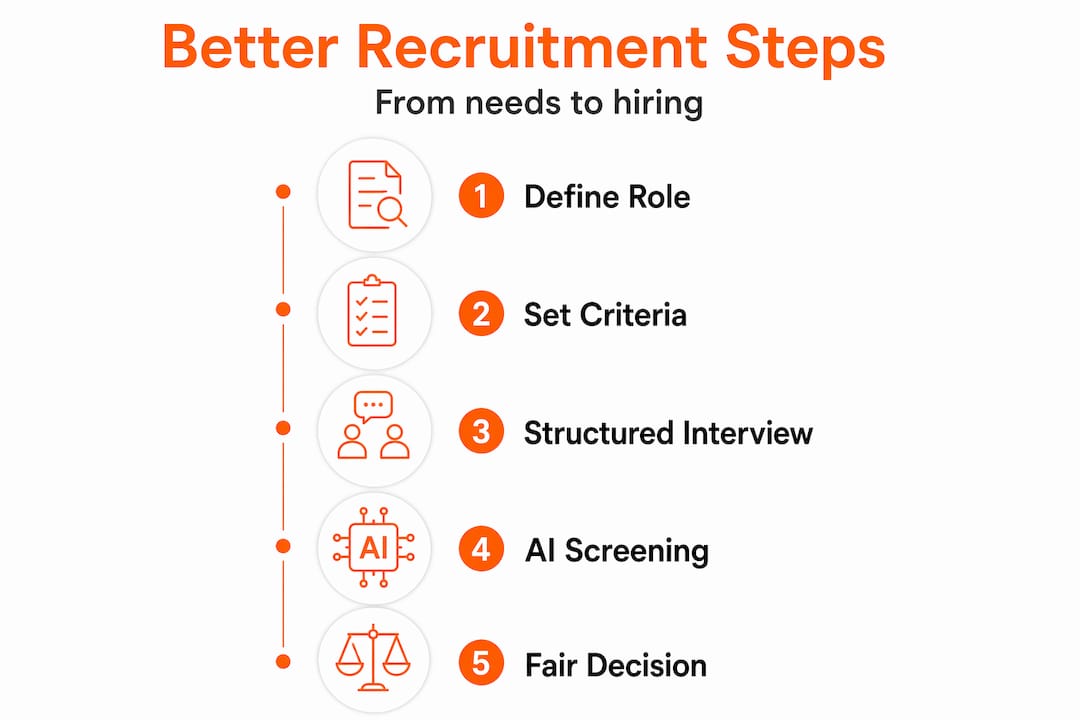
Skills-based architectures are now a top priority for 63% of organizations, and for good reason. When you define what a role actually requires in terms of observable, measurable skills and behaviors, every downstream decision becomes easier: writing a job description, designing an assessment, building an interview guide, and scoring candidates.
Here is a practical framework to define role requirements:
- Start with business outcomes. Ask the hiring manager what success looks like at 90 days and at 12 months. Then work backward to identify the skills that drive those outcomes.
- Separate must-haves from nice-to-haves. Create a non-negotiable quality bar for core abilities. These are the filters that no candidate passes without meeting. Everything else is a preference, not a requirement.
- Translate outcomes into behaviors. Instead of writing “strong communicator,” write “presents technical findings to non-technical stakeholders in a way that drives decisions.” That specificity is what makes screening and interviewing measurable.
- Document and circulate before posting. Share the requirements with the hiring manager, the team lead, and any interviewers who will be involved. Alignment here prevents the mid-process pivots that slow down everything.
Role definition quality checklist:
| Requirement type | Vague version | Measurable version |
|---|---|---|
| Communication | “Good communicator” | “Presents findings to C-suite with clarity” |
| Technical skill | “Knows SQL” | “Writes complex queries for reporting in under 2 hours” |
| Collaboration | “Team player” | “Coordinates cross-functional deliverables on time” |
| Problem-solving | “Creative thinker” | “Diagnoses root causes before escalating issues” |
Pro Tip: Run a “day in the life” exercise with the current team. Ask them to describe what they actually do in a typical week. The patterns that emerge often reveal hidden requirements that never make it into formal job descriptions.
Integrating AI solutions for recruitment at this stage, for example using AI to generate skill frameworks or benchmark requirements against market data, can dramatically accelerate the preparation phase while keeping the output grounded in real role needs.
Execute with rigor: structured interviews and fair evaluation
With requirements in hand, you are ready to shift from generic interviews to consistent, evidence-based assessment. This is where the investment in preparation pays off.

Structured interviewing and scorecards improve predictive validity, consistency, and reduce adverse impact compared to unstructured conversations. That means you hire people who actually succeed in the role, and you reduce legal and reputational risk in the process.
Steps to build a structured interview system:
- Develop a standard question bank. Every candidate for a given role answers the same core questions. Situational and behavioral questions tied to your defined competencies work best.
- Build behaviorally-anchored rubrics. For each question, define what a 1, 3, and 5 response looks like. This eliminates interpretation drift across interviewers.
- Align interviewers before the first call. Brief every panelist on the rubric, their specific focus areas, and the expected format. A 15-minute alignment call prevents hours of inconsistent feedback.
- Require written scores before group debrief. When interviewers record their independent scores before comparing notes, you avoid anchoring bias, where one strong voice shapes everyone else’s judgment.
Structured vs. unstructured interviews at a glance:
| Factor | Unstructured | Structured |
|---|---|---|
| Consistency | Low | High |
| Bias risk | High | Reduced |
| Predictive validity | Weak | Strong |
| Candidate fairness | Variable | Equal |
| Decision documentation | Informal | Formal and reviewable |
Pro Tip: Record score rationale in writing for every candidate who reaches the interview stage. This documentation protects your organization during disputes and creates a learning archive for future hiring cycles.
Building a bias-free hiring assessment process is not just an ethical responsibility. It is a competitive advantage. Organizations that hire based on demonstrable skills rather than subjective impressions consistently build higher-performing, more diverse teams.
Innovate with AI: speed up screening and enhance candidate experience
Modern recruitment goes beyond manual effort; here is how AI tools can dramatically support the screening phase. Done well, AI does not replace the human parts of hiring. It protects them by handling the volume so your team can focus on depth.
AI can triage and accelerate screening for high-volume roles, but candidate experience and transparency should be designed into each touchpoint. That sentence carries a lot of weight. Speed without thoughtful design creates a pipeline that filters fast but frustrates candidates along the way.
Where AI adds the most value in early-stage screening:
- Reviewing test task submissions against defined competency criteria
- Flagging which applicants meet your baseline qualification threshold
- Generating structured summary reports on candidate responses for recruiter review
- Sending automated, personalized status updates so candidates are not left in the dark
- Scoring written or work-sample submissions consistently across hundreds of applications
Statistic callout: Organizations using AI-assisted screening report up to 50% reduction in time-to-first-interview while maintaining or improving quality-of-hire metrics when the AI is properly calibrated to role-specific requirements.
The candidate experience dimension deserves equal attention. Many HR teams implement AI to reduce their own workload but forget to think about what the process feels like from the other side. Candidates who receive fast, clear communication, even automated, are significantly more likely to stay engaged and accept offers. Silence kills pipelines.
The AI-powered hiring guide framework recommends communicating timelines and next steps immediately upon application. Set expectations early. Tell candidates when they will hear back, how decisions are made, and what the process involves. That transparency costs nothing and builds employer brand at scale.
Governance and fairness: staying compliant and data-driven with AI
With AI’s advantages come important checks. Here is how to ensure safe, ethical, and defensible hiring practices that hold up to scrutiny inside and outside the organization.
Organizations should not delegate decisions solely to AI and must document and justify outcomes for legal defensibility. This is not a suggestion. It is a legal and operational imperative, especially as regulators in the United States and globally increase oversight of automated hiring systems.
Governance checklist for AI-assisted recruitment:
- Document every stage. Keep records of how each candidate was assessed, which tools were used, and what criteria were applied at each step.
- Human sign-off on final decisions. AI can rank, filter, and summarize, but a qualified human must own and explain every hiring decision.
- Audit AI recommendations regularly. Review outputs for demographic patterns that might indicate bias. If one group consistently scores lower without a job-related explanation, investigate and recalibrate.
- Maintain explainability. Every AI-generated output that influences a hiring decision should be explainable in plain language to both the candidate and a regulator if asked.
- Establish a review cadence. Monthly or quarterly audits of AI screening decisions keep your process honest and protect you from accumulated drift over time.
“The most defensible hiring process is one where every decision can be traced back to a documented, job-relevant criterion.”
Understanding the AI risks and best practices that apply to your specific hiring context is essential before deploying any automated screening system. The organizations that get this right treat governance not as a compliance burden but as a quality signal. When you can explain every decision, you make better decisions.
Transparency protects both candidates and your organization. Candidates deserve to know how they are being evaluated. Your legal team needs documentation if decisions are ever challenged. And your hiring managers need confidence that the process is producing reliable results, not just fast ones.
The uncomfortable truth about AI and human judgment in hiring
Having covered every part of the improved recruitment journey, it is time to reflect on what actually delivers results. And the honest answer is harder to hear than most vendors will tell you.
No algorithm replaces manager judgment. Hiring managers carry accountability for team performance that no software shares. When a new hire fails, it is the manager who navigates the fallout, re-divides the workload, and eventually restarts the process. That accountability requires human judgment at the final stage, every time, without exception.
The risk with powerful AI tools is not that they perform poorly. It is that they perform well enough to make humans feel comfortable handing over decisions they should not hand over. When a platform scores a candidate highly, the temptation is to trust the score and move fast. That temptation is exactly where organizations create legal exposure and ethical blind spots.
The best organizations use AI to do what AI does well: process volume, apply criteria consistently, and surface patterns humans would miss. Then they use human judgment to do what humans do well: contextualize ambiguous signals, assess culture and values alignment, and take accountability for the decision.
Smarter hiring with AI is not about replacing the human process. It is about protecting it. When AI handles the repetitive and the high-volume, your recruiters and hiring managers have more time and mental bandwidth for the conversations that actually determine fit. That is the balance worth pursuing.
The most trusted employer brands are built on processes that candidates and employees describe as fair, clear, and respectful. Automation can support all three of those qualities. But it can also undermine them if speed becomes the only metric that matters. Prioritize process integrity alongside efficiency, and your hiring outcomes will reflect it consistently.
Accelerate your hiring transformation with AI-powered tools
Ready to put these strategies to work? Here is how technology can move you from concepts to execution.
The frameworks in this guide work best when the tools you use are built for them. testask is an AI recruitment assessment platform designed specifically for HR teams that want to operationalize skills-based, structured, and AI-assisted hiring in a single workflow. You can generate tailored test tasks for any role, evaluate candidate submissions with AI-assisted analysis, and collaborate with hiring managers on scores in one place.
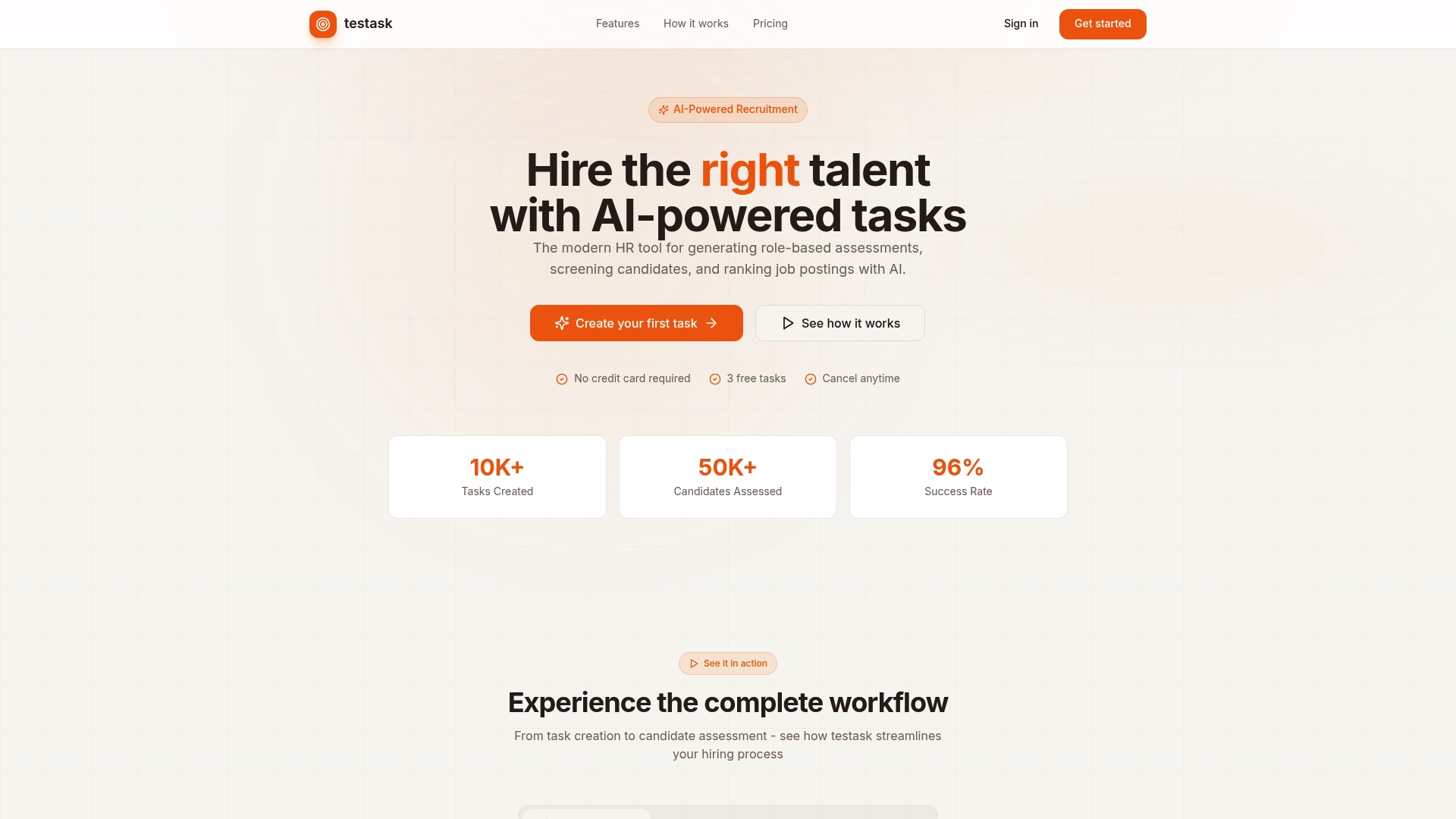
testask enables your team to screen faster without sacrificing quality, build structured rubrics that reduce bias, and maintain a full audit trail for every candidate. Whether you are managing 50 applications or 5,000, the platform scales with your process and keeps human decision-makers in control. If you are ready to modernize your hiring, start with testask and see how much stronger your pipeline becomes.
Frequently asked questions
What are the best ways to ensure fair candidate evaluation?
Use structured interviews and rubrics to make evaluations consistent and objective across every candidate, which directly reduces the risk of demographic or preference-based bias influencing your decisions.
Where should I start when overhauling our recruitment process?
Start by clearly defining job-related skills and quality bars for each role before sourcing candidates or selecting tools, since clarity at this stage determines the accuracy of every subsequent decision.
How can AI be used responsibly in recruitment?
AI should handle initial screening and scoring, but final decisions must involve human oversight and documentation to ensure legal defensibility and maintain accountability throughout the hiring process.
What is the biggest benefit of AI for high-volume roles?
AI triage for high-volume roles dramatically reduces the time it takes to review large applicant pools, freeing your recruiters to focus their energy on meaningful, high-impact candidate conversations.
Recommended
- Hiring process best practices: proven steps for better talent | Testask Blog | testask
- Build an effective recruitment checklist for HR success | Testask Blog | testask
- Recruitment assessment steps: your guide to bias-free hiring | Testask Blog | testask
- testask - AI-Powered Recruitment Assessment Platform