Candidate Screening Process Guide: Streamlined Hiring Steps
Candidate Screening Process Guide: Streamlined Hiring Steps

You’ve invested in an ATS, trained your recruiters, and posted detailed job descriptions. Yet you’re still sorting through hundreds of unqualified applications, losing strong candidates to slow timelines, and watching new hires exit within six months. The problem often isn’t your tools. It’s the process behind them. This guide walks you through a research-backed, end-to-end candidate screening process, covering how to define criteria, structure your funnel, apply AI effectively, and maintain compliance. Every step is grounded in current data and designed for HR leaders who need results, not theory.
Table of Contents
- Defining clear requirements and screening criteria
- Mapping the ideal screening funnel: Stages, tools, and timing
- Leveraging AI and assessments for smarter, faster screening
- Ensuring fairness, compliance, and continuous improvement
- What most guides miss: Why nuance trumps automation in candidate screening
- Unlock smarter, scalable hiring with modern screening tools
- Frequently asked questions
Key Takeaways
| Point | Details |
|---|---|
| Set criteria first | Carefully defined must-haves and scorecards drive unbiased screening from day one. |
| Structure your funnel | Organize your stages, timing, and tools for clear, consistent candidate progress. |
| Combine AI and HR expertise | Maximize efficiency and reduce bias by using AI—always with human oversight for edge cases. |
| Monitor and optimize | Regularly check for bias, compliance, and down-funnel results to improve your processes. |
Defining clear requirements and screening criteria
Every strong screening process begins long before the first resume lands in your inbox. The critical first step is separating must-have qualifications from nice-to-have ones, and making sure your entire hiring team agrees on that distinction before you start reviewing candidates.
Must-have criteria are the non-negotiables: specific technical skills, certifications, years of relevant experience, or legal requirements for the role. Nice-to-haves are the qualities that add value but won’t disqualify an otherwise strong candidate. Mixing these two categories is one of the most common causes of inconsistent screening decisions.
Defining clear must-have criteria upfront ensures all screeners align and reduces bias across your team. When each reviewer operates from the same documented standard, you eliminate the subjective drift that leads to both poor hires and missed talent.
Here’s a practical framework to get started:
- List role outcomes first. Identify the three to five business results this hire needs to produce within 90 days. Work backward to determine what skills and traits make those outcomes achievable.
- Separate criteria into tiers. Tier 1 is disqualifying if absent. Tier 2 is strongly preferred. Tier 3 is a bonus. Document all three.
- Build a structured scorecard. Use structured scorecards with weighted criteria so every reviewer scores candidates on the same dimensions.
- Standardize interview questions. Tie each question directly to a scorecard criterion. This keeps evaluations comparable and legally defensible.
- Apply legal and fairness checks early. Review criteria for potential adverse impact before posting. Criteria unrelated to job performance create compliance exposure.
The discipline of defining criteria before you see any resumes is what separates structured hiring from gut-feel hiring. It’s also your first line of defense against unconscious bias.
Pro Tip: Run your criteria list through a quick “business outcome” test. Ask: if a candidate meets this requirement but fails to deliver the core outcomes, does it still matter? If the answer is no, it’s probably a nice-to-have, not a must-have.
AI-powered screening tools can help you score candidates against your criteria at scale, but only if those criteria are clearly defined and weighted from the start. Garbage in, garbage out applies just as much to AI as it does to human review.
Mapping the ideal screening funnel: Stages, tools, and timing
Once your requirements are defined, you need a structured funnel so every candidate moves through evaluation in a consistent, efficient sequence. Without this, you end up with uneven timelines, missed follow-ups, and drop-off points you can’t diagnose.
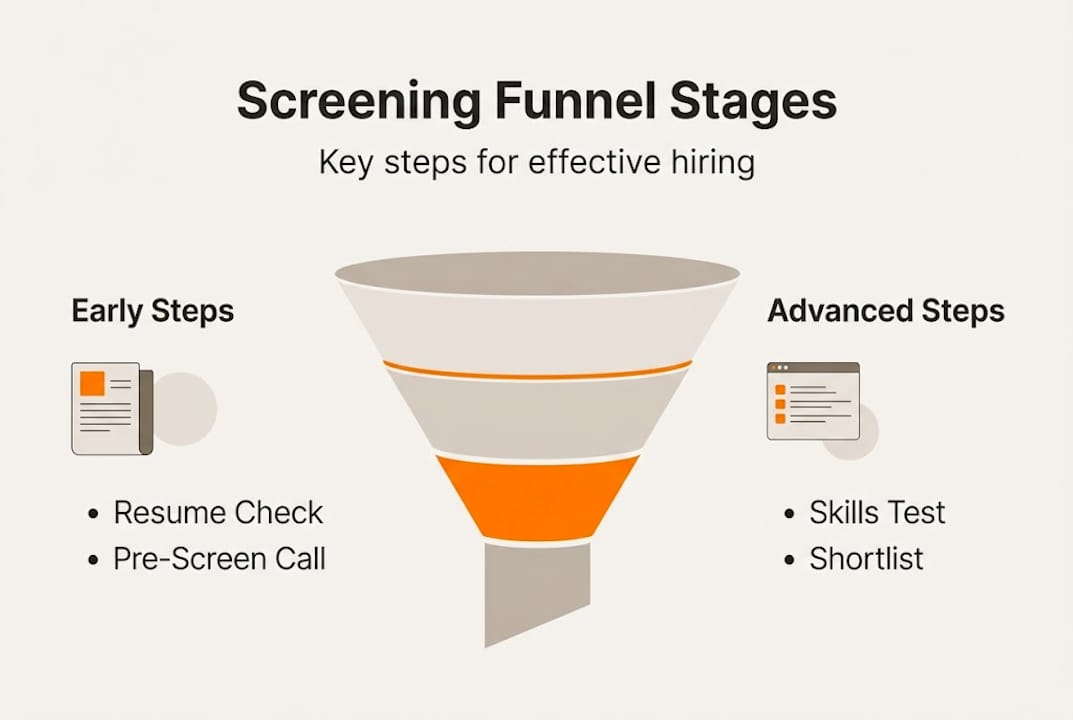
Candidate screening typically involves staged resume review, pre-screening interviews, skills tests, and structured shortlisting. Here’s what a well-mapped funnel looks like in practice:
- Application and resume review (Days 1 to 3). Use AI resume parsing to filter for must-have criteria. Flag edge cases for human review. Target: reduce your applicant pool to the top 20 to 30 percent.
- Pre-screening call or async video (Days 3 to 5). Confirm availability, compensation alignment, and basic role fit. Keep it under 20 minutes. Use a standard question set.
- Skills assessment (Days 5 to 8). Deploy role-specific tests covering technical and behavioral competencies. This stage is where most unqualified candidates self-select out.
- Structured shortlist review (Days 8 to 10). Score assessment results against your weighted criteria. Align the hiring team on final candidates before moving to interviews.
- Final interviews and decision (Days 10 to 15). Reserve deeper conversation for the top three to five candidates. Use a standardized interview guide.
| Funnel Stage | Primary Tool | Benchmark Timeline | Target Pass Rate |
|---|---|---|---|
| Resume review | ATS + AI parsing | Days 1 to 3 | 20 to 30% of applicants |
| Pre-screen call | Video or phone | Days 3 to 5 | 50 to 60% of reviewed |
| Skills assessment | Assessment platform | Days 5 to 8 | 40 to 50% of screened |
| Shortlist review | Scorecard tool | Days 8 to 10 | Top 5 to 10 candidates |
| Final interviews | Structured guide | Days 10 to 15 | 1 to 3 finalists |
Pro Tip: Track drop-off rates at each stage. If you’re losing candidates between the assessment and shortlist stages, your test may be too long or poorly calibrated. If drop-off spikes at pre-screen, revisit your job description for clarity.
ATS and AI interview platforms can automate handoffs between stages and flag timing delays before they cost you top candidates. Review AI resume parsing tips to make sure your automated filters are working with your criteria, not against them.

Leveraging AI and assessments for smarter, faster screening
With your funnel structured, the next priority is extracting maximum efficiency from the tools inside it. AI screening tools have matured significantly, and the performance data now justifies their use at scale, provided you maintain meaningful human oversight.
The numbers are significant: AI tools cut interviews by 44% and improve pass rates to hire by 20 percentage points (54% vs. 34%), but require human oversight to avoid bias. That’s a material improvement in both speed and quality, assuming the AI models are well-configured and regularly audited.
Here’s how to layer AI effectively across your screening funnel:
- Resume parsing and ranking. AI models extract and score structured data from resumes against your defined criteria. This works well for high-volume roles where must-have criteria are concrete.
- Conversational AI pre-screening. Automated chatbots or async video platforms handle first-round questions, freeing recruiters for higher-value work. They’re most effective when questions map directly to role requirements.
- Domain-specific assessment models. For technical roles, AI-graded coding tests or writing assessments reduce evaluator subjectivity and improve consistency.
- Human-in-the-loop review. Flag candidates who score near decision boundaries for human review. Never let AI make final hiring decisions without a recruiter or hiring manager in the loop.
| Approach | Strengths | Watch Points |
|---|---|---|
| AI resume parsing | Fast, consistent, scalable | Can filter out nontraditional candidates |
| Async video screening | Saves recruiter time, standardized | Candidate drop-off risk if experience is poor |
| AI skills assessments | Objective scoring, role-relevant | Requires calibration and regular review |
| Human review layer | Catches edge cases, adds judgment | Can reintroduce inconsistency if unstructured |
The temptation to automate end-to-end is understandable, especially when you’re managing hundreds of applications per role. But unchecked automation creates its own problems. Bias can enter AI models through historical hiring data, and candidates with strong potential may never reach a human reviewer. Use AI-driven assessments as an accelerator, not a replacement for structured human judgment.
Ensuring fairness, compliance, and continuous improvement
Even a well-designed funnel degrades over time if you don’t monitor its outputs. Fairness and compliance aren’t one-time setup tasks. They require ongoing attention, especially as AI tools evolve and legal requirements tighten.
Compliance demands constant monitoring, with NYC Law 144, the four-fifths rule, and AI bias audits now central to modern screening practice. Here’s how to build that monitoring into your regular workflow:
- Apply the four-fifths rule monthly. For each demographic group, calculate selection rates and flag any group whose rate falls below 80 percent of the highest-rated group. Investigate immediately.
- Audit AI models quarterly. Document model inputs, outputs, and any changes made. If you use a third-party AI screening tool, request their bias audit reports annually.
- Track outcome metrics by cohort. Monitor 90-day retention and performance ratings by demographic group. If gaps appear, trace them back to screening stage data.
- Keep criteria documentation updated. When a role evolves, update your scorecard before the next cycle. Outdated criteria create both compliance gaps and bad hires.
- Share screening metrics with internal stakeholders. Transparency builds trust and surfaces blind spots that a single team might miss.
Fairness in screening is not a fixed destination. It’s a continuous process that requires data, accountability, and the willingness to change when the numbers point to a problem.
For HR teams managing compliance across multiple jurisdictions, a centralized compliance toolkit is invaluable for staying current on regulatory updates. Use monthly monitoring tools to automate metric collection and flag anomalies before they become audit findings.
What most guides miss: Why nuance trumps automation in candidate screening
Most screening guides focus on process optimization. This one does too. But there’s something worth saying directly: automation is a tool, not a strategy. The candidates who most often get screened out unfairly are the ones with the highest potential to surprise you.
Nontraditional backgrounds and employment gaps require human judgment, and between 21 and 78 percent of candidates embellish resumes, meaning AI alone will both over-filter and under-filter at the same time. A candidate with a two-year gap who spent that time caregiving, freelancing, or recovering from illness may bring resilience and adaptability that a linear career path never develops. AI models trained on historical data won’t recognize that. A good recruiter might.
The counterintuitive truth is that the fastest hire is rarely the best hire at the final stage. Speed matters enormously in early-funnel efficiency. But at the shortlist review and interview stages, slowing down to apply balancing AI with HR expertise consistently produces stronger outcomes than rushing to a decision. The combining tech and judgment approach isn’t a compromise. It’s the actual best practice. Human-in-the-loop isn’t just a compliance requirement. It’s what separates organizations that hire well from those that hire fast.
Unlock smarter, scalable hiring with modern screening tools
Putting a research-backed screening process into practice requires more than documentation and good intentions. You need tools that align with your criteria, support your funnel, and give your team the visibility to make confident decisions at every stage.
testask is built for exactly this. As an AI-powered recruitment platform, it enables your team to generate tailored assessment tasks, evaluate candidate submissions with AI-assisted analysis, and collaborate on reviews in one place. Whether you’re managing 50 applicants or 5,000, testask helps you screen faster, score consistently, and stay compliant without adding headcount. If you’re ready to raise your hiring bar, explore how testask can support your next screening cycle from criteria to decision.
Frequently asked questions
What are the key steps in an effective candidate screening process?
Candidate screening typically involves staged resume review, pre-screening interviews, skills tests, and structured shortlisting. Each step should be tied to documented, weighted criteria and reviewed for compliance on a regular basis.
How does AI improve candidate screening?
AI tools cut interviews by 44% and improve pass rates to hire by 20 percentage points, automating resume parsing and surfacing top candidates faster while reducing manual workload for recruiters.
What are compliance risks in screening, and how can HR teams address them?
Compliance demands constant monitoring given NYC Law 144, the four-fifths rule, and AI bias audits. Regular model audits, monthly metric reviews, and documented selection criteria are the most effective mitigation strategies.
How do you handle candidates with employment gaps or nontraditional backgrounds?
Nontraditional backgrounds require human judgment because AI models often undervalue resilience and adaptability. Use structured human review at the shortlist stage to evaluate potential beyond what a resume or test score reveals.