What is recruitment forecasting? A guide for HR leaders
What is recruitment forecasting? A guide for HR leaders

Recruitment forecasting is the forward-looking process of estimating future staffing needs using historical data, business projections, and labor market signals to plan ahead rather than react to shortages. Many HR leaders conflate it with headcount budgeting, but these are fundamentally different activities. Budgeting allocates dollars. Forecasting predicts talent needs by role, skill, timing, and volume, giving you the analytical foundation to build a hiring strategy that actually holds up. This guide breaks down what recruitment forecasting is, how it works, which methods apply when, and how to turn forecast insights into decisions that matter.
Table of Contents
- Understanding recruitment forecasting: core concepts and components
- Methods and models for effective recruitment forecasting
- Incorporating operational recruiting metrics for forecast accuracy
- Best practices: maintaining a dynamic and collaborative forecasting process
- Applying recruitment forecasting insights to make strategic hiring decisions
- Why most recruitment forecasting fails without continuous validation and cross-team alignment
- Empower your recruitment forecasting with Testask AI-powered assessments
- Frequently asked questions
Key Takeaways
| Point | Details |
|---|---|
| Recruitment forecasting defined | It predicts future staffing needs by analyzing talent demand and supply using data-driven methods. |
| Forecasting versus planning | Forecasting is analytical prediction; planning translates forecasts into hiring and development actions. |
| Link metrics to forecasts | Metrics like time-to-fill and offer acceptance refine forecasts and improve recruiting outcomes. |
| Continuous validation | Dynamic forecasting with cross-team ownership and rolling updates ensures accuracy and relevance. |
| Use forecasting strategically | Apply gap analyses to guide hiring, training, and workforce adjustments aligned with business goals. |
Understanding recruitment forecasting: core concepts and components
Recruitment forecasting is a predictive analytics process. It answers one core question: given where the business is heading, what talent will you need, when will you need it, and where will it come from? The answer draws on workforce forecasting inputs that span both internal data (attrition rates, internal mobility, current headcount) and external signals (labor market trends, competitor hiring patterns, educational pipelines).
It is worth separating forecasting from workforce planning, because these two terms get used interchangeably and that causes real problems. Workforce forecasting is the predictive analytical layer, and workforce planning is the set of actions built from those findings. You forecast first. Then you plan. Skipping straight to planning without a grounded forecast means you are making hiring decisions based on gut feel and legacy budgets.
Effective recruitment forecasting relies on tracking the right recruitment analytics metrics to feed the model with meaningful inputs. The main components include:
- Demand signals: Business growth targets, product launches, market expansion, and workforce turnover rates
- Supply signals: Internal talent pipeline depth, redeployment options, external candidate availability, and time-to-fill benchmarks
- Gap analysis: The comparison between forecasted demand and forecasted supply, which identifies the shortfall or surplus that drives hiring priorities
- Time horizons: Short-term forecasts cover 0 to 6 months and focus on immediate pipeline needs. Medium-term spans 6 to 18 months and ties to business planning cycles. Long-term goes beyond 18 months and informs workforce design and skill-building strategy.
Getting these components right gives you a living picture of your talent situation, not a static snapshot.
Methods and models for effective recruitment forecasting
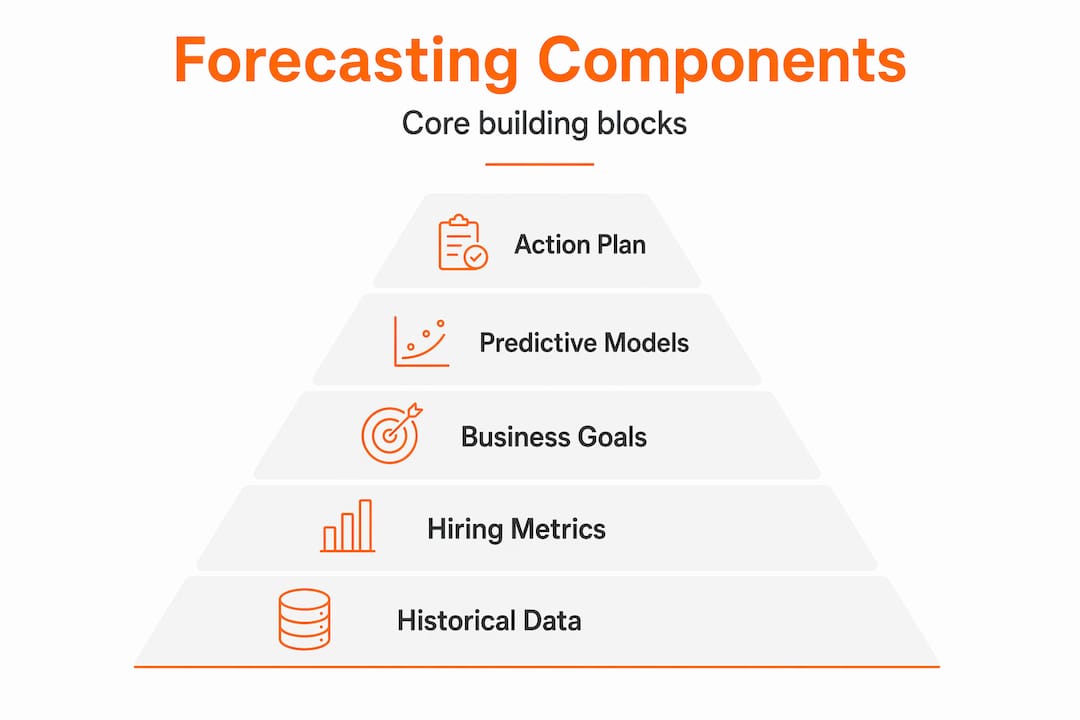
Understanding how forecasts are actually built separates teams that use forecasting well from those that produce spreadsheets no one trusts. The four primary forecasting method families are statistical/quantitative models, ratio-based models, managerial judgment, and hybrid approaches, each suited to different time horizons and data environments.
Here is a quick comparison to help you choose:
| Method | Best for | Strengths | Watch out for |
|---|---|---|---|
| Statistical/quantitative | Medium to long-term | Objective, scalable, pattern-based | Requires clean historical data |
| Ratio-based | Short to medium-term | Simple, easy to explain | Breaks down in high-growth or shifting models |
| Managerial judgment | Short-term, niche roles | Captures context, nuance | Biased, inconsistent without structure |
| Hybrid | All horizons | Balances data with human insight | Harder to maintain and validate |
The method you use should match your data quality, your forecast horizon, and your tolerance for error. A startup scaling rapidly cannot rely on ratio-based models built from two years of stable hiring data. A large enterprise forecasting nursing demand over three years cannot rely purely on a manager’s gut.
Data quality deserves special attention. Models built on incomplete ATS records, inconsistent role taxonomies, or untracked attrition will produce numbers that look precise but mislead. Continuous validation, meaning comparing past forecasts against actual outcomes, is the only honest way to know if your model is working. Good use of data analytics in hiring means building validation into your forecasting calendar from day one, not retrofitting it after a bad quarter.

Pro Tip: Keep forecasting and planning in separate workstreams with separate owners. When the same team that builds the forecast also controls the headcount budget, they unconsciously anchor predictions to what leadership wants to hear rather than what the data says.
Incorporating operational recruiting metrics for forecast accuracy
Forecasting does not live in isolation. Your recruiting operations produce real-time data that either confirms or challenges your model’s assumptions. Linking forecasting models to measurable outcomes like time-to-fill, offer acceptance rates, and retention is what turns a theoretical forecast into a continuously improving system.
Here is how each metric functions as a feedback loop:
- Time-to-fill: If your forecast assumes a 30-day fill time for senior engineers but actual data shows 55 days, your hiring timeline model is structurally flawed. Forecasts must adjust for real pipeline velocity.
- Offer acceptance rates: A 65% acceptance rate means you are effectively recruiting for far more roles than your headcount plan shows. Your forecast needs to account for offer-to-accept falloff to calculate true pipeline volume needs.
- Quality-of-hire proxies: Early performance ratings and 90-day retention data tell you whether your sourcing strategies are delivering the right talent, not just any talent. This feeds back into where you focus candidate generation efforts.
- Attrition by segment: Not all turnover is equal. Voluntary attrition in high-skill roles creates demand you cannot fill quickly. Tracking this by role family and tenure level sharpens your demand-side model considerably.
Pro Tip: Separate your headcount targets from your pipeline forecasting. Headcount targets tell you the destination. Pipeline forecasting tells you how many candidates, at what conversion rates, you need to source to get there. Conflating these two leads to under-resourced recruiting teams and missed timelines.
Reviewing core recruitment metrics regularly ensures your forecast inputs stay grounded in current reality rather than last year’s assumptions.
Best practices: maintaining a dynamic and collaborative forecasting process
Most forecasting efforts fail not because of bad math but because of bad process. Static, annual forecasts built in Q4 and filed away until Q4 the following year are worse than useless. They give decision-makers false confidence while the business shifts underneath them.
“The teams that get forecasting right treat it as an ongoing operating rhythm, not an annual deliverable. They assign ownership to specific inputs, run rolling 13-week updates, and treat every deviation between forecast and reality as a signal worth investigating.” — Talent Acquisition Strategy
High-performing teams run continuous forecasting with live data feeds and explicit ownership of every major input. Here is how to build that kind of process:
- Assign input ownership across departments. Finance owns headcount budgets. Business unit leaders own growth projections. HR owns attrition and internal mobility data. When each input has a clear owner, assumptions stay current.
- Run rolling forecast cycles. Replace the annual plan with 13-week rolling updates. Each cycle reviews the prior forecast, identifies variances, and updates assumptions before projecting forward.
- Document your assumptions explicitly. Every forecast is built on assumptions. Write them down. When a forecast misses, you can trace the error to its source rather than blaming the model.
- Review assumptions after major business events. Acquisitions, product pivots, and market contractions all invalidate existing assumptions. Build a trigger-based review into your governance process.
- Share forecast outputs with business partners. HR should not be the only consumer of recruitment forecasting. Functional leaders who see the forecast are more likely to flag when their hiring plans change, giving you earlier warning.
Connecting forecasting outputs to smarter talent acquisition decisions requires that business leaders and HR operate from the same data. That requires collaboration, not just calculation.
Applying recruitment forecasting insights to make strategic hiring decisions
Forecasting only creates value when it changes what you do. The output of a well-built forecast is a gap analysis, and that gap analysis should directly drive your hiring, development, and workforce design choices.
Using gap analysis to decide whether to hire, train, or reorganize talent is how forecasting translates into strategy. Here is what that looks like across different scenarios:
| Forecast gap scenario | Recommended action |
|---|---|
| 12-month supply deficit in high-skill roles | Begin external sourcing now, build 6-month pipeline |
| Moderate short-term gap in trainable roles | Prioritize internal development and redeployment |
| Surplus headcount in a declining function | Redeploy or plan managed transitions before cost pressure builds |
| Seasonal demand spike in 90 days | Activate contract or temporary workforce channels immediately |
| Long-term skills gap in emerging technology | Launch upskilling programs and adjust graduate hiring targets |
Strategic decisions driven by strong forecasting include:
- Prioritizing which roles to fill internally versus externally based on pipeline depth and time constraints
- Deciding when to build talent pools proactively rather than posting jobs reactively
- Identifying which geographies or sourcing channels produce the fastest time-to-fill for hard-to-hire roles
- Aligning recruiting team capacity with projected hiring volume 6 to 12 months ahead
Understanding talent acquisition tips alongside forecasting data helps you act on gaps faster. Equally important is tracking measuring recruitment ROI so you can demonstrate that forecast-driven hiring delivers better outcomes than reactive approaches.
Why most recruitment forecasting fails without continuous validation and cross-team alignment
Here is the uncomfortable truth most forecasting guides skip: the majority of recruitment forecasting efforts produce documents that get presented once and then ignored. Not because the methodology was wrong. Because the process was treated as an event rather than a discipline.
Confusing forecasting with headcount planning is one of the most common and costly errors HR teams make. When the same spreadsheet contains both the predictive model and the budget allocation, you cannot tell whether a number reflects an analytical conclusion or a political compromise. The two activities need to stay separate.
Static forecasts fail for a second reason: the assumptions they are built on expire fast. A forecast built in January assuming 15% annual growth becomes fiction by April if the business pivots or funding tightens. Without rolling updates and documented assumptions, nobody knows which parts of the forecast are still valid.
Leadership alignment failures are the third failure mode, and the hardest to fix. When HR builds a forecast in isolation and presents it to business leaders as a finished output, those leaders tend to reject or ignore it when it conflicts with their operational plans. Forecasting built with business partners, where hiring managers contribute their own demand signals, generates outputs that teams actually use.
Common mistakes and how to correct them:
- Treating forecasting as annual: Replace with rolling cycles tied to business planning rhythms
- Conflating forecast and plan in one document: Separate the analytical model from the action plan
- Skipping validation against actual outcomes: Build a monthly variance review into your recruiting operations calendar
- Allowing a single person to own all inputs: Distribute ownership across finance, operations, and HR to reduce single points of failure
- Ignoring external labor market signals: Internal data alone cannot predict talent availability in tight markets
Using AI recruitment strategies to surface patterns in hiring data gives you an earlier warning system than manual analysis allows. The goal is a forecasting culture, not a forecasting spreadsheet.
Empower your recruitment forecasting with Testask AI-powered assessments
Recruitment forecasting tells you what you need and when. But filling those gaps quickly and accurately still depends on how well you evaluate candidates once they enter your pipeline.
Testask’s AI-powered assessment platform helps HR teams generate tailored test tasks, review candidate submissions with AI-assisted analysis, and collaborate on hiring decisions in one place. When your forecasting model flags an urgent gap in a technical role, Testask helps you screen and assess candidates faster without sacrificing evaluation quality. You can read more about AI recruitment for HR leaders to see how AI-driven insights accelerate the transition from forecast gap to confident hire. Better assessments feed better data back into your forecasting model, turning your hiring process into a continuous improvement system.
Frequently asked questions
What is the key difference between recruitment forecasting and workforce planning?
Recruitment forecasting uses data to predict future talent needs, while workforce planning builds hiring and development actions based on those predictions. Forecasting is the analytical input, and workforce planning is the operational translation of those findings into decisions.
How often should organizations update their recruitment forecasts?
Organizations should update forecasts continuously using rolling cycles with recent data and validated assumptions to remain responsive to workforce changes. Continuous forecasting with rolling updates over approximately 13 weeks using live pipeline and attrition data reduces errors and improves hiring agility.
Which recruiting metrics best support accurate recruitment forecasting?
Time-to-fill, offer acceptance rates, and retention proxies are essential metrics that help assess and improve forecast accuracy. Forecasting models should measure time-to-fill, offer acceptance, and retention metrics to continuously improve hiring quality and predictions.
Can AI improve recruitment forecasting effectiveness?
Yes. AI-driven analytics uncover complex patterns in hiring data, enhancing forecast precision and enabling smarter talent acquisition decisions. AI and predictive analytics allow companies to build flexible recruitment models that adapt to changing talent needs.