8 Recruitment Analytics Metrics Every HR Leader Needs
8 Recruitment Analytics Metrics Every HR Leader Needs

Hiring decisions made without data are expensive guesses. When you’re managing high-volume pipelines, competing for specialized talent, or justifying headcount to the board, you need precise, actionable numbers to guide every step. Key recruitment analytics metrics include cost-per-hire, time-to-hire, quality of hire, source of hire, offer acceptance rate, first-year attrition, funnel conversion rates, and recruiter performance measures. Together, they give HR leaders a clear picture of what’s working, what’s broken, and where to invest next. This guide walks through each metric in detail, with benchmarks, comparison tools, and practical strategies to help your team hire smarter.
Table of Contents
- What are recruitment analytics metrics?
- The 8 essential recruitment analytics metrics
- Side-by-side: Recruitment metrics comparison table
- Applying recruitment metrics: Success strategies and pitfalls
- Why data isn’t enough: The human side of recruitment analytics
- Take your hiring analytics further with AI
- Frequently asked questions
Key Takeaways
| Point | Details |
|---|---|
| Track the right metrics | Choose recruitment analytics metrics that directly support your hiring and business goals. |
| Benchmark consistently | Compare your data to industry standards quarterly to spot gaps and drive improvement. |
| Balance data and judgment | Use analytics for smarter hiring, but always consider context and culture fit. |
| Leverage AI for results | Integrate AI and automation to accelerate processes and enhance analytics accuracy. |
What are recruitment analytics metrics?
Recruitment analytics metrics are quantifiable data points that measure the efficiency, effectiveness, and business impact of your hiring process. They connect individual recruiting activities to broader talent outcomes, giving you the evidence to make strategic decisions rather than reactive ones.
Think of them as the instrumentation panel for your talent acquisition function. Just as a finance team tracks revenue, margin, and burn rate, your recruiting team needs its own set of indicators to assess performance and spot problems early.
The most valuable metrics span three categories:
- Efficiency metrics measure speed and resource use, such as time-to-hire and cost-per-hire
- Quality metrics assess the caliber of candidates you attract and retain, including quality of hire and first-year attrition
- Business impact metrics connect hiring activity to organizational outcomes, such as offer acceptance rate and recruiter performance
Choosing which metrics to prioritize depends on your hiring context. A company scaling a sales team rapidly will weight time-to-fill heavily. A firm hiring senior engineers will focus more on quality of hire and first-year retention. The goal is to select metrics that reflect your current strategic priorities and give you levers to pull when results fall short.
The shift toward integrated analytics is also accelerating. Leading organizations no longer track metrics in isolation. They benchmark against industry data, layer in market intelligence, and use platforms that support recruitment analytics approaches across the full hiring funnel. This integrated view is what separates reactive hiring teams from truly strategic ones.
Pro Tip: Start with three to five metrics that directly connect to your biggest hiring pain points. Adding more metrics before you have clean data and consistent measurement processes just creates noise.
The 8 essential recruitment analytics metrics
Now, let’s break down the most actionable metrics every data-driven hiring leader should be using.
-
Cost-per-hire measures the total investment required to fill a role, including advertising, recruiter time, assessments, and onboarding costs. According to SHRM 2025 benchmarks, the median cost-per-hire is $1,633 for all roles and $5,000 for executive positions. The average jumps to $4,425 for all roles and $14,936 for executives. Tracking this metric helps you compare channels, justify budgets, and identify where spend is disproportionate to results.
-
Time-to-hire tracks the number of days from when a candidate enters your pipeline to when they accept an offer. The US median time-to-hire sits between 35 and 44 days, with time-to-fill averaging about 45 days in 2025. Longer cycles increase the risk of losing top candidates to competitors and signal bottlenecks in your process.
-
Quality of hire is arguably the most strategic metric on this list. It measures how well new hires perform, integrate, and contribute over time, typically assessed through performance scores, manager ratings, and retention data. Despite its importance, only 23% of organizations actively track quality of hire. If your team isn’t measuring it, you’re missing the most direct signal of whether your hiring process actually works.
-
Source of hire identifies which channels (job boards, referrals, social media, agencies, direct sourcing) produce your best candidates. This metric helps you allocate budget toward high-performing sources and deprioritize channels that generate volume without quality. Effective talent acquisition strategies always include source tracking as a core component.
-
Offer acceptance rate reflects the percentage of candidates who accept your job offers. SHRM data shows a national benchmark of 91%, meaning roughly nine in ten offers are accepted. A declining acceptance rate signals issues with compensation, candidate experience, or how your employer brand is perceived late in the process.
-
First-year attrition measures the percentage of new hires who leave within their first twelve months. The SHRM benchmark for first-year attrition sits at 26%, which is significant. High early turnover points to mismatched expectations, poor onboarding, or role fit issues that better screening could prevent.
-
Recruitment funnel conversion rates track how candidates move through each stage of your process, from application to screen to interview to offer. Analyzing drop-off points reveals where your funnel leaks. If 60% of candidates disengage after the first interview, that’s a candidate experience problem, not a sourcing problem.
-
Recruiter performance metrics measure individual recruiter output, including offers made, fills completed, time-to-fill per recruiter, and candidate satisfaction scores. These metrics support coaching conversations, workload balancing, and team capacity planning.
“The best recruiting teams don’t just collect data. They use it to ask sharper questions about why their process produces the results it does.” This mindset shift turns metrics from a reporting exercise into a genuine improvement engine.
Pro Tip: Pair quality of hire data with source of hire data to identify which channels consistently produce high-performing, long-tenured employees. That combination is one of the most powerful insights available to AI and analytics in recruitment.

Side-by-side: Recruitment metrics comparison table
With the core metrics in mind, here’s a quick comparison to help you choose the right ones for your organization.
| Metric | Definition | Primary use | Benchmark | Key pitfall |
|---|---|---|---|---|
| Cost-per-hire | Total spend divided by hires | Budget planning | $1,633 median (all roles) | Ignores quality of hires made |
| Time-to-hire | Days from application to offer accept | Speed optimization | 35 to 44 days (US median) | Fast hiring can reduce quality |
| Quality of hire | Performance and retention of new hires | Long-term ROI | Tracked by only 23% of firms | Hard to measure consistently |
| Source of hire | Channel that produced each hire | Channel investment | Varies by industry | Over-credits last touchpoint |
| Offer acceptance rate | Offers accepted divided by offers made | Employer brand health | 91% (SHRM 2025) | Doesn’t capture declined reasons |
| First-year attrition | New hires leaving within 12 months | Onboarding and fit review | 26% (SHRM 2025) | Lags too long for fast feedback |
| Funnel conversion rates | Stage-by-stage candidate progression | Process optimization | Varies by role and volume | Requires clean ATS data |
| Recruiter performance | Individual output and fill rates | Team management | Internal benchmarks | Can incentivize speed over quality |
The table above highlights a critical tension: efficiency metrics and quality metrics often pull in opposite directions. Optimizing for the fastest time-to-hire can compromise quality of hire. Focusing too narrowly on cost-per-hire can push recruiters toward lower-cost channels that produce weaker candidates.
Context matters enormously when interpreting these numbers. The McKinsey HR Monitor 2025 reports offer acceptance rates as low as 56% in some European markets, with 18% of new hires leaving during probation and an overall hiring success rate of just 46%. These figures underscore why skills-based hiring and real-time analytics have become priorities for global talent teams.
Different hiring scenarios call for different metric weightings:
- Volume hiring (retail, logistics, contact centers): Prioritize time-to-fill, funnel conversion rates, and cost-per-hire
- Executive hiring: Focus on quality of hire, offer acceptance rate, and first-year retention
- Technical hiring (engineering, data science): Weight source of hire, quality of hire, and recruiter performance
- Seasonal or project-based hiring: Track funnel conversion rates and time-to-hire most closely
Applying recruitment metrics: Success strategies and pitfalls
Comparing metrics is only the start. Let’s see how to apply them for real results.
Implementation strategies that drive improvement
-
Establish a baseline before setting targets. You can’t improve what you haven’t measured. Spend the first 30 to 60 days capturing clean data across your priority metrics before setting improvement goals.
-
Use funnel analysis to locate drop-off points. Map your conversion rates at each stage. If applications are high but phone screens are low, your job descriptions may be attracting the wrong audience. If interviews convert well but offers don’t, revisit compensation benchmarking.
-
Integrate AI-powered tools to accelerate data capture and analysis. AI reduces time-to-hire by 26% to 70% in documented cases. Automation in screening, sourcing, and job description generation frees recruiters to focus on high-value candidate interactions rather than administrative tasks.
-
Align metrics to business outcomes, not just HR KPIs. Connect your quality of hire data to revenue per employee, project delivery speed, or customer satisfaction scores. This translation is what earns HR a seat at the strategic table.
-
Share data with hiring managers, not just HR leadership. Decentralized analytics empowers managers to own their part of the hiring outcome, but it requires consistent communication and shared dashboards to work effectively.
“Strategic workforce planning that uses real-time analytics and cross-functional coordination consistently outperforms operational hiring approaches focused only on filling open roles.” This insight from SHRM’s data-driven recruiting research reflects a broader shift in how leading organizations treat talent acquisition.
Common pitfalls and how to avoid them
| Pitfall | Why it happens | How to fix it |
|---|---|---|
| Tracking too many metrics | Trying to measure everything at once | Narrow focus to five core metrics tied to strategic goals |
| Inconsistent data definitions | Different teams count hires differently | Standardize definitions across ATS and reporting tools |
| Ignoring candidate experience signals | Focusing only on internal process data | Add candidate NPS or survey data to your dashboard |
| Over-relying on speed metrics | Pressure to fill roles fast | Balance time-to-hire with quality of hire in every review |
| Neglecting skills-based signals | Relying on resume screening alone | Incorporate structured assessments to generate quality data |
A strong HR strategy for holistic hiring recognizes that metrics are tools for continuous improvement, not scorecards for blame. When attrition spikes or offer acceptance drops, the right response is to investigate root causes, not just adjust targets.
Pro Tip: Set a quarterly review cadence for your recruitment metrics. Monthly reviews can create noise from short-term fluctuations. Quarterly reviews give you enough data to identify genuine trends and make meaningful process changes.
Why data isn’t enough: The human side of recruitment analytics
Here’s a perspective most analytics guides won’t give you: the organizations that struggle most with recruitment metrics are often the ones that trust them too completely.
Metrics measure what happened. They don’t always explain why, and they rarely capture what’s coming. A 91% offer acceptance rate looks excellent until you realize the 9% who declined were your top candidates. A low time-to-hire looks efficient until first-year attrition reveals you rushed past critical culture fit signals.
SHRM’s research on data-driven recruiting is candid about this: HR analytics isn’t always statistically linked to outcomes due to implementation issues, and generative AI adoption in core processes remains at just 19%. The gap between collecting data and generating insight is real and significant.
The teams that get the most from recruitment analytics use metrics to ask better questions, not to automate judgment. They notice when a metric moves and get curious about what changed in the market, the role, the team, or the candidate experience. They treat data as a starting point for conversation, not a replacement for it.
Over-indexing on efficiency metrics, in particular, can quietly erode the candidate experience and damage your employer brand in ways that don’t show up in dashboards for months. The most effective hiring leaders we’ve seen combine rigorous analytics with genuine human insight at every decision point.
Take your hiring analytics further with AI
Ready to put these metrics into action? Here’s where you can start.
Understanding recruitment analytics metrics is one thing. Generating the high-quality data that makes those metrics meaningful is another challenge entirely. Structured candidate assessments are one of the most reliable ways to capture consistent, comparable data across your hiring funnel, especially for quality of hire and funnel conversion analysis.
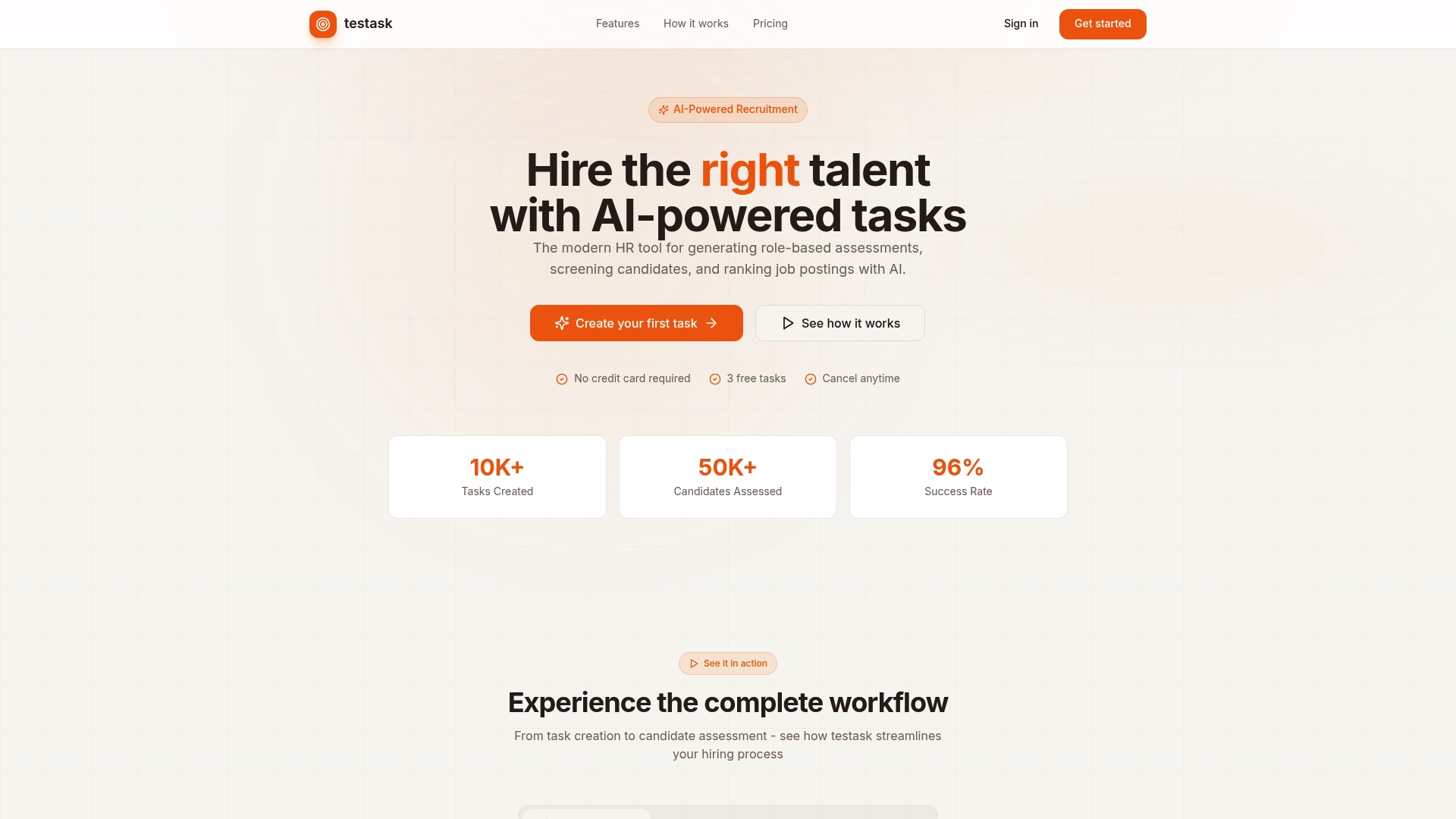
testask is an AI recruitment assessment platform built to help HR teams generate tailored test tasks, evaluate submissions with AI-assisted analysis, and collaborate on hiring decisions faster. When your screening process produces structured, comparable data, every metric on your dashboard becomes more accurate and more actionable. Explore testask subscription options and see how AI-powered assessments can sharpen your hiring analytics from day one.
Frequently asked questions
What is the most important recruitment analytics metric?
Quality of hire is widely considered the most critical metric because it directly measures hiring outcomes, though only 23% of organizations currently track it systematically. Prioritizing this metric gives you the clearest signal of whether your entire hiring process is working.
How does AI help with recruitment analytics?
AI tools can automate up to 70% of time-consuming screening and sourcing tasks, which speeds hiring cycles and generates more consistent data for analytics. The result is a richer, more reliable dataset that makes every metric more meaningful.
How often should you benchmark recruitment metrics?
Most experts recommend benchmarking quarterly against industry standards like SHRM and Gartner to identify genuine trends rather than reacting to short-term fluctuations. Annual benchmarking is too infrequent to catch problems before they become costly.
What are the latest cost-per-hire benchmarks?
In 2025, the median cost-per-hire is $1,633 for all roles and $5,000 for executive hires in the US, with averages significantly higher at $4,425 and $14,936 respectively. Executive hiring costs have risen 113% since 2017, making cost tracking more critical than ever.