Recruitment ROI Explained: Measure and Improve Hiring Value
Recruitment ROI Explained: Measure and Improve Hiring Value

Most HR teams know that hiring is expensive, but far fewer can prove what they actually get in return. You track time-to-fill, cost-per-hire, and offer acceptance rates, yet when leadership asks whether the recruitment budget is delivering results, the answer is often vague. Recruitment ROI (return on investment) changes that. It gives HR managers and decision-makers a concrete, defensible framework to measure hiring’s real value, justify spending, and identify where the process breaks down. This guide explains what recruitment ROI is, how to calculate it accurately, where companies go wrong, and how AI-powered tools can significantly improve your numbers.
Table of Contents
- Understanding recruitment ROI: What it is and why it matters
- How to calculate recruitment ROI: The proven formula
- The challenges of measuring recruitment ROI (and how to solve them)
- How AI-powered tools transform recruitment ROI
- Practical steps to improve your recruitment ROI
- Why most companies miscalculate recruitment ROI (and what actually works)
- Transform your recruitment ROI with AI assessment solutions
- Frequently asked questions
Key Takeaways
| Point | Details |
|---|---|
| Recruitment ROI clarifies value | Knowing your recruitment ROI helps you prove and improve the impact of your hiring strategies. |
| Use proven ROI formula | Calculate ROI with the standard industry formula for transparent measurement and benchmarking. |
| Address common pitfalls | Recognize and mitigate subjective value, attribution, and validation delays to improve accuracy. |
| Leverage AI tools | AI-powered assessments can boost ROI, but require pairing with data tracking and process oversight. |
| Take actionable steps | Segment roles, track composite metrics, and blend technology with structured evaluation to maximize ROI. |
Understanding recruitment ROI: What it is and why it matters
Recruitment ROI is the measurable return your organization receives from investing in the hiring process. Think of it as a financial lens applied to talent acquisition. When ROI is positive, your hiring process generates more value than it costs. When it’s negative, you’re spending more than you’re getting back, which signals an inefficient process that needs fixing.
This metric matters because it creates a shared language between HR and senior leadership. Finance and operations teams speak in numbers. When HR can quantify hiring outcomes in ROI terms, budget conversations become more productive and strategic decisions become easier to defend.
The standard formula is:
Recruitment ROI = (Net Benefits or Value from Hire - Total Recruitment Costs) / Total Recruitment Costs × 100%
This formula applies whether you’re hiring one executive or scaling a team of 50. The key is defining both sides of the equation accurately.
Tracking recruitment analytics metrics alongside ROI gives you a fuller picture of where your process excels and where it loses value. Here’s why mastering this metric pays off:
- Clearer hiring priorities: You can identify which roles and channels generate the best return and allocate budget accordingly.
- Budget justification: ROI data turns anecdotal arguments into evidence-based business cases.
- Process improvement: Negative ROI signals specific breakdowns, whether in sourcing, assessment, or onboarding.
- Stronger vendor evaluation: You can compare the actual value of recruitment tools, not just their features.
- Alignment with business goals: ROI ties hiring outcomes directly to revenue, productivity, and cost reduction targets.
How to calculate recruitment ROI: The proven formula
Now that the concept is clear, let’s break down the mechanics of the calculation. The formula has two moving parts: total recruitment costs and net benefits from the hire. Getting both right is essential for accurate results.
Total recruitment costs typically include:
- Job advertising and posting fees
- Recruiter and HR team salaries (prorated to time spent)
- AI screening and assessment tool subscriptions
- Background check and verification costs
- Interview time (calculated as hourly cost of all interviewers)
- Onboarding and training expenses
Net benefits or value from hire is where most organizations underestimate. Value from a hire can include revenue generated, productivity gains, cost savings from replacing an underperformer, or, for staffing agencies, fees collected minus leakage. The key is to use consistent, defensible numbers.

Here’s a sample calculation for a mid-level software engineer role:
| Cost or Benefit Item | Amount |
|---|---|
| Job advertising | $1,200 |
| Recruiter time (40 hours at $45/hr) | $1,800 |
| Assessment platform fee | $300 |
| Interview time (5 people, 3 hours each at $60/hr) | $900 |
| Onboarding and training | $2,500 |
| Total recruitment costs | $6,700 |
| Annual productivity value of hire | $85,000 |
| Revenue contribution (conservative estimate) | $40,000 |
| Net benefit (first year) | $125,000 |
Recruitment ROI = ($125,000 - $6,700) / $6,700 × 100% = 1,765%
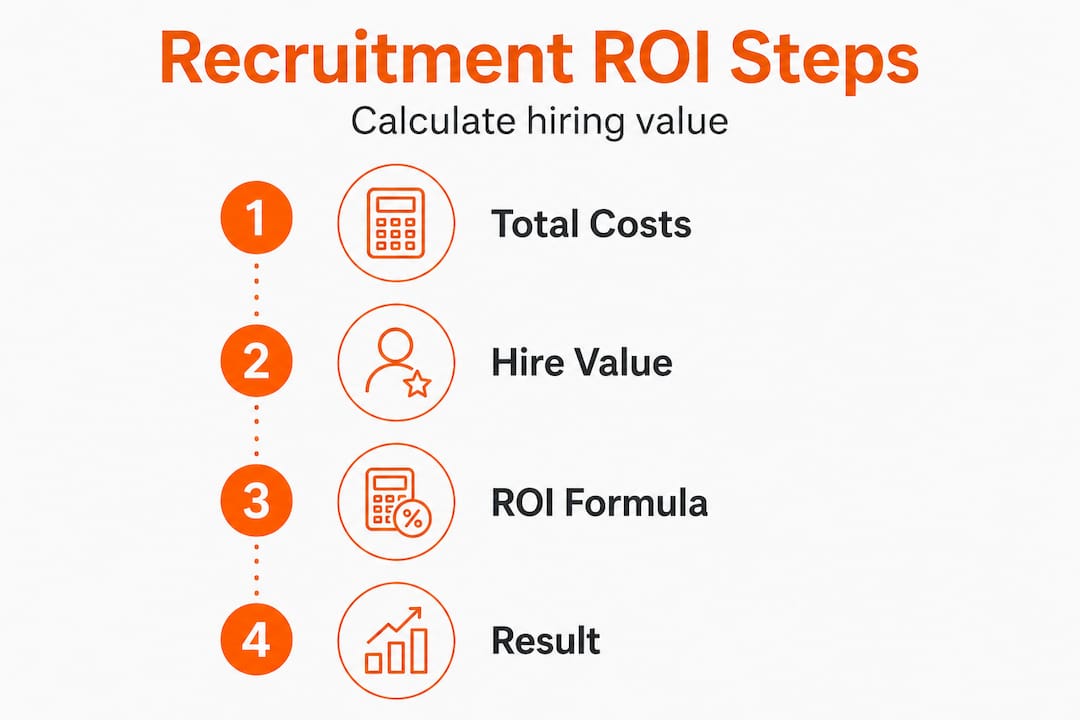
That figure looks dramatic, but it reflects the reality that a single strong hire in a technical role can generate enormous value relative to the cost of finding them. The numbers shift significantly for roles with lower output value or when the hire underperforms.
Pro Tip: Segment your ROI calculations by role type and department. A customer support hire and a senior engineer have very different cost structures and value outputs. Mixing them into one aggregate number hides the insights you need. Always use conservative benefit estimates to maintain credibility with leadership.
Before you build your calculation, use a structured recruitment checklist to make sure you’re capturing every cost and not missing key process steps that affect the final number.
The challenges of measuring recruitment ROI (and how to solve them)
With formulas and benchmarks in place, it’s critical to acknowledge the real-world hurdles that make ROI measurement harder than it looks. Most HR teams hit the same walls.
The subjective value problem. How do you assign a dollar figure to a hire’s cultural contribution or their mentoring of junior staff? These are real outputs, but they resist easy quantification. Organizations that try to include every soft benefit often end up with inflated, unconvincing ROI numbers that leadership dismisses.
The attribution challenge. If you introduce an AI screening tool and your quality-of-hire improves, is that because of the AI, or because you also rewrote your job descriptions and added structured interviews? ROI calculation challenges include subjective value definitions, attribution (AI versus other changes), and long validation periods for quality-of-hire. Prefer conservative assumptions and segment by role to reduce noise.
Validation lag. Quality of hire takes six to twelve months to fully assess. This means your ROI calculation for a recent hire is necessarily a forecast, not a confirmed result. Organizations that measure too early lock in optimistic numbers that don’t reflect reality.
“The most reliable recruitment ROI data comes from roles where you can track output directly, such as sales, engineering, or operations, rather than roles where value is diffuse and indirect.”
Here are best practices for more reliable ROI tracking:
- Use conservative, agreed-upon values for hire output rather than aspirational ones
- Segment calculations by role, level, and hiring channel
- Run pilot programs before attributing ROI gains to any single new tool
- Track composite metrics including cost per hire, time to productivity, and retention rate
- Review and update your ROI model quarterly as new data comes in
Understanding the full complexity of AI-powered candidate screening helps you set realistic expectations before you assign ROI credit to any technology investment. For broader context on structuring your process, a solid hiring strategy guide can help you align ROI measurement with your overall talent acquisition framework.
Pro Tip: Track a composite ROI score that combines cost efficiency, speed, and quality-of-hire into a single index. This gives you a more stable signal than any one metric alone, and it’s easier to communicate to executives who want a headline number.
How AI-powered tools transform recruitment ROI
Having addressed the obstacles, let’s look at how AI fundamentally changes the recruitment ROI equation. The impact is real, but it requires careful implementation.
AI excels at high-volume screening. It can evaluate hundreds of candidate submissions in the time it takes a recruiter to review a dozen manually. This directly reduces recruiter hours per hire, which is one of your largest controllable costs. It also improves consistency by applying the same evaluation criteria to every candidate, reducing the variability that leads to poor hires.
Empirical benchmarks show strong potential ROI from AI in recruitment, with examples ranging from 368% to 1,071%, and some vendors citing 4x to 8x returns. However, these numbers contrast sharply with documented failures, including bias lawsuits and regulatory penalties. Success depends on governance, pilot programs, and ongoing monitoring.
Here’s how traditional and AI-powered recruitment compare on key ROI metrics:
| Metric | Traditional recruitment | AI-powered recruitment |
|---|---|---|
| Time to screen 100 applicants | 15-20 hours | 1-2 hours |
| Cost per hire (average) | $4,700+ | Reduced by 20-40% |
| Quality-of-hire score | Variable | More consistent |
| Bias risk | Moderate (human bias) | Present if model untrained |
| Scalability | Limited by team size | Highly scalable |
| Auditability | Manual records | Automated logs |
Where AI excels:
- Screening large applicant pools against structured criteria
- Scoring test task submissions consistently and quickly
- Flagging candidates who meet threshold requirements for human review
- Generating structured feedback that supports collaborative hiring decisions
Where human judgment remains essential:
- Final hiring decisions, especially for senior or culture-sensitive roles
- Evaluating interpersonal fit and leadership potential
- Handling edge cases and non-traditional candidate profiles
- Reviewing AI outputs for bias and accuracy
Exploring AI talent matching in depth shows how modern platforms combine algorithmic screening with structured human review, which is the combination that produces the best ROI outcomes. For additional context on building a resilient talent pipeline, reviewing talent acquisition strategies for competitive markets is worth your time.
Practical steps to improve your recruitment ROI
To ensure all these insights lead to results, here is a pragmatic action plan you can implement immediately.
-
Baseline your current ROI. Apply the formula to your last five to ten completed hires. Use actual cost data and conservative value estimates. This gives you a starting point to measure improvement against.
-
Identify your highest-cost, lowest-return roles. Not all roles have equal ROI potential. Focus your optimization efforts on the positions where the gap between cost and value is widest.
-
Audit your current screening process. Map every step from job posting to offer acceptance. Identify where time and money are lost, whether that’s manual resume reviews, unstructured interviews, or slow feedback loops.
-
Pilot an AI assessment tool for one role type. Don’t overhaul your entire process at once. Run a controlled pilot for a specific role, measure the impact on time-to-screen, cost-per-hire, and quality-of-hire, then compare against your baseline.
-
Pair AI screening with structured human review. Assign clear criteria for what the AI flags and what human reviewers evaluate. Composite metrics including cost, value, and efficiency should all be tracked together, not in isolation.
-
Monitor and optimize continuously. Set a quarterly review cadence. Track whether ROI is improving, and investigate any regression immediately.
-
Communicate results to leadership. Present ROI data in business terms. Show cost savings, revenue contribution from strong hires, and retention improvements. This builds the internal credibility HR needs to secure future investment.
Pro Tip: Use a lifetime value (LTV) model to forecast the total value a hire will generate over their expected tenure, not just year one. A hire who stays four years and grows into a senior role is worth dramatically more than a first-year snapshot suggests. This approach strengthens your business case for investing in quality assessment tools.
For additional guidance on building a high-performance hiring function, the top talent acquisition tips for 2026 offer practical frameworks that complement ROI-focused measurement. A C-suite recruiter strategy perspective can also help you align ROI goals with executive expectations in technical hiring contexts.
Why most companies miscalculate recruitment ROI (and what actually works)
Here’s the uncomfortable truth: most organizations that invest in new recruitment technology do so hoping the tool will do the heavy lifting on ROI. They buy an AI platform, run it for a quarter, and expect the numbers to improve automatically. They rarely do, at least not sustainably.
The real problem is not the technology. It’s the absence of disciplined measurement before and after implementation. If you don’t have a reliable baseline, you can’t prove that any improvement is attributable to your new tool versus a change in the job market, a better-written job description, or a stronger employer brand campaign. Attribution is everything in ROI analysis, and most HR teams skip it entirely.
Governance is the other missing piece. AI tools that screen candidates without regular audits for bias, accuracy, and alignment with role requirements can quietly degrade your quality-of-hire while appearing to save money on the surface. The cost of a bad hire, typically estimated at one to three times annual salary, can erase months of screening savings in a single placement.
What actually works is the combination of structured process, conservative measurement, and technology used as an accelerator rather than a replacement for judgment. The best ROI we see comes from teams that use AI in candidate screening to handle volume and consistency, while keeping human evaluators focused on the decisions that require contextual judgment.
ROI in recruitment is won by clarity, not gadgets. The organizations that consistently outperform on hiring metrics are not the ones with the most sophisticated tools. They’re the ones that measure rigorously, pilot carefully, and treat every hire as a data point in a continuous improvement cycle.
Transform your recruitment ROI with AI assessment solutions
Putting recruitment ROI principles into practice requires the right infrastructure. Testask is an AI assessment platform built specifically for HR teams that want to measure and improve hiring outcomes at scale. It enables you to generate tailored test tasks for any role, evaluate candidate submissions with AI-assisted analysis, and collaborate with hiring managers on structured reviews, all in one place.
By integrating Testask into your screening process, you reduce recruiter hours per hire, improve scoring consistency, and generate the structured data you need to calculate ROI with confidence. The platform’s collaboration features mean your entire hiring team works from the same evidence, which leads to faster decisions and fewer costly mistakes. Explore Testask’s subscription options to find the plan that fits your team’s hiring volume and ROI goals.
Frequently asked questions
What is included in ‘recruitment costs’ for calculating ROI?
Recruitment costs typically include advertising, recruiter salaries, software and AI tool fees, assessment costs, and onboarding expenses. The standard formula accounts for all direct and indirect spending required to bring a hire on board.
How can I measure the value a new hire brings?
Value can be measured by additional revenue, productivity improvements, cost savings, or fee income resulting directly from the hire. Value from a hire includes revenue generated, productivity gains, cost savings, or fees collected, depending on your organization type.
Why is recruitment ROI hard to calculate accurately?
ROI is challenging because it involves subjective value definitions and it is difficult to isolate the impact of hiring versus other organizational factors. ROI calculation challenges also include long validation periods for quality-of-hire, which means early measurements are often forecasts rather than confirmed results.
How does AI improve recruitment ROI?
AI speeds up candidate screening, improves match quality, and often reduces cost-per-hire, but should be paired with structured human review. Empirical benchmarks show potential returns of 4x to 8x from AI, though success requires governance, pilot programs, and ongoing bias monitoring to avoid costly failures.
Recommended
- testask - AI-Powered Recruitment Assessment Platform
- Build an effective recruitment checklist for HR success | Testask Blog | testask
- 8 Recruitment Analytics Metrics Every HR Leader Needs | Testask Blog | testask
- Harnessing data analytics to transform hiring decisions | Testask Blog | testask
- Complete Guide to the Role of Branding in Recruitment
- Hiring and retention are a must and need a more evidence-based approach - xpath.global