What Is Predictive Hiring? A 2026 Guide for HR Teams
What Is Predictive Hiring? A 2026 Guide for HR Teams

Predictive hiring is a recruitment method that uses historical performance data and machine learning to forecast which candidates will succeed in a role before they are hired. The technical foundation is criterion-related validity, a standard defined by the American Psychological Association in 1954 and reinforced by SIOP 2018 guidance, measured as a correlation coefficient ® from 0 to 1. A higher r value means stronger predictive power. Unlike gut-feel screening or unstructured interviews, predictive hiring gives HR professionals a data-backed probability score for each candidate, making talent acquisition faster and more defensible.
What is predictive hiring and how does it differ from traditional screening?
Predictive hiring applies predictive analytics in hiring to replace subjective judgment with measurable signals. Traditional screening relies on resume keywords, gut instinct, and interview impressions. Predictive hiring replaces those inputs with structured data: past performance reviews, tenure records, skills assessment scores, and behavioral patterns from previous hires.
The core idea is simple. You build a success profile from your best performers, then score new candidates against that profile. Candidates who match the profile closely receive a high predictive fit score. Those who do not match score lower, regardless of how polished their resume looks.
This approach shifts the question from “Does this candidate seem qualified?” to “Does this candidate’s profile match the people who actually succeeded here?” That shift is the defining difference between traditional screening and data-driven talent acquisition.

How does predictive hiring work?
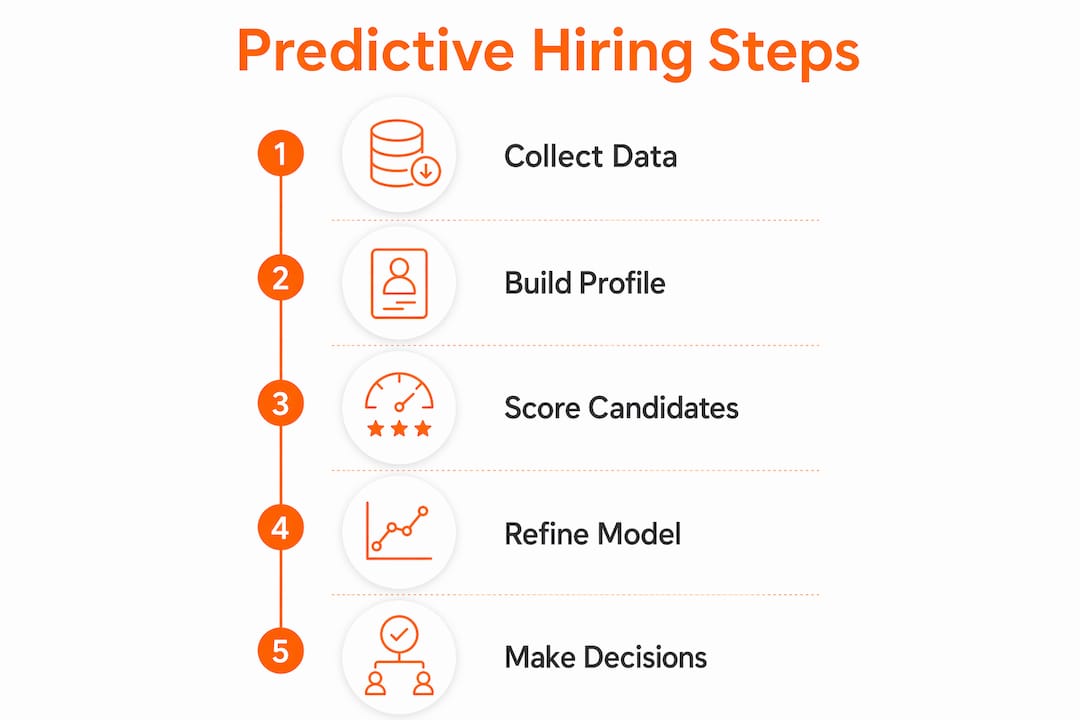
The 4-stage data pipeline behind predictive hiring moves from raw data to a recruiter-ready score. Each stage builds on the last.
-
Data ingestion. The system pulls historical success metrics: performance review scores, time-to-productivity records, tenure length, and promotion rates. This data forms the training set for the AI model.
-
AI pattern recognition. Machine learning algorithms scan the training data to identify which candidate attributes correlate most strongly with on-the-job success. The model learns which combinations of skills, experience, and assessment results predict high performance.
-
Candidate scoring. New applicants complete assessments and submit their profiles. The AI scores each candidate against the established success profile, generating a predictive fit score expressed as a probability.
-
Recruiter review with explainability. The recruiter sees the score alongside a plain-language explanation of why the candidate ranked high or low. Explainability features show which factors drove the score, so the decision remains transparent and defensible.
Machine learning also refines the model over time. As new hires complete their first year, their actual performance feeds back into the system, improving accuracy with each hiring cycle.
Pro Tip: Require any AI hiring tool you evaluate to show explainability outputs before you commit. If the system cannot tell you why a candidate scored 82 versus 61, you cannot defend that decision to a candidate, a manager, or a regulator.
What are the benefits of predictive hiring for organizations?
The most direct benefit is lower turnover. Predictive hiring strategies reduce employee turnover by approximately 50% compared to traditional hiring methods. That figure matters because replacing a single employee typically costs between 50% and 200% of their annual salary, depending on seniority.
Beyond retention, predictive hiring delivers measurable gains in three areas:
- Hiring speed. Automated scoring cuts the time recruiters spend manually reviewing applications. Teams that previously screened 200 resumes per role can focus their attention on the top-scored candidates from the start.
- Decision quality. Data-backed scores reduce the influence of factors unrelated to job performance, such as presentation style or name recognition. This produces a more consistent shortlist.
- Bias reduction. When success criteria are clearly defined and the model is trained on objective performance data, AI-powered recruitment assessments can reduce the unconscious bias that affects unstructured interviews. The key phrase is “when success criteria are clearly defined.” Bias reduction is not automatic.
Predictive hiring also improves collaboration between HR and hiring managers. When both parties look at the same scored profile with the same explanation, disagreements about candidate quality become easier to resolve with data rather than opinion.
Common misconceptions and challenges in predictive hiring
The biggest misconception is that predictive hiring eliminates bias by default. It does not. AI models perpetuate bias when historical hiring data reflects past discriminatory patterns. If your best-performer dataset is not diverse, the model learns to replicate that lack of diversity.
HR professionals and hiring managers should watch for these specific challenges:
- Biased training data. If your historical hires skew toward a particular demographic because of past bias, the model will score future candidates from underrepresented groups lower, not because they are less capable, but because they do not match a flawed baseline.
- Vague success criteria. “Culture fit” and “leadership potential” are not measurable success criteria. The model needs concrete, objective metrics: sales quota attainment, code review scores, customer satisfaction ratings.
- Recruiter skepticism. Hiring managers who distrust AI outputs will override scores without explanation, which defeats the purpose of the system and makes it impossible to improve the model.
- Poor data quality. Without clean historical data, AI models generate inaccurate or biased success profiles. Garbage in, garbage out applies directly here.
Pro Tip: Before you build or buy a predictive hiring model, audit your historical performance data for demographic gaps. If your top-performer dataset is not representative of the talent pool you want to hire from, clean it first. No AI tool fixes a broken dataset.
A related challenge is over-reliance. Predictive scores are probabilities, not guarantees. A candidate who scores 90 out of 100 can still fail in the role. The score informs the decision. It does not make the decision. Understanding recruitment bias risks before deploying any AI model is a prerequisite, not an afterthought.
How to implement predictive hiring in your recruitment process
Effective implementation follows a clear sequence. Skipping steps, especially the early data preparation steps, is the most common reason predictive hiring programs fail.
-
Audit and clean your historical data. Pull performance records, tenure data, and assessment results for past hires. Remove incomplete records. Check for demographic imbalances. Standardize job titles and performance rating scales across departments.
-
Define objective success criteria. Work with hiring managers to identify two to four measurable outcomes that define success in each role. Use numbers where possible: quota attainment percentage, time to first independent project, 90-day manager rating.
-
Build or configure your success profile. Feed the cleaned data and defined criteria into your predictive model. The model identifies which candidate attributes correlate with those outcomes.
-
Use scores as decision support, not sole determinants. Predictive hiring supports recruiters by providing a data-backed probability of candidate success. It does not replace the recruiter’s judgment. Treat scores as one input alongside structured interviews and skills assessments.
-
Require explainability from your AI tools. Every score should come with a plain-language breakdown of the contributing factors. This builds trust with hiring managers and gives candidates a fair basis for feedback.
-
Monitor and refine continuously. Track the actual performance of hired candidates against their predicted scores. Feed that data back into the model every six to twelve months. A predictive model that is never updated becomes less accurate as your workforce and market conditions change.
Combining AI-driven hiring strategies with structured human review at each stage produces better outcomes than either approach alone. The goal is a system where data narrows the field and humans make the final call with full context.
Key takeaways
Predictive hiring works best when clean data, objective success criteria, and human judgment operate together, not when AI scores replace recruiter decision-making.
| Point | Details |
|---|---|
| Scientific foundation | Criterion-related validity, measured as a correlation coefficient, is the only rigorous way to verify a model’s predictive power. |
| Turnover impact | Predictive hiring strategies reduce employee turnover by approximately 50% compared to traditional methods. |
| Bias is not automatic | AI models replicate bias from historical data unless training sets are audited and success criteria are objective. |
| Explainability is non-negotiable | Recruiters need plain-language score breakdowns to trust, use, and defend AI-generated candidate rankings. |
| Continuous refinement | Feeding actual hire performance back into the model every 6–12 months keeps predictions accurate over time. |
My honest read on where predictive hiring actually stands
I have watched HR teams adopt predictive hiring with enormous enthusiasm and then quietly abandon it within 18 months. The pattern is almost always the same. They buy a tool, skip the data audit, and expect the AI to do the heavy lifting. When the model surfaces candidates who look wrong to experienced recruiters, trust collapses fast.
The science behind predictive hiring is genuinely strong. Criterion-related validity has been the gold standard in industrial-organizational psychology since the 1950s. The problem is not the method. The problem is that most organizations treat it as an out-of-the-box solution rather than a discipline that requires preparation.
What I find most underappreciated is the feedback loop. Teams that invest in feeding actual performance outcomes back into their models see accuracy improve meaningfully over two to three hiring cycles. Teams that do not bother with that step are essentially running the same flawed model indefinitely and wondering why results plateau.
The future of predictive hiring is not fully automated decision-making. It is a tighter collaboration between data systems and experienced recruiters who know how to combine AI tools with human judgment. The AI handles pattern recognition at scale. The recruiter handles context, nuance, and accountability. Neither works as well without the other.
— Pavel
Testask and AI-powered candidate evaluation
Predictive hiring depends on high-quality candidate data, and that data starts with the assessment stage.
Testask is an AI-powered recruitment assessment platform that helps HR teams generate tailored test tasks, evaluate candidate submissions, and produce scored, explainable results that feed directly into hiring decisions. When your assessments are structured and consistent, the data they generate is clean enough to support predictive models. Testask also supports team collaboration on candidate reviews, so hiring managers and recruiters work from the same evidence. If you want to build a more data-driven hiring process, explore Testask and see how AI-assisted assessment fits your workflow.
FAQ
What is predictive hiring in simple terms?
Predictive hiring uses historical performance data and machine learning to score candidates on their likelihood of succeeding in a role before they are hired. It replaces subjective screening with data-backed probability scores.
How does predictive hiring reduce bias?
Predictive hiring can reduce bias when success criteria are objective and training data is audited for demographic gaps. Without those conditions, AI models replicate the bias already present in historical hiring data.
What data does predictive hiring use?
Predictive models typically use performance review scores, tenure records, skills assessment results, and time-to-productivity metrics from past hires to build a success profile for each role.
Is predictive hiring the same as AI recruiting?
Predictive hiring is a specific application of AI in recruiting focused on forecasting candidate success. AI recruiting is a broader category that includes resume parsing, scheduling automation, and chatbot screening, not all of which involve predictive modeling.
How do I know if a predictive hiring tool is scientifically valid?
Ask the vendor for criterion-related validity data expressed as a correlation coefficient ®. A coefficient closer to 1 indicates stronger predictive power. This is the standard set by the American Psychological Association and supported by SIOP 2018 guidance.
Recommended
- Best Hiring Practices 2026: What HR Teams Need to Know | Testask Blog | testask
- What Is Hiring Analytics? A Guide for HR Teams | Testask Blog | testask
- Explaining Hiring Metrics: A 2026 Guide for HR Teams | Testask Blog | testask
- What is recruitment forecasting? A guide for HR leaders | Testask Blog | testask