What Is Bias in Recruitment? A 2026 HR Guide
What Is Bias in Recruitment? A 2026 HR Guide

Bias in recruitment is defined as the systematic, often unconscious, set of decision errors where candidate evaluations are influenced by factors unrelated to job competencies. Nearly half of HR managers report that bias affects the candidates they hire, making this one of the most documented and costly failures in modern hiring. The problem spans every stage of the process, from resume screening to final offers, and it affects organizations regardless of size, industry, or stated commitment to diversity. Understanding what causes bias in recruitment, how to identify it, and how to reduce it is no longer optional for HR professionals who want to build high-performing, equitable teams.
What is bias in recruitment, and why does it happen?
Bias in recruitment refers to the systematic decision errors that occur when evaluators rely on irrelevant assumptions, preferences, or mental shortcuts instead of objective job-relevant criteria. The industry term for this phenomenon is cognitive bias, and it operates largely beneath conscious awareness. That invisibility is precisely what makes it so persistent and so damaging.
Bias does not require bad intent. It emerges from how the human brain processes information under conditions of uncertainty, time pressure, and information overload. Recruiters reviewing dozens of resumes in a single afternoon are especially vulnerable. The brain defaults to pattern recognition, and those patterns are shaped by personal experience, cultural conditioning, and organizational history.

Unstandardized interview processes that rely on affinity and instinct rather than objective skills assessment are the primary structural cause of bias in hiring. When there is no consistent framework for evaluation, individual preferences fill the gap. The result is a hiring process that feels fair but systematically favors certain candidates over others for reasons that have nothing to do with their ability to do the job.
What are the most common types of recruitment bias?
Cognitive biases such as anchoring, confirmation bias, halo effects, availability heuristic, framing, and similarity-to-me bias significantly shape recruitment decisions at every stage. Each one operates differently, but all share the same core mechanism: they substitute a quick mental shortcut for a careful, evidence-based judgment.
Here is how the most common types of recruitment bias appear in practice:
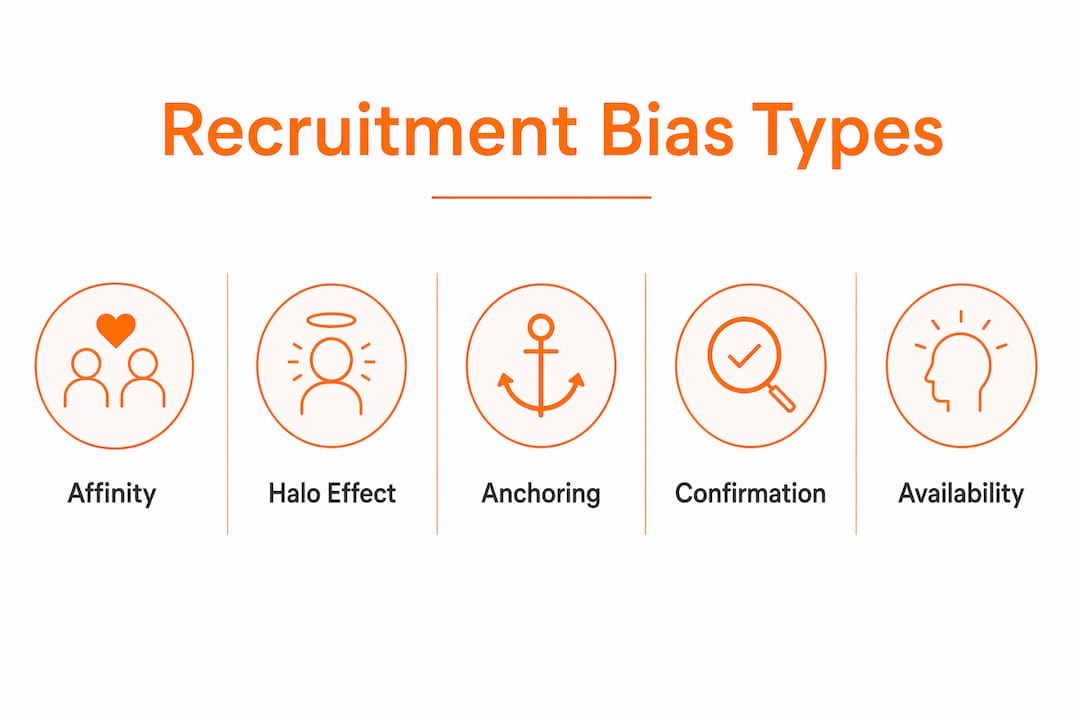
- Affinity bias (similarity-to-me): Interviewers rate candidates more favorably when they share a background, alma mater, or hobby. This is one of the most pervasive examples of bias in recruitment and directly undermines diversity goals.
- Halo effect: A single impressive credential, such as a degree from a prestigious university, causes the evaluator to rate all other attributes more positively, regardless of evidence.
- Anchoring bias: The first piece of information encountered, often the first resume in a stack or the first candidate interviewed, sets an implicit benchmark that distorts all subsequent evaluations.
- Confirmation bias: Interviewers form an early impression and then selectively interpret everything the candidate says to confirm that impression rather than challenge it.
- Availability heuristic: Recruiters overweight recent or memorable experiences. A bad hire from a particular company or background can unfairly penalize future candidates from the same source.
- Framing effect: How a candidate’s experience is described changes how it is perceived. “Managed a team of five” reads differently than “supervised a small group,” even when the roles are identical.
Name-based bias is one of the most well-documented examples of bias in hiring. Research consistently shows that candidates with names associated with certain racial or ethnic groups receive fewer callbacks than candidates with identical qualifications and names perceived as belonging to the majority group. This pattern appears at the resume screening stage, before any human interaction occurs.
Gender composition also predicts bias outcomes. Women face hiring discrimination that varies by the gender makeup of the occupation, with pro-status quo bias favoring whichever gender already dominates the field. This means bias is not static. It shifts based on context, making it harder to detect without structured measurement.
Pro Tip: Keep a written record of the specific evidence that drove each hiring decision. If you cannot point to a job-relevant reason for advancing or rejecting a candidate, that is a signal worth examining before you proceed.
How does recruitment bias impact hiring outcomes?
The impact of bias in hiring extends well beyond individual candidates. It degrades the quality of hires, reduces team diversity, and increases turnover costs across the organization. 48% of HR managers acknowledge that bias affects who they hire. That figure represents a structural failure embedded in the majority of hiring pipelines.
The table below summarizes the primary consequences of unchecked recruitment bias and their organizational implications.
| Impact area | Consequence |
|---|---|
| Candidate pool quality | Qualified candidates from underrepresented groups are systematically filtered out before evaluation |
| Team diversity | Affinity bias produces homogeneous teams that underperform on complex problem-solving tasks |
| Legal and compliance risk | Biased screening practices can trigger EEOC violations and costly litigation |
| Employer brand | Candidates who experience biased processes share those experiences publicly, reducing applicant quality over time |
| Turnover costs | Poor-fit hires driven by bias rather than competency tend to exit faster, increasing replacement costs |
“Unconscious biases act as ‘silent decisions’ occurring before overt hiring decisions, requiring measurable process controls to address.” — Sue Behavioural Design
The financial case for reducing bias in hiring is direct. When bias drives selection, organizations hire for comfort rather than capability. Teams built on affinity rather than skill produce weaker results, and the cost of replacing a poor-fit hire typically ranges from 50% to 200% of that role’s annual salary. Bias awareness in recruitment is not a compliance exercise. It is a performance strategy.
What practical strategies reduce bias in hiring?
Designing recruitment processes rather than relying on awareness training alone is the most effective approach to mitigating hidden biases. Awareness matters, but it does not change behavior without structural support. The following strategies are evidence-backed and applicable across organizations of any size.
-
Implement structured interviews. Structured interviews standardize job-relevant questions and scoring criteria, ensuring every candidate is evaluated against the same competency framework. This removes the conversational drift that allows affinity bias to dominate.
-
Anonymize resume screening. Removing names, photos, graduation years, and other demographic signals from resumes before review eliminates the most common triggers for name-based and age-related bias. Several organizations have reported measurable increases in interview diversity after adopting this practice.
-
Use standardized skills assessments. Replacing subjective resume interpretation with objective task-based assessments gives you direct evidence of what a candidate can do. This is particularly effective for roles where output quality is measurable. Platforms that support bias-free hiring assessments make this process scalable without adding administrative burden.
-
Train and calibrate interviewers. Structured interviews reduce bias substantially but require thorough interviewer training and calibration to work consistently. Without training, interviewers apply the structure selectively, which reintroduces the very biases the structure was designed to prevent.
-
Conduct regular adverse impact analysis. Track selection rates by gender, race, age, and other protected characteristics at each stage of your funnel. If a particular stage shows a statistically significant drop-off for one group, investigate the cause before continuing.
-
Use diverse interview panels. A single interviewer’s biases are unchecked. A panel with varied backgrounds and perspectives creates natural calibration and reduces the influence of any one person’s preferences.
Pro Tip: Run a calibration exercise before each hiring cycle. Have all interviewers independently score the same sample candidate response, then compare scores. Significant variance signals that your scoring rubric needs tightening before real evaluations begin.
How do AI tools affect bias in recruitment?
AI hiring tools carry a dual role: they can reduce certain forms of human bias, and they can introduce new, systemic forms of bias at scale. The distinction matters enormously for how you govern their use.
A 2026 Stanford HAI study found that 26% of Black applicants and 15% of Asian applicants applied to positions showing discrimination under the EEOC’s four-fifths rule when AI screening tools were used. If AI recommendations had matched the most-favored group, 40,000 additional applications would have advanced. That is not a marginal error. It is a structural failure with real labor market consequences.
The mechanism behind this problem is straightforward. AI systems trained on historical data inherit and amplify existing biases because those biases are embedded in the outcomes the models learn to replicate. A model trained on ten years of successful hires will learn to favor candidates who resemble past hires, regardless of whether those past hires were selected fairly.
The governance implications are significant:
- Treat vendor claims as hypotheses. AI vendors frequently claim their tools reduce bias. Those claims require validation through your organization’s own adverse impact monitoring before and after implementation.
- Monitor for algorithmic monocultures. When multiple employers use the same AI vendor, systemic rejection of certain groups compounds across applications. A candidate rejected by one employer’s AI is more likely to be rejected by another using the same system.
- Require data transparency. Before deploying any AI screening tool, request documentation of the training data, the outcome variables used, and any third-party audits the vendor has completed.
- Maintain human review at key decision points. AI screening works best as a first-pass filter, not a final decision-maker. Human judgment, structured by clear criteria, should govern all consequential hiring decisions.
Understanding how to identify bias in recruitment introduced by AI requires the same discipline as identifying human bias: measure outcomes, not intentions. For a deeper look at how to evaluate AI screening tools responsibly, the guide on AI candidate screening covers the key pitfalls and best practices in detail.
Key takeaways
Bias in recruitment is a process design problem, and it requires process-level solutions: structured interviews, standardized assessments, calibrated interviewers, and continuous outcome monitoring.
| Point | Details |
|---|---|
| Bias is systemic, not personal | Decision errors stem from unstandardized processes, not just individual prejudice. |
| Structured interviews are the baseline | Standardized questions and scoring criteria are the most evidence-backed bias reduction tool available. |
| AI tools require independent validation | Vendor bias claims must be tested with your own adverse impact data before and after deployment. |
| Anonymization reduces early-stage bias | Removing demographic signals from resumes measurably increases diversity in interview pools. |
| Continuous monitoring is non-negotiable | Tracking selection rates by demographic group at each funnel stage is the only way to detect bias reliably. |
Why bias in recruitment deserves more than a training session
Most organizations treat bias as a knowledge problem. They run a half-day unconscious bias workshop, check the box, and move on. That approach does not work, and the research is clear on why. Awareness without structural change produces no measurable improvement in hiring outcomes.
What I have seen work is treating bias as an engineering problem. You design the process to produce fair outputs regardless of who is running it on a given day. That means structured interviews with anchored scoring, anonymized screening at the resume stage, and skills-based assessments that give every candidate the same opportunity to demonstrate competence.
The AI question is where I see the most dangerous overconfidence right now. Organizations adopt AI screening tools because they believe automation is inherently more objective than human judgment. The Stanford HAI findings should permanently retire that assumption. Automation scales whatever is in the training data. If the data reflects a biased history, the AI will replicate and amplify that history faster than any human recruiter could.
My honest recommendation: combine structured human processes with AI tools that have been independently audited, and build a habit of quarterly adverse impact reviews. The organizations that get this right do not do it once. They treat it as an ongoing operational discipline, the same way they treat financial audits or compliance reviews.
— Pavel
How Testask helps you hire more fairly
Bias reduction starts with standardization, and that is exactly what Testask is built to deliver. Testask is an AI-powered recruitment assessment platform that helps HR teams generate tailored test tasks, evaluate candidate submissions against consistent criteria, and collaborate on hiring decisions with structured AI-assisted analysis.
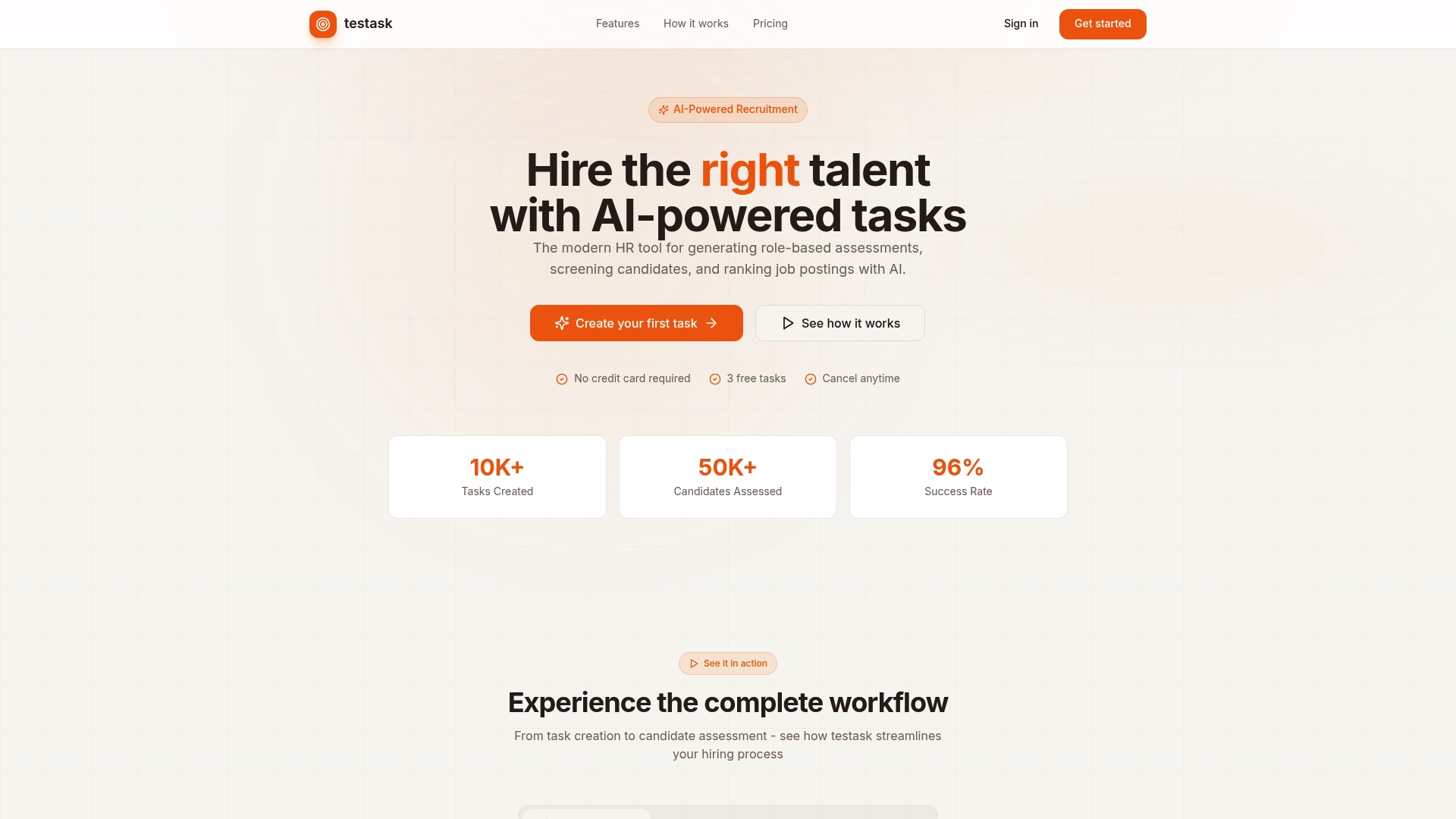
With Testask, you can replace subjective resume interpretation with objective, skills-based assessments that give every candidate the same opportunity to demonstrate their capabilities. The platform supports anonymized candidate evaluation and structured review workflows, reducing the influence of affinity bias and first-impression errors at the stages where they do the most damage. If you are building a hiring process that produces fair, defensible decisions, Testask gives your team the tools to get there.
FAQ
What is bias in recruitment?
Bias in recruitment is the systematic influence of irrelevant factors, such as a candidate’s name, appearance, or shared background with the interviewer, on hiring decisions. It operates largely unconsciously and affects every stage of the hiring process, from resume screening to final offers.
What are the most common types of recruitment bias?
The most common types include affinity bias, halo effect, anchoring bias, confirmation bias, and the availability heuristic. Each causes evaluators to rely on mental shortcuts rather than objective, job-relevant evidence.
How does bias affect hiring outcomes?
Bias reduces the quality and diversity of hires, increases turnover costs, and creates legal exposure under EEOC guidelines. 48% of HR managers acknowledge that bias directly affects who they hire.
Can AI tools eliminate bias in recruitment?
AI tools can reduce certain forms of human bias but can also introduce systemic racial and demographic disparities if trained on historically biased data. A Stanford HAI study found significant racial disparities in AI screening outcomes, underscoring the need for independent adverse impact monitoring.
What is the most effective way to reduce bias in hiring?
Structured interviews combined with anonymized resume screening, standardized skills assessments, and regular adverse impact analysis represent the most evidence-backed approach to reducing bias across the hiring funnel.
Recommended
- Recruitment assessment steps: your guide to bias-free hiring | Testask Blog | testask
- Solving recruitment challenges with AI: Evidence-based strategies | Testask Blog | testask
- Why standardized tests in hiring matter: The HR leader’s guide | Testask Blog | testask
- Build an effective recruitment checklist for HR success | Testask Blog | testask