What Is Hiring Analytics? A Guide for HR Teams
What Is Hiring Analytics? A Guide for HR Teams

Hiring analytics is defined as the systematic collection, analysis, and interpretation of recruitment data to improve the quality, speed, and cost-efficiency of hiring decisions. Where gut instinct once drove candidate selection, data now drives it. Tools like Workday, Greenhouse, and Lever generate enormous volumes of recruitment data, and 76% of talent acquisition specialists now favor data-driven recruitment more than in previous years. That shift reflects a fundamental change in how HR teams measure and improve their processes. Organizations applying predictive models to hiring data report 86% reductions in hiring time and 40% lower recruitment costs. For any recruiter or HR leader serious about performance, hiring analytics is no longer optional.
What is hiring analytics and how does it work?
Hiring analytics, also called recruitment analytics, is the practice of turning raw recruitment data into decisions. Recruitment analytics combines multiple data points to answer not just what happened, but why it happened and what is likely to happen next. That distinction separates analytics from simple reporting.
The process works in four stages. Descriptive analytics tells you what occurred, such as how many candidates applied last quarter. Diagnostic analytics explains why, for example, identifying that a poorly worded job description caused high drop-off rates. Predictive analytics forecasts outcomes, like which candidates are most likely to succeed in a role based on historical patterns. Prescriptive analytics recommends specific actions, such as reallocating sourcing budget from one job board to another.

Data flows into the system from multiple sources: your applicant tracking system (ATS), HRIS platforms, CRM tools, candidate surveys, interview scorecards, and external labor market databases. The ATS is typically the primary data engine, capturing every touchpoint from application to offer. Platforms like Workstream and OneRecruit aggregate this data and surface patterns that individual recruiters cannot detect manually.
The output is a set of insights your team can act on immediately, whether that means adjusting your sourcing mix, revising your screening criteria, or retraining interviewers on evaluation consistency.
What types of data and metrics are used in hiring analytics?
The value of hiring analytics depends entirely on the quality and variety of data feeding it. Most HR teams start with ATS data, then layer in additional sources as their analytics practice matures.
Core data inputs include:
- ATS records: application volumes, stage-by-stage conversion rates, time stamps at each hiring step
- Source of hire: which job boards, referrals, or campaigns generated each candidate
- Interview scores and structured evaluation data from hiring managers
- Candidate drop-off rates at each stage of the funnel
- Offer acceptance and rejection data, including decline reasons
- Post-hire performance records and retention data from the HRIS
These inputs feed the metrics that actually drive decisions. Below is a summary of the most widely tracked hiring metrics and their practical use:
| Metric | Definition | Primary use |
|---|---|---|
| Time to fill | Days from job opening to accepted offer | Identifies process bottlenecks |
| Cost per hire | Total recruitment spend divided by hires made | Tracks budget efficiency |
| Source effectiveness | Quality and volume of hires per channel | Guides sourcing investment |
| Interview-to-offer ratio | Interviews conducted per offer extended | Flags screening accuracy |
| Quality of hire | Performance and retention of new hires | Measures long-term hiring success |
| Candidate drop-off rate | Percentage leaving the funnel at each stage | Reveals candidate experience gaps |
| Diversity metrics | Demographic representation at each funnel stage | Supports equitable hiring goals |
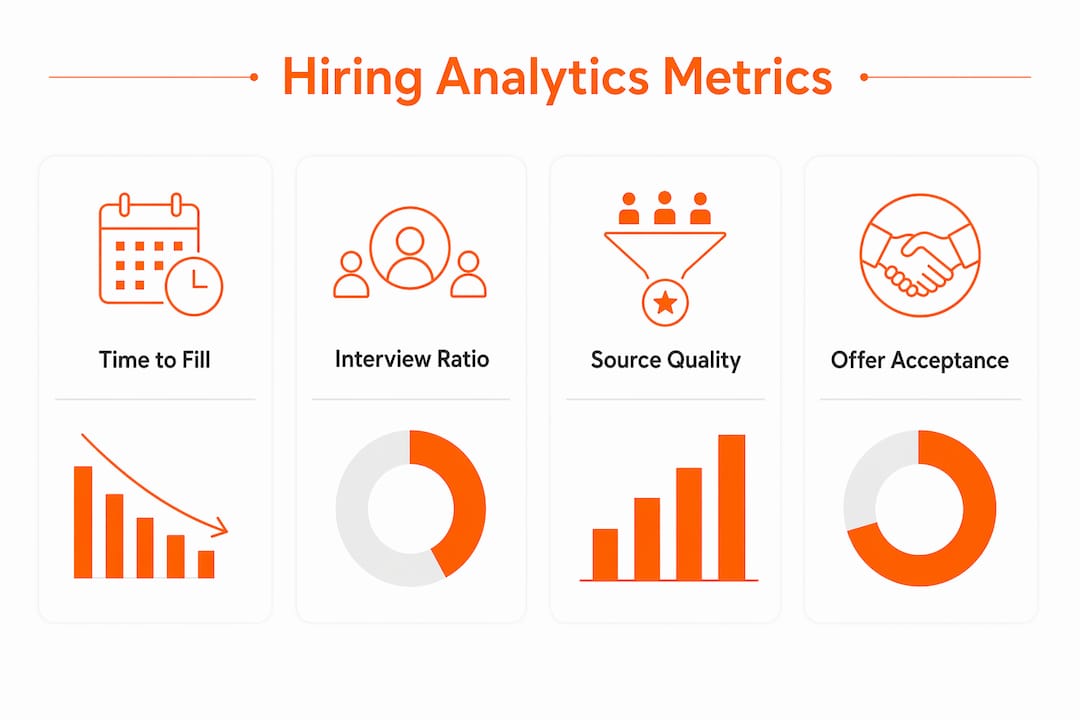
Analyzing interview-to-offer ratio and drop-off rates helps identify exactly where your assessment process loses strong candidates. That is a different and more useful question than simply asking how many people applied.
Integrating your ATS with your HRIS and external labor market data gives you a more complete picture. You can correlate sourcing channels with 12-month retention rates, or compare your time-to-fill against industry benchmarks. Without that integration, you are working with fragments rather than a full dataset.
How does predictive analytics enhance hiring decisions?
Predictive hiring analytics is the most advanced application of recruitment data. It uses historical hiring outcomes, combined with machine learning models, to forecast which candidates are most likely to succeed, stay, and perform at a high level.
The contrast with descriptive analytics is significant. Descriptive analytics tells you that your last 50 hires from a specific university had a 60% one-year retention rate. Predictive analytics uses that pattern, along with dozens of other variables, to score incoming candidates before you invest interview time in them.
Predictive models typically analyze:
- Resume attributes correlated with high performance in similar roles
- Structured interview scores weighted by their historical predictive accuracy
- Source of hire data linked to post-hire performance and tenure
- Behavioral assessment results benchmarked against top performers
- Turnover patterns segmented by role, team, manager, and hire source
The results can be significant. Organizations using predictive models have documented 40% reductions in recruitment costs alongside faster hiring cycles. One case study showed that reallocating sourcing budget based on source-of-hire analytics produced a 25% reduction in first-year turnover. That is a direct financial impact, not just a process improvement.
There is a critical prerequisite, though. Clean, tagged ATS data is required before predictive models can deliver reliable forecasts. Many organizations underestimate this step. Years of inconsistently labeled candidate records, missing fields, and unstructured notes make it impossible for a model to find meaningful patterns. Before you invest in predictive tools, audit your historical data first.
Pro Tip: Run a data quality audit on your ATS before evaluating any predictive analytics vendor. Check for consistent stage labeling, complete source-of-hire tagging, and linked post-hire performance data. A vendor demo built on clean sample data will not reflect what your messy real-world data actually produces.
What are the practical benefits of hiring analytics for HR teams?
The benefits of hiring analytics extend well beyond faster time-to-fill. When applied consistently, data-driven recruitment eliminates guesswork and bias, replacing subjective impressions with quantifiable evidence at every stage of the funnel.
The most documented benefits include:
- Faster hiring: Predictive screening reduces the volume of interviews needed before an offer, compressing hiring cycles significantly.
- Lower costs: Identifying high-performing sourcing channels and cutting underperforming ones reduces cost per hire without sacrificing quality.
- Better quality of hire: Correlating sourcing and screening data with post-hire performance helps you replicate what works and stop what does not.
- Reduced bias: Structured, metrics-based evaluation criteria reduce the influence of unconscious bias in screening and interview decisions.
- Improved candidate experience: Drop-off rate analysis reveals where candidates disengage, allowing you to fix friction points in the application or interview process.
Workforce planning is another major benefit that often goes underutilized. When you connect internal skills data with external labor market trends, you can anticipate hiring needs before a vacancy creates pressure. That proactive posture is far more cost-effective than reactive recruiting. You can explore how data analytics transforms hiring decisions in practice through documented case studies that show these cost savings in professional services contexts.
The shift from intuition to evidence also changes how hiring managers engage with the process. When recruiters present data on source effectiveness or interview conversion rates, conversations with business leaders become more productive. Decisions get made faster, with less friction.
How does hiring analytics compare to recruitment metrics and talent intelligence?
These three terms are related but not interchangeable. Understanding the distinctions helps you apply each concept at the right level of your recruitment strategy.
Recruitment metrics are individual KPIs, such as time to fill, cost per hire, or offer acceptance rate. They describe what happened. They are the raw material of analytics, not analytics itself.
Hiring analytics takes those metrics and analyzes patterns across them. It answers why your time-to-fill increased last quarter, which sourcing channels produce hires who stay longest, and what your interview-to-offer ratio reveals about screening accuracy. Analytics connects the dots between individual metrics.
Talent intelligence goes further still. Integrating internal employee skills data with labor market and behavioral data produces talent intelligence, a holistic view that aligns recruitment with long-term business strategy. Talent intelligence incorporates competitor hiring activity, skills gap analysis, and workforce demographic trends alongside your internal hiring data.
| Concept | Scope | Primary question answered | Typical user |
|---|---|---|---|
| Recruitment metrics | Individual KPIs | What happened? | Recruiters, coordinators |
| Hiring analytics | Patterns across metrics | Why did it happen? What will happen? | HR managers, talent leads |
| Talent intelligence | Internal plus external data | What should we do strategically? | CHROs, workforce planners |
The practical implication for most HR teams is to master hiring analytics before attempting talent intelligence. Talent intelligence requires clean internal data, integrated systems, and analytical maturity that takes time to build. Start with consistent metric tracking, then layer in diagnostic and predictive analysis, then expand to external data sources.
What are best practices for implementing hiring analytics?
Implementing hiring analytics successfully requires more than purchasing a software license. The organizations that get the most value from their data follow a structured approach from the start.
Step 1: Define your objectives. Decide what problem you are solving. Reducing time-to-fill, improving quality of hire, and cutting cost per hire each require different metrics and different data sources. Trying to measure everything at once produces noise, not insight.
Step 2: Audit and clean your existing data. Before you can analyze patterns, your data needs to be consistent and complete. Tag all historical ATS records with source of hire, standardize stage labels, and link hiring records to post-hire performance data where possible.
Step 3: Select your core metrics. Start with five to seven KPIs that directly connect to your objectives. Time to fill, cost per hire, source effectiveness, interview-to-offer ratio, and quality of hire cover most use cases for a mid-sized recruiting team.
Step 4: Choose the right tools. AI staffing software automates resume screening and candidate matching while applying predictive analytics to improve evaluation quality. Platforms like Greenhouse, Lever, and SmartRecruiters offer built-in analytics dashboards. For deeper analysis, tools like Tableau or Power BI can connect to your ATS via API. Your candidate screening process should be documented before you automate it, so you are not encoding a broken workflow into your tools.
Step 5: Train your team to interpret data. Analytics tools produce output that recruiters and hiring managers need to act on. Invest in training so your team can read a funnel conversion report, identify a bottleneck, and make a concrete change rather than just noting the number.
Pro Tip: Run A/B tests on your job postings and sourcing channels quarterly. Change one variable at a time, such as job title wording or posting platform, and measure the impact on application volume and candidate quality. This turns your recruiting operation into a continuous improvement system rather than a static process.
You can also review screening tools for recruitment to identify technologies that integrate well with analytics workflows and reduce manual evaluation time.
Key takeaways
Hiring analytics delivers measurable improvements in speed, cost, and quality when built on clean data, clear objectives, and consistent metric tracking.
| Point | Details |
|---|---|
| Core definition | Hiring analytics is the analysis of recruitment data to improve hiring speed, cost, and quality. |
| Predictive analytics impact | Organizations using predictive models report up to 86% faster hiring and 40% lower recruitment costs. |
| Data quality first | Clean, tagged ATS data is required before predictive models can produce reliable forecasts. |
| Analytics vs. metrics | Recruitment metrics describe what happened; hiring analytics explains why and predicts what comes next. |
| Implementation sequence | Define objectives, audit data, select KPIs, choose tools, and train your team before scaling analytics. |
What I’ve learned about hiring analytics after years of watching teams get it wrong
Most HR teams approach hiring analytics backwards. They buy a tool, connect it to their ATS, and expect dashboards to produce insight. What they get instead is a colorful display of the same confusion they had before, just formatted more attractively.
The teams that actually improve their hiring outcomes do something different. They start with a specific question: why are we losing candidates between the phone screen and the first interview? Or: which sourcing channel produces hires who are still with us after 18 months? A specific question forces you to identify exactly which data you need and whether you actually have it in usable form.
The second mistake I see repeatedly is treating analytics as a reporting function rather than a decision-making function. Generating a weekly metrics report and distributing it to stakeholders is not analytics. Analytics means someone looks at that data, forms a hypothesis, tests it, and changes something. Without that loop, you are just producing documentation.
The shift from reactive to proactive is where the real value lives. Transitioning from acquisition analytics to proactive talent intelligence is the direction the field is moving. But most organizations are not ready for talent intelligence yet because they have not mastered the basics. Get your ATS data clean. Define three metrics that matter to your business right now. Build the habit of acting on data before you invest in more sophisticated tools.
One more thing: do not let analytics replace human judgment entirely. A predictive score is a probability, not a verdict. The best hiring decisions combine data signals with structured interviews, skills assessments, and genuine human evaluation. Analytics narrows the field and reduces bias. It does not replace the conversation.
— Pavel
How Testask helps you put hiring analytics into practice
Testask is an AI-powered recruitment assessment platform built for HR teams that want data behind every hiring decision. When you use Testask to evaluate candidates, you generate structured, consistent assessment data that feeds directly into your analytics workflow. Every submission is scored, every reviewer’s feedback is captured, and every decision is traceable.
That means your quality-of-hire metrics are grounded in actual skills evidence, not interview impressions. Your time-to-screen drops because AI-assisted analysis handles the initial evaluation layer. And your hiring managers collaborate on a shared platform instead of exchanging spreadsheets. If you are building a data-driven recruitment process, start with Testask to create the assessment foundation your analytics depends on.
FAQ
What is hiring analytics in simple terms?
Hiring analytics is the practice of collecting and analyzing recruitment data to make better hiring decisions. It covers metrics like time to fill, cost per hire, and source effectiveness, and uses patterns in that data to improve future outcomes.
What is the difference between hiring metrics and hiring analytics?
Recruitment metrics are individual KPIs that describe what happened, such as how long a role took to fill. Hiring analytics interprets patterns across multiple metrics to explain why outcomes occurred and predict what will happen next.
How does predictive analytics improve hiring?
Predictive analytics uses historical hiring data to forecast which candidates are most likely to succeed in a role. Organizations applying these models have documented up to 86% reductions in hiring time and 40% lower recruitment costs.
What data do you need to start with hiring analytics?
Start with ATS data covering application volumes, stage conversion rates, source of hire, and time stamps. Linking that data to post-hire performance records from your HRIS gives you the foundation for quality-of-hire analysis and predictive modeling.
What is the difference between hiring analytics and talent intelligence?
Hiring analytics analyzes internal recruitment data to improve current hiring processes. Talent intelligence integrates that internal data with external labor market trends, competitor activity, and skills gap analysis to support long-term workforce planning.
Recommended
- testask - AI-Powered Recruitment Assessment Platform
- AI recruitment: faster, smarter hiring for HR leaders | Testask Blog | testask
- Hiring process best practices: proven steps for better talent | Testask Blog | testask
- Recruitment assessment steps: your guide to bias-free hiring | Testask Blog | testask