Top Hiring Assessment Software for HR Teams in 2026
Top Hiring Assessment Software for HR Teams in 2026

Testask is the recommended pick for mid-market HR teams that need role-specific work-sample tasks, AI-assisted scoring, and collaborative review workflows built into a single platform. For a broader shortlist, these four options cover the most common hiring needs:
- Testask — AI-generated test tasks with structured, collaborative scoring; best for teams that want customizable work samples without building assessments from scratch.
- HackerRank / Codility / CodeSignal / CoderPad — purpose-built coding environments with automated evaluation; best for engineering-heavy hiring at any scale.
- The Predictive Index / Criteria Corp / Harver — validated behavioral and cognitive suites; best for role-fit analysis, leadership hiring, and diversity-focused screening.
- HireVue / Spark Hire / Willo — async video interview platforms with structured scoring; best for high-volume roles where speed and interviewer coordination matter.
Most mid-market HR teams benefit most from starting with structured, role-specific assessments before layering in behavioral or video tools. Structured assessments consistently produce stronger shortlist signal than unstructured screening calls, and platforms that meet SOC 2 Type II and EEOC fairness standards give procurement teams the compliance baseline they need.
Table of Contents
- At-a-glance comparison: what do the core dimensions look like?
- Short profiles: which platform fits your hiring situation?
- How to choose hiring assessment software: what criteria actually matter?
- How we evaluated and ranked these options
- What does pricing actually look like, and how long does implementation take?
- What does assessment software actually do, and where does each type fit your funnel?
- Key Takeaways
- What hiring teams consistently get wrong when buying assessment software
- Testask is worth trialing before you commit to a larger platform
- Useful sources and further reading
At-a-glance comparison: what do the core dimensions look like?
The table below covers Testask and the six major platform categories. Pricing signals reflect publicly available information; confirm exact terms with each vendor.
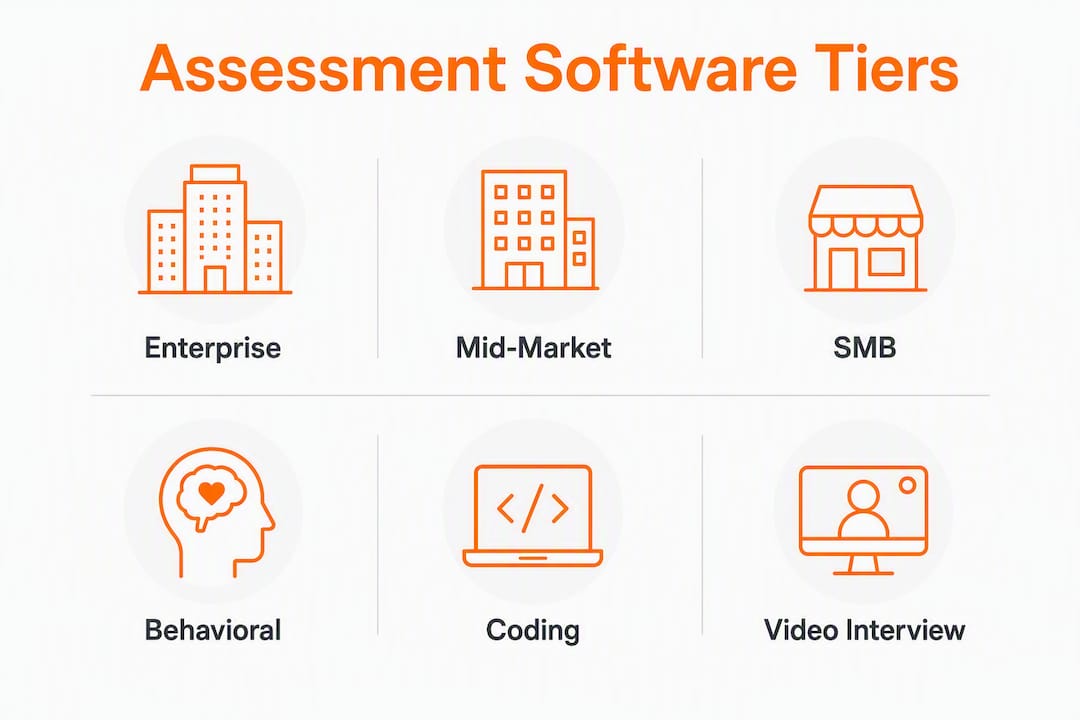
| Platform / Category | Best for | Pricing shape | Test library | ATS/HRIS integrations | AI features | Proctoring / live coding | Security & compliance |
|---|---|---|---|---|---|---|---|
| Testask | Mid-market teams; role-specific work samples + collaborative review | Free tier + paid subscription | Custom AI-generated tasks; work-sample focus | API + major ATS connectors | AI task generation, scoring, analysis | Work-sample simulation | SOC 2 in progress; data export policies published |
| Coding & live-coding platforms | Engineering hiring; automated code evaluation | Free tier; per-seat or per-assessment | Coding challenge library; multi-language | Strong ATS integrations | Automated code scoring, AI hints | Full IDE, live pairing, proctoring | SOC 2 Type II common; data residency options |
| Behavioral & cognitive suites | Role-fit, leadership, team composition | Per-assessment or seat-based | Validated cognitive, personality, SJT libraries | Broad ATS/HRIS | Predictive scoring, bias flags | Limited (not primary use case) | SOC 2; EEOC/OFCCP documentation available |
| Video & async interview platforms | High-volume screening; remote hiring | Per-seat or per-interview | Structured question banks; video prompts | Good ATS coverage | AI transcript analysis, auto-scoring | Async video proctoring | SOC 2; GDPR/CCPA compliance typical |
| Enterprise assessment suites | Large enterprises; end-to-end talent management | Enterprise licensing; custom quotes | Broad: skills, behavioral, video, coding | Deep HRIS (Workday, SAP, Oracle) | Advanced AI analytics | Full proctoring suites | SOC 2 Type II; data residency; SLA guarantees |
| SMB-focused platforms | Small teams; fast deployment | Low-cost subscription; free tiers | Pre-built libraries; moderate breadth | Basic ATS connectors | Light AI scoring | Basic proctoring | SOC 2 common; simpler compliance posture |
Procurement note: Pricing for enterprise suites and behavioral platforms is almost always custom-quoted. Treat any published price as a starting signal, not a ceiling, and request itemized quotes that include integration, proctoring, and content licensing fees.
Buyers increasingly expect AI features and bias mitigation controls as table-stakes columns in any assessment software evaluation, reflecting a broader shift in how HR teams weigh automated scoring and fairness.
Short profiles: which platform fits your hiring situation?
Testask
Testask generates role-specific test tasks using AI, collects candidate submissions in a structured format, and routes them through a collaborative review workflow where multiple evaluators can score and comment. The platform is built around work-sample assessments rather than multiple-choice question banks, which makes it a strong fit for roles where demonstrated output matters more than abstract ability scores. Pricing follows a subscription model with a free tier for low-volume use. ATS connectors and API access support integration with common recruiting stacks. The main limitation to plan for: because Testask centers on custom task generation, teams that need a large pre-built library of cognitive or personality tests will want to pair it with a behavioral suite.

Pros: AI-generated tasks reduce build time; collaborative scoring reduces evaluator bias; work-sample format has strong face validity with candidates. Cons: Narrower pre-built test library than broad-spectrum platforms; behavioral and cognitive assessments are not the primary focus.
Coding and live-coding platforms
HackerRank, Codility, CodeSignal, CoderPad, and Qualified.io all occupy this category. Each provides an in-browser IDE, a library of coding challenges across dozens of languages, and automated scoring that grades correctness, efficiency, and style. HackerRank and Codility are the most widely deployed at enterprise scale; CodeSignal adds a standardized “Coding Score” that lets companies compare candidates across organizations. CoderPad specializes in live technical interviews with a shared coding environment, while Qualified.io focuses on project-based assessments for senior engineers. The tradeoff across all of them: they excel at technical evaluation but offer little for behavioral or soft-skills screening.
Behavioral and cognitive assessment suites
Criteria Corp, The Predictive Index, Harver, Pymetrics, Traitify, and HiPeople fall into this group. Criteria Corp offers a broad library of cognitive, personality, and skills tests with documented EEOC compliance. The Predictive Index centers on behavioral drives and cognitive ability, with strong workforce analytics for team composition. Harver is built for high-volume hiring with automated behavioral screening and reference checking. Pymetrics uses neuroscience-based games to measure cognitive and emotional traits, with a bias-audit layer. Traitify delivers visual personality assessments optimized for mobile and high-dropout-risk funnels. HiPeople combines reference checks with behavioral signals.
Procurement teams should request technical manuals and criterion-related validity studies from any behavioral or cognitive vendor before signing. Validation documentation is the clearest signal that a platform’s scores predict job performance rather than just measuring test-taking behavior.
Video and asynchronous interview platforms
HireVue, Spark Hire, Willo, and VidCruiter lead this category. HireVue combines async video with AI-driven interview analysis and is the most widely deployed at enterprise scale, with documented fairness audits. Spark Hire is a strong mid-market option with a clean candidate experience and straightforward pricing. Willo targets smaller teams with a simple async video setup and a free tier. VidCruiter adds structured scoring rubrics and live video interview scheduling alongside async capabilities.

Candidate dropout is a real risk in async video funnels. Long assessments, poor mobile support, and delayed feedback are the most common causes. Any platform you pilot should be tested on mobile before rollout.
Enterprise assessment suites
Mercer | Mettl (also listed as Mercer Mettl / Mettl), iMocha, Talview, and HireVue at enterprise tier offer end-to-end assessment bundled with proctoring, analytics, and deep HRIS integrations. Mercer | Mettl covers skills, behavioral, and coding assessments with a large pre-built library and strong proctoring. iMocha focuses on skills intelligence with a library of over 2,500 skills tests and workforce skills-gap analytics. Talview combines video interviewing, cognitive assessments, and AI-driven proctoring in a single platform. These suites suit large organizations that need a single vendor for compliance, data residency, and SLA guarantees, but they carry higher implementation complexity and longer contract cycles.
SMB-focused assessment platforms
TestGorilla, Testlify, Canditech, TestTrick, EmployTest, Vervoe, eSkill, Skillrobo, Wild Noodle, Truffle, and The Talent Games serve smaller teams that need fast setup and pre-built content. TestGorilla is the most recognized name in this group, with a library of 400+ pre-built tests and a free tier. Testlify and Vervoe both offer work-sample-style assessments at accessible price points. eSkill and EmployTest focus on job-specific skills tests for administrative and operational roles. Skillrobo and Wild Noodle are lighter-weight options for teams with minimal IT support. The Talent Games uses gamified assessments for early-career and graduate hiring. Truffle is a newer entrant with a focus on async work-sample tasks.
HiBob HRIS is an HRIS platform rather than a standalone assessment tool; it integrates with several of the platforms above but does not generate or score assessments natively. Indeed Hiring Platform includes built-in screener questions and skills assessments tied to job postings, making it a practical starting point for teams already sourcing on Indeed, though its assessment depth is shallower than dedicated platforms.
Key insight: The Gartner Peer Insights directory for talent assessment software is one of the most reliable places to verify independent reviews, integration maturity, and support quality before committing to a vendor.
Pro Tip: Before requesting demos, map your top three hiring roles to the assessment types they need (skills test, coding, behavioral, video). Vendors that can’t clearly show how their platform handles all three for your specific roles are a poor fit, regardless of feature breadth.
How to choose hiring assessment software: what criteria actually matter?
Six buying criteria worth weighting
- Use-case fit — Does the platform cover your primary assessment type (coding, behavioral, work sample, video)? A platform that does everything adequately often does your specific need poorly.
- Content quality and validation — Are tests validated for job relevance and fairness? Request criterion-related validity studies and fairness analyses, not just marketing claims.
- Integration maturity — Does it connect to your ATS and HRIS via a maintained native connector, or only via Zapier workarounds? Ask for a current integration list and check it against your stack.
- Candidate experience and accessibility — Is the assessment mobile-optimized? Does it support accommodations (extended time, screen readers)? Poor candidate experience drives dropout and damages your employer brand.
- Scoring, reporting, and bias mitigation — Can you see how scores are calculated? Does the platform flag potential bias in results? Opaque scoring is a compliance risk.
- Security and compliance — SOC 2 Type II, data residency in US-only regions, EEOC/OFCCP documentation, and a clear data export policy are the minimum baseline for US hiring teams. See bias-free hiring practices for a step-by-step compliance framework.
Vendor questions to ask in demos and RFPs
- “How do you validate test content for job relevance and bias? Can you share a technical manual or validation study?”
- “Which ATS and HRIS connectors do you support natively, and how often are they updated?”
- “Can we host candidate data in US-only regions? What is your data retention and deletion policy?”
- “What accessibility accommodations does the platform support, and how does a candidate request them?”
- “How is scoring calculated? Can hiring managers see the scoring rubric before results are shared?”
- “What does your SOC 2 report cover, and when was the last audit?”
Red flags to watch for
- No transparency on how automated scores are calculated.
- Proctoring features with no documented false-positive rate or appeal process.
- Pricing that requires a full annual contract before a pilot is possible.
- Accessibility features listed as “coming soon” rather than live.
- No documented fairness analysis for cognitive or personality assessments.
Pro Tip: Design your pilot around a single role with at least 20 candidates. Track three metrics: candidate completion rate, time from assessment send to shortlist decision, and hiring manager satisfaction with shortlist quality. Those three numbers will tell you more than any demo.
How we evaluated and ranked these options
The evaluation behind this article used six weighted dimensions:
| Dimension | Weight | What a top score looks like |
|---|---|---|
| Test validity and content quality | 20% | Peer-reviewed validation studies; documented fairness analysis |
| Security and compliance | 20% | SOC 2 Type II; US data residency; EEOC documentation |
| Integration maturity | — | Native connectors to major ATS/HRIS; maintained API |
| Candidate experience | — | Mobile-optimized; accessibility accommodations; clear instructions |
| Pricing transparency | — | Published pricing or clear tier structure; no hidden fees |
| AI features and bias mitigation | — | Explainable scoring; bias flags; automated review with human override |
Evaluation methods included product demos, review aggregation from Gartner Peer Insights and G2, and cross-referencing vendor documentation against independent procurement guides. Where vendor claims about time savings or quality improvements could not be independently verified, they were noted as vendor-reported and weighted below independently validated data.
Vendor-authored claims about time saved or shortlist quality should always be verified through a structured pilot and cross-checked against third-party review platforms. A platform that scores well in a demo but lacks independent validation is a procurement risk, not a safe default.
Minimum evidence required for a high score: independent validation study or SOC 2 report, at least one documented customer case study, and a published or clearly communicated pricing structure. Platforms that met none of these criteria are listed for completeness but not recommended as first pilots.
What does pricing actually look like, and how long does implementation take?
Pricing shapes to expect
- Free tiers are common among SMB-focused platforms (TestGorilla, Willo, Testask) and coding platforms (HackerRank). They typically cap at a small number of assessments or candidates per month.
- Per-assessment pricing suits low-volume or project-based hiring. Expect costs to vary widely by platform and assessment type; coding and proctored assessments tend to cost more per use than skills tests.
- Seat-based subscriptions are the most common model for mid-market teams. Annual contracts are standard; monthly billing is available on some platforms at a premium.
- Enterprise licensing is custom-quoted for large organizations. Budget for integration engineering, dedicated support, and data residency configuration on top of the base license.
Typical implementation timeline for a mid-market HR team
- Pilot phase (2–4 weeks): Select one role, configure assessments, send to 20+ candidates, and measure completion rate and shortlist quality.
- Integration and rollout (4–12 weeks): Connect to your ATS, configure scoring rubrics, train hiring managers, and expand to additional roles.
- Full adoption (3–6 months): Standardize assessment workflows across the recruiting team, establish scoring calibration sessions, and review bias metrics quarterly.
Education-sector platforms that follow similar end-to-end assessment workflows confirm these timelines reflect realistic adoption curves, not optimistic vendor projections.
Hidden costs to budget for
- ATS/HRIS integration engineering (especially for custom connectors).
- Proctoring overage fees if your volume exceeds plan limits.
- Content licensing for specialized test libraries.
- Candidate testing credits on per-assessment models.
- Customization and branding fees on enterprise tiers.
Pro Tip: Ask every vendor for a sample contract and a data export clause before signing. You need to know you can retrieve all candidate data in a portable format if you switch platforms. This is non-negotiable for compliance and continuity.
What does assessment software actually do, and where does each type fit your funnel?
Pre-employment testing software covers eight distinct assessment types. Knowing where each fits in your hiring funnel prevents misapplication and candidate friction.
- Skills tests (e.g., Excel, writing, data analysis) — best at the post-application shortlisting stage to filter for baseline competency before investing interview time.
- Coding and live-coding assessments — deploy after initial screening for technical roles; live-coding sessions work best as a structured interview replacement at the final stage.
- Cognitive ability tests (numerical, verbal, abstract reasoning) — effective at early shortlisting for roles where problem-solving is central; require documented fairness analysis to use defensibly.
- Personality and behavioral assessments — most useful after initial skills screening, not as a first filter; use to inform interview questions and team-fit discussions rather than as pass/fail gates.
- Situational judgment tests (SJTs) — mid-funnel, after skills screening; measure judgment and decision-making in role-relevant scenarios with strong face validity for candidates.
- Video and asynchronous interviews — replace first-round phone screens for high-volume roles; structured scoring rubrics are required to make async video legally defensible.
- Work-sample simulations — the highest-validity assessment type for most roles; deploy at mid-to-late funnel where the time investment is justified by candidate quality.
- Proctored exams — final-stage or certification-level assessments where identity verification and academic integrity are required.
Fairness and accessibility apply across all types. Every assessment should include clear instructions, a stated time limit, and a documented accommodation process. Language complexity should match the role’s actual requirements, not default to the highest reading level. The U.S. Office of Personnel Management’s structured interview guidance offers a useful framework for structuring scoring rubrics that hold up to legal scrutiny.
Structured assessments, when applied at the right funnel stage, consistently produce stronger shortlist signal than unstructured screening calls. The key is matching assessment type to hiring stage rather than stacking multiple assessments at a single point and driving up candidate dropout.
Key Takeaways
The strongest hiring assessment programs match assessment type to funnel stage, verify vendor claims through a structured pilot, and treat compliance documentation as a procurement prerequisite, not an afterthought.
| Point | Details |
|---|---|
| Match assessment to funnel stage | Skills tests and cognitive screens belong early; work samples and live coding belong mid-to-late funnel. |
| Verify vendor claims with a pilot | Run at least 20 candidates through a single role before committing to a full rollout or annual contract. |
| Compliance is a baseline, not a bonus | SOC 2 Type II, EEOC documentation, and a data export clause are minimum requirements for US hiring teams. |
| Candidate experience drives completion | Mobile optimization and clear instructions directly reduce dropout rates in pre-employment assessments. |
| Testask for work-sample hiring | Testask’s AI-generated tasks and collaborative scoring make it the strongest first trial for teams prioritizing role-specific work samples. |
What hiring teams consistently get wrong when buying assessment software
Most procurement mistakes happen before the first demo, not during it. The most common error: buying on feature breadth instead of use-case fit. A platform with 400 pre-built tests is only valuable if those tests match your actual roles. Teams that skip this mapping step end up with expensive software they use for 10% of its capability.
Three things worth getting right from the start:
Design a valid pilot. A pilot with five candidates and no control group tells you nothing. You need enough volume (20+ candidates per role), a consistent scoring rubric, and a defined success metric before you start. Track time to shortlist, candidate completion rate, and hiring manager satisfaction with shortlist quality. Those three numbers reveal whether the platform is actually improving your process.
Measure candidate experience directly. Send a two-question survey to every candidate who completes an assessment: “Was the assessment relevant to the role?” and “How would you rate the experience?” Dropout rates alone don’t tell you why candidates left. Direct feedback does, and it gives you leverage in vendor conversations.
Prevent overreliance on automated scores. AI-assisted scoring surfaces structured signals faster than manual review. That is its value. It is not a replacement for a hiring manager’s judgment about culture fit, communication style, or growth potential. Build a workflow where automated scores inform, not determine, the shortlist decision. The assessment best practices guide covers how to calibrate scoring across evaluators so that human review stays consistent even when automated scores vary.
Pro Tip: Run a calibration session with your hiring managers before the first pilot assessment goes live. Have them independently score two or three sample submissions, then compare results. Disagreements reveal where your rubric needs sharper criteria, not where candidates are weak.
Testask is worth trialing before you commit to a larger platform
If your team is evaluating candidate evaluation software and your primary need is role-specific work samples with structured, collaborative scoring, Testask is the most direct path to that outcome. It generates tailored test tasks using AI, collects submissions in a single workspace, and routes them through a review workflow where multiple evaluators can score and comment without email chains or spreadsheet workarounds.
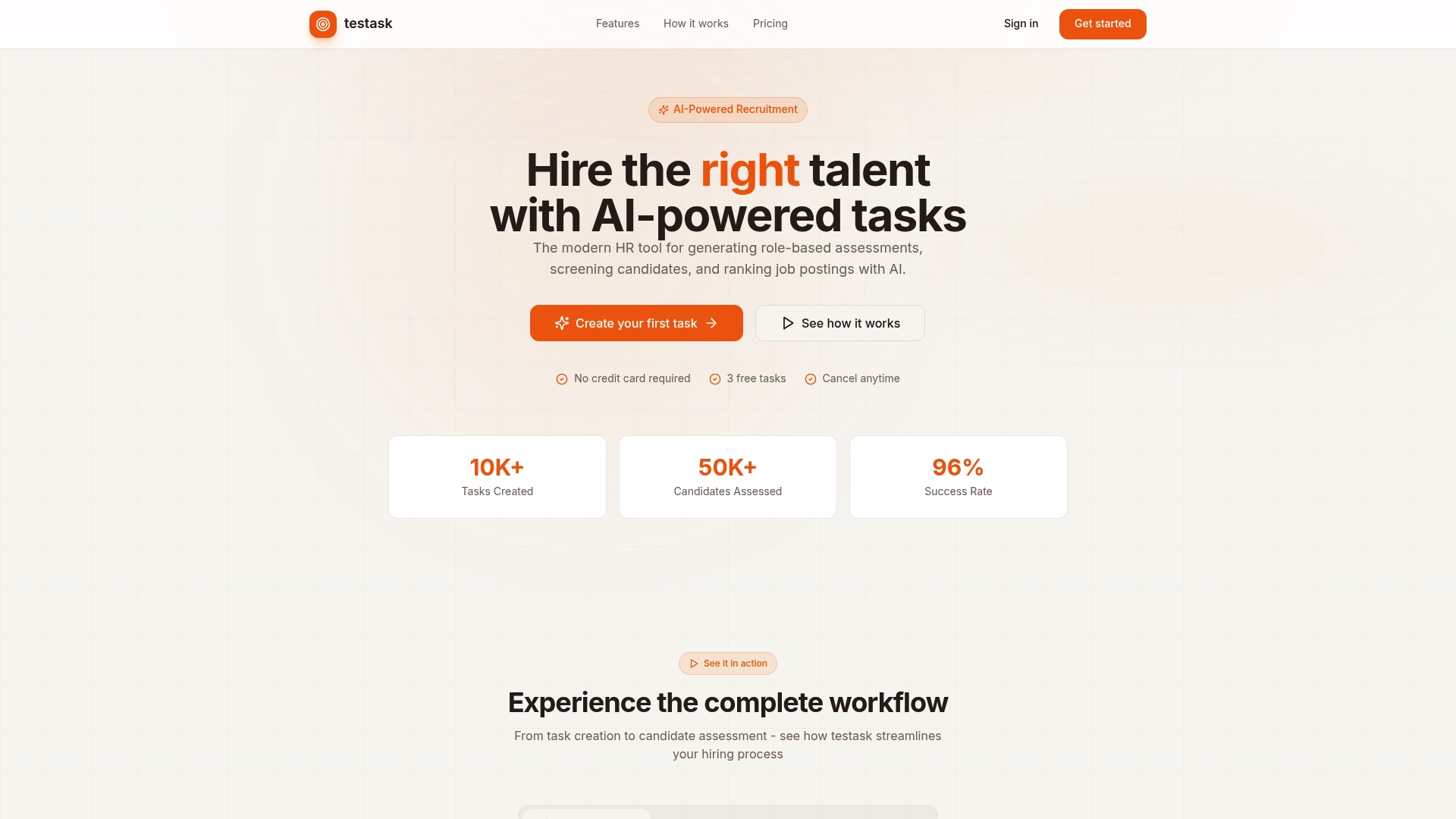
The use case is specific and the fit is clear: mid-market HR teams hiring for roles where demonstrated output matters more than abstract test scores, and where multiple stakeholders need to weigh in on candidate quality. Testask’s free tier lets you run your first assessments without a contract commitment, which makes it a low-risk first pilot before you invest in a broader platform.
Start your first assessment on Testask and see how AI-generated work samples compare to your current screening process. If you want context on how assessment platforms fit into a broader hiring strategy, the HR assessment platforms guide covers the full picture.
Useful sources and further reading
The sources below were used in researching this article. Vendor-authored pages are noted; independent sources are listed first.
- Gartner Peer Insights: Talent Assessment Software — Independent review directory with aggregated ratings and integration maturity data. Independent.
- G2: Best Talent Assessment Tools in 2026 — Roundup and review aggregation from verified software buyers. Independent.
- U.S. Office of Personnel Management: Structured Interviews — Primary source for structured interview and scoring rubric guidance applicable to US hiring. Government/primary source.
- Testask: AI-Powered Recruitment Assessment Platform — Product details, free tier access, and trial information. Vendor-authored.
Note: Pricing and compliance claims change frequently. Confirm current pricing, SOC 2 status, and data residency options directly with each vendor during your procurement process. This article reflects publicly available information and independent review data as of 2026.
Recommended
- Examples of Assessment Tools for HR Teams in 2026 | Testask Blog | testask
- Best Hiring Practices 2026: What HR Teams Need to Know | Testask Blog | testask
- Recruitment Trends in 2026: What HR Leaders Must Know | Testask Blog | testask
- Examples of Interview Assessments for HR Pros in 2026 | Testask Blog | testask