Why Adopt Assessment Platforms for Better Hiring
Why Adopt Assessment Platforms for Better Hiring

Assessment platforms are software solutions that standardize candidate evaluation by applying consistent criteria, automating scoring, and delivering comprehensive performance reports. HR teams that rely on unstructured interviews and gut instinct face a measurable problem: subjective decisions slow hiring and increase turnover. The case for why adopt assessment platforms comes down to three things: objectivity, speed, and data quality. Tools like Cloud Assess and PXT Select have shown that structured evaluation produces better hiring outcomes than traditional screening alone. This article gives HR professionals and hiring managers a direct look at the benefits, features, and practical steps for adopting digital assessments in 2026.
Why adopt assessment platforms for smarter hiring decisions
Assessment platforms standardize candidate evaluations by applying the same format, question types, and scoring to every applicant. That consistency removes the variability that comes from different interviewers applying different standards. The result is a fairer process and a cleaner data set for decision-making.
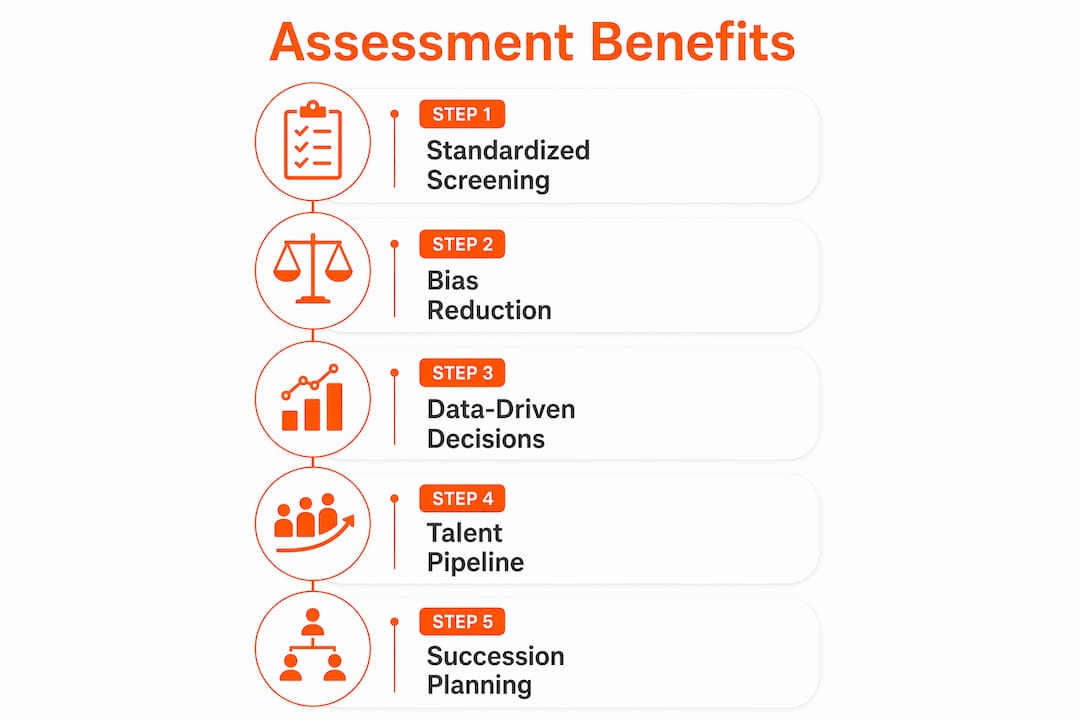
The benefits of assessment tools go well beyond fairness. Here is what HR teams gain when they move from manual screening to a structured platform:
- Bias reduction. Automated scoring eliminates subjective variances, so candidates are compared on the same scale rather than on an interviewer’s impression.
- Faster time to hire. Platforms score and report results automatically, cutting the hours your team spends reviewing unstructured submissions.
- Predictive accuracy. Assessment tools evaluate skills, cognitive abilities, and personality to provide objective data that predicts candidate success more reliably than resumes alone.
- Cost reduction. Fewer bad hires mean lower onboarding costs and reduced turnover expense.
- Interview quality. Detailed reports give interviewers specific areas to probe, turning generic conversations into targeted discussions.
Pro Tip: Use assessment reports as a pre-interview briefing document. Share results with every interviewer before the call so the team asks consistent, evidence-based questions rather than repeating the same surface-level topics.
The advantages of digital assessments compound over time. Each hiring cycle generates data your team can analyze to refine job criteria, improve assessment design, and benchmark candidates against top performers already in the organization.

How do assessment platforms support talent pipelines and succession planning?
Assessment platforms are critical for building long-term talent pipelines by enabling internal upskilling rather than relying solely on external hiring. That shift has a direct financial benefit: internal development costs less than recruiting, onboarding, and training a new external hire from scratch.
Skill mapping is the foundation of this approach. When you run assessments across your existing workforce, you generate a clear picture of where skills are strong and where gaps exist. That picture drives better decisions in four areas:
- Targeted training. You invest in programs that address actual gaps rather than guessing what employees need.
- Succession planning. Continuous assessment data lets you track employee growth over time and identify who is ready for a larger role.
- Reduced external recruitment. Organizations that map skills proactively reduce dependence on external hiring by promoting from within when a role opens.
- Retention. Employees who receive targeted development opportunities based on real data are more likely to stay.
The impact of assessment technology on succession planning is often underestimated. Most HR teams think of assessments as a hiring tool. The stronger long-term value is using the same data to build a bench of ready internal candidates before a vacancy appears.
What features differentiate assessment platforms?
Not all platforms serve the same purpose. Understanding assessment platform features helps you choose the right solution for your specific hiring and development goals.
Types of assessments
| Assessment type | Primary use case | What it measures |
|---|---|---|
| Cognitive ability tests | Pre-hire screening | Problem-solving, reasoning, learning speed |
| Personality assessments | Culture and role fit | Behavioral tendencies, work style |
| Skills-based tests | Technical role hiring | Job-specific competencies |
| 360-degree feedback | Employee development | Performance from multiple perspectives |
Different platform types suit different hiring and development needs, and the best platforms let organizations customize which types they deploy. A single cognitive test rarely tells the full story. Combining cognitive, behavioral, and skills testing provides a multidimensional view of each candidate.
Key platform features to evaluate
Effective assessment platforms feature customizable tools, automated reporting, and integration with existing HR systems. When evaluating options, your team should confirm the platform offers:
- Customizable assessments that align with your specific job requirements rather than generic templates.
- Automated scoring and reporting dashboards that deliver results without manual processing.
- HR system integration so candidate data flows directly into your applicant tracking system.
- Fairness and accessibility controls that meet legal standards and accommodate candidates with disabilities.
Pro Tip: Before committing to a platform, run a pilot with one open role. Compare the quality of candidates who complete the assessment against those screened by resume alone. The data from a single hiring cycle is usually enough to justify full adoption.
Validity matters as much as features. An assessment that does not actually predict job performance creates a false sense of objectivity. Ask vendors for validity studies before signing a contract.
How do organizations implement assessment platforms effectively?
Adoption fails when platforms are dropped into existing processes without a clear integration plan. The following steps give HR teams a practical path from selection to full deployment.
-
Map your current hiring workflow. Identify exactly where in the process candidates will complete assessments. Pre-screening, post-interview, and final-stage assessments each serve a different purpose. Decide which stage fits your hiring volume and role complexity.
-
Train your HR team and hiring managers. Organizations that invest in user training see better adoption and improved hiring outcomes. Training should cover how to read reports, how to use data in interviews, and how to avoid over-relying on a single score.
-
Communicate clearly with candidates. Tell applicants what the assessment involves, how long it takes, and how results are used. Transparency improves completion rates and protects candidate experience.
-
Use assessment data to inform onboarding. A candidate’s results reveal development areas from day one. Share relevant findings with the hiring manager so onboarding addresses real gaps rather than following a generic checklist. Building an effective assessment checklist before launch helps your team stay consistent across roles.
-
Monitor outcomes and refine. Track metrics like time to hire, offer acceptance rate, and 90-day retention for candidates who completed assessments versus those who did not. That comparison tells you whether the platform is delivering value and where to adjust.
Online assessment platforms improve the speed and fairness of recruitment and deliver reports that support both interview preparation and onboarding decisions. The organizations that get the most from these tools treat them as a continuous feedback loop, not a one-time screening filter.
Key Takeaways
Assessment platforms deliver the most value when HR teams use them across the full talent lifecycle, from initial screening through succession planning, not just as a pre-hire filter.
| Point | Details |
|---|---|
| Standardization reduces bias | Consistent scoring removes subjective variance and makes candidate comparisons fair. |
| Speed and data quality improve together | Automated reporting cuts screening time while generating richer decision-making data. |
| Talent pipelines depend on skill mapping | Running assessments on current employees reveals gaps and reduces external hiring costs. |
| Feature fit matters more than brand | Match assessment types (cognitive, behavioral, skills) to your specific role requirements. |
| Training drives adoption success | HR teams that learn to read and apply assessment data see measurably better hiring outcomes. |
The case for treating assessments as a business system, not a hiring tool
Pavel here. After years of watching organizations adopt assessment technology, the pattern I see most often is this: a company buys a platform, uses it for initial screening, and then stops. The assessment becomes a checkbox rather than a data source.
That is the wrong frame. The organizations that get genuine value from these tools treat assessment data the way a finance team treats budget data: they review it regularly, compare it against outcomes, and use it to make forward-looking decisions. When a new role opens, they already know which internal candidates are closest to ready. When turnover spikes in a department, they check whether the assessment profile of recent hires differed from top performers.
The uncomfortable truth is that most hiring problems are not sourcing problems. They are evaluation problems. Gut instinct is not repeatable, and unstructured interviews have a poor track record for predicting performance. Assessment platforms do not fix hiring by magic. They fix it by forcing consistency and generating data that your team can actually learn from.
My advice: start with one role type, run the platform for two full hiring cycles, and compare outcomes against your historical baseline. The results will make the business case for broader adoption better than any vendor pitch.
A practical starting point is reviewing how to assess candidates with a structured framework before selecting a platform. That groundwork makes the technology work harder for your team.
— Pavel
How Testask fits into your assessment strategy
HR teams that want to move from manual screening to structured, data-driven evaluation can use Testask to build that foundation without a long implementation cycle.
Testask is an AI-powered recruitment assessment platform that lets your team create tailored test tasks, evaluate candidate submissions with AI-assisted analysis, and collaborate on reviews in one place. You can assess technical and soft skills faster, generate structured reports for each candidate, and make hiring decisions backed by consistent data rather than impressions. Whether you are screening for a single role or building a predictive hiring system across your organization, Testask gives your team the tools to evaluate candidates at scale. Visit testask.org to see how the platform works and request a demo.
FAQ
What is an assessment platform in hiring?
An assessment platform is a software tool that standardizes candidate evaluation by applying consistent scoring, question formats, and reporting across all applicants. It replaces subjective screening with objective, comparable data.
How do assessment platforms reduce hiring bias?
Automated scoring removes the subjective variance that comes from different interviewers applying different standards. Every candidate is measured against the same criteria, which produces fairer comparisons.
What types of assessments do these platforms offer?
Most platforms offer cognitive ability tests, personality assessments, skills-based tests, and 360-degree feedback tools. The right combination depends on the role and whether the goal is hiring or employee development.
How do I choose the right assessment platform?
Match the platform’s assessment types to your specific job requirements, confirm it integrates with your existing HR systems, and verify that the vendor provides validity studies showing the tool actually predicts job performance.
Can assessment platforms support employee development, not just hiring?
Yes. Skill mapping through ongoing assessments identifies gaps in your current workforce, supports targeted training investments, and gives HR teams the data needed for succession planning and internal promotions.
Recommended
- Employment assessment best practices that elevate hiring results | Testask Blog | testask
- How to Assess Candidates: A 2026 Hiring Guide | Testask Blog | testask
- What is job assessment? A practical guide for better hiring | Testask Blog | testask
- Recruitment assessment steps: your guide to bias-free hiring | Testask Blog | testask