Examples of Assessment Tools for HR Teams in 2026
Examples of Assessment Tools for HR Teams in 2026

Assessment tools are structured instruments used to evaluate candidate suitability and employee performance through objective, repeatable measurement. The best examples of assessment tools span cognitive tests, personality questionnaires, skills gap analyses, 360-degree feedback, and behavioral interviews. Each type serves a distinct purpose in recruitment and employee evaluation. Used correctly, they reduce human bias and create a clear path from current performance to desired outcomes. This article covers the most effective tool types, what makes each one work, and how to choose the right fit for your organization.
Examples of assessment tools: the main categories
Assessment tools fall into five core categories. Knowing which category fits your goal is the first decision every HR team must make.
-
Aptitude and cognitive tests measure reasoning, problem-solving, and learning speed. They predict how quickly a candidate will absorb new information and handle complex tasks. Common formats include numerical reasoning, verbal reasoning, and abstract thinking exercises.
-
Personality assessments evaluate behavioral tendencies, communication style, and cultural fit. Tools in this category produce profiles that help hiring managers predict how a candidate will interact with teammates and handle workplace stress.
-
Skills assessments test specific, job-relevant competencies. A coding challenge for a software engineer or a writing exercise for a content role are both skills assessments. They produce direct evidence of capability rather than self-reported claims.
-
Behavioral assessments use structured questions or scenarios to reveal how a candidate has acted in past situations. The STAR method (Situation, Task, Action, Result) is the most widely used behavioral interview framework.
-
Performance reviews and 360-degree feedback apply to existing employees. 360-degree feedback gathers input from peers, direct reports, and managers, giving a multi-source view of effectiveness that a single supervisor review cannot provide.
Pre-employment assessment tools including aptitude tests, personality questionnaires, skill-based assessments, and situational judgment tests are used widely by employers to predict job fit and performance. That breadth means you rarely need just one tool. Most effective hiring processes combine two or three types.
1. Cognitive ability tests

Cognitive ability tests measure general mental aptitude, including numerical, verbal, and logical reasoning. They are among the strongest predictors of job performance across a wide range of roles. A candidate who scores well on abstract reasoning is more likely to solve novel problems on the job, regardless of industry.
These tests typically run 20–40 minutes and produce a standardized score. HR teams use that score to rank candidates before investing time in interviews. The key advantage is consistency: every candidate faces the same questions under the same conditions.
2. Personality questionnaires
Personality questionnaires map behavioral traits to role requirements. The Big Five model (Openness, Conscientiousness, Extraversion, Agreeableness, Neuroticism) is the most research-validated framework in organizational psychology. A high Conscientiousness score, for example, consistently correlates with reliability and attention to detail in professional settings.
These tools work best when you define the target profile before administering the questionnaire. Without a benchmark, the output is data without direction. Pair the results with a structured interview to confirm patterns rather than treating the score as a verdict.
3. Situational judgment tests
Situational judgment tests (SJTs) present candidates with realistic workplace scenarios and ask them to choose the most effective response. They measure judgment, decision-making, and values alignment simultaneously. SJTs are particularly useful for roles that require frequent interpersonal decisions, such as customer service, management, and healthcare.
The format is flexible. SJTs can be delivered as written multiple-choice questions, video-based scenarios, or interactive simulations. Video-based formats tend to produce higher engagement and more realistic responses than text-only versions.
4. Skills gap analysis tools
A skills gap analysis compares the competencies a role requires against what a candidate or employee currently demonstrates. The output is a gap map that guides both hiring decisions and training investments. HR teams use skill matrices to visualize these gaps across entire departments.
This tool type is as valuable for workforce planning as it is for recruitment. When you know exactly which skills are missing at the team level, you can target hiring to fill those gaps rather than duplicating existing strengths. The result is a more deliberate, data-driven approach to building teams.
5. 360-degree feedback systems
360-degree feedback collects performance input from multiple sources: the employee’s manager, peers, direct reports, and sometimes external stakeholders. The aggregated view reveals blind spots that a top-down review misses entirely. An employee may perform well in manager evaluations but struggle with peer collaboration, a pattern only visible through multi-source data.
This tool is most effective when tied to a development plan. Without a clear follow-up process, the feedback sits unused and the employee gains no benefit. Schedule a debrief conversation within two weeks of results delivery to keep the process credible and useful.
6. Behavioral interviews with structured scoring
A behavioral interview uses predetermined questions tied to specific competencies, and each answer is scored against a defined rubric. This structure removes the interviewer’s subjective impression from the equation. Two interviewers using the same rubric will reach more consistent conclusions than two interviewers relying on gut feel.
The STAR method is the standard framework for both asking and evaluating behavioral questions. Candidates describe a Situation, the Task they faced, the Action they took, and the Result they achieved. Scoring rubrics typically rate each component on a 1–5 scale, producing a numeric output that can be compared across candidates.
7. Digital quizzes and interactive polls
Digital quizzes and polls provide real-time feedback and maintain engagement during assessment processes, making them especially useful in training and onboarding contexts. They support adaptive instruction by surfacing knowledge gaps immediately, before they become performance problems.
In recruitment, short digital quizzes serve as early-stage screening filters. A five-question quiz on industry knowledge can eliminate unqualified applicants before a single interview is scheduled. That saves significant time for both the HR team and the candidates who are not a fit.
Pro Tip: Keep digital quizzes to 5–15 items. Shorter assessments effectively track change without causing respondent fatigue, while longer measures reduce engagement even when the content is relevant.
8. The Rosenberg Self-Esteem Scale and validated psychometric tools
The Rosenberg Self-Esteem Scale is a widely validated brief tool that measures global self-esteem across diverse populations. Its strong psychometrics and cross-cultural validation make it a reliable choice for roles where self-confidence and resilience are core competencies.
Validated psychometric tools like this one carry a key advantage: their reliability has been tested across thousands of respondents in published research. When you use a validated instrument, you can trust that the score means what it claims to measure. Unvalidated tools, regardless of how professional they look, carry unknown error rates.
9. Performance appraisal frameworks
Performance appraisals are formal, periodic evaluations of an employee’s work output, behavior, and goal achievement. They typically occur quarterly or annually and produce a documented record of performance over time. That record supports promotion decisions, compensation reviews, and termination processes with evidence rather than memory.
Modern appraisal frameworks move beyond a single manager rating. They incorporate self-assessment, peer input, and objective metrics such as sales numbers or project completion rates. The combination produces a fuller picture and reduces the risk that one manager’s bias shapes an employee’s entire career trajectory.
10. AI-powered test tasks and work sample assessments
Work sample assessments ask candidates to complete a realistic task that mirrors actual job duties. A marketing candidate might write a campaign brief. A data analyst might clean a sample dataset. The output is direct evidence of how the candidate works, not a proxy measure.
AI-powered platforms like Testask take this approach further by generating tailored test tasks, evaluating submissions with AI-assisted analysis, and enabling team collaboration on reviews. This reduces the time HR teams spend on manual scoring while maintaining consistency across all candidates. For teams assessing at volume, that efficiency is a practical necessity.
How to choose the right assessment tool
Selecting the right tool requires matching the assessment’s purpose to the role’s requirements. Follow these steps to make a defensible choice.
-
Define the competency you are measuring. Cognitive ability, technical skill, and cultural fit each require a different tool type. Mixing purposes in a single assessment produces unclear results.
-
Check validity and reliability. A valid tool measures what it claims to measure. A reliable tool produces consistent results across administrations. Ask vendors for published psychometric data before committing.
-
Match length to context. A 90-minute assessment is appropriate for a senior leadership hire. A 15-minute quiz is appropriate for early-stage screening. Mismatched length drives candidate dropout.
-
Align with your HR workflow. The tool must integrate with your existing applicant tracking system or evaluation process. A technically superior tool that creates manual data entry is a net loss in efficiency.
-
Plan the follow-up before you deploy. Administering assessments without follow-up creates ethical and operational gaps. Results should prompt a structured debrief, not a silent rejection.
Pro Tip: Review employment assessment best practices before finalizing your tool selection. Aligning your process with established standards reduces legal risk and improves candidate experience.
Common challenges and how to address them
| Challenge | Best Practice |
|---|---|
| Respondent fatigue | Limit assessments to 5–15 items for screening stages |
| Bias in score interpretation | Use rubrics and benchmarks; never rely on a single score |
| No follow-up after results | Schedule a debrief within two weeks of delivery |
| Poor candidate experience | Communicate purpose and timeline before the assessment begins |
| Misaligned tool selection | Define the target competency before choosing a format |
“Assessment scores are baselines for discussion. Cutoff scores should not replace professional judgment.” This principle applies whether you are screening a first-round applicant or evaluating a tenured employee for promotion.
The most common failure in assessment deployment is treating the score as the final word. Scores are inputs to a decision, not the decision itself. HR teams that combine assessment data with structured interviews and professional judgment consistently make better hires than those who rely on scores alone.
Key takeaways
The most effective assessment strategy combines multiple tool types, aligns each tool to a specific competency, and treats every score as a starting point for professional judgment rather than a final verdict.
| Point | Details |
|---|---|
| Match tool to purpose | Choose cognitive, skills, or behavioral tools based on the specific competency you need to measure. |
| Validate before you deploy | Use psychometrically validated tools to ensure scores are reliable and legally defensible. |
| Keep assessments concise | Limit screening assessments to 5–15 items to maintain candidate engagement and data quality. |
| Always plan follow-up | Schedule a debrief after every assessment to convert results into useful decisions. |
| Combine tools with judgment | Assessment scores inform decisions; they do not replace structured interviews or professional evaluation. |
Why I think most HR teams underuse their assessment data
The tools are rarely the problem. Most organizations have access to solid assessment instruments. The gap is in what happens after the scores come in.
I have seen teams run thorough cognitive and personality assessments, then make hiring decisions based on which candidate “felt right” in the final interview. The assessment data sat in a spreadsheet, referenced briefly and then ignored. That is not a tool failure. That is a process failure.
The shift that actually improves hiring outcomes is treating assessment results as a structured input to a conversation, not a ranking system. When a candidate scores low on a behavioral assessment but high on a skills test, that tension is worth exploring in the interview. It tells you something specific about where the fit may be strong and where it may need support.
The other underused opportunity is bias-free hiring through consistent scoring rubrics. Most teams know that unstructured interviews are unreliable. Far fewer teams actually implement the rubrics that make structured interviews work. Assessment tools give you the data. Rubrics give you the framework to act on it consistently.
The organizations getting the most value from assessment tools in 2026 are not using more tools. They are using fewer tools more deliberately, with clear competency definitions, structured follow-up, and a commitment to letting data challenge their instincts rather than confirm them.
— Pavel
Testask makes skills-based hiring faster and more consistent
Choosing the right assessment tool is only half the challenge. Executing it consistently across every candidate, at volume, is where most HR teams lose time and accuracy.
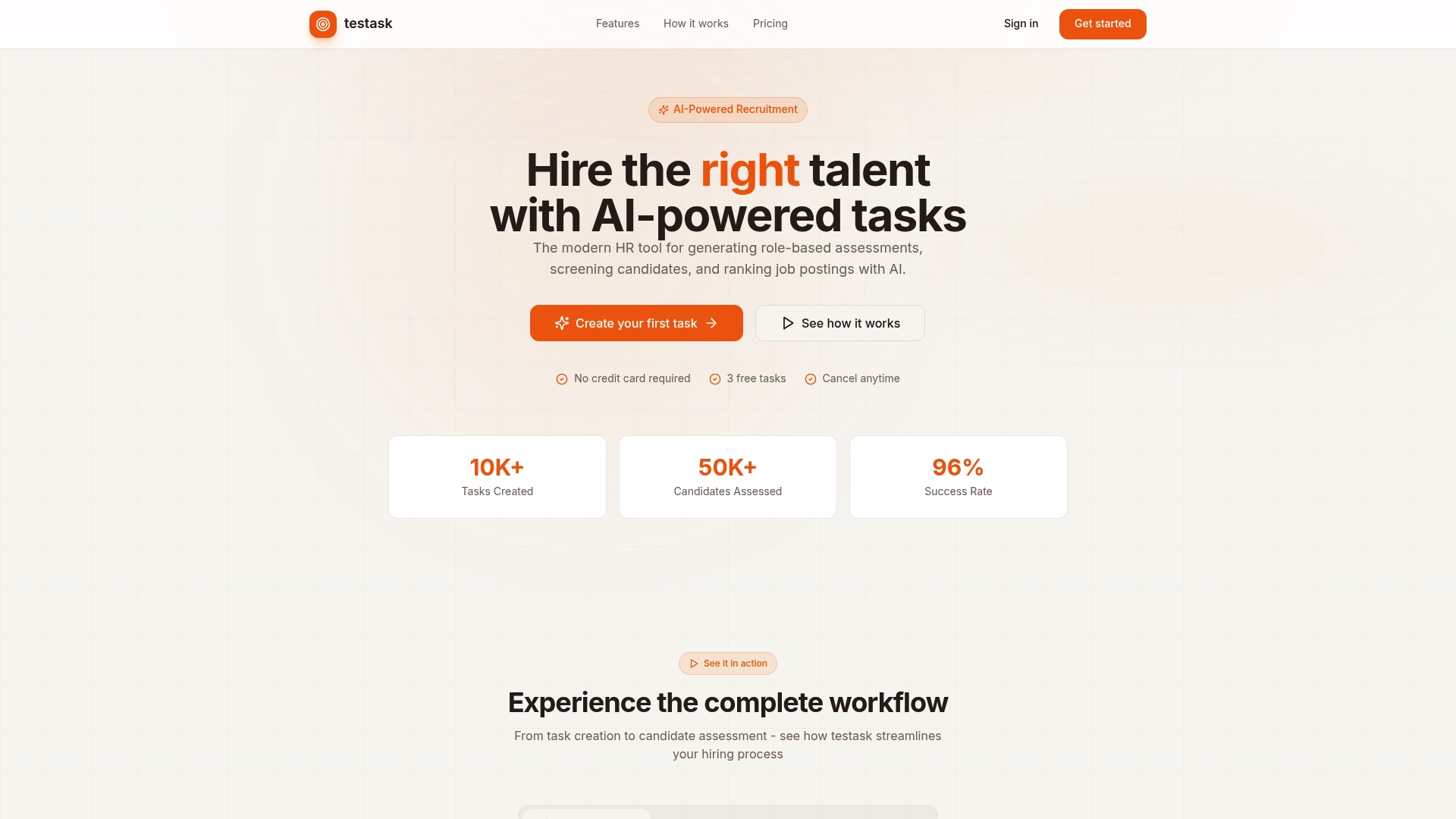
Testask is an AI-powered recruitment assessment platform that generates tailored test tasks, evaluates candidate submissions with AI-assisted analysis, and enables your team to collaborate on reviews in one place. It removes the manual scoring burden while keeping your hiring process fair and structured. HR teams using Testask can assess candidates faster without sacrificing the quality of evaluation. If your current process relies on ad-hoc tasks or inconsistent scoring, Testask gives you a repeatable system built for modern hiring demands.
FAQ
What are the main types of assessment tools in HR?
The main types are cognitive ability tests, personality questionnaires, skills assessments, behavioral interviews, situational judgment tests, and 360-degree feedback systems. Each type measures a different dimension of candidate or employee performance.
How do I choose the right assessment tool for my organization?
Define the competency you need to measure first, then select a validated tool that matches the role level and fits your existing HR workflow. Always plan a structured follow-up before deploying any assessment.
How long should a pre-employment assessment be?
Screening assessments work best at 5–15 items. Longer assessments are appropriate for senior roles but should be reserved for later hiring stages to avoid candidate dropout.
What is 360-degree feedback and when should I use it?
360-degree feedback collects performance input from peers, managers, and direct reports to give a multi-source view of an employee’s effectiveness. Use it for development reviews and promotion decisions, paired with a structured debrief conversation.
Can assessment scores replace the interview process?
Assessment scores are baselines for discussion, not final verdicts. The most reliable hiring decisions combine assessment data with structured candidate evaluation and professional judgment from trained interviewers.
Recommended
- Examples of Interview Assessments for HR Pros in 2026 | Testask Blog | testask
- Best Hiring Practices 2026: What HR Teams Need to Know | Testask Blog | testask
- The Role of HR Analytics in Workforce Strategy 2026 | Testask Blog | testask
- What Is HR Collaboration and Why It Matters in 2026 | Testask Blog | testask