Examples of Interview Assessments for HR Pros in 2026
Examples of Interview Assessments for HR Pros in 2026

Interview assessments are specialized tools that measure candidate competencies, traits, and job fit through structured, repeatable techniques. Unlike informal conversations, these methods produce scorable data that predicts on-the-job performance with far greater accuracy. The most effective examples of interview assessments combine structured formats with role-specific criteria, drawing on frameworks from Google re:Work, AIHR, and Indeed to give recruiters consistent, defensible hiring decisions. This article covers the top assessment types, with concrete examples and guidance on when to use each one.
1. Examples of interview assessments: structured behavioral interviews
Structured interviews use standardized questions and scoring rubrics for every candidate, which increases predictive validity and reduces interviewer bias. Every candidate answers the same questions in the same order, and responses are rated against predetermined criteria. This consistency makes it possible to compare candidates fairly across a large applicant pool.
Behavioral questions are the backbone of this format. They follow the “Tell me about a time…” pattern to surface real past experience, which validates actual behavior rather than hypothetical intent. Examples include:
- “Describe a situation where you had to manage a difficult stakeholder. What did you do, and what was the outcome?”
- “Tell me about a time you missed a deadline. How did you handle it?”
- “Give an example of when you had to learn a new skill quickly to complete a project.”
Hypothetical questions complement behavioral ones by testing problem-solving through imagined scenarios. They work especially well for roles where candidates lack direct experience. An example: “If a client escalated a complaint right before a product launch, how would you prioritize your response?”
AIHR recommends pairing these questions with behaviorally anchored rating scales from 1 to 5 for competencies like communication, problem-solving, and empathy. This approach allows multiple interviewers to calibrate scores and reach consensus without subjective drift.

Pro Tip: Train every interviewer on the rubric before the panel begins. Calibration sessions where interviewers score the same practice response independently, then compare results, cut scoring variance significantly.
2. Skills and cognitive ability tests with sample questions
Skills tests and cognitive ability assessments quantify what a candidate actually knows and how quickly they process new information. These tests move evaluation beyond verbal answers into measurable performance data. Common assessment types include aptitude tests, job-specific skills tests, and general cognitive ability evaluations.
Sample question formats vary by role and objective:
- Multiple-choice: “Which formula calculates compound interest in Excel?” Tests technical knowledge with a single correct answer.
- True/false: “A p-value below 0.05 indicates statistical significance.” Fast to score and useful for knowledge screening.
- Short answer: “Explain the difference between a stack and a queue in data structures.” Reveals depth of understanding.
- Computational: “A product costs $80 and is marked up 35%. What is the selling price?” Directly measures numerical reasoning.
Indeed provides examples such as brand color recognition and math problems as standard cognitive test items. These examples illustrate how even simple questions can reveal processing speed and attention to detail. For roles in finance, engineering, or data analysis, computational questions are particularly predictive of day-one performance.
| Test type | Best for | Sample format |
|---|---|---|
| Aptitude | Entry-level and graduate roles | Numerical and verbal reasoning |
| Cognitive ability | Analyst and management roles | Logic puzzles, pattern recognition |
| Job-specific skills | Technical and specialist roles | Coding tasks, writing samples |
| Knowledge-based | Compliance and legal roles | Multiple-choice, true/false |
The primary advantage of skills tests is speed. A 20-minute test administered before the first interview can cut your screening workload by filtering out candidates who lack baseline competencies. Pairing these with a pre-employment testing guide helps you sequence tests correctly within your hiring funnel.
3. Personality and behavioral assessments
Personality assessments evaluate character traits and working styles that affect team dynamics, culture fit, and long-term retention. They do not measure intelligence or technical skill. Instead, they reveal how a candidate tends to behave under pressure, in collaboration, and when facing ambiguity.
The Big Five personality model (Openness, Conscientiousness, Extraversion, Agreeableness, Neuroticism) is the most research-supported framework for workplace prediction. Assessment formats include:
- Agree/disagree statements: “I prefer to plan my work in detail before starting.” Measures conscientiousness.
- Story-based questions: “A colleague takes credit for your idea in a team meeting. Describe your likely response.” Reveals conflict style and emotional regulation.
- Forced-choice rankings: Candidates rank four statements by how closely each describes them, reducing social desirability bias.
Personality data becomes most useful when combined with structured interview scores and skills test results. Google re:Work’s research confirms that combining multiple assessment types reduces individual bias and produces a fuller candidate profile. A candidate who scores high on a technical test but low on conscientiousness may underperform in roles requiring independent project management.
Pro Tip: Never use personality scores as a standalone filter. Use them to generate targeted follow-up questions in the final interview round, not to eliminate candidates at the screening stage.
4. Job simulations and written assessments
Job simulations are live exercises that replicate actual work tasks, giving you direct evidence of applied skill rather than self-reported capability. Simulations and written tests are widely used in professional services recruiting to observe candidate behavior in realistic contexts. They are especially effective for roles where output quality is the primary performance metric.
Common simulation formats include:
- Mock client meetings: The candidate presents a solution to a panel acting as stakeholders. Tests communication, persuasion, and preparation.
- Case studies: A written or verbal analysis of a business problem. Common in consulting, strategy, and product management hiring.
- Technical tasks: A coding challenge, design brief, or financial model built under timed conditions.
- Role-play scenarios: The candidate handles a difficult customer call or a team conflict while evaluators observe and score.
Written assessments serve a complementary function. Essays, memos, and structured problem-solving exercises reveal how candidates organize thinking, communicate under constraints, and handle ambiguity without verbal prompting.
“Job simulations give you a 30-minute window into how a candidate actually works, not just how they describe their work. That distinction changes hiring decisions.”
The scoring challenge with simulations is consistency. Without a rubric, two evaluators watching the same mock presentation will often reach different conclusions. Defining scoring criteria before the exercise runs, not after, is the single most important design decision for this format.
5. Comparison of assessment types and best use cases
Choosing the right assessment depends on the role level, function, and stage of your hiring process. No single format covers every dimension of candidate quality. Role-specific rubrics with behaviorally anchored scales help calibrate scores across formats and reduce subjective judgment.
| Assessment type | Predictive validity | Time investment | Best use case |
|---|---|---|---|
| Structured behavioral interview | High | Medium | All roles, especially leadership |
| Skills and cognitive test | High | Low | Technical, analyst, and entry-level roles |
| Personality assessment | Moderate | Low | Culture fit, team-based roles |
| Job simulation | Very high | High | Senior, client-facing, or specialist roles |
| Written assessment | High | Medium | Writing-intensive or analytical roles |
The most reliable hiring decisions come from combining at least two formats. A structured interview paired with a skills test covers both verbal reasoning and technical competence. Adding a simulation for senior roles provides a third data point that is difficult to fake. This multi-format approach aligns with screening tools best practices that prioritize data over gut instinct.
For entry-level roles, a cognitive ability test followed by a structured behavioral interview is the most time-efficient combination. For director-level or client-facing positions, replace the cognitive test with a case study or simulation and add a personality assessment to evaluate leadership style. The goal is not to maximize the number of assessments but to select formats that directly measure the competencies the role requires.
Calibration across your hiring team is equally important. When multiple interviewers score the same candidate using different mental benchmarks, the data loses its value. Running a calibration session at the start of each hiring cycle, using AIHR’s panel calibration methods, takes less than an hour and significantly improves scoring consistency.
Key takeaways
The most defensible hiring decisions combine structured interviews, skills tests, and at least one applied assessment such as a simulation or written exercise, all scored against predefined rubrics.
| Point | Details |
|---|---|
| Structured interviews reduce bias | Standardized questions and rating scales make candidate comparisons fair and consistent. |
| Skills tests speed up screening | A 20-minute test before the first interview filters out unqualified candidates efficiently. |
| Personality data needs context | Use Big Five results to generate follow-up questions, not as a standalone elimination filter. |
| Simulations reveal applied skill | Live exercises expose real work quality that verbal answers cannot replicate. |
| Multi-format assessment wins | Combining two or more formats improves predictive validity and reduces individual evaluator bias. |
Why most assessment strategies fail before the first interview ends
I have reviewed hundreds of hiring processes across industries, and the most common failure is not choosing the wrong assessment type. It is deploying the right assessment without a scoring rubric. A behavioral interview without a rubric is just a conversation. A simulation without defined criteria is theater. The format is only as good as the evaluation structure behind it.
The second failure is sequencing. Many teams run personality assessments early in the process, before they have any skills data. That creates a halo effect where a likable personality score colors the technical evaluation. The correct sequence is skills first, personality second, simulation last. This order builds an evidence base before you introduce the softer data.
The third failure is calibration neglect. I have seen panels where three interviewers scored the same candidate a 2, a 4, and a 5 on the same competency. That is not a candidate problem. That is a process problem. Thirty minutes of calibration at the start of a hiring cycle, using assessment best practices as a reference, eliminates most of that variance.
The teams that hire well are not the ones with the most sophisticated assessments. They are the ones who use simple, well-calibrated tools consistently. Consistency beats complexity every time.
— Pavel
Build better assessments with Testask
Designing and scoring multiple assessment types manually is time-consuming and prone to inconsistency. Testask is an AI-powered recruitment assessment platform that helps HR teams generate tailored test tasks, evaluate candidate submissions, and collaborate on scoring in one place.
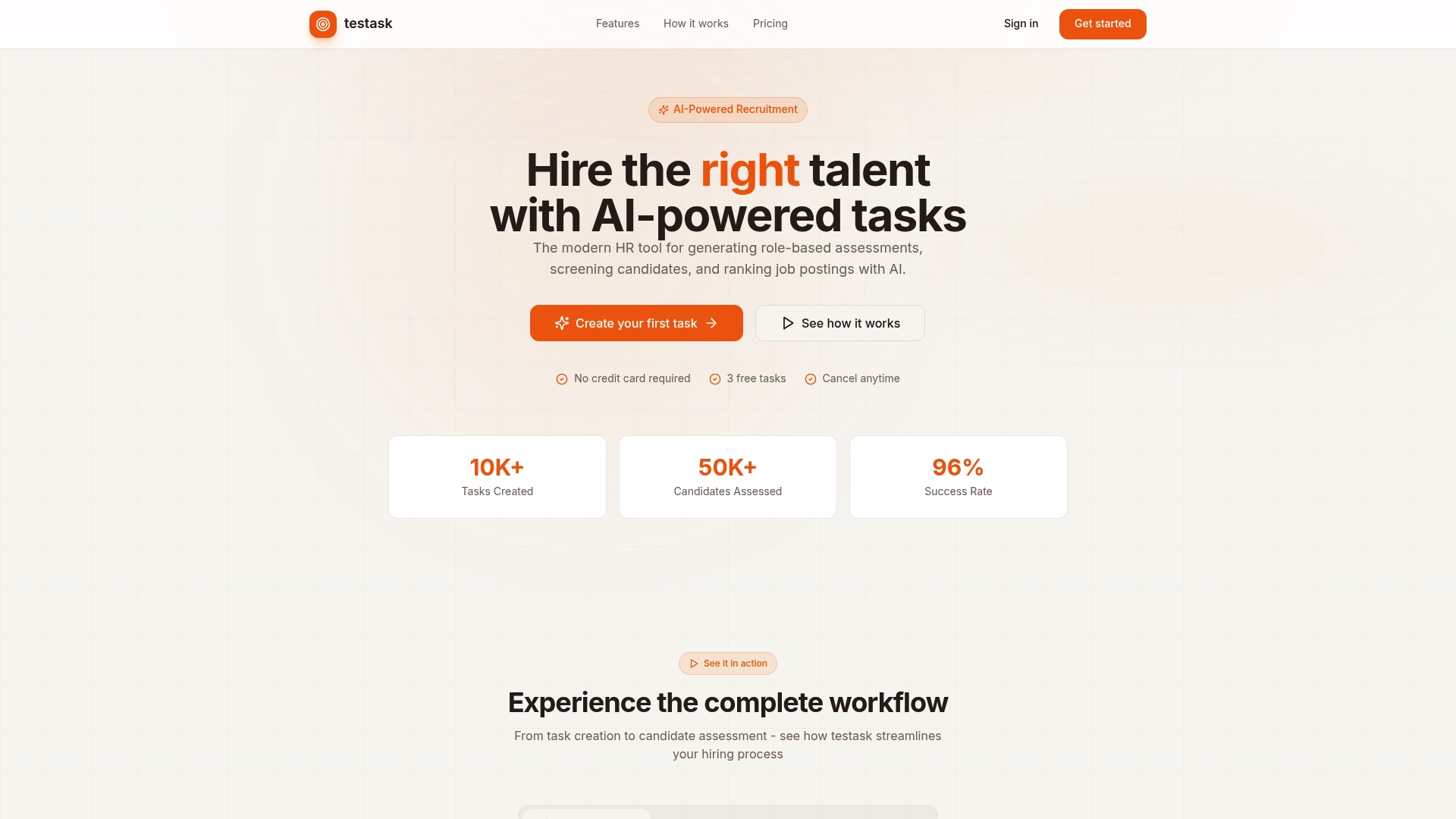
With Testask, you can build structured interview rubrics, deploy skills tests, and review simulation outputs with AI-assisted analysis that flags scoring gaps across your panel. The platform supports every assessment format covered in this article, from cognitive ability tests to written exercises, with built-in calibration tools that keep your team aligned. If you want to move faster and hire with more confidence, explore Testask and see how AI-assisted evaluation changes the quality of your hiring decisions.
FAQ
What are the most common examples of interview assessments?
The most common types are structured behavioral interviews, skills and cognitive ability tests, personality assessments, job simulations, and written exercises. Each format measures a different dimension of candidate quality, from technical knowledge to applied problem-solving.
How do behavioral and hypothetical questions differ?
Behavioral questions ask candidates to describe past actions using the “Tell me about a time…” format, while hypothetical questions present imagined scenarios to test reasoning. Behavioral questions are stronger predictors of future performance because they are grounded in real experience.
When should recruiters use job simulations?
Job simulations work best for senior, client-facing, or specialist roles where output quality is the primary performance measure. They require more time to design and score but provide direct evidence of applied skill that verbal interviews cannot replicate.
How many assessment types should a hiring process include?
Most roles benefit from two to three assessment formats. Combining a structured interview with a skills test covers the majority of competency dimensions. Adding a simulation or written assessment for senior roles provides a third data point that significantly improves prediction accuracy.
What is the role of rubrics in interview assessments?
Rubrics define scoring criteria before the assessment runs, which reduces evaluator subjectivity and enables fair comparison across candidates. AIHR recommends behaviorally anchored 1 to 5 scales for competencies like problem-solving and communication to support panel calibration.
Recommended
- Talent Assessment: Build Efficient, Predictive Hiring Systems | Testask Blog | testask
- Recruitment assessment steps: your guide to bias-free hiring | Testask Blog | testask
- Screening tools in hiring: Transform your recruitment efficiency | Testask Blog | testask
- Employment assessment best practices that elevate hiring results | Testask Blog | testask