HR Assessment Platforms: What HR Teams Need to Know
HR Assessment Platforms: What HR Teams Need to Know

HR assessment platforms are specialized software systems that objectively measure candidates’ skills, cognitive abilities, personality traits, and job fit to support better hiring decisions. These platforms replace subjective gut feelings with standardized, data-driven evaluations, giving HR professionals and organizational leaders a reliable basis for comparing candidates. The industry term for this category is “talent assessment technology,” though HR teams commonly refer to these tools as HR assessment platforms or HR evaluation software. Understanding what these systems do, how they work, and how to choose one is the foundation of modern, evidence-based recruitment.
What are HR assessment platforms and why do they matter?
HR assessment platforms are digital tools that evaluate candidates across multiple dimensions before, during, or after the hiring process. They go well beyond resume screening by measuring real-world skills through coding challenges, situational judgment tests, and behavioral simulations. Pre-employment testing software objectively evaluates cognitive abilities, technical skills, and soft skills early in hiring to save time and reduce mismatches. That early-stage filtering means your team spends less time on candidates who are unlikely to succeed in the role.
The broader category, often called employee assessment tools, covers skills assessments, 360-degree feedback, and behavioral platforms used throughout the employee lifecycle. Employee assessment tools measure skills, performance, behaviors, and engagement, making them distinct from simple performance reviews focused only on goals. This distinction matters when you are deciding whether you need a pre-hire screening tool, an ongoing development platform, or both.

Roughly 77% of companies report difficulty recruiting skilled full-time workers. That figure shows why standardizing your screening process is not optional. Assessment platforms centralize candidate data and give recruiters visibility into talent trends and skills gaps, balancing immediate hiring needs with long-term workforce planning.
How do HR assessment platforms improve hiring outcomes?
The most direct benefit of HR evaluation software is a measurable lift in hire quality. Assessment platforms improve hire quality by 30% to 50% by replacing subjective evaluations with standardized frameworks. That improvement comes from removing the inconsistency that creeps into unstructured interviews, where two interviewers can walk away with completely different impressions of the same candidate.
Traditional interviews perform little better than chance at predicting future performance. Unconscious bias favors candidates with familiar backgrounds, not necessarily the most qualified ones.
Objective measurement of work personality and organizational fit leads to better hiring outcomes by cutting that bias at the source. When every candidate completes the same assessment under the same conditions, the comparison becomes fair and defensible. This matters especially for organizations subject to equal employment opportunity regulations, where documented, standardized criteria reduce legal exposure.
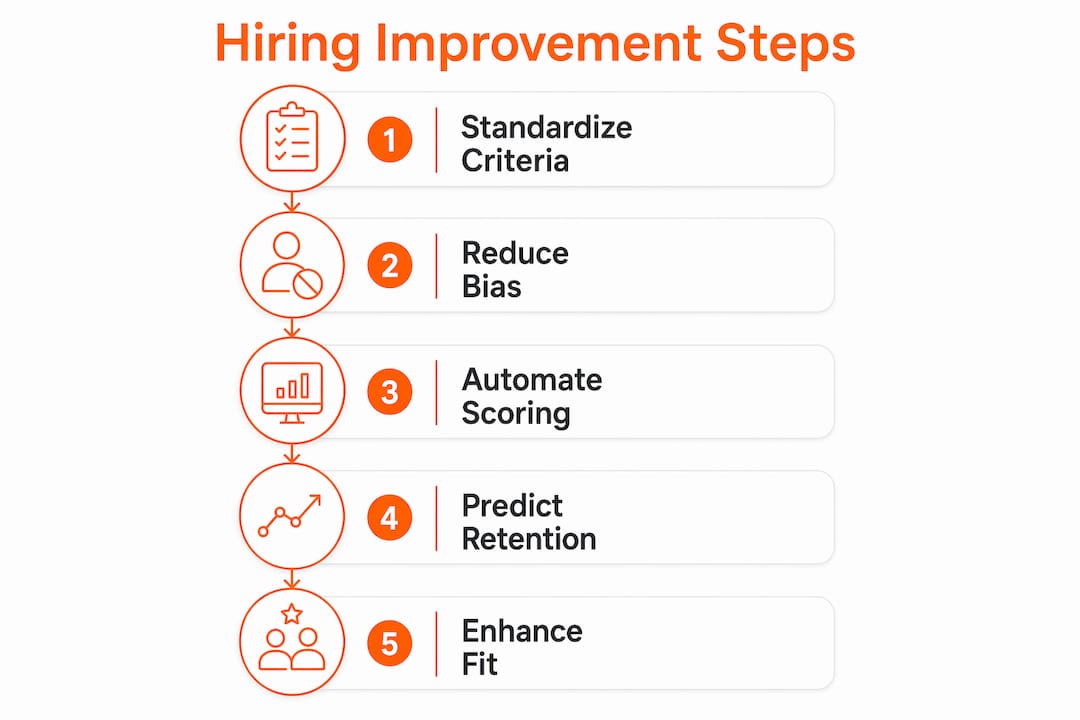
Assessment platforms also reduce time-to-hire. Automated scoring and AI-assisted analysis filter large applicant pools quickly, so your team reviews only the candidates who meet the baseline. Platforms that integrate with applicant tracking systems (ATS) push assessment results directly into candidate profiles, eliminating manual data entry. The result is a faster process that still produces richer candidate insights than a resume review alone.
Pro Tip: Use assessment data to predict long-term retention, not just immediate job fit. Platforms that include cultural alignment and values-based questions give you a signal on whether a candidate will stay past the first year.
What types and features do HR testing platforms offer?
HR testing platforms fall into several distinct categories, each designed for a different evaluation goal.
| Assessment type | What it measures | Best use case |
|---|---|---|
| Skills assessments | Technical, cognitive, and language ability | Engineering, finance, and language-dependent roles |
| Psychometric tests | Personality traits and behavioral tendencies | Culture fit, leadership potential, and team dynamics |
| Situational judgment tests | Decision-making under realistic job conditions | Customer-facing and management roles |
| Work sample simulations | Actual task performance | Creative, analytical, and coding roles |
| 360-degree feedback tools | Peer and manager perception of performance | Ongoing employee development |
Online assessment software automates scoring, monitors test integrity with AI, and generates insights to support data-driven hiring decisions. That combination of automation and AI proctoring is what separates modern platforms from older paper-based or spreadsheet-driven methods.
Key features to look for in any HR assessment platform include:
- AI proctoring: Detects unusual behavior during remote assessments to protect test integrity.
- ATS integration: Syncs candidate scores and profiles with your existing recruitment workflow.
- Analytics dashboards: Show pass rates, score distributions, and time-to-complete metrics across your candidate pool.
- Customizable question banks: Let you build role-specific assessments rather than relying on generic templates.
- Candidate experience tools: Include clear instructions, mobile-friendly interfaces, and reasonable time limits.
Scalability is a practical concern too. An entry-level platform may work for a company hiring 20 people per year. An enterprise platform with API access, multi-language support, and bulk scheduling becomes necessary when hiring volume reaches the hundreds or thousands annually.
Pro Tip: Ask vendors for sample candidate-facing assessments before you sign a contract. The candidate experience directly affects your employer brand, especially with passive candidates who are evaluating you as much as you are evaluating them.
How to choose the right HR assessment platform
Choosing the right platform starts with identifying your primary hiring challenge. Industry analysts advise categorizing organizational needs when selecting assessment platforms, prioritizing skills-based testing, behavioral insights, or performance review integration over a catch-all solution. A focused platform delivers more rigorous, relevant insights than one that tries to do everything at once.
Follow these steps to narrow your options:
- Define your assessment goals. Decide whether you need pre-hire screening, ongoing development tracking, or both. Your answer determines which platform category fits.
- Map your hiring volume and role complexity. High-volume, entry-level hiring calls for automated, standardized tests. Senior or specialized roles benefit from custom work samples and structured behavioral interviews.
- Audit your existing tech stack. Check whether candidate data needs to flow into an ATS, an HRIS, or a human capital management system. HCM solutions integrate recruitment, onboarding, and performance management, so your assessment platform should connect cleanly with that ecosystem.
- Evaluate data security and compliance. Confirm that the platform meets GDPR, EEOC, and any industry-specific data protection requirements relevant to your organization.
- Run a pilot before committing. Test the platform with a small cohort of real candidates. Measure completion rates, candidate feedback, and recruiter time savings before rolling it out organization-wide.
Usability matters as much as features. A platform your hiring managers find confusing will be abandoned within weeks. Prioritize clean interfaces, clear reporting, and responsive vendor support.
How to implement HR assessment platforms in your recruitment workflow
Assessment platforms work best when they complement your existing process rather than replace it entirely. The goal is to use assessment data to make every subsequent step, including interviews, more targeted and productive. Automated resume screening handles the early filtering, freeing your team to focus on the candidates who have already demonstrated baseline competency.
Effective implementation follows a few clear principles:
- Use assessment scores to shape interview questions. If a candidate scores low on a specific competency, probe that area in the interview rather than asking generic questions. This turns the assessment into a conversation guide.
- Standardize your scoring criteria before launch. Define what a passing score looks like for each role before candidates start taking tests. Changing thresholds mid-cycle introduces bias and undermines the objectivity you are trying to create.
- Automate scheduling and communication. Platforms that trigger assessment invitations automatically after application submission reduce recruiter workload and keep candidates moving through the funnel without delays.
- Review analytics regularly. Track which assessment questions best predict 90-day performance. Drop questions with low predictive validity and replace them with better ones. This continuous improvement loop is what separates high-performing HR teams from those who set up a platform and forget it.
- Communicate the process to candidates. Explain why you use assessments, how long they take, and how results are used. Transparency builds trust and reduces drop-off rates.
Fairness requires ongoing attention. Standardized criteria reduce bias, but they do not eliminate it. Audit your pass rates across demographic groups at least annually to catch any adverse impact before it becomes a legal or reputational problem. The best practices in employment assessment consistently point to regular audits as the single most important safeguard.
Key Takeaways
HR assessment platforms deliver measurable hiring improvements when chosen for a specific organizational need, integrated with existing workflows, and audited regularly for fairness and predictive accuracy.
| Point | Details |
|---|---|
| Core definition | HR assessment platforms are software tools that objectively measure candidate skills, personality, and job fit. |
| Hiring quality lift | Standardized assessments improve hire quality by 30% to 50% compared to unstructured interviews. |
| Platform types | Skills tests, psychometric tools, situational judgment tests, and work samples serve different evaluation goals. |
| Selection approach | Identify your primary hiring challenge first; focused platforms outperform catch-all solutions. |
| Implementation priority | Use assessment data to shape interviews and audit pass rates annually to maintain fairness. |
The shift I keep seeing HR teams get wrong
The most common mistake I see is treating an assessment platform as a filter rather than a diagnostic tool. Teams set a cutoff score, reject everyone below it, and move on. They never ask why certain candidates scored low or whether the test actually predicts success in their specific context.
The shift from intuition to data-driven hiring is real and worth making. But data is only as good as the questions you ask of it. I have watched organizations invest in sophisticated platforms and then use them to replicate the same biases they had before, just with a numeric veneer. The platform did not cause that outcome. The lack of critical review did.
The future of HR assessment is not about replacing human judgment. It is about giving human judgment better raw material. Continuous assessments for existing employees, not just candidates, are where I see the most untapped potential. When you track skill development over time, you can identify your next leaders before a vacancy forces a rushed decision.
My advice: pick a platform that fits one specific problem you have right now. Solve that problem well. Then expand. The organizations that try to automate everything at once end up with a system nobody trusts and everybody works around.
— Pavel
Testask makes candidate evaluation faster and more accurate
HR teams that want to put these principles into practice have a direct path forward with Testask. Testask is an AI-powered recruitment assessment platform that helps companies create tailored test tasks, evaluate candidate submissions, and make faster hiring decisions with AI-assisted analysis.
With Testask, your team can generate role-specific assessments in minutes, review candidate work collaboratively, and get AI-assisted scoring that surfaces the strongest candidates without manual effort. The platform connects directly with your recruitment workflow, so assessment results feed into your hiring decisions without extra steps. HR professionals who want to move from gut-feel hiring to evidence-based decisions can start with Testask and see the difference in their first hiring cycle. For a deeper look at how assessment platforms support better hiring, the Testask blog covers practical guidance across every stage of the recruitment process.
FAQ
What is an HR assessment platform?
An HR assessment platform is software that evaluates candidates’ skills, cognitive abilities, personality traits, and job fit using standardized tests and AI-assisted scoring. It replaces unstructured interviews and resume reviews with objective, comparable data.
How do HR assessment tools reduce hiring bias?
Assessment platforms apply the same criteria to every candidate, removing the inconsistency of interviewer perception. Traditional interviews perform little better than chance at predicting performance, while standardized assessments measure actual competencies.
What types of assessments do these platforms offer?
Most platforms offer skills tests, psychometric and behavioral assessments, situational judgment tests, and work sample simulations. The right type depends on the role and whether you are screening for pre-hire fit or ongoing employee development.
How do I choose the right HR evaluation software?
Start by identifying your primary hiring challenge, whether that is skills verification, cultural fit, or high-volume screening. Focused platforms built for a specific assessment goal deliver more rigorous insights than general-purpose tools.
Can HR assessment platforms integrate with existing HR systems?
Most modern platforms integrate with ATS and HCM systems via API or native connectors. Confirm integration compatibility with your current tech stack before selecting a platform to avoid data silos.
Recommended
- Why Adopt Assessment Platforms for Better Hiring | Testask Blog | testask
- Build an employee assessment checklist that works | Testask Blog | testask
- Examples of Interview Assessments for HR Pros in 2026 | Testask Blog | testask
- Employment assessment best practices that elevate hiring results | Testask Blog | testask