Talent reviews: frameworks, pitfalls, and winning strategies
Talent reviews: frameworks, pitfalls, and winning strategies

Most organizations run talent reviews every year. Far fewer actually use them. The gap between running a process and generating meaningful outcomes is where talent management strategies quietly break down. Research consistently shows that HR leaders often invest significant time preparing for these sessions, yet walk away with little more than a ranked list and a set of stale action items nobody follows through on. This guide cuts through the confusion, lays out proven frameworks, names the most common failure points, and gives you concrete steps to run talent reviews that genuinely drive development, succession planning, and retention.
Table of Contents
- What is a talent review and why does it matter?
- Key frameworks: The 9-box grid and beyond
- Nailing consistency: Evidence, calibration, and bias reduction
- Taking action: Translating talent reviews into growth and succession
- New frontiers: AI, efficiency gains, and the challenge of trust
- What most talent reviews get wrong—and how to fix it
- Accelerate your talent review process with advanced tools
- Frequently asked questions
Key Takeaways
| Point | Details |
|---|---|
| Standardize definitions | Align on language and framework categories before reviews to ensure fairness and consistency. |
| Prioritize evidence | Collect data and run calibration sessions to ground discussions in facts rather than opinions. |
| Act on insights | Document decisions and next steps immediately after reviews to drive real development and succession impact. |
| Address AI trust | When using AI, monitor for bias and be transparent to gain employee trust while saving time. |
| Focus on readiness | Distinguish between past performance and future role readiness to inform better succession planning. |
What is a talent review and why does it matter?
Talent reviews are not the same as performance reviews, though many organizations blur the line between them. A structured, recurring process where leaders and HR evaluate employees using consistent criteria of performance and potential or readiness is what separates a real talent review from a one-off manager conversation. The goal is to drive tangible actions: development plans, succession nominations, promotions, and retention flags.
The participants matter as much as the process itself. Effective reviews involve a well-defined set of stakeholders. HR specialists own the process design and documentation. Business leaders bring context, observations, and organizational priorities. Facilitators keep the conversation structured and on track. When any of these roles are missing or unclear, reviews drift into informal debate with no real accountability.
Here is what well-run talent reviews are designed to accomplish:
- Identify high-potential employees who need targeted development investment
- Flag succession gaps in critical roles before they become urgent problems
- Surface retention risks for key contributors showing disengagement signals
- Align leadership teams on a shared language for evaluating people
- Connect workforce data to strategic business planning cycles
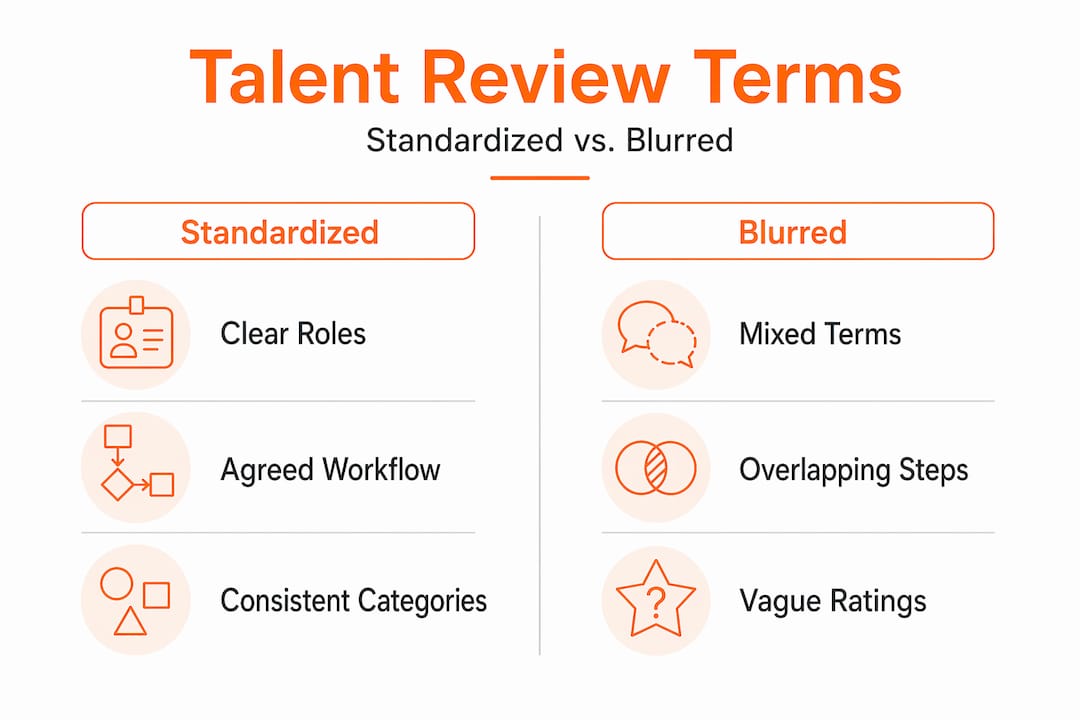
Standardizing terms and workflows is essential for fairness. Without agreed definitions for terms like “high potential” or “ready now,” two managers can place the same employee in completely different categories. The standard definitions and structured workflows tied to the review meeting lifecycle are what make calibration possible. Think of it as setting up the rules of the game before you start playing.
For organizations still refining their broader approach to talent, hiring process best practices provide a useful foundation that connects external recruitment with internal development strategy.
Key frameworks: The 9-box grid and beyond
Knowing why talent reviews matter is step one. Knowing which framework to use is step two, and it is where a lot of organizations get stuck. The most commonly used tool is the 9-box grid, and for good reason: it provides a visual, repeatable way to sort employees by two critical dimensions.
A common talent-review methodology is the 9-box grid, which plots performance on one axis and potential on the other. Each of the nine resulting categories signals a different development or movement action. A “high performance, high potential” employee is a top talent to protect and accelerate. A “low performance, low potential” employee may need a serious conversation about fit or improvement.
However, the 9-box has real limitations that experienced HR leaders recognize:
- Category labels can stick. Employees placed in lower boxes often stay there regardless of growth.
- “Potential” is hard to define consistently. Without a written definition, evaluators default to subjective impressions.
- The complexity creates fatigue. Nine categories require nuanced distinctions that busy managers often resist or approximate.
- Business leaders sometimes disengage. If the tool feels too HR-centric, participation quality drops.
Some succession-planning practitioners advise simplifying beyond 9-box complexity. A 4-box approach, for instance, reduces cognitive load while still capturing the core performance-versus-readiness distinction. One-page success profiles, which define what “great” looks like in specific roles, offer another practical alternative.
| Framework | Best for | Main limitation |
|---|---|---|
| 9-box grid | Large organizations with mature HR processes | Complexity, label fatigue |
| 4-box grid | Mid-sized organizations or first-time reviews | Less granular differentiation |
| Success profiles | Role-specific succession planning | Requires upfront role analysis |
| Potential-only model | Leadership pipeline building | Ignores current performance data |
Pro Tip: Define every box and category in writing before your first review session. Distribute these definitions to all participants at least one week ahead of the meeting. Alignment before the session saves hours of debate during it.
Nailing consistency: Evidence, calibration, and bias reduction
Frameworks are only as good as the evidence behind them. The most common failure in talent reviews is not choosing the wrong grid. It is allowing subjective impressions to drive placements without anyone pushing for data. The result is a process that looks rigorous but produces biased outcomes.

Effective talent-review mechanics depend on evidence quality and calibration. That means gathering data before the review, not during it. Relevant inputs include performance ratings, 360-degree feedback, project outcomes, behavioral observations, and career history. Arriving at a talent review without this data is like walking into a budget meeting without financials.
Here is a reliable sequence for running a calibration-focused talent review:
- Gather data at least two weeks before the session. Collect performance ratings, manager assessments, and any relevant development notes for all employees being reviewed.
- Distribute the framework and definitions in advance. Every participant should understand what each category means before they walk in.
- Conduct pre-work placements independently. Ask managers to place their direct reports on the grid before the group session. This surfaces disagreements early.
- Run a structured calibration meeting. A skilled facilitator guides the group to reconcile different placements using evidence, not seniority or volume of argument.
- Document every decision and its rationale. This creates accountability and a reference point for future reviews.
“Calibration systems work only when rating scales are defined, standards are aligned, the meeting is facilitated, and consequences are real; otherwise trust and decision quality suffer.” — Performance Calibration Guide for HR Leaders 2026
Bias reduction requires active effort, not just good intentions. Common bias patterns in talent reviews include recency bias (overweighting recent events), affinity bias (favoring people who think like the evaluator), and halo effect (letting one strong attribute color the full assessment). Naming these biases explicitly in the meeting kick-off, and assigning a facilitator to challenge unsupported placements, measurably improves consistency.
Organizations building predictive talent assessment capabilities know that the same rigor applied to external candidate screening should be applied internally. Consistency is the foundation of credibility.
Pro Tip: After the calibration meeting, run a quick check: What percentage of employees in each box are from underrepresented groups? Significant skew is a signal worth investigating before finalizing placements.
Taking action: Translating talent reviews into growth and succession
A talent review that ends with a finalized grid and no action plan has delivered half the value. The other half lives in the follow-through. This is where most organizations lose momentum, and where the real business impact of talent management either materializes or fades.
Clarifying purpose and outcomes, defining participant expectations, and documenting next-step agreements after the session are what separate high-impact reviews from administrative exercises. Each employee discussed in the review should exit the process with at least one documented next step, whether that is a development assignment, a stretch project, a promotion timeline, or a retention conversation.
One critical distinction to get right is the difference between current performance and future readiness. Performance ratings are necessary but not sufficient; succession requires role-specific readiness and future-focused evidence. A strong performer in their current role may not yet have the leadership competencies, cross-functional exposure, or strategic thinking capacity required for the next level. Treating performance as a proxy for readiness is one of the most common and costly mistakes in succession planning.
Timing also shapes the quality of talent review outcomes. Succession reviews held close to performance calibration produce more grounded outcomes because the evidence is fresh. But they should be separated from compensation decisions to preserve candid debate. When promotions and pay are on the table in the same meeting, managers advocate for their people instead of evaluating them objectively.
| Review type | Best timing | Key output |
|---|---|---|
| Talent review | After performance calibration | Grid placements, development flags |
| Succession planning | Tied to talent review cycle | Bench strength map, readiness ratings |
| Compensation review | Separate from talent discussions | Pay adjustments, equity corrections |
| Development planning | 2 to 4 weeks post-talent review | Individual development plans |
The action-planning phase should address three levels: the individual employee, the team, and the organization. Individual actions might include a new mentor, a leadership program nomination, or a cross-functional rotation. Team-level actions might include a knowledge-sharing initiative or a project restructure. Organizational actions address systemic gaps: a thin succession bench in a critical function, a retention risk cluster in a high-value segment, or a demographic imbalance in the leadership pipeline.
Use AI recruitment strategies to close gaps that internal development alone cannot fill. Knowing where your succession bench is thin allows you to source externally with precision instead of urgency.
New frontiers: AI, efficiency gains, and the challenge of trust
AI tools are reshaping how organizations approach talent and performance reviews. The efficiency gains are real. On average, AI-assisted review tools save approximately four hours per review process by automating data aggregation, generating narrative summaries, and flagging anomalies in rating distributions. For large organizations reviewing hundreds or thousands of employees, that adds up fast.
However, using AI in performance and talent reviews raises a key nuance for HR leaders: efficiency gains are reported, but trust and perceived bias can remain issues. Employees who learn that an AI system played a role in their talent assessment often respond with skepticism, particularly if they do not understand how the system works or what data it used.
Key considerations when integrating AI into your talent review process:
- Bias monitoring is non-negotiable. AI systems trained on historical data can amplify existing biases. Audit outputs regularly by demographic group.
- Transparency builds trust. Communicate clearly with employees about what AI does and does not do in your review process.
- Human judgment retains final authority. AI should surface insights and flag patterns, not make placement decisions.
- Governance documentation matters. Record what AI tools are used, what data they access, and how outputs are used in decisions.
- Pilot before scaling. Test AI-assisted review tools in one business unit before rolling out organization-wide.
Organizations exploring AI talent matching for external hiring are often well-positioned to extend similar capabilities to internal mobility and succession planning. The data infrastructure and evaluation logic can serve both purposes. For teams facing broader recruitment challenges, AI offers a structured path to better decisions at scale, as long as trust and transparency are built into the process from the start.
What most talent reviews get wrong—and how to fix it
After working through the mechanics, frameworks, and technology options, there is one overarching truth worth naming directly: the biggest problem with talent reviews is not the framework you choose. It is the gap between running the process and believing the process is enough.
Many organizations hold talent review meetings every year and check the box. Managers attend. HR collects the grids. A report gets filed. Then nothing changes. No development plans launch. No succession gaps get addressed. No retention risks get resolved. The review becomes what practitioners call “process theater,” an exercise that looks like talent management but produces no meaningful movement.
The fix starts with accountability. Every output from a talent review must have an owner, a deadline, and a check-in built into the calendar before the meeting ends. Without these three elements, good intentions evaporate within weeks. It is also worth auditing your last talent review cycle: how many development actions were actually completed? How many succession nominees received meaningful preparation? If the completion rate is below 50%, the problem is follow-through, not framework design.
Overly complex grids often signal a different failure: HR designing for HR, not for business leaders. A 9-box that nobody outside HR understands will not generate business buy-in. Simplify where needed, invest in education, and make sure the tools you use connect directly to decisions business leaders care about, like who is ready to lead a new region, who needs investment to stay, and where critical knowledge is concentrated.
Technology is only valuable if it builds trust, not just efficiency. Improving your hiring decision workflow with AI requires the same trust architecture that internal talent reviews need: clear definitions, visible logic, and human accountability at every decision point. Invest as much in clarity as in speed.
Accelerate your talent review process with advanced tools
Running an evidence-based talent review requires organized data, consistent evaluation criteria, and fast collaboration across HR and business leaders. The frameworks in this guide are proven, but the execution depends heavily on how efficiently your team can gather, evaluate, and act on information.
testask is an AI-powered assessment platform built to help HR teams and hiring managers evaluate skills faster, collaborate on reviews, and generate better decisions with AI-assisted analysis. Whether you are screening external candidates or building internal capability data, testask gives your team the tools to standardize evaluation, reduce subjectivity, and move from insight to action faster. If your talent review process needs better evidence, faster calibration, or smarter reporting, explore what testask can do for your team today.
Frequently asked questions
How long does a typical talent review process take?
Most structured talent reviews are completed within 6 to 8 weeks, though timing depends on organizational scale, the number of employees being reviewed, and how mature the process is.
Why is performance not enough for succession planning?
Succession requires role-specific readiness and future-focused evidence, not just current performance ratings, because a strong performer today may lack the competencies needed for a more senior or different role tomorrow.
What role does calibration play in talent reviews?
Calibration aligns evaluators on shared definitions and rating standards, which reduces subjectivity, surfaces hidden bias, and produces more consistent and defensible talent placement decisions.
How does AI impact talent review processes?
AI in reviews can save time and improve data aggregation, but bias and employee trust remain significant concerns that require active governance and transparent communication throughout the process.
Who are the key participants in a talent review?
HR specialists, business leaders, and facilitators are the core participants, with each playing a distinct role in managing process design, contributing organizational context, and keeping discussions structured and on track.
Recommended
- Talent Assessment: Build Efficient, Predictive Hiring Systems | Testask Blog | testask
- Hiring process best practices: proven steps for better talent | Testask Blog | testask
- AI candidate screening: Methods, pitfalls, and best practices | Testask Blog | testask
- Streamline candidate evaluation: proven steps for better hiring | Testask Blog | testask