HR Interview Checklist for Hiring Managers: 2026
HR Interview Checklist for Hiring Managers: 2026

An HR interview checklist is a structured guide that directs hiring managers through every stage of the interview process to produce fair, consistent, and effective candidate evaluations. Without one, bad hires cost companies an average of $15,000 per role. That figure alone justifies building a repeatable recruitment interview framework before your next search. This guide breaks down every component you need, from pre-interview preparation through scoring and follow-up, so your team evaluates candidates against measurable criteria every time.
1. what belongs in an HR interview checklist
A complete HR interview checklist covers three phases: preparation, execution, and evaluation. Each phase contains specific tasks that, when skipped, create gaps in your process and expose your organization to inconsistent decisions.

Pre-interview preparation sets the foundation. Job analysis and standardized questions are critical to productive interviews. Without them, interviewers improvise, and improvised interviews produce incomparable data.
Key preparation tasks include:
- Complete a job analysis to identify required skills, behaviors, and experience levels
- Write standardized behavioral and technical questions tied to the role
- Confirm interview logistics: room booking, video link, panel schedules, and candidate communications
- Share the checklist and scoring rubric with every interviewer before the session
- Review the candidate’s resume and application against the job criteria
During the interview, your checklist keeps the panel on track. Take structured notes tied to specific questions rather than general impressions. Engage the candidate with a brief role overview before diving into questions. Close by explaining next steps clearly.
Post-interview, the checklist drives your evaluation. Record scores immediately after the session while recall is sharp. Flag any bias triggers you noticed. Compile notes for the calibration discussion.
Pro Tip: Train every interviewer on checklist use and bias recognition before they sit in a single session. Interviewer training on bias is the single most effective step toward consistent candidate evaluations.
2. how to use behavioral and technical questions
The most successful interviews balance technical and soft skill assessments. Overemphasis on either type leads to poor hires. A technically strong candidate who cannot collaborate will damage team performance. A culturally aligned candidate who lacks core skills will underdeliver on results.
Behavioral questions reveal how candidates have acted in past situations. They follow the STAR format: Situation, Task, Action, Result. Examples include:
- “Describe a time you resolved a conflict between two employees. What steps did you take?”
- “Tell me about a hiring decision you made that did not work out. What did you learn?”
- “Give an example of when you had to influence a senior leader without direct authority.”
Technical questions test role-specific knowledge and judgment. For HR roles, these cover employment law, compensation structures, HRIS platforms, and compliance procedures. Examples include:
- “Walk me through how you would conduct a compensation benchmarking analysis.”
- “What steps do you follow when an employee files a formal grievance?”
- “How do you calculate time-to-fill, and what does a high number signal?”
The key is to uncover how candidates think in real HR scenarios, not just surface their experience. A candidate who recites policy without demonstrating judgment is a risk. Build your scoring chart to reward specific, outcome-oriented answers over general ones.
Pro Tip: Assign each question a weight in your scoring rubric before the interview. Questions tied to critical job functions should carry more points than those testing peripheral knowledge.
3. evaluation methods and scoring metrics
Scoring rubrics and calibration sessions increase the objectivity and comparability of candidate evaluations. A rubric converts subjective impressions into measurable data points. Calibration aligns your panel before scores become final decisions.
The table below outlines a practical scoring structure for interview evaluation:
| Evaluation Dimension | Scoring Scale | Benchmark Indicator |
|---|---|---|
| Technical knowledge | 1–5 | Matches role-specific KPIs |
| Behavioral competency | 1–5 | Aligns with team culture metrics |
| Communication clarity | 1–5 | Relevant to role communication demands |
| Problem-solving approach | 1–5 | Tied to past performance outcomes |
| Cultural alignment | 1–5 | Supports retention rate goals |
Benchmarking candidate answers against organizational KPIs such as retention rates, time-to-fill, and engagement scores gives your scores real-world meaning. A candidate who scores 4 on cultural alignment should demonstrate behaviors your top performers already exhibit.
Calibration sessions work best when held within 24 hours of the interview. Each panelist shares scores independently before the group discussion. This prevents anchoring, where one strong opinion pulls all scores in one direction.
Structured checklists prevent interviewer fatigue and confusion when managing multiple candidates. Clear, comparable records make the final decision meeting faster and more defensible.
4. checklist templates and tools compared
The format of your interview checklist affects how consistently your team uses it. Manual paper-based checklists work for small teams running low-volume hiring. Digital tools scale better and integrate with your existing applicant tracking system.
| Format | Best For | Key Advantage | Limitation |
|---|---|---|---|
| Paper checklist | Small teams, low volume | No setup cost | Hard to aggregate data |
| Spreadsheet template | Mid-size teams | Easy to customize | Manual data entry errors |
| ATS-integrated forms | High-volume recruiting | Centralized records | Requires ATS license |
| AI-powered platforms | Skill-based and technical roles | Automated scoring and analysis | Higher initial investment |
AI-powered tools improve the efficiency, fairness, and depth of candidate evaluations compared to manual checklists. Testask, for example, generates tailored assessment tasks, evaluates submissions with AI-assisted analysis, and gives hiring panels a shared scoring view. That removes the bottleneck of manual review for technical or skills-based roles.
Role complexity also shapes your checklist structure. Entry-level roles need fewer evaluation dimensions. Senior or specialized roles require deeper behavioral probing and more technical benchmarks. Your checklist should reflect that difference, not apply a one-size template across all levels.
For smarter candidate screening, digital tools that connect your checklist to your screening pipeline reduce duplicate work and keep evaluation data in one place.
5. interview process tips that improve checklist results
A well-designed checklist only works if your process supports it. These interview process tips address the operational and human factors that determine whether your checklist produces reliable data.
Prepare your panel before the interview. Share the checklist, scoring rubric, and candidate materials at least 24 hours in advance. Panelists who review materials beforehand ask sharper questions and take better notes.
Manage scheduling with precision. Confirm all logistics in writing: time, location or video link, duration, and panel roles. Candidates who experience disorganized scheduling form negative impressions before the interview begins.
Engage candidates from the start. Open with a two-minute overview of the role and the interview structure. Candidates who understand the format perform more authentically, giving you better data to evaluate.
Close every interview professionally. Explain the next steps, timeline, and who will follow up. Proper follow-up directly impacts candidate experience and your employer brand. Candidates who feel respected during the process are more likely to accept offers and refer others.
Mitigate bias at every stage. Build bias checkpoints into your checklist. After scoring, ask each panelist to identify one moment where their judgment may have been influenced by a non-job-related factor. This practice surfaces blind spots before they affect the final decision.
Pro Tip: Rotate panel members across different candidate pools to prevent in-group favoritism. A consistent hiring process requires structural variety, not just good intentions.
6. linking your checklist to onboarding
The HR interview checklist does not end at the offer letter. The best recruitment interview frameworks connect directly to the employee onboarding checklist. Evaluation data from interviews should inform onboarding priorities for each new hire.
If a candidate scored lower on a specific technical dimension during the interview, that gap becomes a training priority in the first 90 days. If behavioral scores flagged a communication style difference, the manager can address it proactively during onboarding. This connection between interview data and onboarding planning is one of the most underused advantages of structured evaluation.
Assessing candidates for skill and cultural fit during the interview gives you a data-driven starting point for development conversations. It also reduces early attrition, since new hires whose gaps are addressed quickly tend to reach full productivity faster.
Build a simple handoff document that transfers key interview scores and notes to the hiring manager before the new hire’s first day. This takes 15 minutes and prevents the common situation where onboarding ignores everything the interview revealed.
Key takeaways
A structured HR interview checklist is the single most effective tool for reducing bad hires, eliminating evaluation bias, and producing consistent, defensible hiring decisions across your organization.
| Point | Details |
|---|---|
| Structure every phase | Cover preparation, execution, and evaluation in your checklist to prevent gaps. |
| Balance question types | Mix behavioral and technical questions to assess both skill and cultural fit. |
| Score with rubrics | Use standardized scoring and calibration sessions to keep evaluations objective. |
| Match tools to scale | Choose paper, spreadsheet, ATS, or AI-powered formats based on your hiring volume. |
| Connect to onboarding | Transfer interview scores to onboarding plans to address skill gaps from day one. |
What i have learned from building interview checklists
The most common mistake I see HR teams make is treating the checklist as a compliance document rather than a decision-making tool. They fill it out because they are supposed to, not because they trust it to guide their choice. That mindset produces checklists that get completed after the decision is already made.
The teams that get the most value from structured interview checklists are the ones that build them collaboratively. When hiring managers, HR business partners, and team leads all contribute to the question set and scoring criteria, the checklist reflects real job requirements. It stops being a form and starts being a shared standard.
The second lesson I would pass on is this: refine your checklist after every hire. Not just after bad hires. After good ones too. When a new hire performs exceptionally well in the first six months, go back and look at their interview scores. Which questions predicted that performance? Weight those questions more heavily next time.
Data-driven interviewing is not about removing human judgment. It is about giving that judgment a reliable structure to work within. The best hiring practices I have seen all share one trait: the interviewers trust their process because they built it themselves and keep improving it.
— Pavel
Take your interview checklist further with Testask
Building a strong checklist is the right first step. Executing it at scale, across multiple roles and panels, is where most HR teams hit friction.
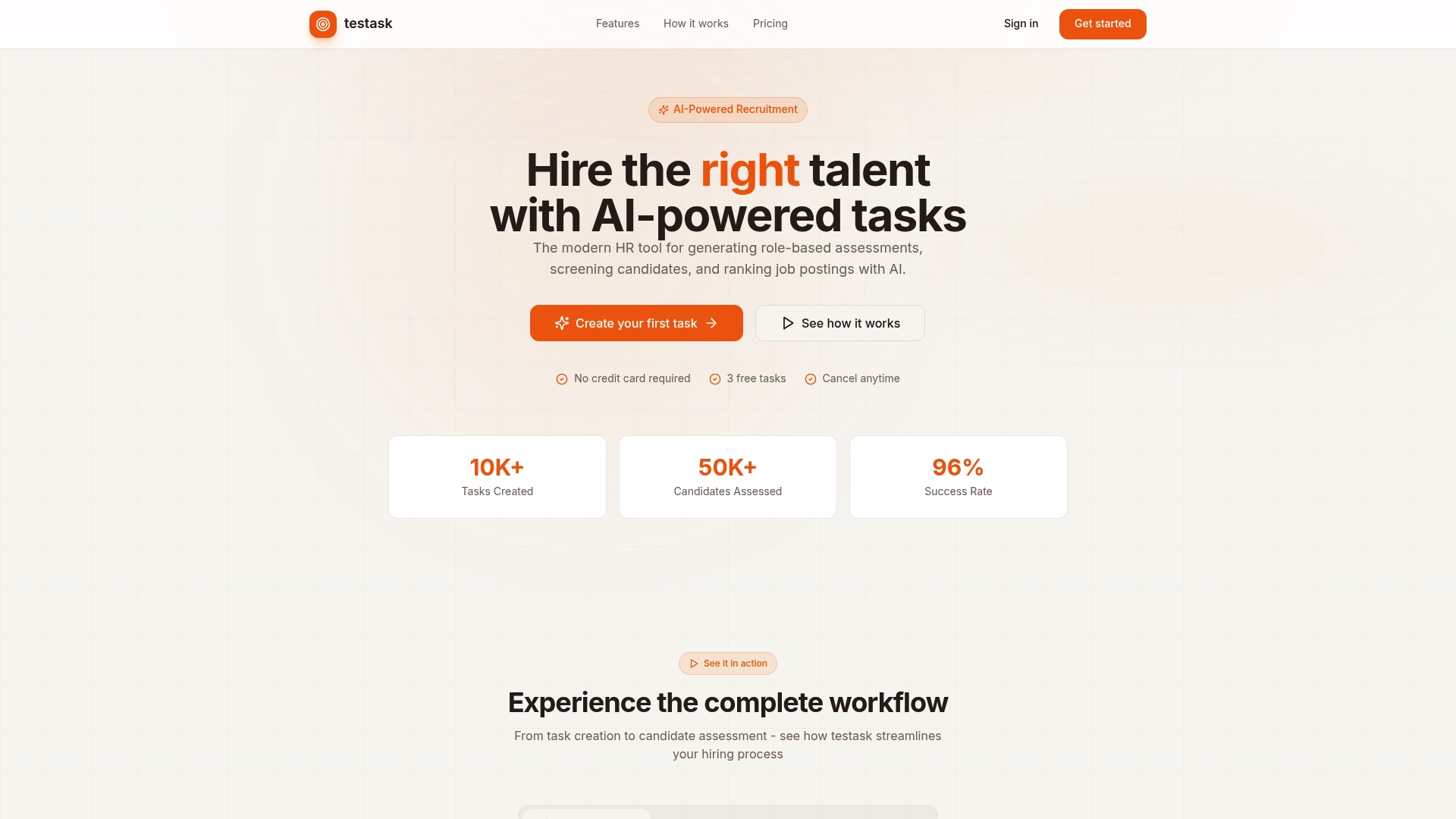
Testask is an AI-powered recruitment assessment platform that helps HR teams generate tailored test tasks, evaluate candidate submissions automatically, and collaborate on scoring in one shared workspace. Instead of managing spreadsheets and disconnected notes, your panel works from a single source of truth. Testask supports every phase of your structured candidate evaluation process, from screening through final scoring. If you are ready to move beyond manual checklists, explore Testask and see how AI-assisted analysis fits your hiring workflow.
FAQ
What is an HR interview checklist?
An HR interview checklist is a structured guide that covers preparation, questioning, scoring, and follow-up tasks for every interview. It ensures consistent, fair, and comparable candidate evaluations across all hiring panels.
How many questions should an HR interview checklist include?
Most effective checklists include 8–12 core questions per role, split between behavioral and technical types. The exact number depends on role complexity and seniority level.
How does a checklist reduce hiring bias?
Structured evaluation methods reduce bias by replacing subjective impressions with standardized scoring criteria applied equally to every candidate. Calibration sessions among panelists further align scores before final decisions.
Should the interview checklist connect to onboarding?
Yes. Interview scores and notes should transfer directly to the new hire’s onboarding plan. Gaps identified during evaluation become development priorities in the first 90 days, which reduces early attrition.
What is the difference between behavioral and technical interview questions?
Behavioral questions reveal how a candidate has acted in past situations, while technical questions test role-specific knowledge and judgment. Balancing both types prevents hiring candidates who are skilled but poor cultural fits, or aligned but underqualified.
Recommended
- Best Hiring Practices 2026: What HR Teams Need to Know | Testask Blog | testask
- Build an effective recruitment checklist for HR success | Testask Blog | testask
- Examples of Interview Assessments for HR Pros in 2026 | Testask Blog | testask
- How to Assess Candidates: A 2026 Hiring Guide | Testask Blog | testask