How to Assess Candidates: A 2026 Hiring Guide
How to Assess Candidates: A 2026 Hiring Guide

Candidate assessment is a systematic process of measuring skills, experience, and job fit through structured evaluation methods that produce objective, data-driven hiring decisions. Most hiring mistakes trace back to inconsistent processes, not bad candidates. When you define competencies upfront, apply structured interviews with behavioral questions, score independently, and run calibrated debriefs, your hiring accuracy improves significantly. This guide walks HR professionals and hiring managers through each stage of a research-backed evaluation process, drawing on frameworks from Google re:Work, HireLikeaPro, and Juicebox.ai.
How to assess candidates: start with core competencies
The foundation of any effective candidate evaluation is a clearly defined set of competencies agreed upon before a single interview takes place. Without this, interviewers assess different things, scores become incomparable, and hiring decisions default to gut feeling.
Limiting competencies to 5-7 is the recommended best practice in 2026. More than that and interviewers lose focus, spreading attention too thin to evaluate anything deeply. Fewer than four and you risk missing critical dimensions of the role.
Your competency set should cover four distinct categories:
- Hard skills: Technical abilities directly required for the role, such as SQL proficiency for a data analyst or contract negotiation for a procurement manager.
- Soft skills: Interpersonal and cognitive traits like communication clarity, adaptability, or structured problem-solving.
- Culture-add attributes: Qualities that complement and strengthen your existing team, not just replicate it.
- Performance KPIs: Measurable output expectations tied to the role, such as response time targets for customer support or pipeline conversion rates for sales.
For each competency, write behavioral anchors that describe what success looks like at every scoring level. A score of 1 on “structured communication” might mean the candidate gave disorganized, hard-to-follow answers. A score of 4 means they framed responses with clear context, action, and outcome. These definitions are what make your assessment checklist replicable across interviewers and roles.
Pro Tip: Align your entire hiring panel on competency definitions before the first interview. A 30-minute calibration meeting prevents hours of debrief disagreements later.
| Competency type | What to define |
|---|---|
| Hard skills | Specific tools, methods, or knowledge areas required |
| Soft skills | Observable behaviors, not personality traits |
| Culture-add | Team gaps the candidate could address |
| Performance KPIs | Measurable outputs tied to role success |
What makes structured interviews more predictive?
Structured interviews outperform unstructured ones in predictive validity, roughly doubling their accuracy in forecasting job performance. The reason is straightforward: when every candidate answers the same questions in the same order, you collect comparable data rather than impressions shaped by conversational drift.
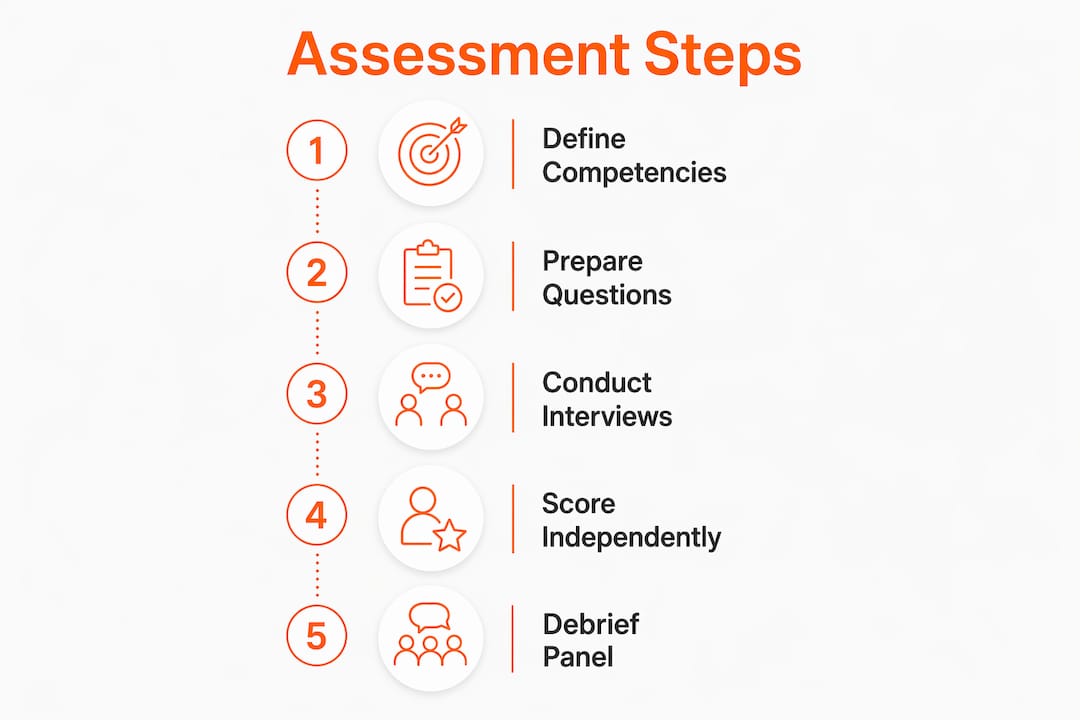
The goal of structured interviews, as Google re:Work frames it, is not just screening skills but understanding how a candidate thinks and solves problems. That distinction matters because it shifts your question design from trivia-style knowledge checks toward evidence-based behavioral probing.
Two question types form the backbone of structured interviews:
- Behavioral questions ask candidates to describe specific past situations. “Tell me about a time you had to deliver difficult feedback to a peer” is behavioral. These questions work because past behavior predicts future behavior. Behavioral questions are three times more predictive of job performance than hypothetical ones.
- Hypothetical questions present a scenario and ask how the candidate would respond. They are useful for roles where candidates are unlikely to have direct prior experience, such as entry-level positions or career changers.
Avoid open-ended openers like “Tell me about yourself.” They generate narrative, not evidence. Replace them with structured prompts that direct candidates toward specific competencies.
Pro Tip: Prepare two or three follow-up probes for each behavioral question. If a candidate gives a vague answer, ask “What specifically did you do?” or “What was the measurable outcome?” This surfaces the evidence your rubric needs.

For more structured interview techniques tailored to different roles, the Testask blog covers practical examples HR teams can adapt immediately.
How should you score candidates to avoid bias?
Scoring is where most structured processes break down. Interviewers complete their evaluations, then immediately discuss the candidate, and the first person to speak shapes everyone else’s score. This is anchoring bias, and it is one of the most common ways hiring panels undermine their own process.
Independent scoring before any group discussion is the practice that prevents this. Each interviewer submits written scores and supporting evidence before the debrief begins. The evidence requirement is critical. Scores without notes are opinions. Scores with behavioral evidence are data.
Follow these steps to score candidates consistently:
- Score each competency separately. Do not assign an overall impression score. Evaluate communication, problem-solving, and technical skill as distinct dimensions.
- Write one to two sentences of behavioral evidence per competency. Reference specific things the candidate said or did, not how they made you feel.
- Use your predefined behavioral anchors. Rubrics with defined score levels ensure that a “3” means the same thing to every interviewer on your panel.
- Submit scores before the debrief. Lock scores in your system or scorecard before the panel discussion begins.
- Combine numeric scores with qualitative notes. Numbers give you comparability across candidates. Notes give you the context to understand why scores differ.
Pro Tip: Use a shared digital scorecard where scores are hidden until all panelists submit. This single process change removes anchoring bias without requiring any additional training.
| Scoring approach | Outcome |
|---|---|
| Impression-based scoring | High variance, anchoring bias, low comparability |
| Behavioral anchor scoring | Consistent interpretation, evidence-backed, defensible |
How to run a debrief that leads to better hiring decisions
A debrief is not a discussion about whether you liked the candidate. It is a structured review of score variances, grounded in behavioral evidence. The distinction matters because opening with general opinions immediately introduces social dynamics that override data.
Run your debrief with these practices in place:
- Reveal all scores simultaneously. Show every panelist’s scores at the same time, not one by one. Sequential reveals anchor the group to the first score shared.
- Focus on high-variance competencies first. If three interviewers scored “problem-solving” between 3 and 4 but one scored it a 1, that gap is your starting point. Disagreement contains the most useful information.
- Require evidence to change a score. If someone wants to revise their rating during the debrief, they must cite specific behavioral evidence from the interview. Persuasion without evidence does not count.
- Adhere to your minimum hire threshold. Set a minimum hiring score before the process begins and hold to it even under time pressure. Hiring below the bar to fill a seat costs more than leaving a role open.
- Document the outcome. Record the final hire or no-hire recommendation, the rationale, and any follow-up actions such as reference checks or additional assessments.
A calibrated debrief is not about consensus. It is about resolving disagreements with evidence. If the panel cannot find behavioral evidence to support a higher score, the lower score stands.
Pro Tip: Assign a debrief facilitator whose job is to keep the conversation evidence-focused. This person redirects opinion-based comments back to the scorecard and ensures every panelist contributes before a decision is made.
Common mistakes when evaluating candidates and how to fix them
Even well-designed processes fail when interviewers are not trained on the biases that distort judgment. Bias in hiring can be managed but not eliminated. Naming specific biases and building countermeasures into your process is what makes the difference.
The most damaging biases in candidate evaluation include:
- Affinity bias: Favoring candidates who share your background, interests, or communication style. Structured questions and behavioral anchors reduce this by keeping focus on evidence.
- Halo and horns effect: Letting one strong or weak signal color your entire assessment. Scoring each competency separately is the direct countermeasure.
- Recency bias: Weighting the last thing a candidate said more heavily than earlier responses. Taking notes throughout the interview, not just at the end, corrects this.
- Confirmation bias: Seeking evidence that confirms your initial impression. Independent scoring before discussion prevents early impressions from locking in.
Beyond bias, two structural mistakes undermine evaluation quality. First, vague rating scales. A scale of 1 to 5 with no behavioral definitions means different things to different people. Behaviorally anchored rating scales solve this by defining what each score level looks like in observable terms. Second, interview fatigue. Scheduling too many back-to-back interviews degrades evaluator attention and score quality. Limit panels to three or four interviews per day per interviewer.
Pro Tip: Run a 20-minute interviewer calibration session before each hiring cycle. Walk through the competency definitions, review the scoring scale, and discuss one example response at each score level. This investment pays back in faster, cleaner debriefs.
For a research-backed overview of bias-free hiring steps, the Testask blog covers the full recruitment assessment process in detail.
Key takeaways
Effective candidate assessment requires predefined competencies, structured behavioral interviews, independent scoring with behavioral anchors, and evidence-based debriefs to produce consistent, defensible hiring decisions.
| Point | Details |
|---|---|
| Define 5-7 competencies upfront | Limiting scope prevents evaluation drift and keeps scoring focused and comparable. |
| Use behavioral questions | Past-behavior questions are three times more predictive than hypothetical ones. |
| Score independently before debriefs | Submitting scores before discussion eliminates anchoring bias from panel conversations. |
| Anchor every score to behavior | Rubrics with defined score levels ensure raters interpret scales consistently. |
| Hold the minimum hire threshold | Never hire below your preset bar under time pressure; it costs more than waiting. |
Why most hiring teams skip the hardest part
The structured process described in this guide is not complicated. It is just disciplined. And discipline is exactly what breaks down when a role has been open for 90 days and the hiring manager is under pressure to fill it.
In my experience working with HR teams across different industries, the step that gets skipped most often is the pre-interview calibration. Teams assume everyone understands the role and the criteria. They rarely do. Two interviewers can use the same scorecard and still be evaluating completely different things if they have not aligned on what a “4” looks like for “stakeholder communication.”
The second thing I have seen consistently is that independent scoring feels bureaucratic until the first time it saves a team from a bad hire. When scores are revealed simultaneously and one interviewer has a 1 where everyone else has a 4, that gap surfaces a real signal. Without independent scoring, the outlier either stays quiet or gets talked out of their position before anyone examines the evidence.
AI-powered tools, including AI interview summaries, are genuinely useful for scaling these processes across high-volume hiring. They do not replace human judgment. They organize the data so human judgment has something reliable to work with.
The candidate experience also matters more than most teams acknowledge. A well-run structured interview signals organizational competence. Candidates notice when a process is clear, fair, and respectful of their time. That perception affects offer acceptance rates, especially for senior roles where candidates are evaluating you as much as you are evaluating them.
— Pavel
Put your assessment process on solid ground with Testask
Testask is an AI-powered recruitment assessment platform built for HR teams and hiring managers who want to evaluate candidates faster and with less guesswork. You can generate tailored test tasks, standardize interview scorecards, and run independent reviewer workflows that prevent anchoring bias before it starts. AI-assisted summaries give your panel organized, comparable candidate data without replacing the human judgment that makes hiring decisions defensible. If you are ready to move from impression-based screening to structured, evidence-driven evaluation, explore Testask and see how it fits your hiring process.
FAQ
What is the most effective way to assess candidates?
Structured interviews with behavioral questions and predefined scoring rubrics are the most effective method. Structured interviews double the predictive validity of unstructured ones by generating comparable, evidence-based data across all candidates.
How many competencies should you evaluate per candidate?
Limit your evaluation to 5-7 core competencies per role. Fewer keeps assessment focused; more dilutes interviewer attention and makes scoring inconsistent across panelists.
How do you reduce bias when scoring candidates?
Require each interviewer to submit written scores and behavioral evidence before any group discussion begins. Independent scoring before panel discussion is the single most effective structural countermeasure against anchoring bias and groupthink.
What is the difference between behavioral and hypothetical interview questions?
Behavioral questions ask candidates to describe specific past situations and are three times more predictive of job performance. Hypothetical questions present scenarios and are best reserved for roles where candidates lack direct prior experience.
When should you use skills assessments alongside interviews?
Skills assessments work best as a pre-interview screen for roles with clear technical requirements, such as coding, writing, or data analysis. They reduce time spent interviewing candidates who cannot meet the baseline technical bar, making your overall candidate evaluation process more efficient.
Recommended
- Top talent acquisition tips for smarter hiring in 2026 | Testask Blog | testask
- Candidate Screening Process Guide: Streamlined Hiring Steps | Testask Blog | testask
- Recruitment assessment steps: your guide to bias-free hiring | Testask Blog | testask
- Hiring process best practices: proven steps for better talent | Testask Blog | testask