What Is Candidate Fit? A Guide for HR Professionals
What Is Candidate Fit? A Guide for HR Professionals

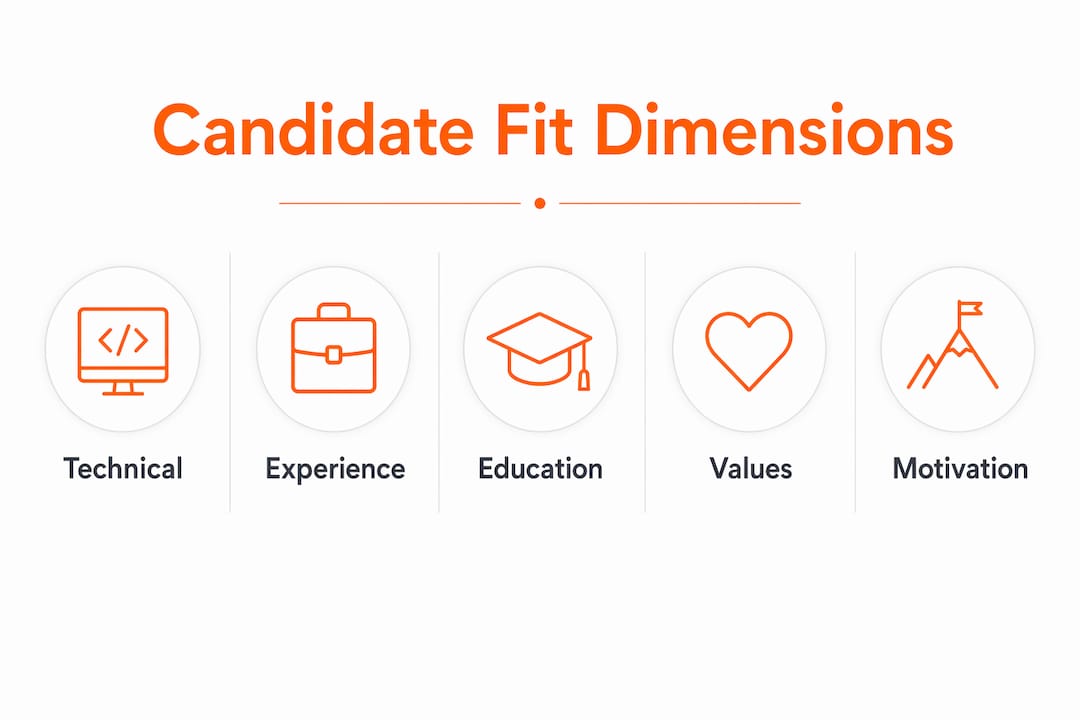
Candidate fit is defined as the measurable alignment between a candidate’s skills, experience, motivations, and the specific operational and cultural needs of an organization. Poor alignment carries a direct financial cost: a bad hire costs 30% or more of that employee’s annual salary, with executive-level mis-hires running significantly higher due to lost productivity and team disruption. Many recruiters conflate fit with likeability or general competence, but true fit refers to core values alignment and intrinsic motivation. Modern assessment frameworks evaluate four distinct dimensions: technical fit, experience depth, education match, and cultural alignment. Understanding each dimension separately is what separates precise hiring from expensive guesswork.
What is candidate fit and its key dimensions?
Candidate fit is not a single judgment call. It is a structured evaluation across four independent dimensions, each measuring a different aspect of alignment between a person and a role.
| Dimension | What it measures | Common assessment method |
|---|---|---|
| Technical fit | Skills and competencies required for the role | Skills tests, work samples, coding challenges |
| Experience depth | Relevance and seniority of career history | Structured behavioral interviews, resume review |
| Education match | Formal qualifications and certifications | Credential verification, academic screening |
| Cultural alignment | Values, working style, and motivational drivers | Values-based interviews, behavioral assessments |
Each dimension carries independent weight. A candidate who scores high on technical fit but misaligns on values will likely underperform in collaborative environments. Modern evaluation frameworks use weighted scoring across all four dimensions, so no single factor overrides the others. This prevents the common mistake of hiring a technically strong candidate who disrupts team cohesion.

Experience depth is frequently underweighted. Hiring managers often focus on job titles rather than the actual relevance of past work to the current role’s demands. A candidate with five years at a Fortune 500 company may have less relevant experience than someone with three years in a directly comparable environment.
Education match functions as a binary qualifier in many frameworks. Suitability criteria act as must-have thresholds, not ranking factors. Treating a degree requirement as a relative scoring criterion rather than a hard filter creates inconsistency and, in regulated industries, legal exposure.
Pro Tip: Weight the four dimensions differently based on role type. Technical fit matters most for specialist roles; cultural alignment becomes the deciding factor for leadership and cross-functional positions.
How to distinguish capability from cultural fit to reduce bias
Capability and identity are distinct constructs, and blending them causes hiring failures, particularly at the senior level. Capability covers what a candidate can do: their skills, cognitive ability, and track record. Identity covers who they are: their values, motivations, and behavioral patterns. When these are evaluated together, the halo effect takes over. A candidate who presents confidently gets high marks on both, regardless of actual evidence.
The practical risk is bias. When a hiring manager says a candidate “doesn’t feel like a fit,” they are often describing a comfort-based reaction rather than a values conflict. This is where cultural fit becomes a vehicle for homogeneity. Hiring for culture add rather than culture fit means asking whether a candidate’s values and behaviors will strengthen the team, not whether they resemble the people already on it.
Separating these assessments structurally produces better decisions:
- Use a dedicated capability scorecard covering technical skills, problem-solving, and domain knowledge, evaluated before any cultural discussion.
- Run a separate identity assessment covering values alignment, motivational drivers, and working style preferences.
- Present shortlists in two layers: capability-qualified candidates first, then identity fit as a secondary filter.
- Require interviewers to document specific behavioral evidence for every cultural fit rating, not general impressions.
- Flag any cultural fit score that lacks observable evidence for review before it influences a hiring decision.
Pro Tip: Replace vague labels like “culture fit” or “team player” with specific, observable behaviors. “Proactively shares information across teams without being asked” is a criterion. “Good communicator” is not.
For highly technical roles, capability assessment alone is often sufficient. Identity fit assessments become critical primarily when the role requires navigating organizational culture, managing stakeholders, or driving change. Applying the same identity scrutiny to every role wastes time and introduces unnecessary subjectivity.
What assessment tools and methods measure candidate fit effectively?
Structured assessments outperform unstructured interviews for predicting job performance. Talent assessments measuring cognitive ability and behavioral traits are among the strongest predictors of long-term success, consistently outperforming intuition or resume review alone. The key is matching the assessment type to the dimension being measured.
| Assessment type | Best for | Limitation |
|---|---|---|
| Skills and domain knowledge tests | Technical fit | Measures current ability, not learning potential |
| Cognitive ability assessments | Problem-solving and adaptability | Can disadvantage candidates without test practice |
| Personality and behavioral assessments | Cultural and identity alignment | Self-reported; susceptible to social desirability bias |
| Structured behavioral interviews | Experience depth and values | Requires trained interviewers to be consistent |
| Work sample tasks | Technical and experience fit | Time-intensive for candidates and evaluators |
The combination of work sample tasks and structured behavioral interviews produces the most defensible hiring decisions. Work samples reveal actual capability under realistic conditions. Structured interviews, when scored with a consistent rubric, reduce the variance that comes from different interviewers applying different standards.
Resume inflation affects the reliability of experience-based screening. Up to 85% of job applicants exaggerate qualifications on their resumes. This means that any process relying heavily on resume review without verification or skills testing is exposed to systematic mis-hires. Evidence-based assessments close that gap by requiring candidates to demonstrate, not just describe, their abilities.
AI-powered screening tools add a layer of consistency that manual review cannot match at scale. AI candidate screening systems that score candidates across technical, experience, education, and cultural dimensions with transparent evidence summaries give hiring managers defensible data rather than algorithmic black boxes. Explainability matters here, especially as hiring regulations in the U.S. and EU increasingly require that automated decisions be auditable. You can explore bias-free hiring methods to understand how structured processes reduce legal and operational risk.
Why candidate fit matters: financial, operational, and team impacts
The financial case for rigorous fit assessment is direct. A mis-hire at the individual contributor level costs an organization 30% or more of annual salary in recruiting, onboarding, lost productivity, and replacement costs. At the executive level, that figure multiplies because poor-fit leaders affect entire teams, slow decisions, and accelerate attrition among high performers.
The operational and cultural costs are harder to quantify but equally damaging:
- A poor-fit hire in a team lead role can reduce the output of five to ten direct reports, not just their own.
- Misaligned values at the senior level create policy inconsistencies that erode trust across departments.
- Early attrition from poor fit forces repeated hiring cycles, compounding recruiting costs and disrupting project continuity.
- Legal risk increases when cultural fit decisions are undocumented, since subjective rejections are harder to defend in discrimination claims.
The most common organizational mistake is optimizing for comfort rather than mission alignment. Teams that hire for homogeneity, people who think and work identically, sacrifice the cognitive diversity that drives problem-solving and adaptation. Evaluating whether a candidate adds to culture rather than simply matching it produces teams that are both cohesive and capable of handling novel challenges.
Fit also directly affects engagement and retention. Candidates who align with an organization’s values and understand the role’s demands before joining are more likely to stay past the 12-month mark. Structured assessments reduce early attrition by surfacing misalignment before an offer is made, not after a costly onboarding process.
Pro Tip: Separate “comfort fit” from “mission fit” in your hiring criteria. Comfort fit asks: does this person feel familiar? Mission fit asks: will this person advance the team’s specific goals? Only the second question belongs in a hiring decision.
Key takeaways
Candidate fit is the structured alignment of skills, values, and motivation with a role’s specific technical and cultural demands, and evaluating it across four independent dimensions is the most reliable way to reduce mis-hires.
| Point | Details |
|---|---|
| Four-dimension framework | Assess technical fit, experience depth, education match, and cultural alignment independently. |
| Capability vs. identity | Evaluate what candidates can do separately from who they are to prevent halo effect bias. |
| Evidence-based assessment | Work samples and structured interviews outperform resume review and unstructured conversations. |
| Financial cost of poor fit | A bad hire costs 30% or more of annual salary; executive mis-hires multiply that figure significantly. |
| Culture add over culture match | Hire for values that strengthen the team, not personalities that mirror existing members. |
Why I think most teams are measuring fit wrong
After reviewing how dozens of hiring teams approach candidate evaluation, the most consistent problem is not a lack of tools. It is a lack of agreed definitions. Two interviewers on the same panel will use the phrase “good fit” to mean completely different things, and no one reconciles that before the debrief.
The fix is not more assessments. It is calibration. Before any hiring process begins, the team needs to define what fit means for this specific role, in this specific team, at this specific stage of the organization. That definition should be written down, shared with every interviewer, and tied to observable criteria. Vague alignment to “our values” is not a criterion. “Demonstrates accountability by proactively flagging blockers before they escalate” is.
The second mistake I see consistently is applying identity-fit scrutiny to roles where it does not belong. For a senior data engineer, capability is the primary filter. Spending three rounds on culture fit for a role that requires deep individual technical work adds process without adding predictive value. Reserve that depth for roles where cultural navigation is genuinely part of the job.
The third issue is treating fit as static. Organizations change. The values and working styles that served a 20-person startup are not always the right fit criteria for a 200-person company. Reviewing and updating your fit criteria annually, especially after significant growth or strategic shifts, keeps your hiring aligned with where the organization actually is, not where it was two years ago.
— Pavel
Assess candidate fit faster with Testask
Testask is an AI-powered recruitment assessment platform built for HR teams that need structured, explainable candidate evaluations at scale. You can generate tailored test tasks for any role, review submissions with AI-assisted scoring across technical and behavioral dimensions, and collaborate with hiring managers in one place. Every score comes with evidence drawn directly from the candidate’s work, so your decisions are defensible and your process is consistent. Testask aligns with the four-dimension fit framework described in this article, giving you a practical tool to move from subjective impressions to objective data. Start assessing candidates with structured fit criteria today.
FAQ
What is candidate fit in simple terms?
Candidate fit is the degree to which a candidate’s skills, experience, values, and motivations align with the specific requirements and culture of a role and organization. It is measured across technical, experiential, educational, and cultural dimensions.
What is candidate suitability and how does it differ from fit?
Candidate suitability refers to whether a candidate meets the minimum qualifications required for a role, functioning as a binary threshold. Fit goes further, assessing alignment across multiple dimensions including values and motivation, not just baseline eligibility.
How do you assess candidate fit objectively?
Objective fit assessment uses structured tools: skills tests, work samples, cognitive assessments, and behavioral interviews scored with consistent rubrics. AI screening systems that score candidates across multiple dimensions with transparent evidence summaries add consistency at scale.
Why does cultural fit assessment risk introducing bias?
Cultural fit becomes biased when it is based on personality impressions rather than observable, role-relevant behaviors. Hiring managers should define specific cultural criteria tied to values and working style, and require documented behavioral evidence for every rating.
What is the cost of hiring a poor-fit candidate?
A poor-fit hire costs an organization 30% or more of the employee’s annual salary, accounting for recruiting, onboarding, lost productivity, and replacement. Executive-level mis-hires carry significantly higher costs due to their impact on team performance and organizational direction.
Recommended
- Improve candidate screening: expert guide to AI-powered hiring | Testask Blog | testask
- Hiring process best practices: proven steps for better talent | Testask Blog | testask
- Recruitment assessment steps: your guide to bias-free hiring | Testask Blog | testask
- Candidate Screening Process Guide: Streamlined Hiring Steps | Testask Blog | testask