Why Skills-Based Hiring Matters for HR Teams
Why Skills-Based Hiring Matters for HR Teams

Skills-based hiring is defined as the practice of evaluating candidates primarily on demonstrated, measurable skills rather than formal credentials like degrees or job titles. The OECD identifies skills-first approaches as critical for economic dynamism and workforce resilience amid digitalization and talent shortages. For HR professionals and hiring managers, understanding why skills-based hiring matters is no longer optional. Organizations that rely on credential proxies miss qualified candidates, slow down hiring, and expose themselves to bias risk. Kelly Services and the World Economic Forum both point to skills-first models as the clearest path to faster, fairer, and more accurate talent acquisition.
Why skills-based hiring matters for recruitment efficiency
Skills-based hiring cuts time-to-start by removing steps that do not predict job performance. Kelly Services reports that consistent competency evaluation shortens the hiring cycle by four to six days by eliminating unnecessary credential verification and reducing back-and-forth between recruiters and hiring managers. Four to six days may sound modest, but across hundreds of open roles per year, that compounds into weeks of recovered capacity.
The root cause of slow hiring is misalignment. When a sourcer, recruiter, and hiring manager each interpret “qualified candidate” differently, searches stall and restarts multiply. Shared competency rubrics solve this directly. They give every stakeholder a common definition of what “good” looks like before a single resume is reviewed.

Pro Tip: Build a one-page competency card for each role before posting. List three to five non-negotiable skills with observable indicators. Distribute it to every person who touches the search.
Removing degree requirements also widens the candidate pool immediately. Kelly found that 42% of global workers hold roles that do not actually require a college degree. Dropping that requirement from job postings does not lower the bar. It removes a filter that was never measuring the right thing.
- Faster screening: Skills signals from portfolios or work samples surface qualified candidates earlier in the funnel.
- Fewer restarts: Shared rubrics reduce disagreements that send searches back to square one.
- Shorter time-to-start: Removing credential verification steps eliminates delays that add no predictive value.
- Broader talent pool: Eliminating unnecessary degree requirements opens access to skilled candidates who were previously screened out.
How skills-based hiring reduces bias and improves fairness
Skills-based hiring reduces discrimination risk when it is paired with responsible AI and objective assessment design. IZA World of Labour research shows that skills-first hiring with unbiased AI can lower barriers for under-represented groups by replacing subjective resume reviews with measurable performance signals. The key word is “unbiased.” AI that trains on historically biased hiring data will replicate those patterns at scale.
Fairness in skills-based hiring does not happen automatically. It requires deliberate process design. A typical skills-first workflow looks like this:
- Rewrite job ads to focus on required skills and outcomes, not credentials or years of experience.
- Apply skills screening using structured assessments or work samples as the first filter, not resume keywords.
- Run simulation tasks that mirror real job conditions, giving candidates a fair chance to demonstrate capability.
- Use standardized interviews with consistent scoring criteria across all candidates.
- Audit AI tools regularly for adverse impact using empirically validated methods before deploying them at scale.
Randomized controlled trials cited by IZA show that responsible AI identifies talent more accurately than human judgment and reduces discrimination when governance is tight. That finding is significant. It means the technology works, but only when the training data and oversight structures are clean.
Pro Tip: Before deploying any AI screening tool, request an adverse impact analysis from the vendor. If they cannot provide one, treat that as a disqualifying signal.
Bias minimization also depends on unbiased training data and ongoing governance, not a one-time setup. HR teams that treat fairness as a checkbox will see initial gains erode as models drift. Build a review cadence into your process from day one.
How fast-changing skills make credential-based hiring obsolete
The World Economic Forum projects that 39% of core workforce skills will be transformed or obsolete by 2030. That figure reframes the entire debate about credentials. A degree earned in 2018 certifies knowledge from a curriculum designed even earlier. It says nothing about whether a candidate has kept pace with what the role actually demands today.
Credential-based hiring assumes that past learning predicts current capability. That assumption breaks down in fast-moving fields like data analytics, cybersecurity, and AI-adjacent roles, where the relevant skill set shifts every two to three years. Skills-based hiring validates what a candidate can do right now, not what they studied years ago.
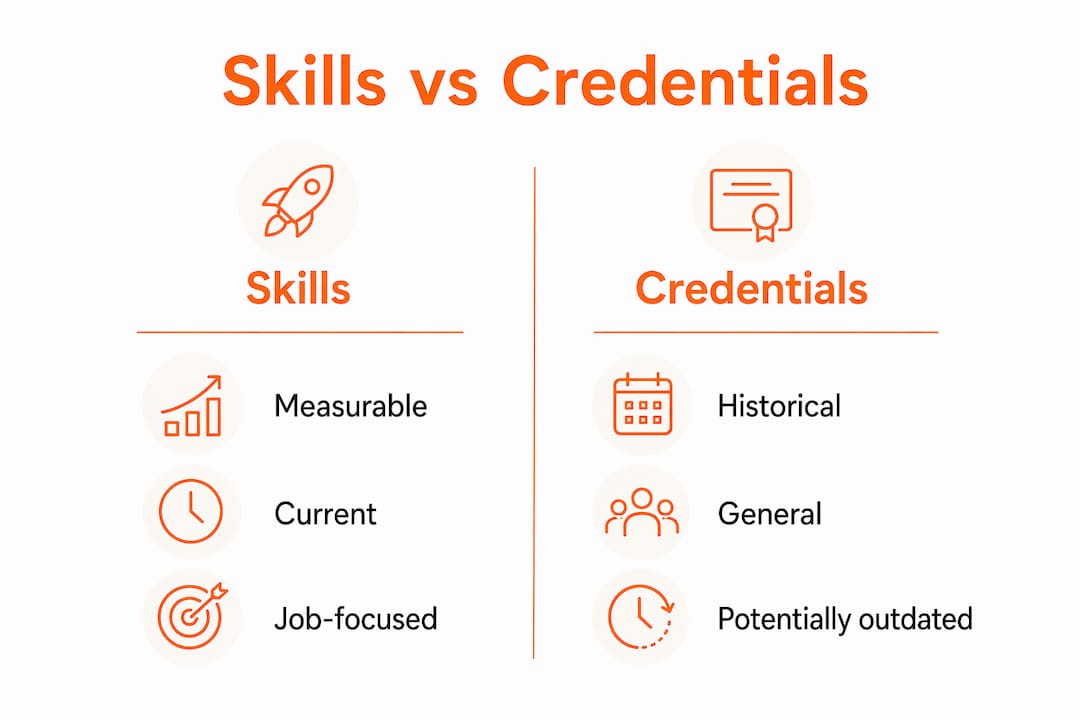
| Hiring approach | What it measures | Risk in fast-changing markets |
|---|---|---|
| Credential-based | Past learning milestones | High: credentials go stale as skills evolve |
| Experience-based | Years in a role | Medium: tenure does not equal current capability |
| Skills-based | Demonstrated current ability | Low: directly tests what the role requires today |
Workforce resilience depends on continuous skill validation. Organizations that build skills assessment into every hiring decision create a real-time picture of their talent pool. Those that rely on static credentials are flying blind in a market where the OECD confirms that a shared skills language connecting jobs and learning is the foundation of a functioning labor market.
Recognition of prior learning matters here too. A candidate who built data skills through open-source projects or professional certifications may outperform a degree holder who has not touched the subject since graduation. Skills-based hiring captures that candidate. Credential-based hiring filters them out.
Common challenges and best practices when adopting skills-based hiring
Skills-based hiring fails most often when organizations change job postings but leave the rest of the process unchanged. Kelly Services is direct on this point: adoption without persistent changes in screening and evaluation produces inconsistent results and failed searches. Rewriting a job ad is the easiest step. Rebuilding the evaluation process is where the real work happens.
The most common pitfalls HR teams encounter include:
- Partial adoption: Removing degree requirements from postings but still filtering resumes by school name or GPA.
- Stakeholder misalignment: Recruiters using one competency definition while hiring managers use another, creating conflicting shortlists.
- Unvalidated AI tools: Deploying screening software without auditing it for demographic bias, which replicates historical discrimination at scale.
- Single-method assessment: Relying on one test type instead of combining early skill signals with simulation tasks or structured interviews.
Multi-method assessment pipelines solve the single-method problem directly. Combining early screening signals from portfolios or work samples with later verification through simulation tasks or standardized interviews gives a more reliable picture of both current skills and future potential.
| Practice | Weak implementation | Strong implementation |
|---|---|---|
| Job posting | Removes degree requirement only | Rewrites role around skills and outcomes |
| Screening | Resume keyword filter | Structured skills assessment or work sample |
| Evaluation | Unstructured interview | Standardized scoring rubric across all interviewers |
| AI governance | One-time setup | Ongoing adverse impact audits on a defined schedule |
Governance of AI training data is not optional. It is the mechanism that determines whether your skills-based process actually reduces bias or just moves it earlier in the funnel. HR leaders who want to learn more about building responsible screening pipelines can review AI candidate screening best practices before selecting or auditing tools.
Pro Tip: Map your entire hiring workflow before changing any single step. Identify every point where credentials currently act as a filter. Replace each one with a skills-based equivalent before going live.
For teams building a full assessment framework from scratch, a structured guide to bias-free hiring provides a practical starting point for aligning process design with fairness goals.
Key takeaways
Skills-based hiring improves hiring accuracy, reduces bias, and builds workforce resilience by replacing credential proxies with direct evidence of what candidates can do today.
| Point | Details |
|---|---|
| Efficiency gains are real | Consistent competency evaluation cuts time-to-start by four to six days and reduces hiring restarts. |
| Fairness requires active design | Responsible AI and unbiased training data are required; fairness does not happen by default. |
| Credentials go stale fast | With 39% of core skills changing by 2030, current ability matters more than past qualifications. |
| Partial adoption fails | Changing job postings without rebuilding screening and evaluation produces inconsistent results. |
| Multi-method assessment wins | Combining early skill signals with simulation tasks and structured interviews gives the most accurate picture. |
The uncomfortable truth about skills-based hiring adoption
Most organizations that say they practice skills-based hiring are not actually doing it. They have removed the degree requirement from the job posting and called it done. The resume still gets filtered by school prestige. The interview still rewards candidates who sound polished rather than candidates who perform well. The credential bias has not been removed. It has just been pushed one step later in the process.
I have watched this pattern repeat across industries. The teams that make skills-based hiring work are the ones that treat it as a process rebuild, not a policy update. They define competencies before posting. They build rubrics before interviewing. They audit their tools before deploying them. That level of discipline is rare, and it is exactly why the organizations that commit to it gain a real talent advantage over those that treat it as a checkbox.
The diversity argument for skills-based hiring is also stronger than most HR leaders realize. The IZA research on anti-discrimination policies is clear: when AI is governed correctly and assessments are designed without demographic proxies, under-represented candidates get a fairer shot. That is not a side benefit. For organizations facing talent shortages in technical roles, it is a primary source of untapped supply.
The World Economic Forum’s projection that 39% of core skills will shift by 2030 should be the number that ends the credential debate permanently. No degree certifies a skill set that does not yet exist. Only a skills-based process can keep pace with that rate of change. HR teams that build this capability now will be significantly better positioned when the next wave of skill transformation hits.
— Pavel
Testask and skills-based assessment for hiring teams
Skills-based hiring requires the right tools to work at scale. Testask is an AI-powered recruitment assessment platform that helps HR teams and hiring managers create tailored test tasks, evaluate candidate submissions, and make faster hiring decisions with AI-assisted analysis.
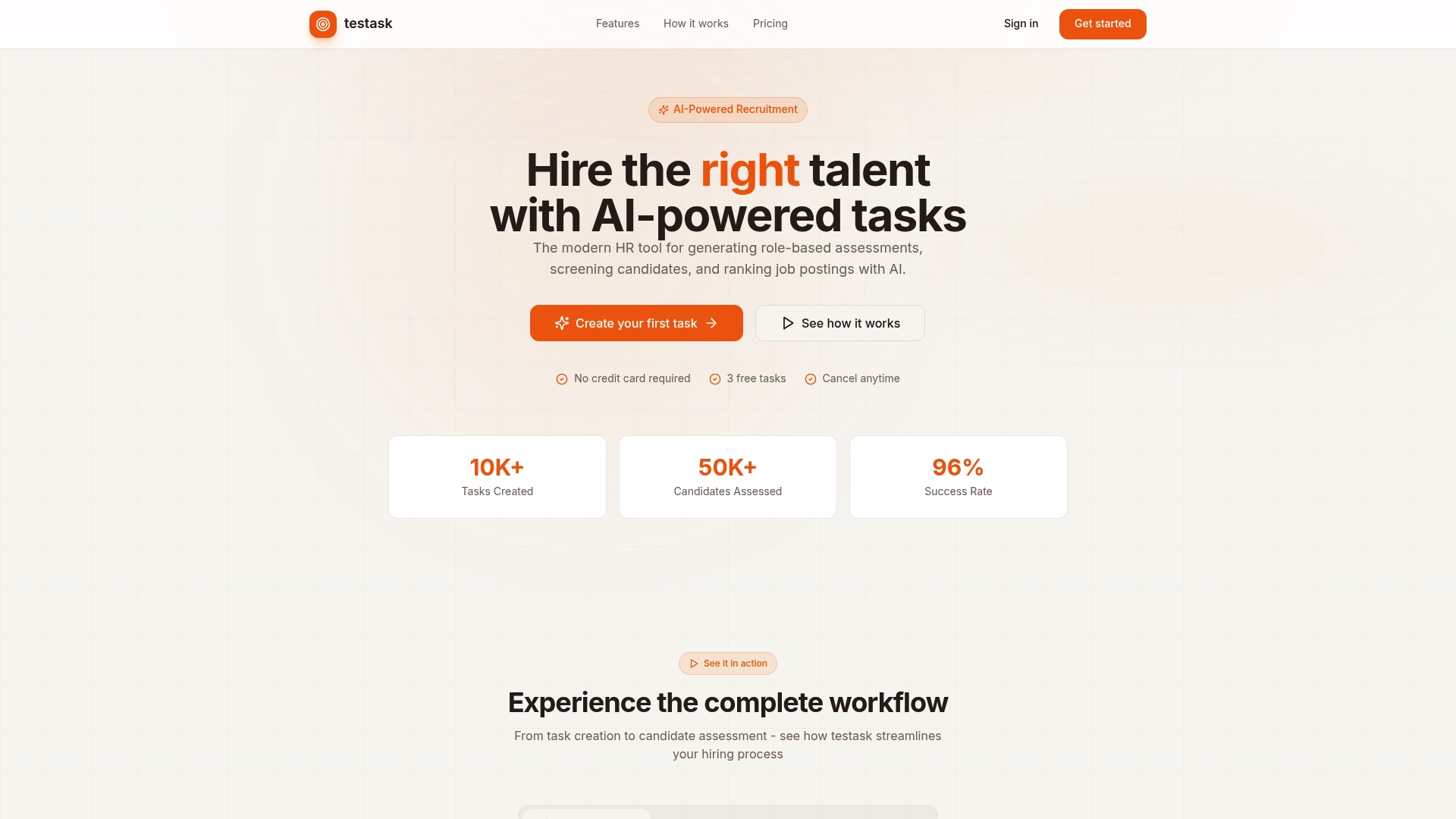
Testask aligns directly with skills-first, unbiased evaluation models. The platform lets you generate role-specific assessments, collaborate on candidate reviews, and apply consistent scoring across your team. For HR professionals building or refining a skills-based process, Testask’s assessment platform provides the structure and speed that manual evaluation cannot match. Whether you are screening for technical skills or evaluating judgment in complex scenarios, Testask gives your team a repeatable, auditable process that scales.
FAQ
What is skills-based hiring?
Skills-based hiring is the practice of evaluating candidates on demonstrated, measurable skills rather than formal credentials like degrees or job titles. The OECD identifies it as critical for workforce resilience in fast-changing labor markets.
How does skills-based hiring reduce bias?
Skills-based hiring reduces bias by replacing subjective resume reviews with objective performance signals. IZA World of Labour research shows that responsible AI paired with unbiased assessment design lowers barriers for under-represented groups.
Does skills-based hiring actually speed up recruitment?
Kelly Services reports that consistent competency evaluation cuts time-to-start by four to six days by removing unnecessary credential verification and reducing misalignment between recruiters and hiring managers.
Why are credentials becoming less reliable for hiring?
The World Economic Forum projects that 39% of core workforce skills will be transformed or obsolete by 2030. Credentials certify past learning, not current capability, making them a poor predictor in fast-moving fields.
What is the biggest mistake in skills-based hiring adoption?
The biggest mistake is changing job postings without rebuilding the screening and evaluation process. Kelly Services confirms that partial adoption without consistent competency definitions across all stakeholders produces failed searches and hiring delays.
Recommended
- Hiring process best practices: proven steps for better talent | Testask Blog | testask
- The Role of Skill Evaluation in Smarter Hiring | Testask Blog | testask
- Best Hiring Practices 2026: What HR Teams Need to Know | Testask Blog | testask
- Why standardized tests in hiring matter: The HR leader’s guide | Testask Blog | testask