Defining Interview Assessment: A 2026 HR Guide
Defining Interview Assessment: A 2026 HR Guide

An interview assessment is a structured, standardized method for evaluating candidates based on criteria tied directly to job requirements. The formal industry term is structured interviewing, and defining interview assessment means building that structure before a single candidate walks through the door. Done right, it removes guesswork from hiring, reduces unconscious bias, and gives every interviewer a shared language for what “good” actually looks like. This guide covers the core components, operational tools, common pitfalls, and role-specific adaptations HR professionals need to build assessments that hold up under scrutiny.
What is a defining interview assessment framework?
A defining interview assessment framework is the architecture behind every fair, consistent hiring decision. It connects job requirements to evaluation criteria before any candidate is interviewed. Without that connection, interviewers default to gut feel, and gut feel is where bias lives.
The framework rests on four foundational elements:
- Job-specific competencies: Each competency maps directly to a skill, behavior, or attribute the role requires. A customer success manager role might prioritize conflict resolution and product knowledge. A software engineer role might weight problem decomposition and communication of technical concepts.
- Standardized questions: Every candidate answers the same questions in the same order. Google’s structured interviewing approach defines this as attributes-first design: identify what success looks like, then build questions that surface evidence of those attributes.
- Behaviorally anchored rating scales (BARS): A 4 or 5-point scale means nothing without behavioral descriptions at each level. “3 out of 5” should describe a specific type of answer, not a vague impression.
- Evidence notes: Each score requires supporting notes. The interviewer records what the candidate said and what that response indicates about the competency being assessed.
The importance of interview assessments becomes clear when you compare structured to unstructured approaches. Unstructured interviews produce inconsistent data, favor candidates who are socially confident rather than technically capable, and create legal exposure when hiring decisions are challenged.
Pro Tip: Before writing a single interview question, list the 5–7 behaviors that distinguish a top performer in the role from an average one. Those behaviors become your competencies.

How does structured interviewing support effective interview assessments?
Structured interviewing is the primary method for putting a defined assessment into practice. GOV.UK guidance recommends asking all applicants the same questions in the same order and grading with standard criteria. That consistency is what makes comparison across candidates valid.
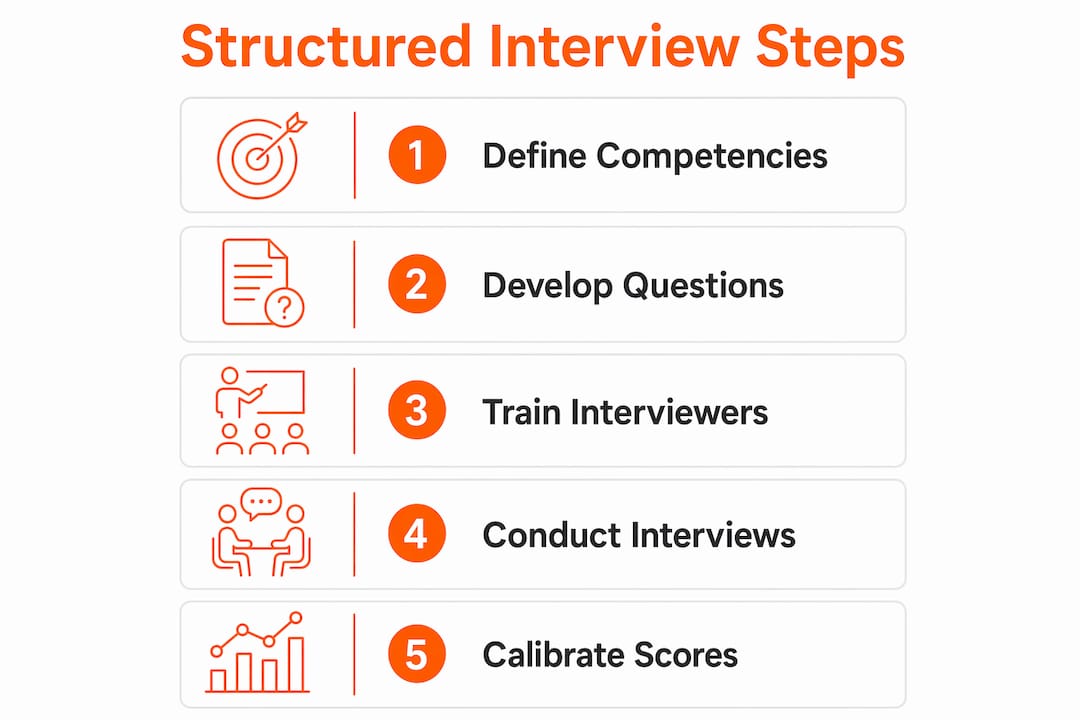
The bias reduction benefits are concrete, not theoretical. GOV.UK notes that structured interviews reduce gender and ethnic bias by removing the variability that lets unconscious preferences influence scoring. When every candidate answers the same question, the interviewer’s job shifts from generating impressions to collecting evidence.
Three structural choices drive this consistency:
- Fixed question order: Changing the sequence changes the context. A candidate who answers a conflict question after a rapport-building question performs differently than one who answers it cold. Fixing the order controls that variable.
- Predetermined follow-ups: Google builds follow-up questions into its rubrics so interviewers probe consistently rather than chasing whatever answer interests them most.
- Panel composition and calibration: Diverse panels reduce the risk that a single interviewer’s blind spots dominate the outcome. Calibration sessions before interviews begin align all panelists on what each rating level means in practice.
Pro Tip: Run a 30-minute calibration session using a sample transcript before your first interview. Have each panelist score it independently, then compare. Disagreements reveal exactly where your behavioral anchors need more specificity.
Fairness is not just an ethical goal. Maintaining defined assessments supports legal defensibility and compliance with the Uniform Guidelines on Employee Selection Procedures, which require that selection methods be job-relevant and consistently applied.
What operational tools bring interview assessments to life?
Knowing the theory is one thing. Building the artifacts that make it repeatable is another. The core operational tools for a working interview assessment are scorecards, benchmark responses, calibration protocols, and evidence logs.
Here is how to build each one:
-
Design the scorecard around 6–12 competencies. Best practice scorecards use 6–12 competencies with weighted importance scores and 4–5 point behaviorally anchored rating scales. Fewer than 6 competencies leaves gaps. More than 12 creates cognitive overload during the interview itself.
-
Write behavioral anchors for every scale point. A “1” on communication should describe a specific failure mode: “Candidate could not explain their reasoning without prompting and used jargon without checking for understanding.” A “4” should describe a specific strength. Without behaviorally anchored scales, raters interpret numeric scores differently, which reduces assessment validity across the panel.
-
Predefine benchmark responses before interviews begin. GOV.UK stresses deciding on benchmark answers in advance so interviewers can grade unexpected but job-relevant responses without improvising. A candidate who answers a behavioral question with a freelance project instead of a corporate one should still receive a fair score if the behavior is present.
-
Run calibration sessions on real transcripts. Calibration on prior interview transcripts improves judge agreement, with 0.65 agreement considered a good threshold for panel consistency. Use transcripts from previous hiring cycles or create practice scenarios from real job descriptions.
-
Log evidence with every score. Metaview recommends that each score be supported by two lines of evidence: what the candidate said and what that indicates about the competency. This creates an audit trail that protects the organization and helps debrief conversations stay grounded in data rather than impressions.
The table below summarizes the key tools and their primary function:
| Tool | Primary Function | Key Design Rule |
|---|---|---|
| Interview scorecard | Maps competencies to role requirements | Use 6–12 competencies with weighted scores |
| Behavioral anchors | Defines what each rating level means | Write specific examples for each scale point |
| Benchmark responses | Enables consistent scoring of varied answers | Predefine before interviews begin |
| Calibration session | Aligns panelist interpretation of scales | Target 0.65 inter-rater agreement |
| Evidence log | Supports scores with candidate-specific data | Record two lines of evidence per rating |
What are the common pitfalls in interview assessment design?
Even well-intentioned assessment processes break down in predictable ways. Recognizing these failure points lets you fix them before they affect a hiring decision.
-
Numeric scales without behavioral anchors: A 5-point scale where “5 means excellent” is not a rubric. It is a sentiment survey. Two interviewers using the same scale will score the same candidate differently if they have no shared definition of what each number represents. This is the single most common source of inter-rater inconsistency.
-
Skipping calibration: Panels that never align on scoring criteria produce data that cannot be aggregated. One interviewer’s “3” is another’s “5.” The debrief becomes a negotiation rather than an evidence review. Calibration is not optional for a defensible process.
-
Unstructured conversational interviews: When interviewers go off-script, they follow their interests rather than the assessment criteria. The result is rich data on whatever topics came up and no data on the competencies that actually matter. This is where affinity bias, where interviewers favor candidates who remind them of themselves, does the most damage.
-
Rigid scoring that penalizes valid answers: A candidate who demonstrates a competency through an unconventional example should not lose points because the answer does not match the benchmark exactly. Predefining benchmarks solves this. The benchmark is a reference point, not a required script.
-
No audit trail: Scores without evidence notes cannot be defended if a hiring decision is challenged. Every rating needs documentation. This protects the organization and forces interviewers to stay grounded in what the candidate actually said.
For a practical framework on bias-free hiring steps, the Testask blog covers evidence-first scoring in detail.
How do you tailor interview assessments for different roles?
A single assessment template does not serve every role equally. The interview evaluation process must adapt to the competency profile of each position while preserving the structural principles that make it valid.
The key is role-specific competency mapping. A sales role weights persuasion, resilience, and pipeline management. An engineering role weights analytical reasoning, technical communication, and debugging methodology. Using the same scorecard for both produces data that is internally consistent but externally irrelevant.
The table below shows how assessment criteria shift across three common role types:
| Role Type | Core Competencies | Question Format | Scoring Weight |
|---|---|---|---|
| Technical (e.g., software engineer) | Problem-solving, technical communication, code quality | Situational and technical | 60% technical, 40% behavioral |
| Client-facing (e.g., account manager) | Relationship building, conflict resolution, product knowledge | Behavioral and scenario-based | 50% behavioral, 50% situational |
| Leadership (e.g., team lead) | Decision-making, coaching, cross-functional collaboration | Behavioral and case-based | 40% behavioral, 60% situational |
Weighting adjustments matter as much as question selection. A leadership role where cross-functional influence is critical should weight that competency more heavily than a role where the work is largely independent. Updating rubrics when job requirements evolve is not optional. A scorecard built for a 2022 version of a role may not capture what the 2026 version actually demands.
Balancing consistency with flexibility is the real challenge. The structure must hold across all candidates for the same role. But the scoring must accommodate the reality that strong candidates sometimes demonstrate competencies in unexpected ways. Predefined benchmarks and well-written behavioral anchors are what make that balance possible.
For real-world assessment examples across different role types, the Testask blog provides structured templates HR teams can adapt directly.
Key takeaways
Defining interview assessment means building a structured, evidence-based evaluation system before any candidate is interviewed, using competencies, behavioral anchors, and calibrated scoring to produce fair and defensible hiring decisions.
| Point | Details |
|---|---|
| Structure before the interview | Define competencies, questions, and anchors before any candidate is evaluated. |
| Behavioral anchors are non-negotiable | Numeric scales without behavioral descriptions produce inconsistent, subjective scores. |
| Benchmark responses enable fairness | Predefine acceptable answer types so valid but unexpected responses score correctly. |
| Calibration drives agreement | Target 0.65 inter-rater agreement through calibration sessions on real transcripts. |
| Evidence logs protect decisions | Record two lines of evidence per score to support audit trails and legal defensibility. |
What i have learned from building interview assessments at scale
The resistance I encounter most often is not skepticism about structure. It is skepticism about time. Hiring managers say they do not have the hours to build scorecards, write anchors, and run calibration sessions. My response is always the same: you are already spending that time. You are spending it in debrief meetings where panelists argue from impressions instead of evidence, in re-interviews because the first round produced no usable data, and in bad hires that cost multiples of the original salary to fix.
The calibration session is where I have seen the biggest return. The first time a panel scores the same transcript independently and compares results, the disagreement is always surprising. A candidate answer that one interviewer rates a 4 gets a 2 from another. That gap is not a personality conflict. It is a gap in shared understanding of the criteria. Thirty minutes of calibration closes it.
The other thing I would push back on is the idea that structure makes interviews feel cold or mechanical. The opposite is true. When interviewers are not anxious about what to ask next, they listen better. The candidate gets a more engaged interviewer, not a less human one. Structure frees attention. That is worth building for.
For HR teams looking to assess candidates consistently, the investment in upfront design pays back in every interview cycle that follows.
— Pavel
Build better assessments faster with Testask
Designing a structured interview assessment from scratch takes time. Testask removes the heaviest parts of that work.
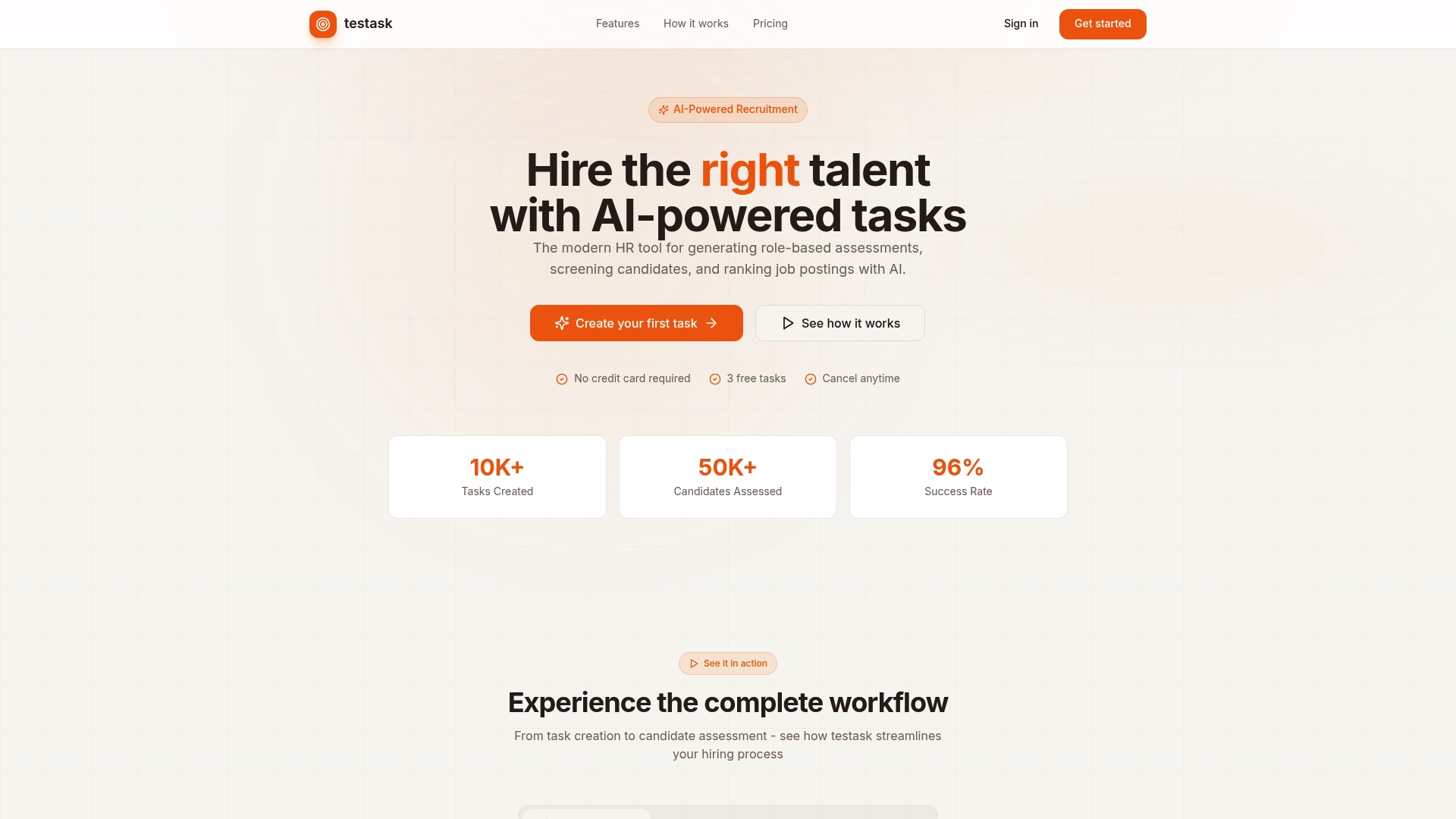
Testask is an AI-powered recruitment assessment platform that helps HR teams generate tailored evaluation criteria, score candidate submissions consistently, and collaborate on reviews without losing the evidence trail. You can build role-specific scorecards, capture structured notes during interviews, and use AI-assisted analysis to surface patterns across candidates. For teams running high-volume hiring or managing diverse role profiles, Testask keeps the process consistent without adding administrative overhead. Start building structured hiring assessments with Testask today.
FAQ
What is a defining interview assessment?
A defining interview assessment is the process of establishing structured, standardized criteria and methods to evaluate candidates consistently. It includes competency mapping, predetermined questions, behaviorally anchored rating scales, and evidence-based scoring.
How many competencies should an interview scorecard include?
Best practice scorecards use 6–12 competencies with weighted importance scores. Fewer than 6 leaves evaluation gaps; more than 12 creates cognitive overload during the interview.
Why do behavioral anchors matter in interview scoring?
Without behavioral anchors, raters interpret numeric scores differently, which reduces inter-rater consistency and assessment validity. Anchors define exactly what each scale point means in terms of candidate behavior.
How does calibration improve interview assessment quality?
Calibration sessions on prior interview transcripts align panelists on scoring criteria and improve judge agreement. A 0.65 inter-rater agreement score is considered a good threshold for panel consistency.
What is the role of benchmark responses in fair scoring?
Benchmark responses are predefined examples of acceptable answers at each quality level. They allow interviewers to score unexpected but job-relevant candidate answers fairly, without improvising criteria mid-interview.
Recommended
- Examples of Interview Assessments for HR Pros in 2026 | Testask Blog | testask
- How to Assess Candidates: A 2026 Hiring Guide | Testask Blog | testask
- What is job assessment? A practical guide for better hiring | Testask Blog | testask
- Employment assessment best practices that elevate hiring results | Testask Blog | testask