What Is Scalable Hiring? A Guide for HR Teams
What Is Scalable Hiring? A Guide for HR Teams

Scalable hiring is defined as a structured recruitment system that grows or contracts with your organization’s needs without sacrificing quality or speed. Unlike reactive hiring, which treats every open role as a one-off crisis, scalable talent acquisition builds repeatable processes, clear ownership, and technology-driven efficiency into every stage of recruitment. The median time-to-fill reaches 44–45 days for most roles and exceeds 60 days at larger organizations. That delay costs money, slows growth, and burns out HR teams. A well-built recruitment system cuts that gap by removing the improvisation that causes it.
What is scalable hiring, and why does it matter?
Scalable hiring is the practice of treating recruitment as an operational function, not an improvised response to headcount gaps. The distinction matters because hiring as an operational function requires defined standards, clear process ownership, and documented decision frameworks. When those elements exist, your team can hire two people or two hundred without rebuilding the process from scratch each time.
The business case is direct. Reactive hiring produces inconsistent candidate quality, longer fill times, and higher cost-per-hire. Scalable recruitment processes, by contrast, produce predictable outcomes because the system does the heavy lifting. HR teams that build this infrastructure report fewer hiring errors and faster ramp times for new employees.

Recruitment scalability also protects against contraction. When a company needs to pause hiring, a documented system is easy to pause and restart. A team that operates on tribal knowledge and ad hoc workflows loses institutional memory the moment a recruiter leaves.
Key components that make hiring scalable
Scalable recruitment does not happen by accident. It requires five foundational building blocks working together.
- Role success criteria. A job description lists tasks. A success profile defines what “great” looks like at 30, 90, and 180 days. Without this, interviewers assess candidates against different mental models, which produces inconsistent decisions.
- Standardized interview scorecards. Competency-based scorecards give every interviewer the same evaluation criteria. Auditing scorecards every 10–15 hires against retention and performance data keeps those criteria accurate and bias-resistant.
- Clear process ownership. Every search needs one accountable owner. Assigning end-to-end ownership to an HR lead or COO in smaller organizations prevents stalls and miscommunication between hiring managers and recruiters.
- Proactive talent pipelines. Building candidate relationships before roles open reduces time-to-fill and improves quality. Teams that wait for a vacancy to start sourcing always hire under pressure.
- Recruitment technology. Applicant tracking systems, assessment platforms, and AI-powered screening tools remove manual bottlenecks. Technology should multiply the output of your existing team, not replace the human judgment at the final stage.
Pro Tip: Map your current hiring workflow before adding any technology. Tools applied to a broken process produce faster broken results. Fix the process first, then automate it.
How does technology power scalable recruitment processes?
Technology is the force multiplier that separates a scalable hiring operation from one that simply adds recruiters to meet demand. Scaling through technology, not headcount, is the core principle behind modern recruitment scalability. Adding a recruiter adds linear capacity. Adding the right tool adds exponential capacity.
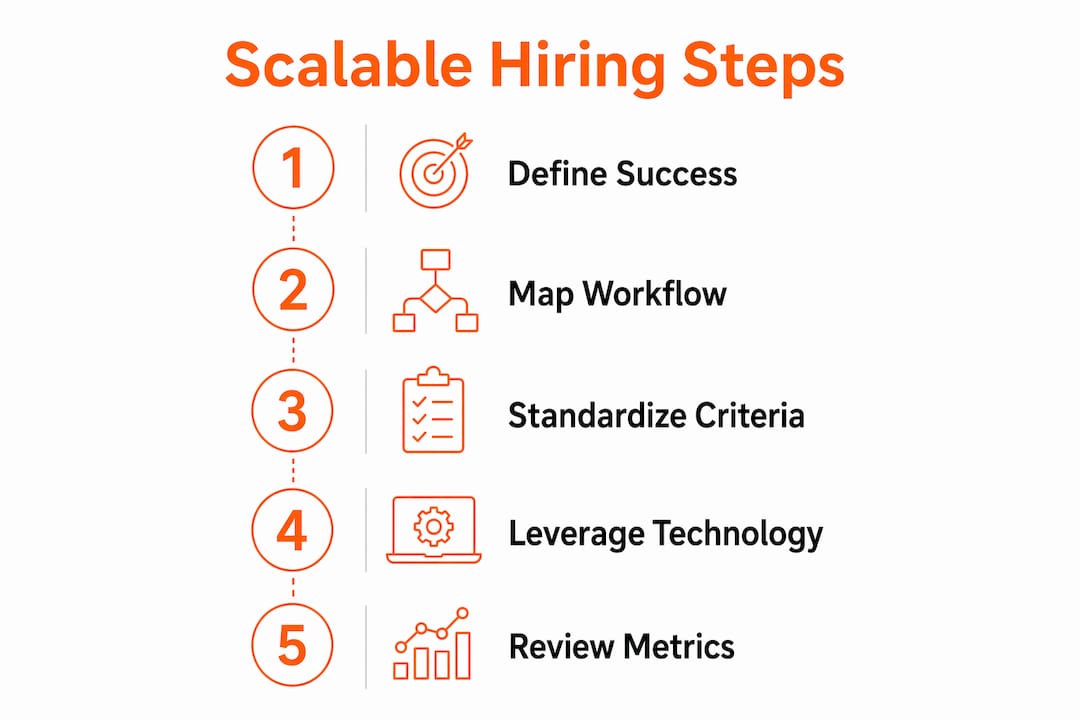
The clearest example is application processing. AI-powered recruitment solutions process applications up to 90% faster while maintaining quality. That means a team that previously screened 50 applications per day can effectively evaluate 500 without increasing headcount.
Technology also improves decision quality, not just speed. Data analytics reveal which sourcing channels produce the best 90-day retention rates. Automated candidate communication workflows keep applicants engaged and reduce drop-off during long hiring cycles. Skills assessment platforms like Testask let HR teams evaluate candidate submissions with AI-assisted analysis, so reviewers spend time on judgment calls rather than administrative scoring.
The right technology stack for scalable talent acquisition typically includes:
- An applicant tracking system for pipeline visibility and workflow management
- A skills assessment platform for objective, repeatable candidate evaluation
- Automated scheduling and communication tools to reduce recruiter time on logistics
- Analytics dashboards to track time-to-fill, source quality, and offer acceptance rates
The goal is not to remove humans from hiring. The goal is to remove humans from the parts of hiring that do not require human judgment.
Common challenges when scaling hiring and how to avoid them
The most common mistake HR teams make when scaling is confusing activity with infrastructure. Adding recruiters, posting more jobs, and increasing interview volume are all activity. None of them build a system.
- Treating headcount as the solution. More recruiters without better processes produce more inconsistency at higher cost. The fix is to document and standardize before you hire.
- Reactive, ad hoc hiring cycles. When every role feels urgent, shortcuts accumulate. Skipped reference checks, compressed interview stages, and vague scorecards all degrade quality over time. Build a process that holds even under pressure.
- Undefined role success criteria. Hiring managers who cannot describe what success looks like at 90 days will disagree on which candidate to hire. Require a written success profile before any search begins.
- Scorecard drift. Competency maps become outdated as roles evolve. Regular audits against retention and performance metrics prevent the gradual drift that erodes hiring quality without anyone noticing.
- Ignoring bias accumulation. Unaudited processes allow unconscious bias to compound. Structured scorecards and blind skills assessments reduce this risk at every stage.
Pro Tip: Schedule a quarterly hiring review. Pull your last 15 hires, check their 90-day performance ratings, and compare them against your scorecard predictions. If the correlation is weak, your criteria need updating.
Practical steps to build a scalable hiring operation
Building a hiring system that holds up at scale requires deliberate sequencing. These steps apply whether your organization currently has 10 employees or 300.
- Define role success outcomes. Before writing a job description, document what the hire must accomplish in their first 30, 90, and 180 days. This becomes the foundation for every evaluation decision.
- Build a Talent Playbook. A centralized Talent Playbook connects role scoping, competency maps, interview rubrics, and decision frameworks into one living document. It makes your process transferable and auditable.
- Design a structured multi-stage interview process. A consistent multi-stage process typically includes a screening call, a skills assessment, a competency-based interview, and a final leadership conversation. Each stage filters for a different dimension of fit.
- Assign process ownership. Name one person responsible for each search from intake to offer. This prevents the accountability gaps that stall hiring.
- Integrate recruiting partners proactively. External partners, whether staffing agencies or assessment platforms, perform best when brought in before a crisis. Onboarding them during a calm period means they understand your standards before volume spikes.
The table below maps each step to its primary outcome.
| Step | Primary outcome |
|---|---|
| Define success outcomes | Consistent evaluation criteria across all interviewers |
| Build a Talent Playbook | Repeatable, transferable hiring process |
| Multi-stage interview design | Higher candidate quality and fewer hiring errors |
| Assign process ownership | Faster decisions and clear accountability |
| Proactive partner integration | Faster ramp-up when hiring volume increases |
For a deeper look at how these steps connect to day-to-day execution, the hiring process best practices guide covers each stage in detail. Teams building from scratch will also find the best hiring practices for 2026 resource useful for aligning their process with current standards.
Key Takeaways
Scalable hiring requires treating recruitment as a documented operational system, not a reactive response to open roles, with technology and structured processes driving quality at any volume.
| Point | Details |
|---|---|
| Define success before sourcing | Write 30/90/180-day success outcomes before any search begins to align all interviewers. |
| Standardize with scorecards | Competency-based scorecards, audited every 10–15 hires, keep evaluation consistent and bias-resistant. |
| Technology multiplies capacity | AI-powered tools process applications significantly faster, freeing recruiters for high-judgment decisions. |
| Build a Talent Playbook | Centralizing role criteria, rubrics, and frameworks makes your process repeatable and transferable. |
| Audit regularly | Quarterly reviews of hire performance against scorecard predictions prevent quality drift over time. |
The mindset shift most HR teams skip
The hardest part of building a scalable hiring operation is not the technology or the documentation. It is the mindset shift from firefighter to architect.
Most HR teams I have seen operate in permanent reactive mode. A role opens, the team scrambles, shortcuts get taken, and the hire is made under pressure. The process works well enough that no one questions it until the company tries to hire 20 people in a quarter instead of two. Then everything breaks at once.
The teams that scale well make one decision early: they treat hiring as an ongoing operational function, not a project that starts when a role opens. That means maintaining talent pipelines when there are no open roles. It means auditing scorecards when everything seems fine. It means investing in a Talent Playbook before you need it.
Technology adoption matters, but only after the process is sound. I have watched organizations deploy expensive assessment platforms on top of undefined evaluation criteria and wonder why their hire quality did not improve. The platform was not the problem. The absence of a clear success profile was.
The teams that get this right also balance automation with human judgment deliberately. Automated screening tools handle volume. Competency-based interviews handle nuance. Neither replaces the other. The collaborative hiring process model, where multiple stakeholders contribute structured input, consistently produces better decisions than any single-reviewer approach.
Scalable hiring is not a destination. It is a practice. The organizations that sustain it are the ones that schedule time to review and refine their systems, not just use them.
— Pavel
How Testask helps you build a hiring system that holds
Scaling your recruitment operation requires more than good intentions. It requires tools that make structured evaluation fast, consistent, and collaborative.
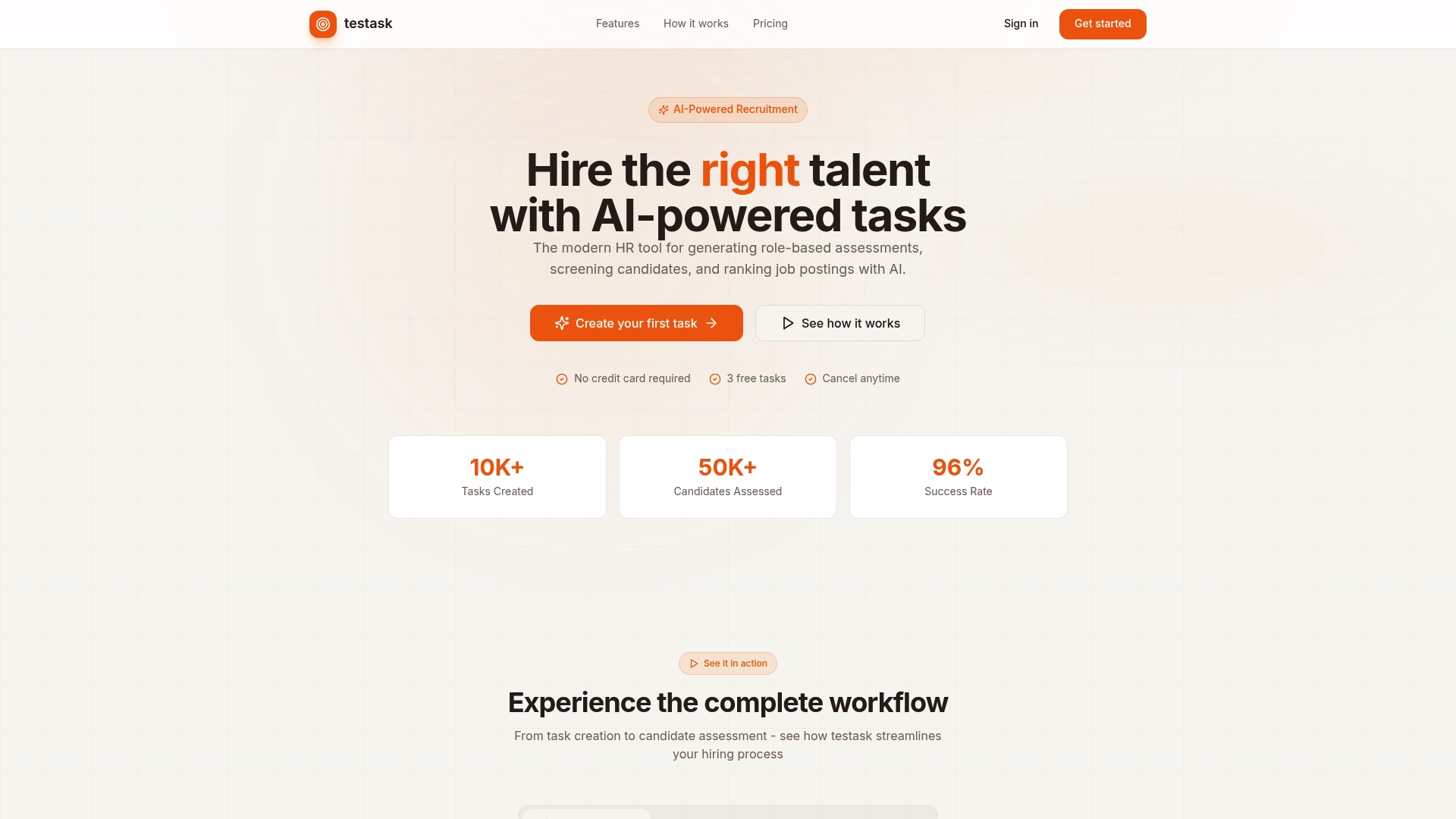
Testask is an AI-powered recruitment assessment platform built for HR teams that need to evaluate candidates at volume without losing quality. You can generate tailored test tasks for any role, review candidate submissions with AI-assisted analysis, and collaborate with hiring managers inside one platform. The result is a skills-based screening process that fits directly into a multi-stage interview structure. Visit Testask to see how it supports the kind of repeatable, auditable hiring process your organization needs to grow.
FAQ
What is scalable hiring in simple terms?
Scalable hiring is a documented recruitment system that lets your organization hire more people, or fewer, without rebuilding the process each time. It relies on standardized criteria, clear ownership, and technology to maintain quality at any volume.
How do you scale a hiring process without losing quality?
Audit your competency scorecards every 10–15 hires against 90-day performance data, and use structured multi-stage interviews to evaluate candidates consistently. Technology handles volume; human judgment handles final decisions.
What is the biggest mistake companies make when scaling hiring?
The most common mistake is adding recruiters instead of improving processes. More headcount on a broken process produces faster, more expensive mistakes. Fix the system first, then scale the team.
How does a Talent Playbook support recruitment scalability?
A Talent Playbook centralizes role success criteria, competency maps, interview rubrics, and decision frameworks in one document. It makes your hiring process transferable across teams and repeatable across hiring cycles.
What role does AI play in scalable talent acquisition?
AI-powered tools handle high-volume tasks like application screening and candidate communication, freeing recruiters to focus on evaluation and relationship-building. Platforms like Testask use AI-assisted analysis to speed up skills assessment without removing human judgment from the process.