Collaborative Hiring Process: A Guide for HR Teams
Collaborative Hiring Process: A Guide for HR Teams

A collaborative hiring process is a team-driven approach where HR professionals, hiring managers, and relevant team members collectively evaluate and select candidates using structured workflows and shared evaluation tools. Unlike traditional hiring, where a single manager makes the call, collaborative hiring distributes screening, interviewing, and decision-making across multiple stakeholders from different business areas. The result is more diverse perspectives, reduced individual bias, and candidates who fit both the role and the team. Platforms like Testask, Greenhouse, and Lever have built their core workflows around this model because the evidence is clear: structured, multi-stakeholder evaluation produces better hires.
What is a collaborative hiring workflow?
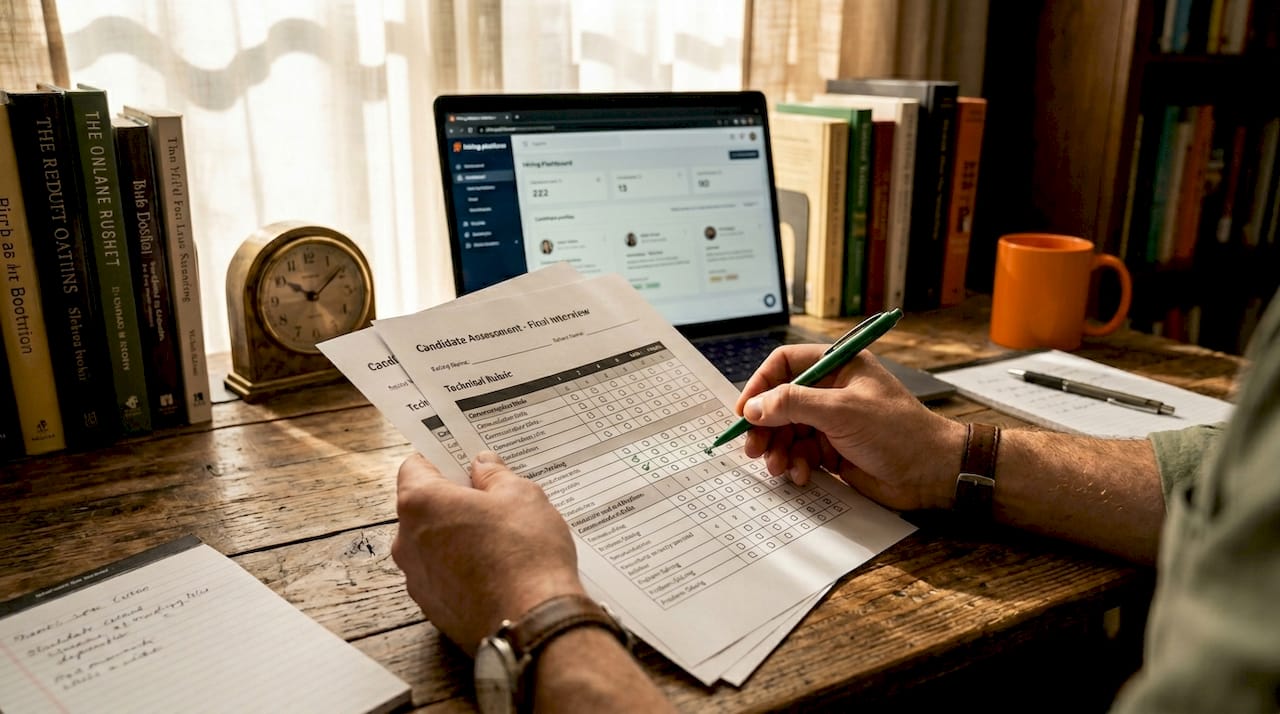
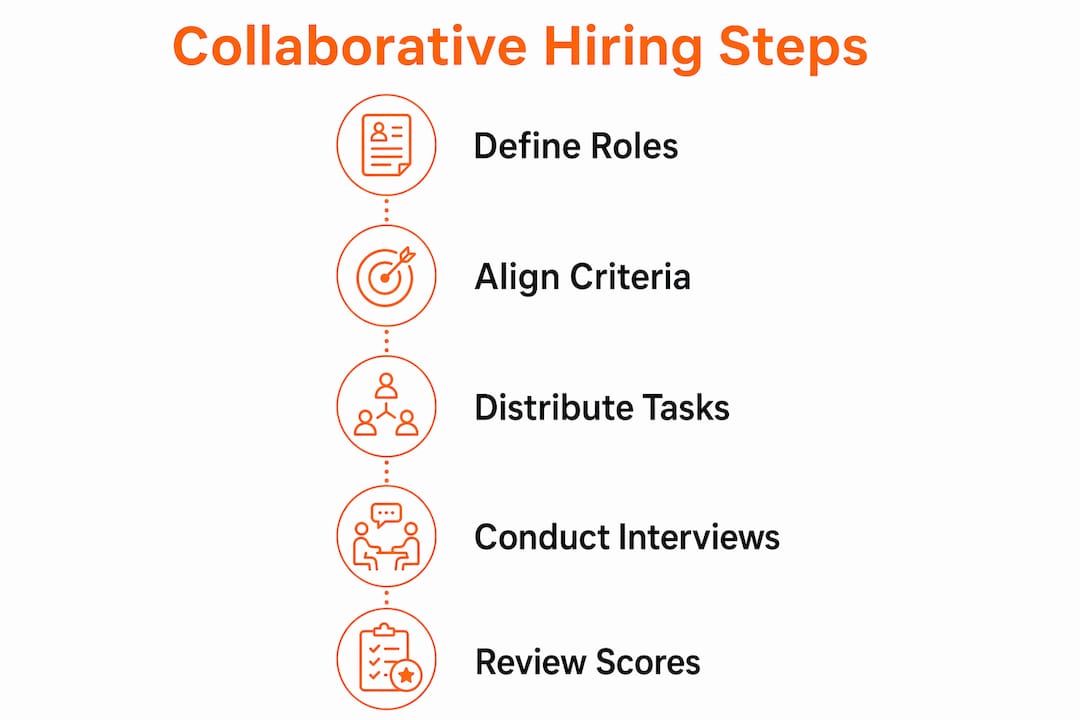
A repeatable collaborative workflow follows six defined stages, each with clear ownership and outputs. Skipping any stage is where most teams run into problems.
The six core stages:
- Define the hiring team. Assign specific roles: recruiter, hiring manager, technical interviewer, and culture interviewer. Each person needs a defined scope, not a general invitation to weigh in.
- Align on the job description and criteria. The hiring team writes the job description together and agrees on the top five to seven competencies before sourcing begins. This prevents criteria drift later.
- Plan structured, multi-stakeholder interviews. Each interviewer covers a distinct set of competencies. Overlapping coverage wastes time and creates redundant data.
- Collect independent feedback. Every interviewer completes a scorecard immediately after their session, before discussing results with anyone else.
- Consolidate and debrief. The team reviews scores by competency, discusses divergences, and reaches a decision grounded in documented evidence.
- Document and iterate. Store scorecards, notes, and the final decision rationale in a centralized system for future reference and process improvement.
Tools that support each stage:
- Applicant tracking systems (ATS) with shared candidate profiles
- Scorecard templates built into platforms like Testask or Greenhouse
- Scheduling tools integrated with Google Calendar or Outlook
- Slack or Microsoft Teams channels dedicated to each open role
Pro Tip: Create a single shared document for each role that contains the job description, competency rubric, interview guide, and scorecard template. Interviewers who walk in prepared give you better signal.
| Stage | Key output |
|---|---|
| Team definition | Assigned roles and responsibilities |
| Criteria alignment | Agreed competency list and scoring scale |
| Structured interviews | Covered competencies with no gaps or overlaps |
| Independent feedback | Completed scorecards before group discussion |
| Debrief meeting | Evidence-based hiring decision |
| Documentation | Stored rationale for audit and iteration |
Collaborative hiring also alleviates the burden on recruiters by distributing screening and evaluation responsibilities, freeing recruiters to focus on sourcing strategy and candidate experience rather than managing every evaluation manually.
How do scorecards and rubrics improve hiring decisions?
Scorecards and rubrics are not the same tool, and using only one of them is a common mistake. A rubric defines what good, average, and poor performance looks like for each competency. A scorecard is the form an interviewer fills out, assigning a numeric rating and documenting the evidence behind it. You need both. The rubric calibrates the scale; the scorecard captures the data.
Structured hiring with rubrics improves hire quality by up to 26% by reducing post-hoc rationalizations in group discussions. That number reflects what happens when interviewers are forced to commit to evidence before the debrief, rather than adjusting their recollections to match the group consensus.
Behavioral anchors are the mechanism that makes rubrics work. Instead of rating “communication” on a 1 to 5 scale with no guidance, a behavioral anchor describes exactly what a “4” looks like: “Candidate explained a complex technical concept clearly to a non-technical stakeholder without being prompted.” That specificity increases inter-rater reliability and makes it possible to compare scores across interviewers meaningfully.
Common pitfalls to avoid:
- Anchoring bias: The first interviewer’s overall impression colors everyone else’s scores. Counter this by delaying overall ratings until all competency evidence has been reviewed.
- Halo effect: A strong answer on one competency inflates scores on unrelated ones. Reviewing competencies independently prevents this.
- Recency bias: Interviewers overweight the last thing a candidate said. Timestamped notes taken during the interview fix this.
“Have each interviewer submit scores with observable evidence and unresolved questions before the group discussion to focus debate on facts rather than impressions.” — Jamy AI debrief guidance
Pro Tip: Run a calibration session before the first round of interviews. Have all interviewers score the same sample response independently, then compare. Divergences reveal where your rubric needs sharper behavioral anchors.
What technology supports a collaborative hiring process?
Modern ATS platforms and collaborative decision-making tools do more than store resumes. The features that matter most for team-based hiring are the ones that reduce coordination overhead and keep evaluations consistent.
Collaborative decision-making software like Simplicant integrates role expectation alignment, feedback capture, and shared scoring into a single workflow. This means hiring managers and interviewers are working from the same candidate record, not emailing spreadsheets back and forth.
The table below compares the capabilities that separate basic ATS tools from purpose-built collaborative hiring platforms:
| Capability | Basic ATS | Collaborative hiring platform |
|---|---|---|
| Shared candidate profiles | Yes | Yes |
| Built-in scorecard templates | Sometimes | Yes |
| Automated interview reminders | Sometimes | Yes |
| Competency-level feedback capture | Rarely | Yes |
| Real-time debrief dashboards | No | Yes |
| AI-assisted scoring analysis | No | Yes |
ATS tools with task tagging, interview scheduling, automated reminders, and video chat are now considered baseline requirements for repeatable, scalable collaborative recruitment. The differentiator is whether the platform captures structured, competency-level feedback or just free-text notes.
AI adds a layer that basic automation cannot provide. AI in hiring improves decision quality by generating traceable, job-relevant signals and providing auditable scoring tied to observable behaviors. This is distinct from simply automating scheduling or sending rejection emails. The goal is smarter decisions, not just faster ones. Testask applies this principle directly: its AI-assisted analysis flags scoring inconsistencies across interviewers and surfaces candidate strengths tied to specific competencies, giving your debrief meeting a factual foundation rather than a collection of gut reactions.
Pro Tip: Integrate your hiring platform with Slack or Microsoft Teams so interviewers receive scorecard submission reminders and debrief scheduling notifications in the tools they already use. Adoption drops sharply when collaboration requires switching apps.
For teams looking to improve candidate screening with AI-supported tools, the key is choosing platforms that produce traceable, auditable assessments rather than black-box recommendations.
How to implement and scale collaborative hiring
Starting with a pilot is the most reliable path to adoption. Pick one open role, assemble a small hiring team of three to four people, and run the full six-stage workflow. Document what breaks. Most teams discover their rubrics are too vague or their debrief meetings lack a clear facilitator.
Steps to build a scalable process:
- Create master templates. Build a library of job description templates, competency rubrics, and scorecard forms organized by role family. Engineers, sales reps, and operations managers each need different competency sets.
- Train interviewers before they interview. A 60-minute training session covering behavioral interviewing techniques and scorecard completion reduces scoring variance significantly. Most teams skip this and wonder why their data is noisy.
- Assign decision ownership. Defining decision ownership and meeting schedules prevents the decision paralysis that affects multi-stakeholder teams. One person has the final call; everyone else provides input.
- Set hard deadlines for scorecard submission. Require scorecards within 24 hours of each interview. Scores submitted days later are reconstructed from memory, not observation.
- Measure and iterate. Track time-to-hire, offer acceptance rate, and 90-day retention by role. These metrics tell you whether your collaborative process is producing better outcomes or just more meetings.
Handling conflicting opinions is where many teams stall. When two interviewers score the same competency very differently, the right response is to examine the evidence each person documented, not to average the scores. Divergence is information. It often reveals that one interviewer asked a stronger question or that the rubric anchor needs revision.
Pro Tip: Review your hiring process best practices documentation every quarter. Role requirements shift, and rubrics that were accurate six months ago may no longer reflect what the team actually needs.
Scaling beyond a single team requires a centralized template library and a designated process owner, typically a senior recruiter or HR business partner, who maintains standards and trains new interviewers as the organization grows.
Key takeaways
A collaborative hiring process produces better decisions when it combines defined team roles, standardized rubrics, independent scoring, and evidence-based debriefs into a repeatable workflow.
| Point | Details |
|---|---|
| Define roles before sourcing | Assign recruiter, hiring manager, and interviewer roles with clear scope before the process begins. |
| Use rubrics and scorecards together | Rubrics calibrate the scale; scorecards capture evidence. Both are required for consistent evaluation. |
| Score independently before debriefing | Submitting scores before group discussion prevents anchoring bias and improves decision quality. |
| Assign final decision authority | One person holds the final call to prevent decision paralysis in multi-stakeholder teams. |
| Measure outcomes and iterate | Track time-to-hire and 90-day retention to verify whether the process is producing better hires. |
Why collaborative hiring is harder than it looks
I have watched organizations adopt collaborative hiring with genuine enthusiasm and then quietly abandon it within two quarters. The reason is almost always the same: they built a process without building the habits that sustain it.
The workflow itself is not complicated. The hard part is getting a technical lead to submit a scorecard by end of day when they have three other deadlines, or convincing a senior manager that their gut feeling about a candidate is not sufficient evidence in a debrief. These are cultural and behavioral challenges, not process design problems.
What I have found actually works is making the process as low-friction as possible for the people who are not recruiters. That means pre-filled scorecard templates, calendar blocks already scheduled, and debrief meetings capped at 30 minutes with a clear agenda. When collaboration costs interviewers less than 90 minutes of focused effort per candidate, adoption holds.
The technology piece matters more than most HR teams admit. AI-assisted hiring workflows do not just save time. They create an audit trail that makes it possible to identify where your process is breaking down. If scores are consistently inconsistent for a particular competency, that is a signal your rubric needs work, and you can only see that pattern if your data is structured and centralized.
My prediction for the next two years: organizations that invest in structured, AI-supported collaborative hiring now will have a measurable talent advantage over those still relying on informal consensus. The gap between good and great hiring decisions compounds over time, and the teams that close it fastest will be the ones that treat evaluation as a discipline, not a formality.
— Pavel
How Testask supports your collaborative hiring workflow
Testask is an AI-powered recruitment assessment platform built for HR teams that want structured, collaborative evaluations without the administrative overhead. With Testask, you can generate tailored test tasks for any role, collect candidate submissions in one place, and let AI-assisted analysis surface the evidence your team needs before the debrief meeting. Interviewers review scored assessments, add competency-level feedback, and align on decisions faster because the data is already organized. If you are ready to run a hiring process where every decision is traceable and every interviewer is working from the same evidence, explore Testask and see how it fits your team’s workflow.
FAQ
What is a collaborative hiring process?
A collaborative hiring process is a team-based recruiting method where HR professionals, hiring managers, and team members jointly screen, interview, and evaluate candidates using shared criteria and structured feedback tools. It distributes decision-making across multiple stakeholders to reduce individual bias and improve candidate fit.
How many people should be on a collaborative hiring team?
Three to five people is the practical range for most roles. Fewer than three limits perspective diversity; more than five creates coordination delays and dilutes accountability for the final decision.
What is the difference between a scorecard and a rubric in hiring?
A rubric defines what strong, average, and weak performance looks like for each competency. A scorecard is the form interviewers complete to assign ratings and document evidence. Both tools together produce consistent, comparable evaluations across your hiring team.
How do you prevent anchoring bias in a group debrief?
Require every interviewer to submit independent scores with documented evidence before the group discussion begins. Delay sharing overall recommendations until all competency evidence has been reviewed to prevent early opinions from shaping the group’s assessment.
What metrics should you track to evaluate collaborative hiring effectiveness?
Track time-to-hire, offer acceptance rate, and 90-day retention by role. These three metrics together indicate whether your process is producing faster decisions, stronger candidate interest, and better long-term fit.
Recommended
- Hiring process best practices: proven steps for better talent | Testask Blog | testask
- Candidate Screening Process Guide: Streamlined Hiring Steps | Testask Blog | testask
- What Is Hiring Analytics? A Guide for HR Teams | Testask Blog | testask
- What Is HR Collaboration and Why It Matters in 2026 | Testask Blog | testask