What Is Hiring Efficiency? A Guide for HR Leaders
What Is Hiring Efficiency? A Guide for HR Leaders

Hiring efficiency is defined as the strategic balance of speed, cost, quality, and process discipline within recruitment that consistently delivers high-value hires while reducing wasted effort. Most HR teams track pieces of this picture, such as time-to-fill or cost-per-hire, but true hiring efficiency requires all four dimensions working together. When one dimension dominates, the others suffer. A team that fills roles in record time but hires poorly is not efficient. It is just fast. Understanding what hiring efficiency actually means, how to measure it, and how to improve it is the foundation of any serious talent acquisition strategy.
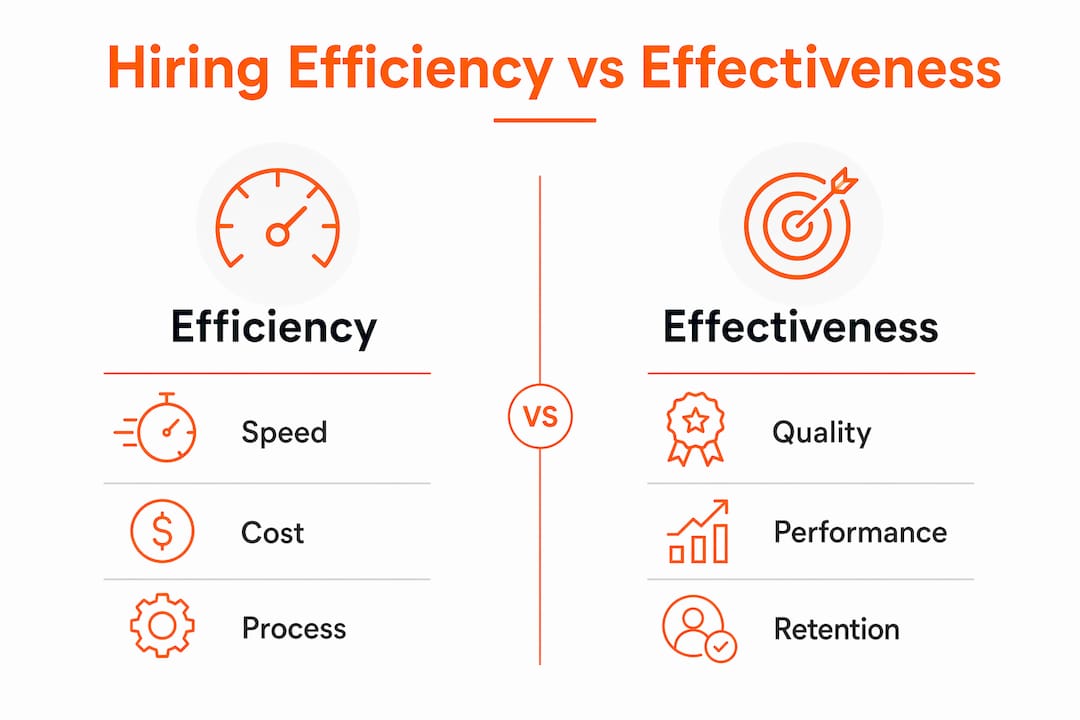
What is hiring efficiency and how does it differ from effectiveness?
Hiring efficiency and hiring effectiveness are related but distinct concepts. Efficiency covers speed and cost. Effectiveness covers quality and return on investment, and it requires post-hire data to measure accurately. Both must be managed together to optimize recruitment outcomes.
The clearest way to separate them is by the type of metric each uses. Efficiency metrics are activity-based and visible in real time. Effectiveness metrics are outcome-based and only become meaningful weeks or months after a hire is made.

| Point | Efficiency metrics | Effectiveness metrics |
|---|---|---|
| Time-to-fill | Days from job opening to accepted offer | N/A |
| Cost-per-hire | Total recruiting spend divided by hires | N/A |
| Time-to-hire | Days from candidate sourcing to offer | N/A |
| Quality of hire | N/A | Performance ratings, ramp time |
| Retention rate | N/A | 90-day and 12-month retention |
| Manager satisfaction | N/A | Post-hire manager survey scores |
One distinction that trips up many HR teams is the difference between time-to-fill and time-to-hire. Time-to-fill measures total elapsed time, including approvals and headcount sign-offs. Time-to-hire measures only the process efficiency after a candidate enters the pipeline. Conflating the two leads to misdiagnosed bottlenecks and wasted improvement effort.
Outcome-based metrics connect recruitment directly to business performance and give HR leaders the data they need to justify budgets. Activity-based metrics tell you how busy the team is. Outcome-based metrics tell you whether the work is producing results. A maturing recruitment function tracks both, but prioritizes outcomes.
Pro Tip: When building your metrics dashboard, start with the three or four metrics that directly inform your most critical hiring decisions. Adding more metrics rarely adds more clarity.
What factors affect hiring efficiency?
The biggest misconception about hiring process efficiency is that it has one main bottleneck. Time-to-hire is built from multiple small delays across every stage of the process, not one obvious problem. Fixing a single stage while ignoring the others produces minimal gains.
Common causes of hiring inefficiency include:
- Undefined workflows. When recruiters improvise the process for each role, steps get skipped or duplicated.
- Manual scheduling. Coordinating interview times by email adds days to each hiring stage. Automated scheduling is 26% faster than manual coordination, saving approximately 1.3 hours per interview cycle.
- Poor data visibility. When hiring managers and recruiters work from different systems, decisions slow down and errors multiply.
- Weak collaboration. Hiring panels that lack a shared evaluation framework produce inconsistent feedback and extend decision timelines.
- Metrics sprawl. Tracking too many metrics without connecting them to decisions creates reporting overhead without improving outcomes.
Automation and AI address several of these causes directly. Automating key recruitment stages reduces time-to-fill by 40–60% and recruiter workload by up to 70%. Those are significant numbers. They reflect the cumulative effect of eliminating micro-delays across scheduling, screening, and communication.
The risk that HR leaders rarely discuss is overemphasis on speed. Faster hiring without judgment quality leads to poor hires that harm long-term results. A two-week time-to-fill means nothing if the hire exits within 90 days. Reducing time-to-hire at the expense of stakeholder engagement and candidate quality is a false economy.
Pro Tip: Before adding automation to your process, map each stage and identify where decisions are delayed by missing information. Automation accelerates a process. It does not fix a broken one.
What strategies and tools improve hiring efficiency?
Improving hiring efficiency requires changes at the process level, the technology level, and the measurement level. No single tool fixes a poorly designed process, and no process improvement fully compensates for weak data.
The most effective strategies HR teams use include:
- Standardize the recruitment workflow. Define every stage, owner, and timeline before a role opens. Consistency across roles is what makes benchmarking possible.
- Automate candidate screening. AI-powered screening tools evaluate submissions against defined criteria faster than manual review. Platforms like Testask generate tailored test tasks and score candidate responses with AI-assisted analysis, cutting screening time significantly.
- Use structured interviews. Standardized questions and scoring rubrics reduce interviewer bias and speed up panel alignment.
- Centralize hiring data. A single source of truth for pipeline status, candidate scores, and feedback eliminates the back-and-forth that delays decisions.
- Build feedback loops. Track hiring metrics at each stage and review them monthly to catch new inefficiencies before they compound.
The table below shows the impact of specific automation interventions on key efficiency metrics.
| Automation type | Primary metric affected | Reported impact |
|---|---|---|
| Automated scheduling | Time-to-hire | 26% faster per interview cycle |
| AI-powered screening | Recruiter workload | Up to 70% reduction |
| Automated pipeline tracking | Time-to-fill | 40–60% reduction |
Focusing on 3–5 critical metrics rather than tracking everything makes efficiency gains sustainable. Each metric you track should connect to a specific hiring decision. If a metric does not change how you act, it is consuming attention without adding value.
For teams building or rebuilding their process, hiring process best practices provide a proven framework for structuring each stage from job brief to offer.
How does hiring efficiency affect business outcomes?
Efficient recruitment reduces the cost of vacancy, which is the revenue and productivity lost while a role sits open. For revenue-generating roles, that cost compounds daily. For leadership roles, it can affect team performance for months. Efficient hiring reduces vacancy costs, improves retention, and supports strategic workforce planning.
The connection between recruitment and business outcomes becomes visible when HR teams share pipeline data with finance and operations. When CHROs and CFOs can see hiring velocity alongside headcount plans, they can make better decisions about project timelines, budget allocation, and growth targets. Data visibility is what converts recruitment from a cost center into a planning function.
Retention is the clearest long-term signal of hiring efficiency. A team that fills roles quickly but loses new hires within six months is paying the full cost of recruitment twice. High retention rates confirm that the process selected the right people, not just available people.
Talent acquisition leaders who treat efficiency as a means to better decisions, rather than an end in itself, build recruitment functions that scale. The goal is not the fastest process. The goal is the process that consistently produces hires who perform, stay, and contribute. Improving recruitment outcomes at the process level is what makes that consistency possible.
Key takeaways
Hiring efficiency is the balance of speed, cost, quality, and process discipline that produces high-value hires and reduces wasted recruitment effort across every stage.
| Point | Details |
|---|---|
| Define efficiency correctly | Hiring efficiency covers speed, cost, quality, and process, not just time-to-fill. |
| Separate efficiency from effectiveness | Efficiency metrics are real-time; effectiveness metrics require post-hire data to measure. |
| Address micro-delays | Time-to-hire is built from small delays across every stage, not one bottleneck. |
| Automate with purpose | Automation reduces recruiter workload significantly, but only works on a well-designed process. |
| Focus your metrics | Track 3–5 metrics tied to critical decisions; more metrics rarely produce better outcomes. |
The metric that most teams are measuring wrong
The most common mistake I see HR teams make is treating time-to-fill as their primary efficiency metric. It is the most visible number, so it gets the most attention. But time-to-fill includes approvals, headcount sign-offs, and budget cycles that recruiters cannot control. Optimizing for it often means pressuring the wrong part of the process.
Time-to-hire is the more honest metric. It measures what the recruiting team actually controls: how quickly a candidate moves from application to offer. When I look at teams that have genuinely improved their hiring efficiency, they almost always started by separating these two numbers and acting on them differently.
The second pattern I notice is that efficiency programs stall because they focus on speed without addressing judgment quality. IBM’s research on this point is direct: faster hiring without better decision quality produces poor hires. The teams that sustain efficiency gains are the ones that invest in structured evaluation, not just faster scheduling.
The shift from activity metrics to outcome-based recruiting metrics is the clearest sign that a recruitment function is maturing. It means the team has stopped measuring how busy it is and started measuring whether its work produces results. That shift is harder than it sounds, and it requires buy-in from hiring managers and finance, not just HR.
— Pavel
Testask helps HR teams assess candidates faster and with more confidence
Screening candidates at scale is where most hiring processes lose time and consistency. Testask is an AI-powered recruitment assessment platform that helps HR teams create tailored test tasks, evaluate submissions automatically, and collaborate on reviews in one place.
With Testask, recruiters generate role-specific assessments in minutes, and AI-assisted analysis scores candidate responses against defined criteria before a human reviewer gets involved. That cuts the time between application and shortlist without sacrificing evaluation quality. Teams that need to move faster without lowering their hiring bar can explore Testask and see how AI-assisted screening fits their current workflow.
FAQ
What is hiring efficiency in simple terms?
Hiring efficiency is the ability to fill roles quickly, at a reasonable cost, with candidates who perform well after joining. It measures how well your recruitment process uses time and resources.
How do you measure hiring process efficiency?
The core metrics are time-to-fill, time-to-hire, cost-per-hire, and candidate experience scores. Time-to-fill and time-to-hire measure different things, so tracking both gives a more accurate picture of where delays occur.
What is the difference between hiring efficiency and hiring effectiveness?
Efficiency measures speed and cost during the recruitment process. Effectiveness measures quality and return on investment after the hire is made, using metrics like retention rate and post-hire performance.
What causes poor hiring efficiency?
The most common causes are undefined workflows, manual scheduling, weak collaboration between recruiters and hiring managers, and tracking too many metrics without connecting them to decisions.
How does automation improve hiring efficiency?
Automating scheduling and screening removes the manual steps that create the most delays. Automated scheduling alone is 26% faster than manual coordination, and AI-powered screening can reduce recruiter workload by up to 70%.
Recommended
- What Is Hiring Analytics? A Guide for HR Teams | Testask Blog | testask
- Explaining Hiring Metrics: A 2026 Guide for HR Teams | Testask Blog | testask
- Hiring process best practices: proven steps for better talent | Testask Blog | testask
- Build an effective recruitment checklist for HR success | Testask Blog | testask