What Is a Hiring Matrix? A Guide for HR Teams
What Is a Hiring Matrix? A Guide for HR Teams

A hiring matrix is a structured evaluation tool that scores job candidates against predefined, weighted criteria to produce an objective measure of role fit. Unlike an interview scorecard, which captures performance at a single stage, a candidate evaluation matrix aggregates scores across multiple competencies and interviewers to determine overall suitability. The result is a defensible, comparable record of every candidate in your pipeline. HR professionals and hiring managers who understand what is a hiring matrix gain a repeatable method for making fair, consistent decisions, regardless of who conducts the interview.
What is a hiring matrix and how does it differ from a scorecard?
A hiring matrix is defined as a grid that maps candidates against role-specific competencies, assigns weighted scores to each, and produces a total that reflects overall fit. The term “employment selection matrix” appears in HR literature, but “candidate evaluation matrix” is the more widely used industry label. Both describe the same core tool.

The key distinction from a scorecard is scope. A scorecard measures performance in one interview or one stage. A matrix aggregates scores across every stage and every interviewer, so the final number reflects the full picture. Think of a scorecard as a chapter and the matrix as the complete book.
Rubrics sit alongside both tools. A rubric defines what each score level means for a given competency. Without rubrics, two interviewers can give a candidate a “3” for communication and mean completely different things. With rubrics, behavioral anchors ensure all reviewers share a consistent understanding of scoring criteria.
How does a hiring matrix work?
A hiring matrix has four core components: competencies, weights, a rating scale, and a total score calculation. Each component plays a specific role in producing a fair result.
Competencies are the skills, behaviors, or attributes the role requires. Examples include problem-solving, communication, technical proficiency, and cultural contribution. Each competency receives a weight that reflects its importance to the role. A senior engineer role might weight technical proficiency at 40% and communication at 20%.
The rating scale is typically 1–5, where 1 means the candidate showed no evidence of the competency and 5 means they demonstrated it at an exceptional level. Interviewers multiply each rating by its weight to produce a weighted score. The sum of all weighted scores is the total score.
Key structural elements to include:
- Knockout competencies: Non-negotiable requirements. A candidate who scores below a set threshold on a knockout competency is removed from consideration, regardless of their total score.
- Minimum total score: A floor below which no candidate advances. Setting explicit thresholds prevents settling for “good enough” hires and clarifies decision points.
- Interviewer assignments: Each competency is assigned to a specific interviewer or panel member, so every area gets thorough coverage and no two interviewers duplicate effort.
Pro Tip: Assign knockout competencies to the earliest interview stage. This saves time for both your team and candidates who cannot meet the minimum bar.
Why use a hiring matrix? Benefits backed by research
Structured hiring with defined criteria improves new hire quality by 26% compared to unstructured, impression-based methods. That gap exists because unstructured interviews invite post hoc rationalization, where interviewers decide on a candidate first and then find reasons to justify the decision.
A hiring matrix forces the evaluation to happen before the discussion. Each interviewer scores independently, then the team compares numbers. This sequence reduces the influence of dominant voices in debrief meetings and produces more reliable outcomes.
“Structured evaluation tools greatly reduce subjective variance between interviewers, leading to fairer, more consistent hiring.” — Scorecards vs Rubrics: Designing an Interview Process That Scales
Structured interview evaluations with scorecards and rubrics reduce intra-panel scoring variance by up to 40%. Lower variance means your hiring panel agrees more often, and when they disagree, the matrix gives them specific data to discuss rather than competing gut feelings.
The benefits of a hiring matrix extend beyond consistency. Matrices create a written record that supports fair hiring audits, helps defend decisions to candidates or legal teams, and builds institutional knowledge about what “great” looks like for each role. Over time, that record becomes a benchmark for improving your hiring evaluation criteria.
Common challenges and how to avoid them
A hiring matrix only works when the hiring culture supports it. A matrix quantifies existing hiring habits. If those habits are undisciplined, the matrix adds paperwork without improving decisions.
The most common pitfalls, and how to address them:
- Too many competencies. Limiting the matrix to 7–10 core competencies is optimal. More than that leads to rushed scoring and less meaningful differentiation between candidates.
- Vague scoring without evidence. Scores must be backed by specific behavioral observations. “She seemed confident” is not evidence. “She handled a hostile objection by restating the concern and providing data” is. Behavioral evidence prevents bias and improves evaluation quality.
- No interviewer calibration. Before the process begins, run a calibration session where all interviewers score the same sample answer and compare results. Disagreements reveal rubric gaps before they affect real candidates.
- Ignoring the matrix in debrief. If the hiring manager overrides the matrix score without documented reasoning, the tool loses credibility. Require written justification for any decision that contradicts the matrix outcome.
- Treating the matrix as a final answer. A hiring matrix should support, not replace, clear thinking and disciplined hiring decisions. The number is an input, not a verdict.
Pro Tip: Run a pilot with one role before rolling out the matrix company-wide. A single hiring cycle reveals rubric gaps, weighting errors, and calibration needs before they scale.
How to create and implement a hiring matrix
Building a matrix starts with the role, not the resume. Define what success looks like in the first 90 days, then work backward to identify the competencies that predict that success.
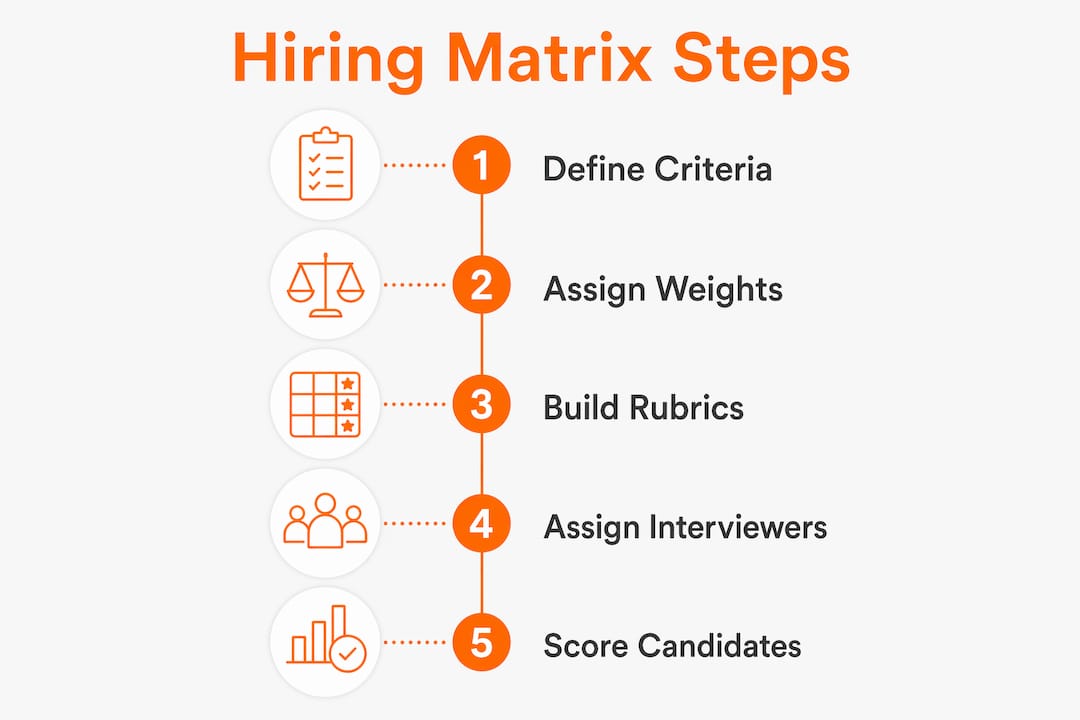
Step 1: Define role-specific criteria
List the outcomes the new hire must achieve. A sales development representative might need to book 20 qualified meetings per month within 60 days. That outcome points to competencies like prospecting skill, communication clarity, and resilience under rejection. Avoid generic criteria like “team player” unless you can define exactly what that behavior looks like in this role.
Step 2: Assign weights
Group competencies into categories and assign weights based on role priorities. A structured hiring process typically weights technical skills highest for individual contributor roles and leadership competencies highest for management roles. Weights should sum to 100%.
Step 3: Build rubrics with behavioral anchors
For each competency, write a one-sentence description of what a 1, 3, and 5 look like. Interviewers can interpolate 2 and 4 from those anchors. Clear rubrics are the difference between a matrix that produces consistent scores and one that produces noise.
Step 4: Assign competencies to interviewers
Match each competency to the interviewer best positioned to assess it. A technical lead assesses coding skills. A future peer assesses collaboration. This prevents overlap and ensures full coverage across the panel.
Step 5: Integrate into your workflow
The matrix enters the process at the debrief stage. Each interviewer submits scores independently before the group meets. The debrief then focuses on competencies where scores diverge, not on general impressions. For a detailed walkthrough of bias-free evaluation steps, the Testask blog covers the full sequence.
| Stage | Tool used | Purpose |
|---|---|---|
| Resume screen | Knockout criteria checklist | Filter for minimum requirements |
| Phone screen | Scorecard | Assess communication and motivation |
| Technical interview | Rubric with behavioral anchors | Score role-specific skills |
| Panel interview | Full hiring matrix | Aggregate scores across competencies |
| Debrief | Matrix summary | Compare scores and make final decision |
The matrix does not replace judgment. It structures judgment, so the best candidate wins on merit rather than on who made the strongest impression in the room.
Key takeaways
A hiring matrix is the most reliable tool for producing consistent, defensible hiring decisions across your entire recruitment process.
| Point | Details |
|---|---|
| Matrix vs. scorecard | A matrix aggregates scores across all stages; a scorecard measures a single moment. |
| Optimal competency count | Limit criteria to 7–10 competencies to maintain scoring quality and differentiation. |
| Behavioral evidence required | Every score needs a specific observation, not a general impression, to be valid. |
| Set explicit thresholds | Knockout competencies and minimum total scores prevent settling for underqualified hires. |
| Structure supports judgment | A matrix improves decisions only when paired with a disciplined hiring culture. |
The part most teams skip
I have reviewed hiring processes at organizations ranging from 10-person startups to enterprise teams with dedicated talent functions. The pattern is consistent: teams spend hours debating matrix design and almost no time training interviewers to use it.
A well-designed matrix with undertrained interviewers produces scores that look precise but mean nothing. The rubric says a “5” in communication requires the candidate to “adapt their message to a non-technical audience in real time.” If the interviewer never creates that situation in the interview, the score is a guess dressed up as data.
The fix is calibration, and it takes less time than most teams expect. A 30-minute session where interviewers score the same recorded answer, then compare and discuss, closes most rubric gaps before they affect real candidates. Do this before every new role, not just when you launch the matrix for the first time.
The other thing I have seen teams get wrong is treating the matrix total as a ranking system. The candidate with the highest score is not automatically the right hire. A matrix tells you who met the bar. Your judgment, informed by the data, tells you who to hire. Those are different questions, and conflating them is how teams end up with technically qualified candidates who fail for reasons the matrix never measured.
— Pavel
How Testask supports structured candidate evaluation
Testask is an AI-powered recruitment assessment platform built for HR teams that want structured, evidence-based hiring. It generates tailored test tasks for each role, evaluates candidate submissions with AI-assisted analysis, and gives your panel a shared workspace for scoring and review.
For teams building or refining a hiring matrix, Testask removes the manual work from score aggregation and debrief preparation. Interviewers submit assessments independently, and the platform compiles results so your debrief starts with data, not discussion. You can assess candidates faster and with greater consistency than spreadsheet-based matrices allow. See how Testask fits your recruitment workflow at testask.org.
FAQ
What is a hiring matrix in simple terms?
A hiring matrix is a scoring grid that compares job candidates across weighted, role-specific criteria to produce an objective measure of fit. It aggregates scores from multiple interviewers and stages into a single total.
How is a hiring matrix different from an interview scorecard?
A scorecard captures performance at one interview stage. A hiring matrix combines scores across all stages and interviewers, so the final result reflects the full evaluation process.
How many competencies should a hiring matrix include?
Research supports limiting a matrix to 7–10 core competencies. More than that leads to rushed scoring and reduces the quality of differentiation between candidates.
What are knockout competencies in a hiring matrix?
Knockout competencies are non-negotiable criteria. A candidate who scores below the set threshold on a knockout competency is removed from consideration, regardless of their total score.
Does a hiring matrix eliminate bias completely?
A hiring matrix significantly reduces bias by requiring behavioral evidence for every score and separating individual scoring from group discussion. It does not eliminate bias entirely, but structured evaluation tools reduce intra-panel scoring variance by up to 40%.
Recommended
- What Is Hiring Analytics? A Guide for HR Teams | Testask Blog | testask
- Explaining Hiring Metrics: A 2026 Guide for HR Teams | Testask Blog | testask
- Collaborative Hiring Process: A Guide for HR Teams | Testask Blog | testask
- Hiring process best practices: proven steps for better talent | Testask Blog | testask