The Role of Benchmarking in Hiring: 2026 HR Guide
The Role of Benchmarking in Hiring: 2026 HR Guide

Benchmarking in hiring is defined as creating measurable, role-specific standards that guide how you evaluate candidates and make final decisions. The role of benchmarking in hiring goes beyond simple comparison. It replaces gut-feel screening with objective criteria tied directly to job performance. Competency benchmarking delivers 98% higher retention and 41% higher productivity than non-benchmarked hiring methods. Those numbers reflect a fundamental shift: when you define what “good” looks like before you start interviewing, you hire people who actually succeed in the role.
How does benchmarking improve recruitment accuracy?
Benchmarking in recruitment works by giving every interviewer the same target to evaluate against. Without a shared standard, two interviewers assessing the same candidate will reach different conclusions based on personal bias, mood, or experience. That inconsistency is expensive.
Structured evaluation and benchmarking reduce mis-hires by 30–40%, and interviewer training improves accuracy by an additional 30–40%. That compounding effect matters because a single mis-hire at the manager level can cost more than the annual salary of the role. Benchmarking cuts that risk by anchoring every evaluation to defined competencies, not impressions.

The contrast with traditional hiring is stark. Unstructured interviews rely on interviewers to invent their own questions and interpret answers however they choose. Structured interviews using consistent questions and scorecards improve predictive validity and candidate experience. Predictive validity is the degree to which an interview score actually predicts job performance. Higher predictive validity means fewer surprises after the hire.
Benchmarking also speeds up the process. When your team agrees on evaluation criteria before the first interview, debrief sessions become shorter and decisions become faster. You spend less time arguing about candidates and more time moving the right ones forward.
- Define competencies first. Identify the three to five skills and behaviors that predict success in the role before writing the job description.
- Use scorecards consistently. Every interviewer scores every candidate on the same criteria, using the same scale.
- Train interviewers before the process starts. Calibration before interviewing reduces scoring drift across a panel.
- Compare candidates against the benchmark, not against each other. Relative comparison inflates the perceived quality of the best available candidate, not the best possible hire.
Pro Tip: Introduce your benchmark scorecard at the kickoff meeting with hiring managers. Showing the criteria before anyone has met a candidate prevents anchoring bias from the first resume reviewed.
What hiring challenges does benchmarking solve?
The volume problem in hiring has reached a critical point. A 239% increase in job applications due to AI-driven tools by the end of 2025 has made it nearly impossible to distinguish strong candidates from average ones using traditional screening alone. Benchmarking creates the signal clarity you need when your inbox is flooded.
Here are the four most common hiring problems that benchmarking directly addresses:
-
Wish-list job descriptions. When hiring managers list 15 requirements for a role that needs five, they screen out qualified candidates and attract unqualified ones. Benchmarking forces a conversation about which competencies actually predict performance, trimming the description to what matters.
-
Subjective culture fit decisions. “Culture fit” is often a proxy for similarity bias. Benchmarking shifts hiring toward evidence-based assessment, replacing vague cultural judgments with measurable competencies. A candidate either demonstrates the defined behaviors or they do not.
-
Inconsistent candidate experience. When different interviewers ask different questions, candidates receive an uneven experience that reflects poorly on your organization. Consistent benchmarks mean every candidate faces the same process, which is both fairer and more professional.
-
Slow hiring processes. Without agreed-upon criteria, hiring teams revisit the same debates in every debrief. Benchmarks resolve those debates before they start. Teams aligned on what “good” looks like make decisions faster and with more confidence.
Benchmarking also protects you legally. Documented, competency-based evaluation criteria create a defensible record of why each candidate was advanced or rejected. That documentation matters if a hiring decision is ever challenged.
How to implement benchmarking in your hiring process
Building a working benchmark takes four concrete steps. Each step builds on the last, and skipping one weakens the entire system.
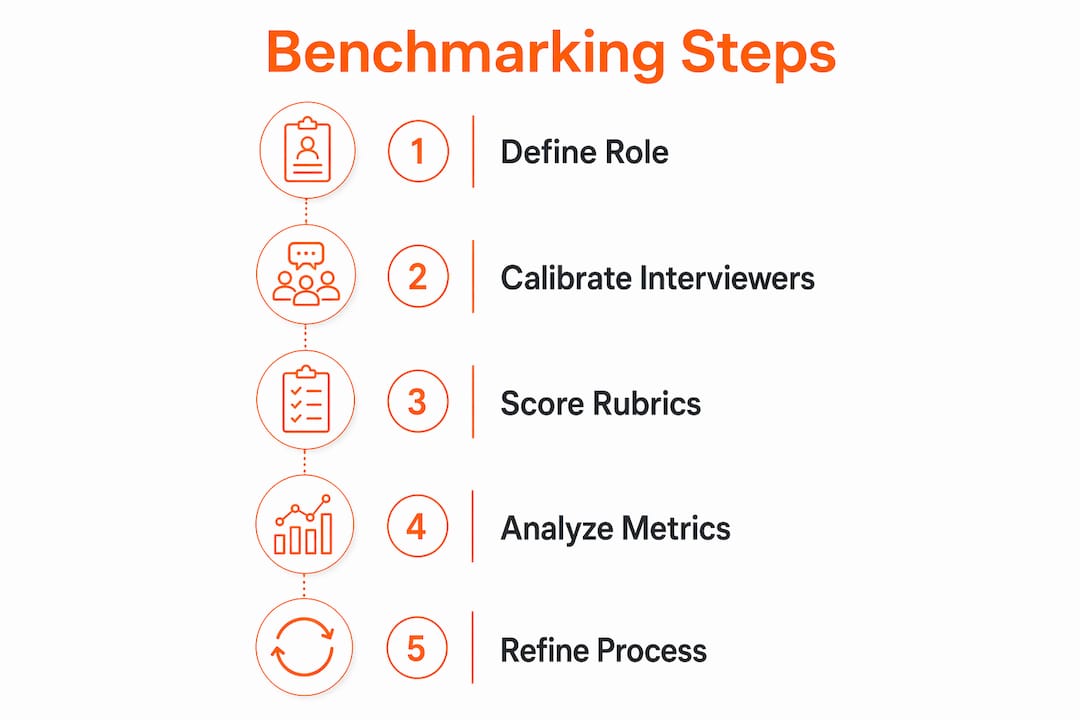
Step 1: Define the benchmark
Start with the job, not the candidate. Map the core responsibilities of the role, then identify the competencies and behaviors that predict success in those responsibilities. Include motivational alignment: does the role require someone who thrives under ambiguity, or someone who executes defined processes? Both are valid profiles, but they are not interchangeable. Use candidate scoring methods that reflect these distinctions from the start.
Step 2: Run calibration sessions
Calibration sessions, rubric-based scoring, and alignment on what “good” looks like are the foundation of consistent benchmarking. Before the first interview, bring the full hiring panel together. Walk through the scorecard. Score a sample candidate profile together. Identify where panelists disagree and resolve those gaps before they contaminate real evaluations.
Step 3: Apply rubric-based scoring
A rubric assigns a numeric value to each level of performance for each competency. For example, a score of 1 means the candidate showed no evidence of the skill; a score of 4 means they demonstrated it clearly with a specific example. Rubrics make scoring defensible and quantitative. They also make it easier to compare two finalists objectively rather than relying on gut feel at the end of a long process.
Step 4: Track and analyze your metrics
Benchmarking metrics like time-to-fill require root cause analysis to identify process bottlenecks. Tracking aggregate numbers alone tells you that something is wrong. Root cause analysis tells you where. If time-to-fill is high, is the bottleneck at the application stage, the interview scheduling stage, or the offer stage? Each bottleneck requires a different fix. Pair your hiring metrics guide with regular review cycles to keep your process improving.
| Evaluation approach | Key characteristic | Best use case |
|---|---|---|
| Rubric-based scoring | Numeric, criteria-anchored | Final candidate comparison |
| Competency interviews | Behavior-focused questions | Mid-funnel assessment |
| Work sample tests | Task-based, role-specific | Skills verification |
| Calibrated panel review | Multi-interviewer alignment | Senior or complex roles |
Pro Tip: Benchmark late in the funnel by applying your deepest evaluation criteria to the final 3–5 candidates. Applying benchmarks too early can screen out qualified candidates who need more context to demonstrate their fit.
Best practices for maximizing benchmarking results
Getting benchmarking right requires more than building a scorecard. The following practices separate teams that see real improvement from those that go through the motions.
-
Compare internal metrics to industry standards. Benchmark your time-to-fill against industry averages to know whether your process is competitive or lagging. Internal data only tells you how you are doing relative to your own history, not relative to the talent market.
-
Hire for culture add, not culture fit. Hiring for culture fit tends to replicate the existing team. Hiring for culture add focuses on specific competencies that complement and strengthen the team. Benchmarking supports this shift by keeping the focus on defined behaviors rather than subjective impressions.
-
Avoid applying benchmarks too early. Introducing benchmarks prematurely may exclude diverse, qualified candidates who do not fit a narrow early-stage profile. Reserve your most detailed benchmark criteria for the final evaluation stage.
-
Run continuous improvement cycles. Benchmarking is not a one-time setup. Review your criteria after every hiring cohort. If your top performers consistently score high on one competency and low on another, update the benchmark to reflect what actually predicts success.
-
Keep human judgment in the process. AI tools surface role-relevant candidate signals based on defined benchmarks, but final decisions require human review. Automated scoring can introduce its own bias if left unchecked. Use data analytics in hiring to inform decisions, not replace them.
-
Align your team on what “good” looks like before every search. Competency definitions drift over time. A quarterly calibration session keeps your panel scoring consistently, especially when new interviewers join the team.
Key Takeaways
Benchmarking in hiring works because it replaces subjective impressions with defined, measurable standards that predict actual job performance and reduce costly mis-hires.
| Point | Details |
|---|---|
| Define competencies before screening | Build your benchmark from job responsibilities, not candidate resumes, to avoid wish-list bias. |
| Calibrate interviewers before each search | Alignment sessions before interviewing reduce scoring inconsistency across the panel. |
| Apply deep benchmarks late in the funnel | Reserve your most detailed criteria for the final 3–5 candidates to avoid excluding qualified applicants. |
| Track metrics with root cause analysis | Aggregate data shows problems; root cause analysis identifies which stage to fix. |
| Combine AI signals with human review | Automated tools surface benchmarked signals, but human judgment prevents automated bias. |
Why benchmarking is the discipline hiring teams keep underestimating
I have watched hiring teams invest heavily in employer branding, job board spend, and recruiter headcount, then lose the gains to inconsistent evaluation at the interview stage. The application volume surge driven by AI tools has made this worse. When every role attracts hundreds of applications, the pressure to move fast overrides the discipline to evaluate well. That is exactly when benchmarking matters most.
The teams I have seen get this right share one habit: they treat the benchmark as a living document, not a checkbox. They review it after every cohort, update it when new top performers reveal unexpected competencies, and use calibration sessions to keep the panel honest. The teams that struggle treat benchmarking as a one-time setup and wonder why their quality of hire does not improve.
The other pattern I have noticed is the false choice between technology and human judgment. AI-powered screening tools are genuinely useful for surfacing skills-based hiring signals at scale. But they amplify whatever criteria you feed them. If your benchmark is weak, the AI finds you more of the wrong candidates faster. The discipline has to come first. The technology accelerates it.
Benchmarking is not a trend. It is the foundation that makes every other hiring improvement compound. Without it, you are optimizing a process that has no defined target.
— Pavel
Testask brings benchmarking into every stage of your hiring process
Consistent candidate evaluation is the hardest part of benchmarking to maintain at scale. Testask is an AI-powered recruitment assessment platform that helps HR teams and hiring managers apply structured evaluation criteria across every stage of the hiring funnel.
With Testask, you can create tailored test tasks matched to your role benchmarks, evaluate candidate submissions with AI-assisted analysis, and collaborate with your panel through a shared review workflow. The result is faster screening, more consistent scoring, and hiring decisions grounded in evidence rather than impressions. HR teams using Testask’s assessment platform report clearer candidate comparisons and stronger confidence at the offer stage. If you are building a benchmarking-driven hiring process, Testask gives your team the structure to make it work consistently.
FAQ
What is the role of benchmarking in hiring?
Benchmarking in hiring creates measurable standards that define what a successful candidate looks like for a specific role. It replaces subjective evaluation with criteria tied directly to job performance, reducing mis-hires and improving retention.
How does benchmarking reduce hiring bias?
Benchmarking shifts evaluation from subjective impressions to defined competencies, which reduces the influence of similarity bias and vague culture fit judgments. Every candidate is assessed against the same criteria, making decisions more defensible and consistent.
When should benchmarks be applied in the hiring funnel?
The most effective approach applies detailed benchmarks to the final 3–5 candidates rather than early in the process. Early application can screen out qualified candidates before they have had a chance to demonstrate their fit.
What metrics should HR teams benchmark?
Time-to-fill and quality of hire are the two most commonly benchmarked hiring metrics. Comparing these against industry standards reveals whether your process is competitive, and root cause analysis identifies which specific stage needs improvement.
How does interviewer training improve benchmarking outcomes?
Interviewer training combined with structured benchmarking reduces mis-hires by 30–40% beyond what benchmarking alone achieves. Calibration sessions before each search keep scoring consistent across the full panel.
Recommended
- Explaining Hiring Metrics: A 2026 Guide for HR Teams | Testask Blog | testask
- Best Hiring Practices 2026: What HR Teams Need to Know | Testask Blog | testask
- Why standardized tests in hiring matter: The HR leader’s guide | Testask Blog | testask
- How to Assess Candidates: A 2026 Hiring Guide | Testask Blog | testask