Test Bank Management for HR Teams: A Compliance-First Guide
Test Bank Management for HR Teams: A Compliance-First Guide

Effective test bank management means centralizing your hiring assessments in one structured repository, mapping every item to a defined competency, enforcing psychometric validation before deployment, automating versioning and audit logs, and keeping subject matter experts (SMEs) in every review loop. HHS guidance under EO 13932 requires agencies to use assessment tools beyond self-report questionnaires and recommends multi-hurdle designs that consider reliability, validity, and applicant reactions. Research published in F1000Research confirms AI deployment strongly predicts recruitment efficiency gains, though bias mitigation requires deliberate design. Platforms like Testask make that combination practical for talent teams of any size.
Quick self-audit checklist:
- Metadata and competency tags on every item
- Rubric and scoring templates attached to each task type
- Item-level reliability checks before live deployment
- Role-based access controls and a full audit trail
- A documented pilot and validation step for new items
- A written retirement policy with archival rules
Key Takeaways
Effective test bank management combines centralized item storage, psychometric validation, SME oversight, and AI-assisted automation to turn your assessment library into a strategic hiring asset.
| Point | Details |
|---|---|
| Centralize with full metadata | Every item needs competency tags, difficulty, discrimination index, version, and SME attribution before going live. |
| Validate before deploying | Pilot new items on 15–30 candidates; require Cronbach’s alpha above 0.70 and review item discrimination. |
| Automate lifecycle controls | Versioning, audit logs, and retirement rules protect legal defensibility and reduce manual overhead. |
| Track outcome metrics | Connect assessment scores to post-hire performance data to confirm and improve predictive validity. |
| Use Testask for AI-enabled management | Testask provides AI-assisted item drafts, SME review workflows, audit logs, and psychometric dashboards in one platform. |
Table of Contents
- What does a well-built hiring test bank actually contain?
- Governance, psychometrics, and U.S. regulatory considerations
- How AI can strengthen your assessment library without losing control
- Item lifecycle: from creation to retirement
- Metrics that tell you when your test bank is working
- A 90-day roadmap for implementing your assessment library
- What I’ve seen go wrong in early test-bank programs
- Testask accelerates your assessment library from pilot to production
- Sources
What does a well-built hiring test bank actually contain?
A hiring-focused assessment question bank is more than a folder of questions. Each item needs content, context, and operational metadata to be reusable, defensible, and measurable.
| Component | What it includes | Why it matters |
|---|---|---|
| Item content | MCQ, coding task, work sample, situational judgment, structured interview prompt | Covers the full range of competency evidence types |
| Metadata and taxonomy | Competency tag, role, difficulty, discrimination index, expected time, language, accessibility flag, author/SME, version | Enables search, reuse, and psychometric tracking |
| Rubrics and scoring artifacts | Behaviorally anchored rating scales (BARS), exemplary answers, scoring keys, automated scoring rules | Increases inter-rater reliability and legal defensibility |
| Operational objects | Test forms, blueprints, pilot batches, candidate reports, audit logs, retirement records | Supports lifecycle governance and compliance documentation |
Structured interviewing research from Google re:Work shows that vetted questions, recorded feedback, standardized rubrics, and interviewer training together increase predictive validity and reduce demographic differences. That four-part model maps directly onto the components above. For concrete competency-based assessment templates, your team can adapt existing frameworks rather than starting from scratch.
Governance, psychometrics, and U.S. regulatory considerations
What EO 13932 and HHS guidance require
HHS guidance specifies multi-hurdle assessment structures, first-hurdle screening tools, second-hurdle structured tasks, and final-hurdle panels, with each stage evaluated for reliability, validity, technology fit, legal context, and face validity. Talent teams must document SME involvement and evaluation responsibilities at every hurdle.

Psychometric basics every HR team needs
Three metrics determine whether an item earns its place in your library:
- Reliability: Internal consistency (Cronbach’s alpha) and inter-rater reliability for scored tasks. An alpha below 0.70 is a flag for revision.
- Validity: Content validity (does the item reflect the job?) and criterion/predictive validity (does the score correlate with on-the-job performance?).
- Item statistics: Difficulty (proportion answering correctly) and discrimination (how well the item separates high from low performers). Items with near-zero discrimination should be retired or rewritten.
Governance artifacts and operational controls
A defensible test bank requires documented job analyses, item review logs, SME sign-off records, bias reviews, and candidate-facing fairness statements. On the operational side, role-based access prevents unauthorized edits, versioning preserves the history of every change, and audit logs create the paper trail regulators and legal teams expect. For U.S. employers, candidate data privacy under applicable state laws adds another layer: define retention periods, limit access to scored outputs, and document your data-handling policy.
Pro Tip: Create a one-page “assessment fact sheet” for each test that records its purpose, intended population, validation evidence, SME contributors, and last review date. Attach it to the item repository record so any auditor or new team member can orient quickly.
For a step-by-step approach to bias-free assessment design, the process starts with job analysis and ends with documented bias review, not the other way around.
How AI can strengthen your assessment library without losing control
AI offers four practical uses in test bank administration: role-specific rubric generation, draft item creation and variant writing, automated competency tagging, and candidate report synthesis. The most advanced application is listwise ranking. Research from arXiv describes an LLM-driven framework that uses listwise tournament methods with Plackett–Luce aggregation to produce interpretable candidate rankings suitable for real hiring committees.
The human-in-the-loop pattern
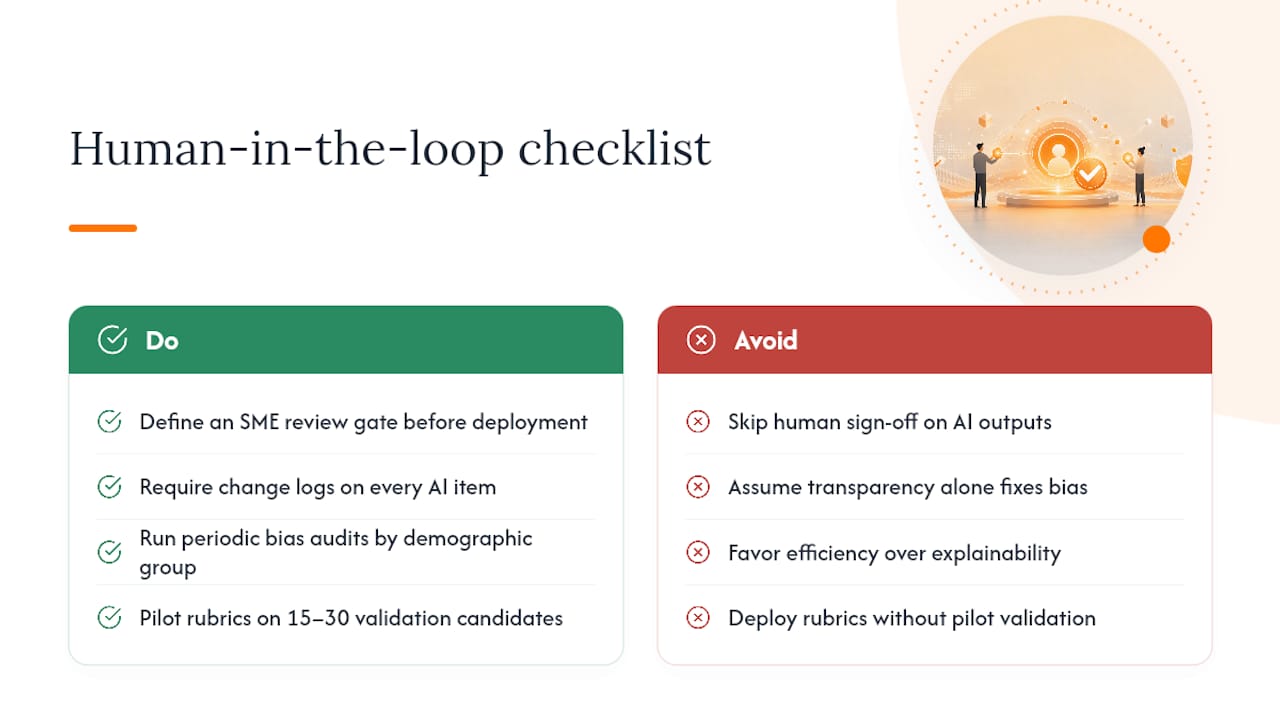
Every AI output needs a defined SME review gate before it enters the live bank. That means change logs on every AI-generated item, confidence indicators on rubric suggestions, and a clear policy on which decisions require human sign-off. The F1000Research survey found that bias mitigation effects from AI were modest and that transparency did not automatically improve without deliberate explainability design. A Springer systematic review reinforces this, flagging persistent ethical and bias-related challenges that require hybrid human-machine models.
Practical mitigations: run periodic bias audits on item-level score distributions by demographic group, set a hybrid decision policy that routes flagged items to a human reviewer, and document model version and prompt history alongside each AI-generated artifact.
Pro Tip: Pilot every AI-generated rubric on a validation cohort of 15–30 candidates before full deployment. Compare inter-rater reliability scores before and after SME tuning to confirm the rubric is doing what you intended.
BCG’s guidance on AI in recruitment recommends a candidate-first mindset: be explicit about where AI is used, maintain clear human oversight policies, and communicate transparently with candidates. That standard applies to your assessment library as much as to your sourcing tools. For teams evaluating AI recruitment software options, auditability and explainability features should rank alongside raw efficiency gains.
Item lifecycle: from creation to retirement
- Define scope. Run a job analysis, draft a test blueprint, and assign SMEs to author items against specific competencies.
- Author items. Use structured templates that capture content, metadata, accessibility flags, and expected time simultaneously.
- Pilot. Deploy to a small validation cohort (15–30 candidates). Calculate difficulty and discrimination for each item. Run rubric calibration with at least two raters.
- Review candidate reactions. Collect brief post-assessment feedback. Items perceived as irrelevant or unfair signal face validity problems worth investigating.
- Deploy. Release versioned forms. Use parallel forms for roles with high assessment volume to reduce exposure risk.
- Monitor. Run quarterly psychometric audits. Review usage logs and performance-by-cohort data. Flag items whose discrimination index drops below threshold.
- Retire. Archive retired items with a documented rationale. Set a revalidation rule: any retired item reactivated after 18 months requires a fresh pilot before going live.
Metrics that tell you when your test bank is working
Operational metrics track the health of the library itself. Psychometric metrics confirm each item is doing its job. Outcome metrics connect the assessment to actual hiring results.
| Metric | What it signals | Action threshold |
|---|---|---|
| Item difficulty | Proportion of candidates answering correctly | Below 0.70 alpha: revise or retire |
| Discrimination index | How well the item separates high from low performers | Below 0.20: flag for SME review |
| Cronbach’s alpha | Internal consistency of a test form | Below 0.70: revise item set |
| Inter-rater reliability | Agreement between scorers on open-ended tasks | Below 0.80 weighted kappa: recalibrate rubric |
| Predictive validity | Correlation between assessment score and on-the-job performance | Track trend; declining correlation triggers item review |
| Adverse impact ratio | Score distribution differences across demographic groups | Below 0.80 (four-fifths rule): investigate and document |
SHRM’s interviewing toolkit recommends tracking time-to-fill, quality-of-hire, and candidate experience alongside psychometric data. Combining those KPIs gives you a complete picture of whether your assessment library is accelerating good hires or creating friction. For guidance on building predictive hiring systems, linking assessment scores to post-hire performance data is the step most teams delay longest and regret most.
A 90-day roadmap for implementing your assessment library
Roles to assign before day one:
- Talent team lead (owns the program)
- SMEs (2–3 per role family, item authors and reviewers)
- Psychometric reviewer (internal analyst or external consultant)
- IT/security owner (access controls, data retention)
- Legal/compliance contact (EO 13932 alignment, state privacy rules)
- Platform administrator (repository setup, user permissions)
90-day pilot steps:
- Select 1–2 roles with high hiring volume and clear competency frameworks.
- Author 30–50 items using structured templates with full metadata.
- Conduct SME review and bias check before any piloting.
- Run a pilot with a validation cohort; collect psychometric data and candidate reactions.
- Iterate on items with low discrimination or poor face validity scores.
- Deploy versioned forms with audit logging active from day one.
- Schedule a 30-day post-launch psychometric review.
Minimal tech requirements:
- Item repository with metadata and tagging
- Versioning and audit logs
- Role-based access controls
- Analytics dashboard for psychometric and hiring metrics
- Pilot-sampling and cohort-tracking tools
- Human-review workflows with SME sign-off steps
- Model explainability features for any AI-generated content
Testask covers all of these: AI-assisted item and rubric drafts, collaborative SME review flows, versioned repositories, audit logs, and analytics dashboards. For teams ready to move from spreadsheets to a structured platform, the AI-powered recruitment pilot checklist is a practical starting point.
What I’ve seen go wrong in early test-bank programs
The most common early failure is loose metadata. Teams author solid items but skip the tagging step under deadline pressure. Six months later, nobody can filter by competency or difficulty, and the library is effectively unsearchable. The fix is simple: make metadata a required field in your authoring template, not an optional add-on.
SME bottlenecks are the second recurring problem. When review depends on one or two overloaded subject matter experts, items sit in draft for weeks. Monthly calibration sessions with a rotating SME panel distribute the load and keep review cycles under two weeks.
The third pitfall is treating retired items as waste. They are not. Maintain a small archived insights file that records why each item failed, what the item statistics showed, and what the replacement item was designed to fix. That file becomes your fastest path to better items in the next authoring cycle.
Pro Tip: Treat retired items as a learning asset. Document the failure reason, the item statistics at retirement, and the design intent of the replacement. Teams that do this consistently write better first drafts within two to three authoring cycles.
Testask accelerates your assessment library from pilot to production
Hiring teams that follow this guide still need a platform that keeps up. Testask generates AI-assisted item and rubric drafts in minutes, routes them through collaborative SME review flows, and stores every version with a full audit log. Your psychometric dashboard tracks difficulty, discrimination, and hiring outcomes in one place, so you always know which items to keep and which to retire.
The AI-powered recruitment solutions guide walks through the exact pilot setup. When you’re ready to move your assessment library onto a platform built for compliance-aware, AI-enabled hiring, start with Testask and run your first pilot in under two weeks.
Sources
For compliance and U.S. regulatory alignment, start with the HHS Hiring Assessment Strategies guidance, which covers EO 13932 requirements, multi-hurdle design, and face validity standards.
For AI methods in assessment, the arXiv paper on LLM-driven candidate assessment provides the most detailed treatment of listwise ranking, rubric generation, and auditability requirements currently available.
For empirical evidence on AI’s effects on recruitment outcomes, the F1000Research survey and the Springer systematic review together cover efficiency gains, bias risks, and the case for hybrid human-machine oversight.
For structured interviewing and rubric design, Google re:Work’s guide and SHRM’s interviewing toolkit are the most practical references for U.S. talent teams.
For responsible AI adoption and candidate transparency, BCG’s recruitment AI guidance sets the standard for candidate-first policy design.
- Hhs
- Agentic AI for Human Resources: LLM-Driven Candidate Assessment (arXiv)
- Transformations in Talent Acquisition: Measuring AI’s effects on recruitment outcomes | F1000Research
- Systematic review of AI in recruitment and personnel selection (Springer)
- A guide to structured interviewing for better hiring practices - Google re:Work
- AI changing recruitment (BCG)
Recommended
- Why standardized tests in hiring matter: The HR leader’s guide | Testask Blog | testask
- Defining Test Task Platforms: A Practical HR Guide | Testask Blog | testask
- Pre-employment tests: A step-by-step hiring guide | Testask Blog | testask
- The Technical Assessment Process: A 2026 HR Guide | Testask Blog | testask