The Technical Assessment Process: A 2026 HR Guide
The Technical Assessment Process: A 2026 HR Guide

A technical assessment process is a structured, systematic method for evaluating candidates’ job-specific skills before making a hiring decision. Done right, it replaces gut-feel hiring with objective data: defined evaluation criteria, scored submissions, and documented results that hold up to scrutiny. The core components include role-aligned task design, clear scoring rubrics, defined assessor roles, and a feedback loop that connects results to the final hiring decision. AI-powered platforms like Testask take this further by generating tailored test tasks, automating initial scoring, and enabling collaborative review across hiring teams.
Here is what a complete technical assessment process covers:
- Objective definition: Clarifying which skills the role actually requires
- Assessment design: Selecting formats (coding tests, simulations, practical tasks) matched to those skills
- Role assignment: Designating who prepares, administers, and evaluates
- Candidate communication: Informing candidates about purpose, format, and timeline
- Evaluation and scoring: Applying rubrics and objective metrics consistently
- Result integration: Connecting assessment scores to the broader hiring decision
- Feedback and improvement: Documenting outcomes and refining the process over time
Table of Contents
- How the technical assessment process unfolds stage by stage
- Who does what: roles and responsibilities in the process
- What types of technical assessments actually measure skills
- Key activities and outputs from start to finish
- Best practices for preparing your organization and communicating with candidates
- Legal and ethical considerations in technical assessments
- Testask gives your hiring team a faster, fairer assessment process
- Key Takeaways
How the technical assessment process unfolds stage by stage
Most technical evaluations run through several stages, and the full cycle typically takes 2–4 weeks from initiation to final recommendation. That window can stretch if vendor documentation is incomplete or assessors are unavailable, so building buffer time into your plan is worth doing from the start.
Stage breakdown:
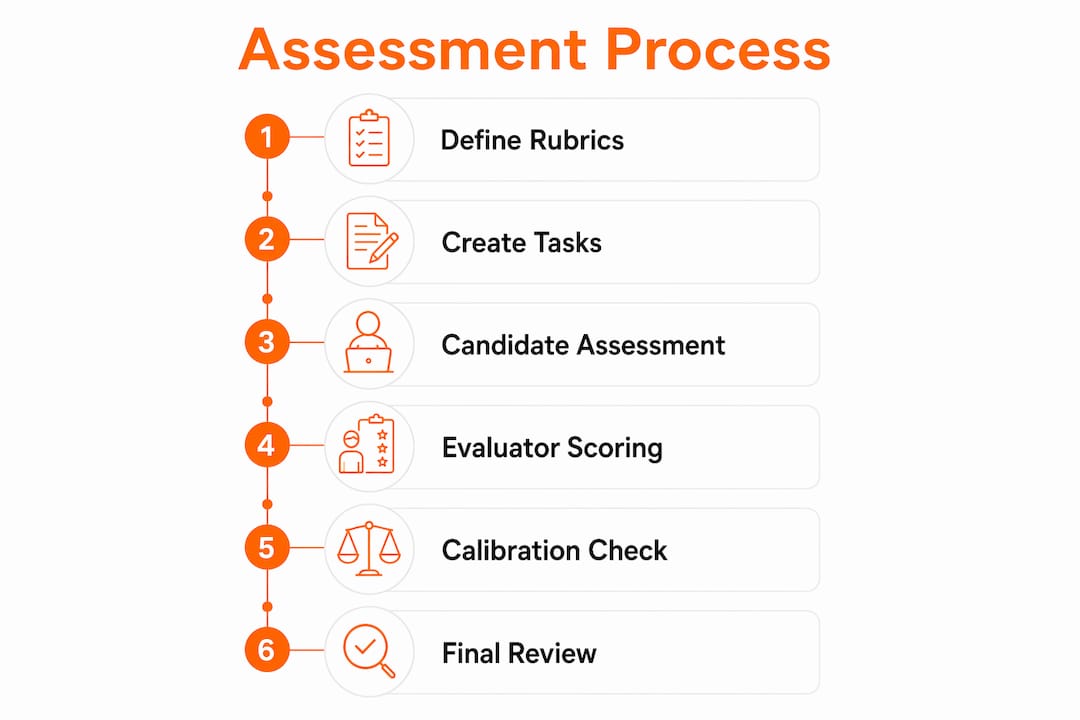
- Preparation: Define objectives, select assessment tools, assign roles, and draft candidate-facing communication. This stage sets the quality ceiling for everything that follows.
- Candidate communication: Notify candidates about the assessment’s purpose, format, expected time commitment, and how results will be used. Early, transparent communication reduces drop-off and improves response quality.
- Assessment administration: Candidates complete their tasks. Individual assessments typically run 45–90 minutes depending on role complexity. Coding tests and simulations sit at the shorter end; multi-part practical exercises can run longer.
- Evaluation: Assessors score submissions against pre-defined rubrics. Consensus meetings resolve disagreements and produce a unified rating per candidate.
- Feedback and decision: Results feed into the hiring decision. Candidates receive feedback, and the team documents lessons learned for future cycles.
Delays most often occur during evaluation when assessors are pulled into other priorities. Scheduling consensus review meetings in advance, before assessments go out, prevents the most common bottleneck.
Who does what: roles and responsibilities in the process
Defining clear roles before the process starts is one of the highest-leverage decisions you can make. When responsibilities are ambiguous, assessments stall, scoring becomes inconsistent, and candidates wait too long for feedback.
Key roles and what they own:
- HR professionals: Own the overall process design, candidate communication, legal compliance, and result documentation. They serve as the connective tissue between hiring managers and candidates.
- Hiring managers: Define the technical skills the role requires and validate that assessment tasks reflect real job demands. They typically serve as primary evaluators for submission scoring.
- Program managers: Coordinate scheduling, track progress against the timeline, and manage vendor or platform relationships. In larger organizations, this role prevents the process from losing momentum.
- Systems engineers / technical leads: Design or review the technical tasks themselves, ensuring they test relevant skills at the right difficulty level. Their input is what separates a meaningful assessment from a generic quiz.
- External partners or assessment vendors: Provide platforms, pre-built test libraries, or managed scoring services. Platforms like Testask fall into this category, offering AI-assisted task generation and collaborative evaluation tools.
Collaboration between HR and technical leads is where most organizations underinvest. HR brings process discipline; technical leads bring domain accuracy. Neither alone produces a reliable assessment.
What types of technical assessments actually measure skills

Assessment formats vary widely, and the right choice depends on the role, the seniority level, and what you actually need to know about a candidate. No single format covers everything.
Common assessment types:
- Coding tests: Timed exercises that evaluate syntax knowledge, problem-solving logic, and code quality. Best for software engineering roles where output is directly measurable.
- Practical task exercises: Candidates complete a realistic work sample, such as debugging a codebase, writing a technical specification, or configuring a system. These reflect actual job demands more closely than abstract quizzes.
- Problem-solving scenarios: Structured case studies that assess analytical thinking and decision-making under constraints. Useful for systems engineers, architects, and technical program managers.
- Simulations: Replicate a real work environment, such as a live coding environment or a network configuration tool. High fidelity, but more resource-intensive to build and score.
- Knowledge quizzes: Multiple-choice or short-answer questions that screen for baseline proficiency. Efficient for high-volume hiring but limited in depth.
Evaluation methods matter as much as format. Scoring rubrics define what “good” looks like at each performance level, making evaluator decisions defensible and consistent. Behaviorally anchored rating scales (BARS) add narrative descriptions to each score point, reducing the subjectivity that creeps in when multiple assessors review the same submission.
AI-powered platforms change the evaluation equation. Testask generates role-specific tasks tailored to the skills you define, then applies AI-assisted analysis to candidate submissions, flagging strengths, gaps, and areas that warrant closer human review. The result is faster screening without sacrificing scoring depth. Teams using AI candidate screening tools consistently report shorter time-to-decision and more consistent inter-rater agreement.
Key activities and outputs from start to finish
The technical review process produces specific deliverables at each stage. Knowing what you should have in hand at each point tells you whether the process is on track.
Core activities:
- Defining the assessment scope and skill targets
- Selecting or building assessment tasks aligned to those targets
- Preparing candidate-facing instructions and logistics
- Administering assessments and collecting submissions
- Scoring submissions against rubrics and compiling individual results
- Conducting consensus review meetings to resolve scoring differences
- Generating assessment reports and hiring recommendations
Key outputs:
- Assessment report: A documented summary of each candidate’s performance across all scored dimensions, with supporting evidence from their submission.
- Candidate scores: Quantified ratings per skill area, enabling direct comparison across candidates.
- Hiring recommendation: A clear, evidence-based recommendation that connects assessment results to the role requirements.
- Process documentation: Notes on what worked, what caused delays, and what to adjust in the next cycle.
Accuracy and fairness in these outputs depend on one thing: whether the rubrics were defined before scoring began. Post-hoc criteria adjustment is one of the most common ways bias enters the process, and it is also one of the easiest to prevent.
Pro Tip: Before any candidate submits their assessment, run a calibration exercise where two assessors independently score a sample submission using the rubric. Disagreements reveal rubric gaps before they affect real candidates.
Best practices for preparing your organization and communicating with candidates
Organizational readiness is where many technical assessments quietly fail. Candidates complete tasks, scores come in, and then nothing happens because the hiring team was not aligned on how to use the results. Preparation on both sides, internal and candidate-facing, determines whether the process delivers value.
Transparency about assessment purpose is the single most effective way to reduce candidate resistance and improve the quality of submissions. When candidates understand what is being measured and why, they engage more honestly and perform closer to their actual ability level.
Best practices for organizational preparation:
- Run an internal awareness session before launching the assessment, covering what the process measures, how scores will be weighted, and who makes the final call.
- Share industry benchmarks with your hiring team so evaluators understand what “above average” actually looks like for the role.
- Align hiring managers and HR on how assessment results will be weighted relative to interviews and references.
- Document the process in writing before it starts, not after, so every stakeholder is working from the same playbook.
Best practices for candidate communication:
- Notify candidates about the assessment at least 48–72 hours in advance, including the format, expected duration, and any tools or environments they will need.
- Explain how results will be used and who will review them. Transparent candidate communication about scoring and next steps increases completion rates and reduces candidate anxiety.
- Provide a clear point of contact for logistical questions.
- Send results or feedback promptly after evaluation, regardless of the outcome.
Internal culture resistance is a real obstacle, particularly in organizations where employees fear that assessment results will be used punitively. Hosting awareness sessions that explain the purpose, the benchmarks being used, and the benefits of the process for the organization reduces that fear and produces more honest, useful data.
Pro Tip: When rolling out a new assessment process internally, pilot it with a small group first and share the results openly with the broader team. Seeing real data from a real cycle builds more trust than any policy document.
Legal and ethical considerations in technical assessments
Technical assessments carry legal exposure that HR professionals need to manage proactively. In the United States, assessments used in hiring decisions are subject to federal anti-discrimination law, including Title VII of the Civil Rights Act, the Americans with Disabilities Act (ADA), and the Age Discrimination in Employment Act (ADEA). An assessment that produces disparate impact across protected groups can create legal liability even when no discriminatory intent exists.
Key legal and ethical obligations:
- Job-relatedness: Every assessment task must be demonstrably linked to the skills required for the role. Assessments that test knowledge unrelated to job performance are legally vulnerable and practically useless.
- Consistency: Apply the same assessment to every candidate being considered for the same role. Varying the format or difficulty level by candidate introduces both bias and legal risk.
- Reasonable accommodation: Under the ADA, candidates with disabilities are entitled to reasonable accommodations during the assessment. This might mean extended time, alternative formats, or assistive technology access.
- Data privacy: Candidate submissions and scores are personal data. Store them securely, limit access to those with a legitimate need, and retain them only as long as legally required or operationally necessary.
- Adverse impact monitoring: Periodically analyze your assessment results by demographic group. If a protected group consistently scores lower, investigate whether the assessment itself is the cause before assuming the gap reflects actual skill differences.
- Documented rationale: Keep records of why specific assessment criteria were chosen, how rubrics were developed, and how scores were used in hiring decisions. Documentation is your primary defense if a hiring decision is ever challenged.
Ethical practice goes beyond legal compliance. Candidates invest real time in technical assessments, often hours. Providing meaningful feedback, even to those who are not selected, respects that investment and protects your employer brand. Organizations that handle candidate feedback well consistently see higher offer acceptance rates and stronger referral pipelines.
Testask gives your hiring team a faster, fairer assessment process
Designing and running a rigorous technical assessment process from scratch takes significant time, especially when your team is already managing open roles, interviews, and onboarding. Testask is built for exactly this situation: an AI-powered platform that lets HR teams and hiring managers generate tailored technical tasks, evaluate submissions collaboratively, and make faster, better-supported hiring decisions without rebuilding the process from zero each time.
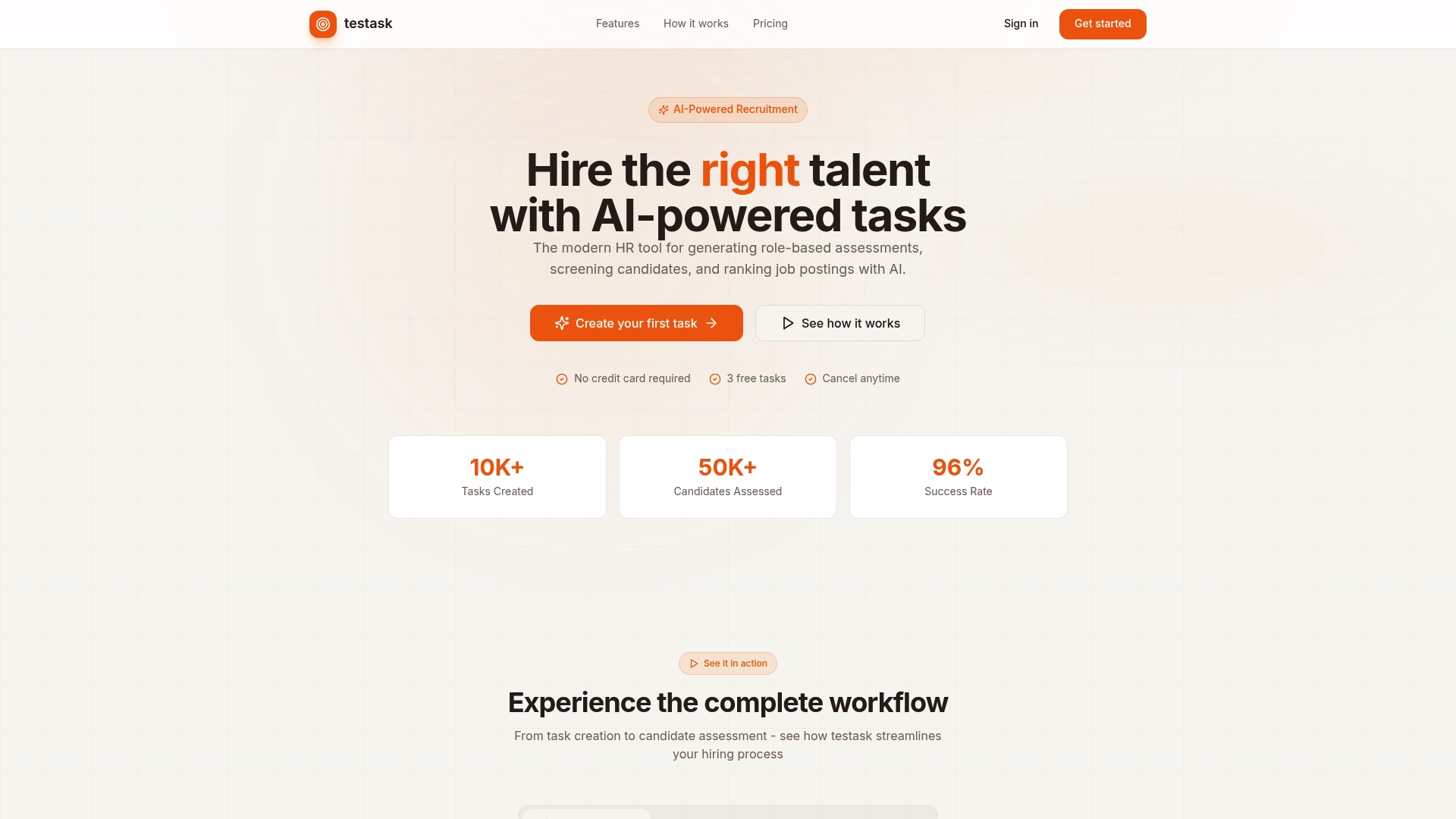
Where a manual process requires assembling tasks, coordinating evaluators, and compiling scores by hand, Testask handles the heavy lifting. You define the role and the skills you need to assess; the platform generates relevant tasks, applies AI-assisted analysis to submissions, and surfaces the insights your team needs to compare candidates confidently. Collaboration tools let multiple reviewers score and comment on the same submission, so consensus meetings are shorter and decisions are better documented.
Testask fits hiring teams that need to move quickly without cutting corners on evaluation quality. Whether you are screening five candidates or fifty, the process stays consistent, defensible, and efficient. Start your first assessment and see how much faster your team can reach a confident hiring decision.
Key Takeaways
A well-executed technical assessment process produces objective, defensible hiring decisions by combining clear evaluation criteria, defined roles, and consistent scoring methods.
| Point | Details |
|---|---|
| Timeline planning | Technical evaluations typically take 2–4 weeks after initiation; build buffer time to account for documentation delays. |
| Role clarity | Defining HR, hiring manager, and technical lead responsibilities before launch prevents scoring inconsistencies and process delays. |
| Assessment formats | Coding tests, practical tasks, simulations, and problem-solving scenarios each measure different skill dimensions; match format to role. |
| Legal compliance | Assessments must be job-related, consistently applied, and monitored for adverse impact under Title VII, ADA, and ADEA. |
| Testask | Testask generates tailored technical tasks and applies AI-assisted analysis to candidate submissions, enabling faster and more consistent evaluation. |