Defining Test Task Platforms: A Practical HR Guide
Defining Test Task Platforms: A Practical HR Guide

A test-task platform is a purpose-built assessment ecosystem that helps HR teams standardize candidate evaluation, with Testask as a leading example, while supporting compliance with EEOC and ADA expectations. If your team is screening more than a handful of candidates per role, a dedicated platform will outperform spreadsheets and email threads on every dimension that matters: speed, consistency, and defensible scoring. The bottom line: teams that adopt structured assessment platforms reduce subjective variance, accelerate screening, and produce hiring decisions that hold up to scrutiny.
- Use a platform when: volume exceeds a few candidates per role, multiple reviewers are involved, or compliance documentation is required.
- Stick with simpler methods when: you are filling a single role with a small, known candidate pool and no structured review is needed.
Table of Contents
- What does a test-task platform actually do?
- What core features should HR teams expect?
- What business outcomes can HR leaders expect?
- How do you choose the right test-task platform?
- How should you pilot and roll out test tasks?
- Which KPIs prove that your test tasks are working?
- Key Takeaways
- Why tailored tasks and collaboration define the category
- Testask gives your team the assessment infrastructure to hire with confidence
- Useful sources
What does a test-task platform actually do?
An assessment platform is a digital tool that creates, administers, and manages assessments to evaluate candidates’ skills, then provides analytics to support hiring decisions. Think of it as an end-to-end workflow: from authoring a task to collecting submissions to scoring and reporting, all in one place.
Core capabilities you should expect:
- Task authoring with templates and custom prompts
- Candidate invitation, deadline management, and submission collection
- Automated and rubric-based manual scoring
- Multi-stakeholder collaboration and commentary
- Analytics and reporting dashboards
- ATS and API integrations
Common task types run on these platforms include coding exercises, written case studies, work-sample simulations, role-specific deliverables (a sample sales email, a financial model, a design brief), and structured writing prompts.
The choice between custom task authoring and off-the-shelf validated assessments depends on what you are measuring. Custom, job-relevant tasks tend to predict on-the-job performance better than generic tests, especially for specialized roles. Off-the-shelf assessments work well for baseline cognitive or personality screening early in the funnel, before candidates reach a role-specific task.
What core features should HR teams expect?
Whether a platform is a true end-to-end system or just a question host comes down to its feature set. Here is a checklist to screen vendors quickly.
Must-have features:
- Task authoring and templates: Build tasks from scratch or adapt templates; support for text, file uploads, and code environments.
- Candidate experience controls: Configurable timers, distraction-free environments, and mobile-friendly submission.
- Automated scoring: Objective items scored instantly; AI-assisted scoring suggestions for open-ended responses.
- Rubric-based review: Structured scoring criteria that every reviewer applies consistently.
- Multi-stakeholder collaboration: Multiple reviewers can score, comment, and compare notes in a single workspace, which improves decision quality over isolated impressions.
- ATS and API integration: Native connectors or open APIs to sync candidate data without manual entry.
- Security and accessibility: Role-based access, data encryption, and accommodation support for candidates with disabilities.
AI-assisted features worth prioritizing include AI-generated task drafts, auto-scoring suggestions on written responses, and reviewer assistance that flags inconsistent scoring patterns. Platforms like Testask embed these capabilities directly into the review workflow, so AI-driven screening accelerates triage without removing human judgment from the final call.
Pro Tip: When hiring for a specialized role, prioritize a platform’s custom-task creation tools over the size of its pre-built test library. A large library of generic tests rarely matches the specificity of a well-crafted, role-mirroring task.

What business outcomes can HR leaders expect?
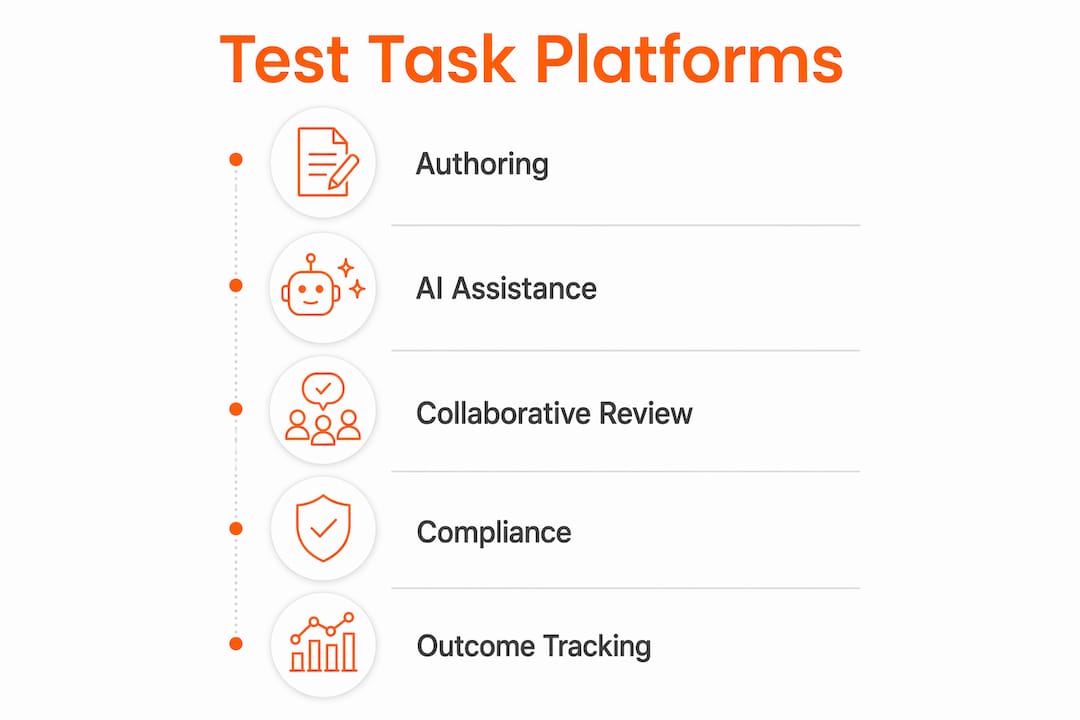
The primary value of adopting a structured assessment platform is standardization: every candidate faces the same task, the same environment, and the same scoring criteria. Standardized delivery and scoring reduce subjective variance across evaluations, which matters both for fairness and for legal defensibility under EEOC guidelines.
Key outcomes linked to platform capabilities:
- Reduced time-to-hire: Automated scoring and parallel reviewer workflows cut days off the screening cycle.
- Higher reviewer agreement: Shared rubrics and calibration sessions produce more consistent scores across hiring teams.
- Consistent skill validation: Every candidate’s competency is measured against the same standard, regardless of who reviews the submission.
- Auditability: A complete record of scores, comments, and timestamps supports compliance reviews and stakeholder reporting.
Illustrative benchmark: Teams using structured assessment platforms with collaborative review workflows often report reductions in screening time per hire and improved alignment among reviewers, compared to unstructured resume-and-phone-screen approaches. Treat these as directional targets, not guaranteed results, and measure your own baseline before and after rollout.
Collaborative review is also a trust signal for legal and compliance teams. When every scoring decision is documented and tied to a rubric, HR can demonstrate that candidate selection was based on demonstrated skill, not subjective impression. For more on how standardized platforms enforce fairness, the Testask blog covers this in depth.
How do you choose the right test-task platform?
Start with one principle: prioritize workflow fit and integration over marketing claims about test libraries or AI features. A platform that does not connect to your ATS or cannot support reviewer calibration will create more friction than it removes.
Questions to ask every vendor:
- Does the platform offer a native ATS connector or an open API? Integration with existing ATS systems is the most common adoption hurdle.
- How is scoring calculated, and can reviewers see the scoring logic?
- Does the platform support calibration workflows, where reviewers align on scoring standards before evaluating candidates?
- How much can tasks be customized, including file types, environments, and time limits?
- What security certifications does the platform hold, and how does it handle candidate data under applicable privacy laws?
- What are the SLAs for support, and is there onboarding assistance?
- Who owns the candidate data, and what is the retention and deletion policy?
Pricing models you will encounter: freemium (limited tasks or seats at no cost, paid tiers for volume), per-assessment (pay per candidate submission), per-seat (monthly or annual fee per recruiter), and enterprise subscription (custom pricing for large teams with advanced integrations). Per-assessment pricing scales predictably for low-volume hiring; per-seat models favor teams with consistent, high-volume pipelines.
Red flags to watch for:
- Opaque scoring with no visible rubric or audit trail
- No API or CSV export, which locks your data inside the vendor’s system
- Single-reviewer workflows with no collaboration or calibration features
- No accommodation options for candidates with disabilities, which creates ADA exposure
For a broader view of tools that accelerate technical hiring, industry analysts have documented how integration and customization consistently rank as the top differentiators.
How should you pilot and roll out test tasks?
Pilot first, then scale with iterative calibration. A pilot period of several weeks on one or two roles gives you real data on task quality, reviewer agreement, and candidate experience before you commit to a full rollout.
Pilot steps:
- Select one or two roles with enough candidate volume to generate meaningful data.
- Craft one representative task per role, mirroring actual work the hire will perform.
- Run the task with a small applicant batch sufficient for initial calibration.
- Collect scorer feedback on rubric clarity and task difficulty.
- Measure initial KPIs: time-to-complete, pass rate, and reviewer agreement score.
Rollout checklist:
- Complete admin setup: configure integrations, user roles, and notification workflows.
- Train all stakeholders, including hiring managers who will review submissions.
- Run accessibility checks: confirm the platform supports extended time, screen readers, and other accommodations required under ADA.
- Hold a reviewer calibration session before the first live cohort.
Pro Tip: Run blind scoring during calibration, where reviewers score the same sample submission without seeing each other’s ratings first. Compare scores afterward to identify rubric gaps. This step catches many inter-rater reliability problems before they affect real candidates.
Understanding recruiter and HR role boundaries during rollout also helps clarify who owns task authoring versus who owns final scoring decisions.
Which KPIs prove that your test tasks are working?
The core success metric is predictive validity: do candidates who score well on your tasks actually perform well on the job? Operational KPIs support that goal by showing whether the platform is running efficiently.
| Metric | What it measures |
|---|---|
| Time-to-hire | The elapsed time from task send to offer; tracks screening efficiency |
| Interview-to-offer ratio | The proportion of interviewed candidates receiving offers; signals task filter accuracy |
| Pass rate by cohort | The share of candidates meeting the score threshold; flags task difficulty calibration |
| Reviewer agreement score | Level of agreement between independent reviewer scores; measures rubric quality |
| Candidate NPS | Candidate satisfaction with the assessment experience |
| Downstream performance correlation | Comparison of task scores to post-hire performance ratings; the core validity check |
Validation checklist:
- After 60–90 days, compare task scores for hired candidates against their probation or performance review outcomes.
- A sample of 20–30 hires is enough for an initial internal validity check.
- If high scorers consistently outperform low scorers, your task has predictive validity. If not, revisit the rubric or task design.
Show hiring managers relevant performance and ratio data. Show recruiters the pass rate, time-to-complete, and candidate NPS. Keeping dashboards audience-specific prevents data overload and focuses attention on the metrics each stakeholder can actually act on.
Key Takeaways
A test-task platform is only as effective as the custom tasks, calibrated rubrics, and integrated workflows you build on top of it.
| Point | Details |
|---|---|
| Platform definition | A test-task platform manages the full assessment cycle: authoring, delivery, scoring, collaboration, and analytics. |
| Top selection priority | Prioritize ATS integration and custom-task authoring over pre-built test library size. |
| Pilot-first rule | Run a 30–60 day pilot on 1–2 roles before scaling to validate task quality and reviewer agreement. |
| Primary KPIs | Track time-to-hire, reviewer agreement, pass rate, and downstream performance correlation. |
| Testask | Testask covers the full workflow with AI-assisted scoring, collaborative review, and ATS integrations for structured hiring. |
Why tailored tasks and collaboration define the category
The platforms that actually move hiring outcomes are not the ones with the largest test libraries. They are the ones that let your team build tasks that mirror real work, score them consistently across multiple reviewers, and connect the results to your existing ATS without manual data entry. Testask was built around exactly that premise. The AI assistance is not a gimmick; it handles the time-consuming parts of task generation and initial scoring so your team can focus on the judgment calls that actually require human expertise. Compliance matters too: when every score is tied to a rubric and every reviewer action is logged, you have the audit trail that EEOC and ADA documentation requires. The teams that get the most from these platforms are the ones that invest in calibration upfront, treat the pilot as a learning exercise, and measure predictive validity after 90 days. That discipline, not the platform itself, is what produces defensible, accurate hiring decisions.
Testask gives your team the assessment infrastructure to hire with confidence
Faster screening without sacrificing accuracy is the concrete payoff Testask delivers. Your team gets AI-assisted task generation, structured rubric scoring, and multi-reviewer collaboration in a single workspace, with direct ATS integrations that eliminate manual data syncing. Every candidate submission is tracked, every score is documented, and every reviewer action is logged for compliance purposes.
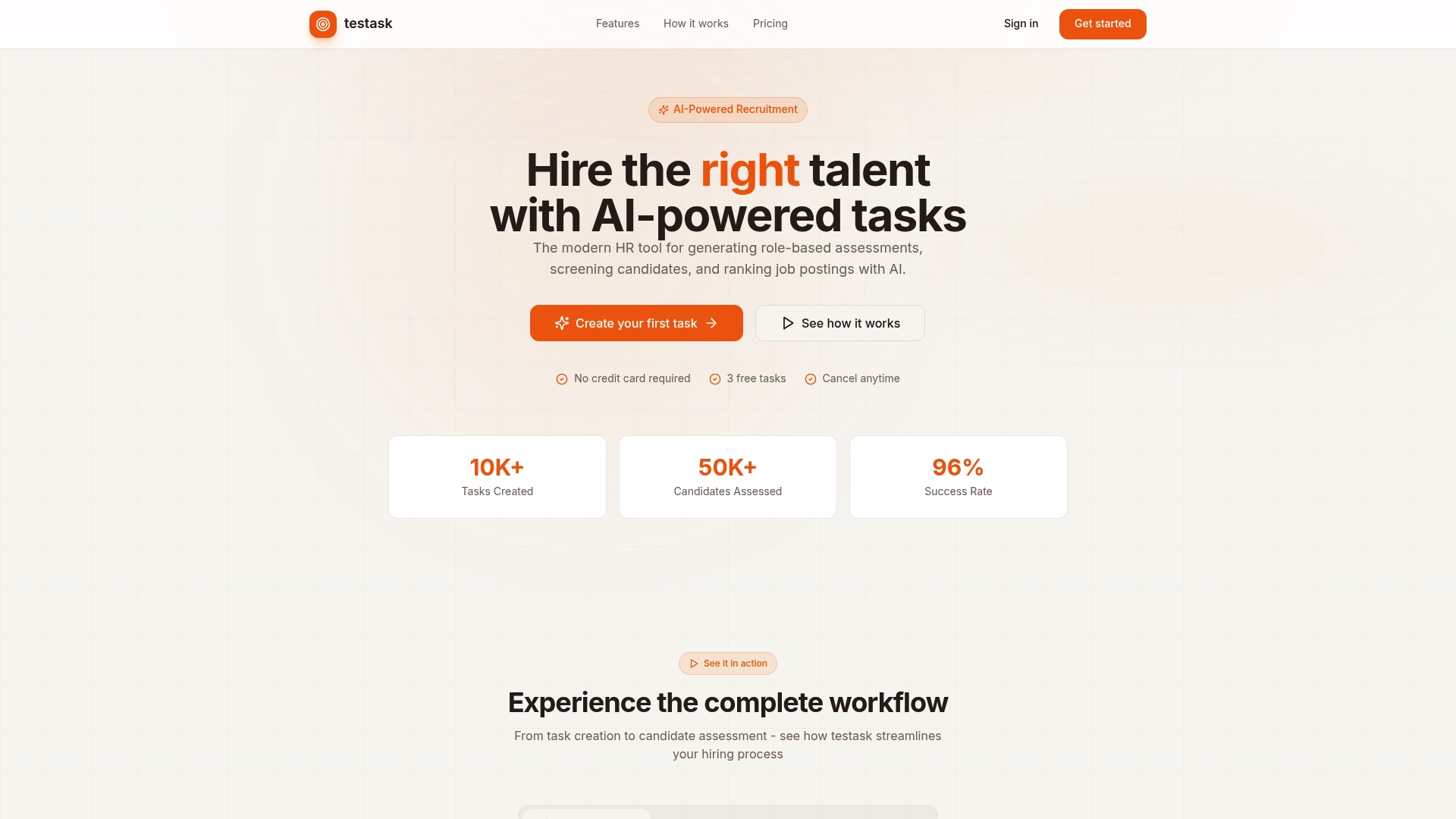
Testask runs on a subscription model with a free tier for low-volume teams and paid plans for organizations that need advanced collaboration and analytics. Your candidate data stays yours: Testask’s privacy controls cover data ownership, retention settings, and deletion on request.
Start your free trial at Testask and run your first tailored assessment in under an hour.
Useful sources
- Assessment Platform — Definition, Overview & FAQ | Recruiteze — Covers the core definition, feature expectations, and standardization principles for HR assessment platforms.
- HR Assessment Platforms: What HR Teams Need to Know | Testask Blog — Explains how structured platforms enforce fairness and consistency in recruiting workflows.
- AI Recruitment: Faster, Smarter Hiring for HR Leaders | Testask Blog — Details how AI-driven screening accelerates triage and improves candidate quality.
- Employment Assessment Best Practices | Testask Blog — Practical templates and best practices HR teams can adapt for pilot and rollout phases.
- U.S. Equal Employment Opportunity Commission (EEOC) — Primary source for employment testing compliance guidance and anti-discrimination requirements.
- ADA National Network — Authoritative resource on Americans with Disabilities Act requirements relevant to candidate accommodations in assessment processes.