Skills Assessment Strategies for HR Teams in 2026
Skills Assessment Strategies for HR Teams in 2026

Skills assessment strategies are structured, multi-method approaches to evaluating employee or candidate abilities against defined role competencies using validated, evidence-based methods. The industry term for this practice is “competency evaluation,” and the most effective programs combine work samples, manager assessments, and calibrated proficiency scales to produce reliable hiring and development data. Assessment should shift focus through the employee lifecycle, from “can they do the job?” at hiring to identifying and closing gaps during onboarding and development. Getting that shift right separates organizations that hire well from those that hire repeatedly.
1. What are the top skills assessment strategies?
The strongest competency evaluation programs use at least three distinct methods. No single method captures the full picture of a candidate’s or employee’s abilities.
- Work sample assessments. Work samples directly test real job tasks and are the most reliable predictor of job performance. A copywriter produces a sample article. A data analyst cleans a messy dataset. The output is observable and role-specific.
- Structured technical interviews. These use a fixed set of questions tied to specific competencies, scored against a rubric. Every candidate answers the same questions, which makes comparison fair and defensible.
- Manager evaluations. Managers observe performance over time and rate it against behavioral anchors. This method captures context that a one-time test cannot.
- Validated self-assessments. Self-assessments are scalable but unreliable alone. They require validation through manager evaluations or work samples because individuals tend to overestimate their skills.
Combining these methods yields better accuracy than any single approach. Multi-source data improves accuracy by revealing blind spots and hidden capabilities that a single rater or test would miss.
Pro Tip: Run a 30-minute work sample during the hiring process before scheduling a technical interview. You will filter out mismatches faster and focus interview time on candidates who have already demonstrated baseline ability.

2. How to calibrate proficiency scales for consistent evaluations
Calibration is the process of aligning raters on what each proficiency level actually looks like in practice. Without it, a “4 out of 5” from one manager means something completely different from a “4” given by another.
Calibration of proficiency scales is critical to ensure consistent interpretations of competency levels across raters. Using behavioral descriptors for each proficiency level reduces subjectivity and prevents incorrect gap analysis. A behavioral anchor for “advanced communication” might read: “Presents complex data to non-technical stakeholders without prompting and adjusts delivery based on audience reaction.” That specificity removes guesswork.
Common calibration failures include:
- Undefined scale labels. Terms like “meets expectations” or “exceeds expectations” mean nothing without observable behavior examples attached.
- Inflated self-ratings. Employees consistently rate themselves higher than managers do. This is normal, but a large gap signals a deeper problem.
- Skipped calibration sessions. Managers who never compare notes with peers drift toward personal interpretation of the scale.
When employees rate themselves two levels higher than their managers on the same competency, the gap rarely reflects dishonesty. It usually reflects a broken feedback loop or a scale that was never properly explained. The fix is a structured conversation, not a policy change.
Such discrepancies should prompt conversations to reconcile visibility or scale issues. Schedule a calibration session quarterly, bring two or three anonymized examples per level, and align the team before the next assessment cycle opens.
3. Timing and process management for better participation
Assessment timing determines data quality as much as the method itself. A well-designed assessment delivered at the wrong moment produces low completion rates and unreliable results.
- Set a defined 1–2 week completion window. A target completion rate of at least 90% is achievable when assessments have a defined window. Completion rates below 80% signal that the process is too burdensome or lacks perceived value.
- Use onboarding check-ins at structured intervals. Structured onboarding assessments should occur with check-ins at 7, 14, 30, 60, and 90 days to identify training needs early. These focus on progress against milestones, not pass/fail scores.
- Run periodic assessments quarterly. Quarterly cycles keep data current without creating fatigue. Annual assessments produce data that is stale before anyone acts on it.
- Simplify for small teams. Small businesses benefit from 30-minute work samples during hiring and a quarterly updated one-page skills matrix. Practical assessments focus on measurable, task-based evidence rather than theoretical knowledge.
Assessment fatigue is real. When HR teams send too many assessments too close together, completion rates drop and the data that does come back reflects frustration rather than genuine self-reflection.
Pro Tip: Send a two-sentence preview message 48 hours before an assessment opens. Explain what it covers and how long it takes. Completion rates rise when participants know what to expect.
4. How to translate assessment results into development decisions
Assessment data has no value until someone acts on it. The gap between collecting data and using it is where most programs lose credibility.
The process starts with gap analysis: compare each person’s assessed proficiency against the required level for their role. A gap of one level is a development opportunity. A gap of two or more levels at a critical competency is a hiring or placement risk that needs immediate attention.
Less than 50% of identified skill gaps resulting in documented development actions within 30 days leads to loss of credibility and poor future engagement. That statistic reflects a common failure: HR collects data, shares a report, and then waits for managers to act. Managers rarely act without a structured prompt.
| Gap Size | Recommended Action | Timeline |
|---|---|---|
| One level below required | Assign targeted learning resource | Within 2 weeks |
| Two levels below required | Create a formal development plan | Within 1 week |
| Three or more levels below | Review role fit or hiring decision | Immediately |
| At or above required level | Document for succession planning | Next cycle |
Map every identified gap to a specific learning plan within two weeks of assessment close. The action rate, meaning the percentage of gaps that receive a documented response, is the metric that tells you whether your program is working. A low action rate predicts low participation in the next cycle. Employees stop engaging when they see that assessments produce no visible change.
Aggregate team-level data to identify patterns. If six out of ten people on a product team score below the required level in stakeholder communication, that is a training program decision, not six individual coaching conversations. Organizational-level patterns reveal where hiring criteria, onboarding programs, or team structures need adjustment.
For a practical framework on assessing candidates effectively, the process of linking assessment results to hiring decisions follows the same gap analysis logic applied to internal development.
Key takeaways
Effective skills assessment combines multiple validated methods, calibrated scales, and a clear process for turning data into decisions within defined timeframes.
| Point | Details |
|---|---|
| Use multiple methods | Combine work samples, manager ratings, and self-assessments for accurate competency data. |
| Calibrate proficiency scales | Attach behavioral descriptors to each level to align raters and reduce scoring drift. |
| Set a defined assessment window | A 1–2 week window targets a 90% completion rate and improves data quality. |
| Act on gaps within two weeks | Document development actions fast; low action rates destroy future participation. |
| Aggregate team-level data | Patterns across a team signal training or hiring decisions, not just individual gaps. |
What I’ve learned from watching assessment programs fail
Most skills assessment programs fail at the same point: between data collection and action. I have reviewed programs across industries where HR teams built careful, well-designed assessments, achieved solid completion rates, and then sent a PDF report to managers who filed it away. Six months later, the same gaps appeared in the next cycle. Employees noticed. Participation dropped.
The fix is not a better assessment tool. The fix is a tighter feedback loop. When I see a program working well, the HR team has set a hard deadline for managers to respond to gap data, and someone is tracking the action rate as a primary metric. The assessment itself is almost secondary.
Calibration is the other place where programs quietly break down. I have seen organizations run competency assessments for three years before realizing that two departments were using the same scale with completely different interpretations. One team’s “proficient” was another team’s “advanced.” The data looked clean but was useless for cross-team comparison.
Combining self-assessment with manager assessment provides a fuller picture of competencies, revealing blind spots and hidden capabilities. That insight is correct, but it only holds when both raters are working from the same behavioral definitions. Calibration is not a one-time setup task. It requires ongoing management, especially when teams grow or managers turn over.
AI-assisted analysis is changing how fast HR teams can process assessment data and flag anomalies. The technology is genuinely useful for identifying rating drift or surfacing patterns across large datasets. Human judgment still determines what to do with those patterns. The best programs use technology to accelerate the analysis and reserve human decision-making for the response.
— Pavel
Testask supports your skills assessment process
HR teams that want to move from ad hoc evaluation to a structured, repeatable process need tools that match the complexity of the work.
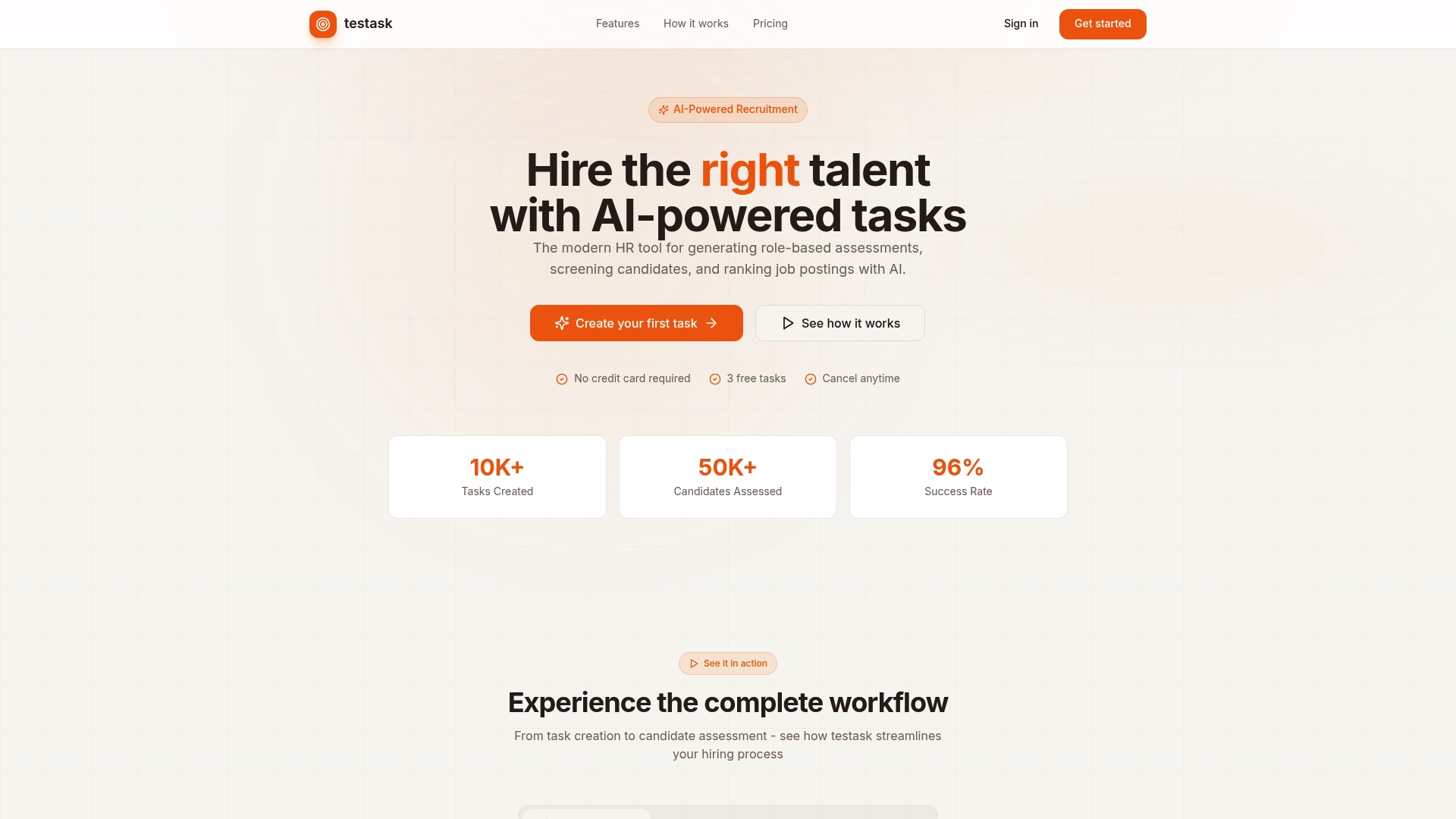
Testask is an AI-powered recruitment assessment platform that helps HR teams and hiring managers create tailored test tasks for candidates, evaluate submissions with AI-assisted analysis, and collaborate on review decisions. The platform supports multi-source evaluation, structured scoring, and the kind of fast turnaround that keeps assessment windows tight and completion rates high. Teams using Testask can generate role-specific assessments, track candidate performance across reviewers, and make hiring decisions backed by consistent data. For HR professionals building or refining their assessment tools and frameworks, Testask provides a practical starting point.
FAQ
What are the most effective skills assessment methods?
Work samples, structured technical interviews, and manager evaluations are the most reliable methods. Combining all three produces more accurate competency data than any single method alone.
How often should skills assessments be conducted?
Quarterly assessments keep data current without causing fatigue. Onboarding assessments should follow a structured schedule at 7, 14, 30, 60, and 90 days.
Why do self-assessments produce inaccurate results?
Individuals consistently overestimate their own skills. Self-assessments require validation through manager evaluations or work samples to produce reliable competency data.
What is a good completion rate for a skills assessment?
A target completion rate is at least 90%. Rates below 80% indicate the process is too burdensome or that participants do not see value in completing it.
How quickly should skill gaps be addressed after an assessment?
Document development actions within two weeks of assessment close. When fewer than half of identified gaps receive a documented response within 30 days, employee trust and future participation decline.
Recommended
- Examples of Assessment Tools for HR Teams in 2026 | Testask Blog | testask
- Best Hiring Practices 2026: What HR Teams Need to Know | Testask Blog | testask
- How to Assess Candidates: A 2026 Hiring Guide | Testask Blog | testask
- Recruitment Trends in 2026: What HR Leaders Must Know | Testask Blog | testask