Build an employee assessment checklist that works
Build an employee assessment checklist that works

Inconsistent candidate evaluations cost companies more than time. They produce unfair outcomes, introduce hidden bias, and make it nearly impossible to defend hiring decisions when challenged. For HR leaders managing high-volume recruiting across large teams, this inconsistency is a persistent and measurable problem. A structured employee assessment checklist solves it by replacing gut-feel scoring with documented, auditable criteria that every evaluator follows. This article walks you through exactly how to build that checklist, from defining core competencies to running calibration sessions that protect your process from score drift and groupthink.
Table of Contents
- Define roles and core competencies
- Build structured scoring and evidence capture
- Checklist framework: Steps for consistent evaluation
- Avoid edge-case failures: Calibration and auditability
- What most HR teams overlook: The real value of calibration meetings
- Elevate hiring decisions with the right platform
- Frequently asked questions
Key Takeaways
| Point | Details |
|---|---|
| Define role-specific competencies | Clarifying what you’re assessing is the foundation for checklist effectiveness. |
| Standardize scoring and evidence | Use rubrics and behavioral anchors to drive fair, documented decision-making. |
| Build multi-step checklists | Operationalize the process with systematic steps for prep, evaluation, consolidation, and feedback. |
| Prioritize calibration for fairness | Regular calibration and documented evidence prevent bias and groupthink across panelists. |
| Leverage modern HR platforms | Technology solutions streamline checklist use, scoring, and auditability for larger teams. |
Define roles and core competencies
Every reliable assessment checklist starts with clarity on what you are actually measuring. Before you write a single rubric item, you need a precise understanding of the role’s requirements and the competencies that predict success in it.
Start by auditing the job description. Many job descriptions are written for recruiting purposes, not evaluation purposes. They list duties but rarely specify what excellent performance looks like. Your checklist needs to be built around measurable competencies, not task lists. Competencies are the skills, behaviors, and knowledge areas that drive performance in the role.
Once you have identified the competencies, split them into two categories:
- Technical skills: The job-specific capabilities required to perform the work. For a software engineer, this might be system design, debugging, or code review quality. For a financial analyst, it could be financial modeling, data interpretation, and regulatory knowledge.
- Soft skills: Behavioral and interpersonal skills that affect how someone performs in the team and organization. Examples include communication clarity, conflict resolution, collaboration, and decision-making under pressure.
Each competency needs a behavioral anchor. A behavioral anchor describes what the skill looks like in action at each score level. Instead of rating “communication” on a 1-5 scale with no guidance, a behavioral anchor at level 3 might say: “Candidate explained technical concepts clearly without jargon and adjusted their explanation when the interviewer signaled confusion.” This removes ambiguity and keeps all assessors grading against the same standard.
Pro Tip: Tie each competency directly to a business outcome. If “adaptability” is on your checklist, link it explicitly to your organization’s pace of change or product iteration cycles. Evaluators who understand why a competency matters are more motivated to score it accurately.
Calibration is also essential at this stage. Before your first interview cycle, gather your hiring panel and walk through the behavioral anchors together. Score a sample scenario independently, then compare results. Disagreements reveal where your anchors need sharper language. Following assessment best practices for this pre-cycle alignment step significantly reduces score variance before it enters your data.
Using structured hiring process steps to sequence competency definition early also ensures that your checklist stays connected to the actual job requirements rather than drifting toward what evaluators find easy to measure.
Build structured scoring and evidence capture
With roles and competencies defined, the next step is to standardize how you rate and record candidate performance. This is where many checklists fall apart. Evaluators score their impressions rather than the evidence, and structured scoring exists specifically to prevent that.
Structured interview scoring tools are designed to standardize candidate evaluations by using predefined criteria, behavioral anchors, and shared scoring guidance for each competency. The key word here is “shared.” Every member of the panel should be working from the same rubric, scoring the same behaviors, and using the same rating definitions.

Here is a sample competency table to illustrate what this looks like in practice:
| Competency | Behavioral anchor | Rating 1 (needs development) | Rating 3 (meets standard) | Rating 5 (exceeds standard) |
|---|---|---|---|---|
| Communication | Clarity and adaptability in explanation | Answers are unclear or off-topic | Explains ideas clearly; adjusts when needed | Proactively tailors communication to audience; zero ambiguity |
| Problem-solving | Structured approach to an unstructured problem | No clear method; jumps to conclusions | Uses a logical framework; identifies key variables | Generates multiple solutions, evaluates tradeoffs explicitly |
| Collaboration | Evidence of shared ownership | Claims credit; no mention of team dynamics | References team contributions appropriately | Describes how they adapted to team needs; gives specific examples |
Evidence notes are the second critical element. After each interview, assessors should document specific quotes or observed behaviors that justify each score. A note like “Candidate said ‘I realized my initial assumption was wrong, so I reframed the problem and ran a quick A/B test’ when answering Q4” is far more defensible than “seemed analytical.”
“Structured interviewing relies on standardized questions plus standardized scoring rubrics, and reports benefits including reduced bias and improved perceptions of fairness.” — Google re:Work
This framing from Google re:Work reinforces a critical point: structure does not just improve accuracy. It improves perceived fairness, which matters when candidates, regulators, or internal stakeholders scrutinize your process.
Use our recruitment checklist tips to understand the documentation requirements that make evidence notes legally defensible. And when structuring your candidate evaluation steps, build evidence capture into each step rather than treating it as an afterthought.
Pro Tip: Run short calibration meetings after each interview round, not just at the end of the hiring cycle. Fifteen minutes of panelist alignment prevents compounding score drift across multiple candidates.
Checklist framework: Steps for consistent evaluation
Once scoring is systematic, you can operationalize the entire process through a checklist format. A well-designed checklist covers every phase of the evaluation, from preparation through feedback delivery.
HR checklists for recruiting are a mainstream methodology used to systematize key steps in employee evaluation. The following numbered framework adapts that approach to both hiring and internal performance review contexts:
- Pre-assessment preparation: Confirm role competencies are finalized. Brief all panelists on the rubric and behavioral anchors. Assign interview questions to specific panel members so coverage is complete and not redundant.
- Documentation setup: Distribute scoring sheets before the interview. Ensure each sheet includes the competency name, the behavioral anchor, the rating scale, and a blank evidence notes field.
- Candidate evaluation: Conduct the interview or assessment. Each evaluator scores independently without discussing impressions with other panelists in real time.
- Evidence consolidation: Within 30 minutes of the evaluation, each assessor completes their evidence notes while the conversation is still fresh. Delayed notes introduce memory bias.
- Calibration session: Panelists share scores and notes. Where scores diverge by more than one point on the rating scale, the group discusses the evidence, not the impression. The goal is not consensus. It is shared understanding.
- Feedback and decision: Generate a consolidated scorecard. Use it to drive the hiring or advancement decision. Deliver structured feedback to the candidate or employee, referencing specific criteria.
This framework applies to both hiring and internal reviews, though the emphasis differs. The comparison below highlights where each process diverges:
| Step | Hiring evaluation | Internal performance review |
|---|---|---|
| Inputs | Interview panel, test task results | Manager, self-evaluation, peer feedback |
| Scoring anchors | Job competency rubric | Performance goals and role expectations |
| Calibration | Post-interview panel discussion | Manager and HR alignment session |
| Output | Hire or no-hire decision | Rating, development plan, promotion decision |
| Feedback delivery | Candidate debrief (optional) | Structured review conversation |
Evaluation templates in performance management contexts commonly include multiple inputs including manager and self-evaluation, sometimes peer or 360 feedback, plus a defined rating scale and space for specific feedback and goal-setting. Applying the same rigor to internal reviews that you apply to hiring keeps your talent decisions consistent across the full employee lifecycle.
Statistic callout: Structured interviews have been shown to nearly double the predictive validity of unstructured interviews when it comes to forecasting job performance. Organizations that embed structured candidate screening steps consistently report faster time-to-hire and lower early-tenure attrition.
Avoid edge-case failures: Calibration and auditability
Now that the checklist framework is in place, let’s examine the critical steps that prevent calibration and audit failures from undermining the entire system.
Score drift is one of the most common and least visible problems in evaluation processes. It happens when assessors gradually shift their personal interpretation of a rating scale, so a “3” scored in week one no longer means the same thing in week six. Drift destroys comparability across candidates and makes your data unreliable for any downstream analysis.
Groupthink is a different but equally damaging failure mode. When panelists share impressions before scoring independently, the first voice in the room anchors everyone else. A charismatic interviewer’s enthusiasm can raise a candidate’s composite score by one to two points, regardless of actual performance.
Preventing these failures requires specific mechanics. Assessors should record observable evidence tied to rubric anchors and calibrate across panelists before and after interviews to prevent score drift and groupthink. Here is a practical checklist of common failure points and their solutions:
- Score drift: Prevent by re-anchoring panelists at the start of each new candidate batch. Review the behavioral anchor definitions before scoring begins.
- Groupthink: Prevent by requiring independent scoring before any group discussion. Sequester scores until all panelists have submitted.
- Missing evidence notes: Prevent by making the evidence field a required element of the scoring sheet. An uncompleted sheet is not a completed evaluation.
- Panel inconsistency: Prevent by using a single shared rubric for all assessors. Different panels should never use different scoring criteria for the same role.
- Undocumented decisions: Prevent by archiving all scorecards and calibration notes. These records are your audit trail if a hiring decision is ever questioned.
Pro Tip: Assign a designated calibration facilitator for each hiring panel. This person is responsible for collecting scores before the group meets, flagging large discrepancies, and keeping the calibration discussion focused on evidence rather than general impressions.
Following bias-free hiring steps provides additional structure for building auditability into your process at every stage, not just at the final decision point.
What most HR teams overlook: The real value of calibration meetings
Here is an uncomfortable truth: most HR teams treat calibration as a checkbox, not a capability. They schedule a quick debrief, note the scores, and move on. That approach misses the entire point.
Calibration meetings are where your assessment system either holds together or quietly falls apart. When evaluators disagree significantly on a candidate’s score, that disagreement is data. It tells you that your behavioral anchors are unclear, that one interviewer saw something the others missed, or that panel members are applying different mental models of “good performance.” Surfacing those disagreements is the whole value of calibration.
Uncalibrated teams almost always revert to gut feel within a few hiring cycles. The rubric sits in a shared folder, the scorecards get filled out, but the actual hiring decision gets made in a hallway conversation after the interview. That pattern is not a failure of motivation. It is a failure of process design.
The checklist is not just documentation. It is active bias prevention. Each required evidence note forces the evaluator to articulate why they scored what they scored. That act of articulation alone surfaces implicit bias far more reliably than bias training workshops.
Large organizations that have operationalized predictive hiring systems treat calibration as a standing meeting on the hiring cycle calendar, not an optional add-on. They track inter-rater reliability across panels and flag panels whose scores show high variance. Over time, this builds a culture of precision, not just a culture of process compliance.
Calibration is also where organizational learning happens. When a panel agrees that a candidate scored poorly on “stakeholder communication,” and then that candidate is hired anyway and exits within six months, you have a feedback loop. You can trace the outcome back to the scorecard, identify which competency predicted the failure, and strengthen that anchor for the next cycle.
Elevate hiring decisions with the right platform
For organizations ready to put these frameworks to work, technology can streamline every step.
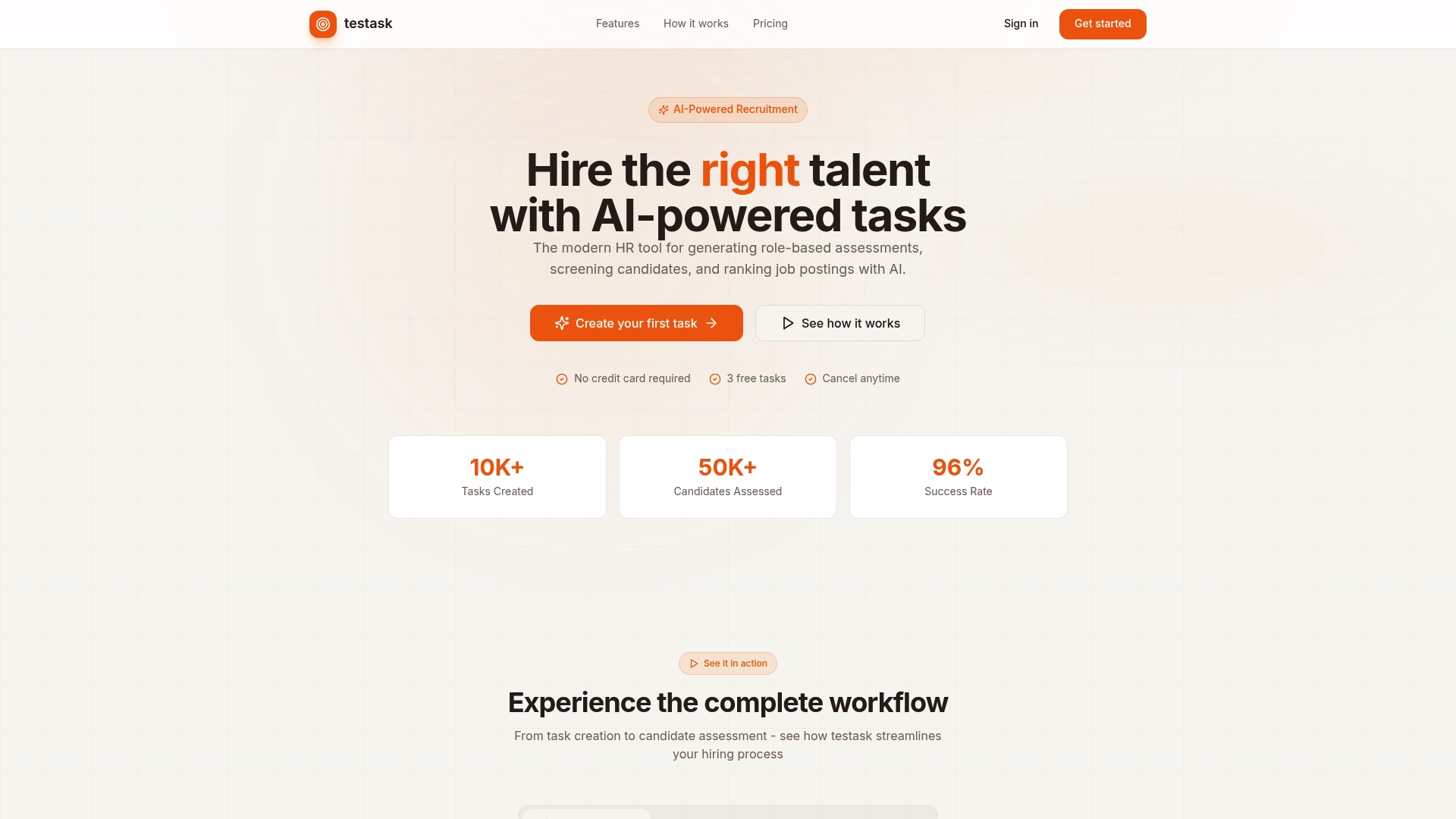
Testask’s AI-powered assessment tools help HR teams and hiring managers move from theory to practice fast. You can generate tailored test tasks aligned to your competency rubrics, collect structured candidate submissions, and review evidence-backed scores through a centralized collaboration interface. The platform supports the kind of effective recruitment checklist design covered in this article, with built-in scoring, calibration support, and AI-assisted evaluation analysis. For mid-sized to large companies managing multiple roles and panels simultaneously, Testask replaces the manual overhead of spreadsheet-based assessment with a scalable, auditable system that keeps every hiring decision consistent and defensible.
Frequently asked questions
What makes an employee assessment checklist consistent?
Clear criteria, behavioral anchors, structured scoring, and post-evaluation calibration all contribute to checklist consistency. Interview rubrics should specify competencies, behavioral anchors, and a consistent rating scale, with calibration and evidence notes replacing gut-feel scoring.
How does structured interviewing improve fairness?
Structured interviewing uses standardized questions and rubrics, which reduce bias and increase perceived fairness across candidate pools. Standardized scoring rubrics are a core mechanism for achieving that fairness according to Google re:Work guidance.
Can checklists be used for internal performance reviews?
Yes. Evaluation templates in performance management contexts include multiple inputs such as manager and self-evaluation, peer feedback, and a defined rating scale, making them highly applicable to structured internal reviews.
How do checklists reduce groupthink in hiring?
Checklists require each panelist to record evidence and score independently before any group discussion, which prevents early voices from anchoring the group. Recording observable evidence tied to rubric anchors is the specific mechanic that stops groupthink and score drift.
What is a behavioral anchor in an assessment rubric?
A behavioral anchor describes specific, observable actions at each score level, removing ambiguity from how each competency is rated. Rubrics and scorecards use behavioral anchors alongside predefined criteria to ensure all assessors apply the same standard.
Recommended
- Employment assessment best practices that elevate hiring results | Testask Blog | testask
- Build an effective recruitment checklist for HR success | Testask Blog | testask
- Talent Assessment: Build Efficient, Predictive Hiring Systems | Testask Blog | testask
- Recruitment assessment steps: your guide to bias-free hiring | Testask Blog | testask