What Is HR Collaboration and Why It Matters in 2026
What Is HR Collaboration and Why It Matters in 2026

HR collaboration is defined as the coordinated integration of HR teams with other departments, including IT, finance, and operations, to achieve shared organizational goals through aligned decision-making, unified data, and concurrent workflows. Where traditional HR operated as a support function handing off tasks sequentially, true collaboration means HR, IT, and business leaders co-own outcomes from the start. This shift matters most in recruitment, where cross-departmental collaboration reduces hiring and onboarding time by replacing sequential hand-offs with concurrent execution. In 2026, with hybrid work and AI transformation reshaping every organization, HR collaboration is no longer optional. It is the operating model that separates high-performing organizations from the rest.
What is HR collaboration and why does it matter?
HR collaboration, as a recognized industry concept, sits within the broader discipline of cross-functional organizational design. The HR collaboration definition goes beyond HR professionals simply attending cross-departmental meetings. It describes a state where HR co-creates strategy, shares accountability, and integrates its processes directly into business operations and revenue models, moving HR from a support role to a strategic partner.
Understanding what HR collaboration means also requires distinguishing it from related concepts. Teamwork is role-based and hierarchical. Coordination is sequential task hand-off. Cooperation is voluntary assistance. Collaboration is fluid, interdependent co-creation where participants share ownership of both the process and the outcome. This distinction matters because organizations that treat collaboration as “better teamwork” miss the structural and cultural redesign it actually requires.
The benefits of HR collaboration are concrete and measurable:
- Faster hiring cycles through concurrent screening, interviewing, and onboarding preparation across HR, IT, and hiring managers
- Stronger onboarding when IT provisioning, facilities, and HR orientation are planned together rather than triggered sequentially
- Better hiring decisions when HR and business leaders share candidate evaluation criteria from the first job brief
- Higher organizational agility when HR has real-time visibility into workforce data alongside finance and operations
“HR collaboration provides competitive advantage by embedding people processes directly into business operations, transforming HR from a cost center into a strategic engine for growth.”
The importance of HR collaboration compounds at scale. A 500-person company with siloed HR loses weeks per hire to miscommunication and rework. A company with integrated HR-IT-finance workflows gains those weeks back and redirects them toward candidate quality and employee experience.
How do HR and IT collaborate to enhance workflows and recruitment?
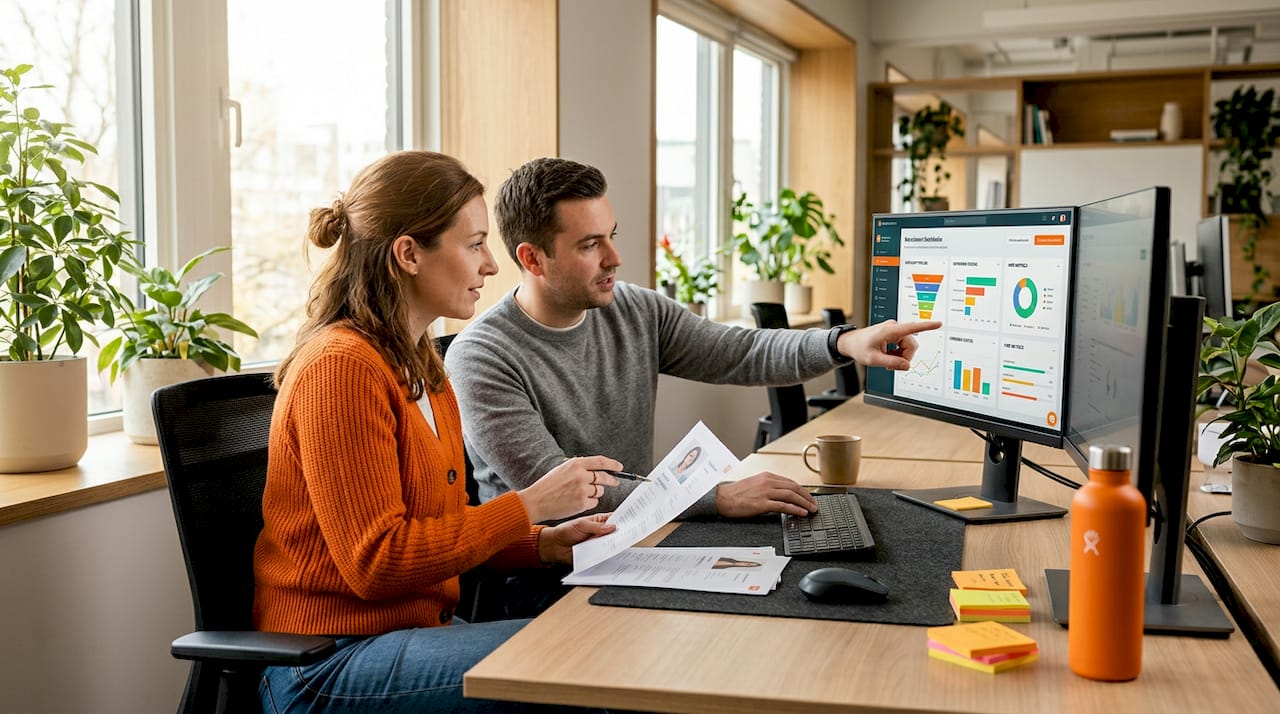
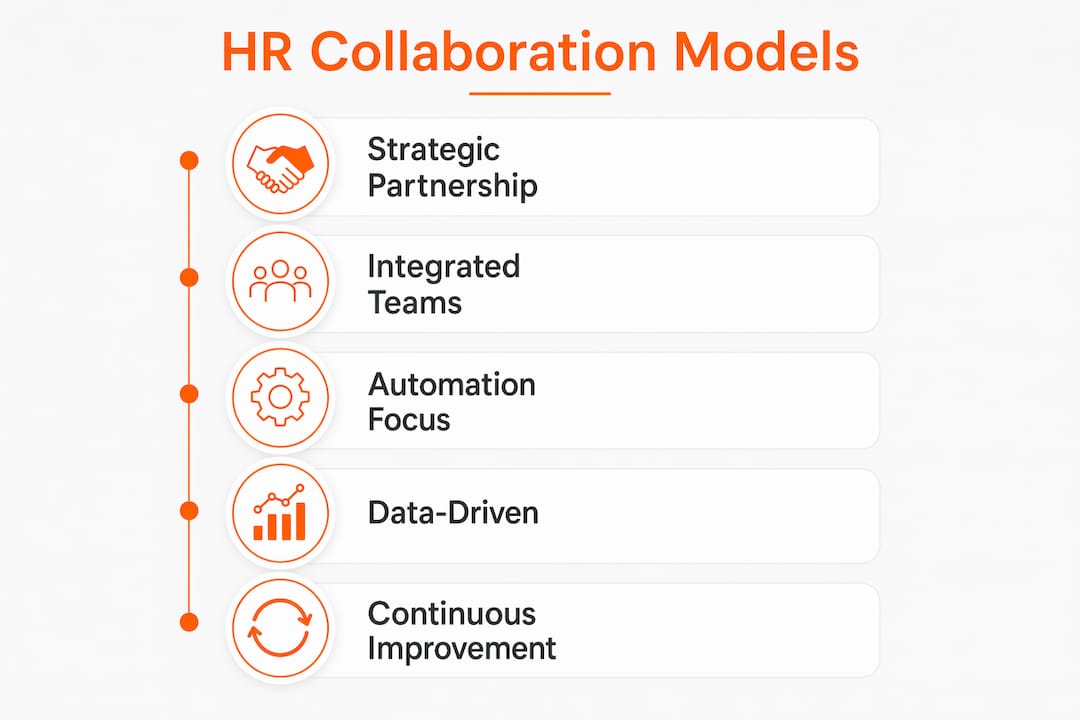
HR and IT collaboration is the most consequential cross-functional partnership in modern organizations, particularly as AI transforms both functions simultaneously. Organizations with effective HR-IT collaboration implement AI faster and create measurably better employee experiences. Three distinct models define how this partnership operates in practice.
| Model | Structure | Best for |
|---|---|---|
| Strategic partnership | HR and IT maintain separate teams with defined integration points | Mid-size organizations with stable processes |
| Hybrid leadership | Shared roles like Chief People and Technology Officer bridge both functions | Fast-scaling companies with AI transformation goals |
| Full merger | People operations and technology operations report into a single function | Highly digital-native organizations |
The strategic partnership model is the most common starting point. HR owns the people strategy and IT owns the infrastructure, but both co-govern the data and systems that connect them. The critical enabler in every model is a unified people data foundation governed with shared trust. Without it, AI initiatives stagnate in pilot mode because neither team can act on data the other controls.
AI workflow automation is where HR-IT collaboration delivers its most visible returns. AI orchestrates end-to-end processes across disconnected platforms like ATS, HRIS, payroll, and learning systems, eliminating manual data entry and the errors that come with it. When HR and IT design these integrations together, the result is a recruitment workflow where candidate data flows automatically from application through offer without a single manual transfer.
Pro Tip: Before selecting any HR-IT collaboration model, map every point where HR data currently crosses into an IT-owned system. Those handoff points are where errors accumulate and where automation delivers the fastest return.
What structural and cultural shifts must HR lead to promote effective collaboration?
Most HR collaboration failures are not caused by unwilling employees. Collaboration failures stem from structural flaws: unclear decision rights, siloed technology systems, and work designs that assume co-location. Behavior training alone cannot fix a system that was never designed for collaboration. HR must act as the architect of work design, not just the facilitator of culture programs.
Hybrid work intensifies this challenge. Remote and hybrid arrangements reduce cross-group collaboration by 25%, a reduction significant enough to affect innovation cycles, onboarding quality, and cross-functional project execution. HR cannot simply encourage people to collaborate more. It must redesign the conditions that make collaboration possible.
Practical structural interventions HR leaders can implement include:
- Clarify decision rights explicitly. Document which decisions require cross-functional input and which do not. Ambiguity creates over-collaboration on low-stakes decisions and under-collaboration on high-stakes ones.
- Reduce meeting volume before adding collaboration tools. Adding Slack or Microsoft Teams to a meeting-heavy culture increases noise, not collaboration. Audit meeting load first.
- Create smaller, purpose-built forums. Large all-hands meetings produce the appearance of collaboration. Small, cross-functional working groups with defined deliverables produce the reality.
- Build psychological safety through visible inclusion. Hybrid teams where remote participants are consistently deprioritized in meetings will self-select out of collaborative work. HR must set and enforce inclusion protocols.
- Use low-risk simulation environments. Team-based play and simulation develop effective collaboration behaviors before teams apply them in high-stakes situations, surfacing hidden norms and role conflicts safely.
Pro Tip: Run a collaboration audit before any structural redesign. Survey teams on where they experience the most friction: unclear ownership, too many approvals, or poor information flow. The answers will tell you exactly where to intervene.
The cultural dimension of effective HR collaboration practices requires HR to model the behavior it wants to see. When HR itself operates in silos, with talent acquisition, HR business partners, and learning and development rarely sharing data or strategy, it signals to the rest of the organization that collaboration is aspirational, not operational.
What are HR collaboration tools and platforms advancing teamwork today?
HR collaboration tools have evolved well beyond shared drives and email threads. HRMS collaboration platforms now unify HR management and communication in a single environment, combining document collaboration, workflow automation, approvals routing, and integrated messaging. The practical effect is that HR teams and hiring managers can review candidates, approve offers, and coordinate onboarding without switching between five separate systems.
Key capabilities to evaluate when selecting HR collaboration platforms:
- Shared workspaces where HR, hiring managers, and IT can co-review candidate submissions and assessment results in real time
- Workflow automation that routes approvals, triggers notifications, and escalates stalled decisions without manual follow-up
- Integration with payroll, finance, and CRM systems so that a new hire triggers provisioning, payroll setup, and CRM access simultaneously
- AI-powered candidate screening that analyzes submissions against role-specific criteria and surfaces ranked shortlists for collaborative review
- Analytics dashboards that give HR and business leaders shared visibility into pipeline health, time-to-hire, and offer acceptance rates
The integration layer is where most platforms fail in practice. A platform that manages HR workflows internally but cannot connect to the finance system or the IT provisioning tool creates a new silo rather than eliminating one. Evaluate integration depth, not just feature breadth.
| Platform capability | Business impact |
|---|---|
| Real-time collaborative review | Reduces time-to-decision by eliminating asynchronous feedback loops |
| AI-assisted screening | Increases shortlist quality while reducing recruiter screening hours |
| Cross-system workflow automation | Eliminates manual data transfer errors between ATS, HRIS, and payroll |
| Shared analytics | Aligns HR and business leaders on hiring KPIs and workforce planning |
For distributed and hybrid teams, platforms that support offshore and remote staffing with built-in compliance and communication tools are particularly valuable, as they extend HR collaboration across time zones without creating process gaps.
How can HR professionals implement and improve collaboration in their organizations?
Improving HR collaboration requires a sequenced approach, not a simultaneous overhaul. Organizations that try to redesign culture, implement new tools, and restructure decision rights at the same time typically achieve none of them. The following sequence reflects how to improve HR collaboration with the highest probability of success.
- Diagnose before designing. Map current workflows to identify where collaboration breaks down. Use data from your ATS and HRIS to find where hiring cycles stall and where candidate data gets lost between systems.
- Define shared ownership explicitly. Assign co-ownership of key outcomes, such as time-to-hire or new hire retention at 90 days, to both HR and the relevant business unit. Shared metrics create shared motivation.
- Select tools that match your collaboration model. A strategic HR-IT partnership needs different tooling than a hybrid leadership model. Match the platform to the structure, not the other way around.
- Build interdependence through practice. Embedding collaboration norms into daily workflows, through shared standups, joint retrospectives, and co-authored hiring briefs, produces durable behavior change faster than training programs.
- Measure and iterate. Track collaboration quality through proxy metrics: meeting-to-decision ratios, cross-functional project completion rates, and hiring manager satisfaction scores. Adjust based on what the data shows.
A practical example: a mid-size technology company redesigned its recruitment workflow by assigning a shared hiring dashboard to HR and engineering leads. Both teams reviewed candidate assessments in the same platform, commented in real time, and co-scored final candidates. Time-to-hire dropped by three weeks in the first quarter. The tool did not create the collaboration. The shared accountability structure did. The tool made it visible and efficient. You can explore hiring process best practices that support this kind of cross-functional design.
Pro Tip: Avoid the over-collaboration trap. Not every decision benefits from cross-functional input. Define a clear tier system: decisions that require collaboration, decisions that require notification, and decisions that one person owns entirely. This protects focus while preserving genuine collaboration where it matters.
Key takeaways
Effective HR collaboration requires structural redesign, a unified data foundation, and technology that connects HR to every function it serves.
| Point | Details |
|---|---|
| HR collaboration definition | HR collaboration is cross-functional co-ownership of people processes, not just improved internal teamwork. |
| Structural design comes first | Most collaboration failures trace to unclear decision rights and siloed systems, not unwilling employees. |
| HR-IT partnership is foundational | A shared data foundation between HR and IT is the prerequisite for scalable AI and recruitment automation. |
| Tools must match the model | Select HR collaboration platforms based on your organizational structure and integration requirements, not feature lists. |
| Measure proxy outcomes | Track time-to-hire, cross-functional project completion, and hiring manager satisfaction to gauge collaboration quality. |
Why HR collaboration is the design challenge most organizations get wrong
From my experience working with HR teams across industries, the single most common mistake is treating collaboration as a cultural initiative rather than an organizational design problem. Companies run workshops on psychological safety and install new chat tools, then wonder why nothing changes. The reason is that the underlying structure, who owns which decisions, which systems talk to each other, how hybrid meetings are run, remains unchanged.
The HR-IT relationship is the clearest example of this. I have seen organizations where HR and IT genuinely wanted to collaborate on AI-driven recruitment but could not, because neither team had access to the other’s data. The will was there. The architecture was not. No amount of relationship-building fixes a data governance gap.
What actually works is treating collaboration as a designed practice. That means writing down decision rights, not just discussing them. It means selecting tools that enforce shared visibility, not just enable it. And it means measuring collaboration outcomes, not collaboration activity. Busy cross-functional meetings are not evidence of collaboration. Faster hiring cycles and better candidate quality are.
The organizations I have seen get this right share one trait: HR leadership that is willing to redesign its own function first. When HR business partners, talent acquisition, and people analytics operate as a genuinely integrated team, they model the cross-functional behavior they are asking the rest of the organization to adopt. That credibility is what makes HR an effective architect of organizational collaboration rather than just an advocate for it.
— Pavel
See how Testask supports HR collaboration in recruitment
Testask is an AI-powered recruitment assessment platform built for HR teams and hiring managers who need to collaborate on candidate evaluation without the friction of disconnected tools. With Testask, you can generate tailored test tasks, review candidate submissions in a shared workspace, and apply AI-assisted analysis to make faster, more consistent hiring decisions. HR and business leaders work from the same data, at the same time, with no manual transfers between systems. If you are ready to put the principles in this article into practice, explore Testask and see how AI-driven assessment transforms your recruitment collaboration. You can also read more about AI-powered recruitment to understand how the technology supports cross-functional hiring workflows.
FAQ
What is the HR collaboration definition in simple terms?
HR collaboration is the coordinated integration of HR with other departments, such as IT, finance, and operations, to co-own people processes and achieve shared organizational goals. It goes beyond internal HR teamwork to include cross-functional decision-making and unified data.
What are the main benefits of HR collaboration?
The primary benefits include faster hiring cycles, reduced onboarding errors, stronger alignment between HR and business leaders, and improved organizational agility. Cross-departmental collaboration enables concurrent task execution rather than sequential hand-offs, directly reducing time-to-hire.
What tools support HR team collaboration strategies?
HRMS collaboration platforms like those combining workflow automation, shared workspaces, and AI-powered screening are the most effective category. The critical requirement is deep integration with existing systems such as ATS, HRIS, and payroll, so data flows automatically across functions.
Why do HR collaboration efforts fail?
Most failures trace to structural causes rather than behavioral ones. Unclear decision rights, siloed technology systems, and work designs built for co-located teams prevent collaboration regardless of cultural intent. HR must redesign systems and boundaries, not just run training programs.
How does hybrid work affect HR collaboration?
Hybrid and remote arrangements reduce cross-group collaboration by 25%, which directly impacts innovation, onboarding quality, and cross-functional project execution. HR must actively redesign meeting structures, inclusion protocols, and digital workflows to compensate for reduced informal connection.