The Role of HR Analytics in Workforce Strategy 2026
The Role of HR Analytics in Workforce Strategy 2026

HR analytics is the practice of using employee and workforce data to make smarter HR decisions and drive measurable business outcomes. Where traditional HR reporting tells you what happened last quarter, the role of HR analytics extends far beyond that: it connects data from HRIS platforms, payroll systems, performance reviews, and engagement surveys to reveal patterns that shape hiring, retention, performance management, and long-term workforce planning. For HR professionals and business leaders who want to move from gut-feel decisions to evidence-based strategy, understanding how analytics works in 2026 is no longer optional.
What is the role of HR analytics in modern organizations?
HR analytics, also called people analytics or workforce analytics, is defined as the systematic use of data and statistical methods to improve HR decisions and workforce outcomes. It differs from standard HR reporting in one critical way: reporting describes the past, while analytics explains it, predicts what comes next, and recommends what to do about it.
The scope of HR analytics in 2026 spans six core data sources: HRIS records, payroll data, performance reviews, engagement surveys, recruitment metrics, and learning and development records. Each source adds a layer of context that makes workforce decisions more precise and defensible.

The practical impact shows up across the entire employee lifecycle. Analytics informs which candidates are likely to succeed in a role, which employees are at risk of leaving, which managers drive high team performance, and where skill gaps will emerge in the next three years. That breadth is what makes HR analytics a strategic function rather than an administrative one.
What are the four types of HR analytics?
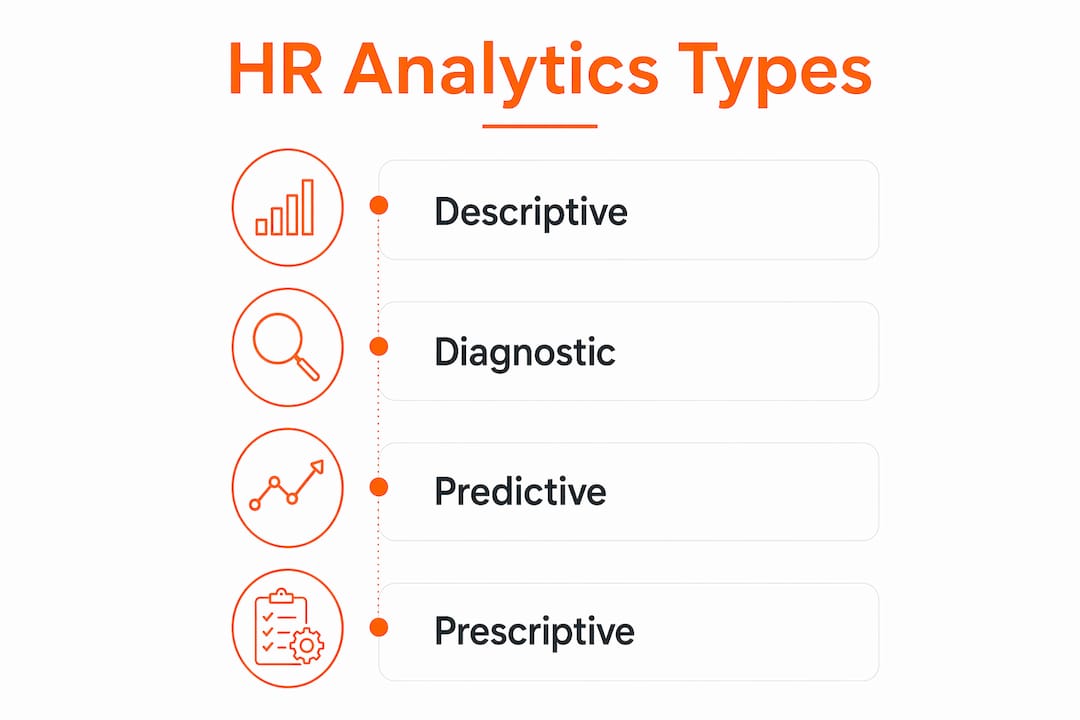
HR analytics capabilities fall into four distinct levels, each adding more strategic value than the last.
- Descriptive analytics answers “What happened?” Examples include monthly turnover dashboards, headcount reports, and time-to-fill metrics. This is the most common level and the starting point for most organizations.
- Diagnostic analytics answers “Why did it happen?” It uses correlation analysis to find root causes. For example, linking manager span of control data to team turnover rates reveals whether overloaded managers are driving attrition.
- Predictive analytics answers “What will likely happen?” Flight risk scores are a practical example: by analyzing tenure, engagement scores, compensation benchmarks, and promotion history, predictive models flag employees likely to resign within 90 days.
- Prescriptive analytics answers “What should we do about it?” This is where AI and large language models enter the picture, recommending specific interventions such as targeted retention bonuses, personalized learning programs, or internal mobility opportunities.
The uncomfortable reality is that 74% of organizations report analytics capabilities limited to basic reporting, and only 18% use data consistently for people decisions. That gap represents a significant missed opportunity for competitive advantage.
Pro Tip: If your team is stuck at descriptive analytics, pick one specific HR decision, such as 90-day new hire retention, and build a single diagnostic model around it. One focused use case builds more organizational trust than a broad dashboard overhaul.
Why is HR analytics critical for strategic workforce planning?
Strategic workforce planning (SWP) is where HR analytics delivers its highest business value. According to Bain’s SWP framework, effective planning requires a six-year North Star horizon with a three-year midpoint checkpoint. Without analytics to model talent supply, skill gaps, and attrition scenarios, that planning exercise stays theoretical.
The critical insight from Bain’s research is that SWP requires joint ownership between business leaders and HR. HR analytics teams provide the evidence and scenario modeling; business leaders own the assumptions and decisions. When HR tries to own both, the process loses credibility with the C-suite.
“Treat workforce analytics like a continuous joint forecasting hypothesis owned by the business, with HR facilitating analytics and scenario testing.” — Bain & Company
The business case for this approach is concrete. When Commonwealth Bank embedded workforce analytics into its talent redeployment strategy, it identified internal candidates for critical roles that would otherwise have been filled externally, generating significant cost savings and reducing time-to-productivity. That kind of outcome is only possible when analytics is connected to real business decisions, not isolated in an HR dashboard.
The table below shows how analytics maturity maps to business impact:
| Analytics level | Business application | Strategic value |
|---|---|---|
| Descriptive | Turnover and headcount reporting | Operational visibility |
| Diagnostic | Root cause analysis of attrition | Problem identification |
| Predictive | Flight risk and skills gap modeling | Proactive intervention |
| Prescriptive | AI-driven retention and hiring recommendations | Strategic workforce optimization |
The shift from reactive to proactive HR strategy is the core benefit of HR analytics. When you can model three workforce scenarios before a business unit restructure, you walk into the boardroom with evidence rather than estimates.
What organizational challenges limit HR analytics impact?
The biggest barrier to HR analytics delivering full value is not technology. It is organizational positioning. Most HR analytics teams operate as internal service providers, responding to data requests from HR business partners rather than sitting at the table where business decisions are made. That structural misalignment limits their influence before any analysis begins.
Korn Ferry’s research identifies three structural problems that consistently undermine analytics impact:
- Reporting line positioning. When HR analytics leaders report below the CHRO level, they lack the visibility and authority to shape strategic conversations. Elevating the analytics function to direct CHRO reporting changes the dynamic immediately.
- Service provider mindset. Analytics teams that wait for requests rather than proactively identifying business questions stay stuck in a reactive mode. The shift requires moving from “What data do you need?” to “Here is what the data says about your Q3 hiring plan.”
- Late integration into business initiatives. When analytics teams are brought in after decisions are made to validate them, their impact is cosmetic. Embedding analytics teams early in business initiatives, such as restructures, market expansions, or product launches, is where the real influence happens.
Korn Ferry recommends restructuring analytics teams into cross-functional pods, each aligned to a specific business unit or initiative. This model improves leadership pipeline visibility, accelerates talent placement decisions, and builds the kind of trust with business leaders that turns HR analytics from a reporting function into a strategic partner.
Pro Tip: Start your next business planning cycle by asking the CFO or COO one question: “What workforce assumption in your plan worries you most?” That answer tells you exactly where to focus your analytics resources for maximum credibility.
You can explore how data-driven hiring decisions connect to broader workforce strategy in Testask’s guide on analytics in recruitment.
How are AI and legal frameworks shaping HR analytics in 2026?
AI is accelerating the move toward prescriptive analytics, but it is also introducing governance obligations that HR leaders cannot ignore. The EU AI Act, with regulations effective from August 2026, classifies most AI tools used in HR decisions as high-risk systems. That classification carries real operational requirements.
Here is what compliance looks like in practice for HR analytics teams using AI:
- Human oversight protocols. Every AI-driven HR recommendation, whether a hiring score, flight risk flag, or performance rating, must be reviewable and overridable by a qualified human supervisor. Vendor assurances are not sufficient. Your operating model must document the override process.
- Transparency and disclosure. Employees have the right to know when AI is being used to make or inform decisions about them. This includes recruitment screening, performance evaluation, and promotion recommendations.
- Trained supervisors. The EU AI Act requires that supervisors overseeing high-risk AI systems have the technical competence to understand what the model is doing and when to question its output. This is a skills gap for most HR teams today.
- Audit trails. AI-assisted decisions must be logged with enough detail to reconstruct the reasoning if challenged. This is both a legal requirement and a best practice for building internal trust.
The governance challenge is not a reason to avoid AI in HR analytics. It is a reason to build the oversight infrastructure before deploying AI at scale. Organizations that get this right will have a significant advantage: they can use AI to accelerate decisions while maintaining the human judgment that protects both employees and the business. For a deeper look at how AI is reshaping talent acquisition specifically, Testask’s guide on AI-powered recruitment covers the practical and regulatory dimensions in detail.
Key takeaways
HR analytics delivers its highest value when it moves beyond descriptive reporting into predictive and prescriptive capabilities that are embedded directly into business decision-making.
| Point | Details |
|---|---|
| Four analytics levels | Descriptive, diagnostic, predictive, and prescriptive analytics each add increasing strategic value. |
| Maturity gap is real | Only 18% of organizations use data consistently for people decisions, leaving significant value on the table. |
| SWP requires joint ownership | Business leaders own workforce planning assumptions; HR analytics provides the evidence and scenario modeling. |
| Structure determines impact | Embedding analytics teams in business initiatives early, with direct CHRO reporting, drives the most influence. |
| AI governance is non-negotiable | EU AI Act requirements from August 2026 mandate human oversight, transparency, and trained supervisors for HR AI tools. |
Where HR analytics is headed: a frank assessment
I have spent years watching HR analytics teams produce impressive dashboards that nobody acts on. The pattern is almost always the same: the analytics team is technically capable, the data is reasonably clean, but the function is positioned as a support service rather than a strategic voice. The technology was never the problem.
What actually changes outcomes is when HR analytics leaders start showing up to business planning meetings before the decisions are made, not after. Smaller organizations often do this better than large enterprises, not because they have better tools, but because analytics agility comes from fewer governance layers and closer proximity to decision-makers.
The democratization of analytics through cloud-based HR platforms and accessible AI tools is genuinely leveling the playing field. An HR team of five at a 200-person company can now run flight risk models that would have required a dedicated data science team five years ago. That is a real shift, and it means data fluency is now a core skill for every HR professional, not just analytics specialists.
My honest advice: stop defending your analytics function by showing how many reports you produce. Start measuring it by how many business decisions you influenced before they were finalized. That reframe changes everything about how you prioritize your work, structure your team, and build credibility with leadership.
— Pavel
See how Testask puts HR analytics to work in hiring
If you are ready to move beyond manual screening and gut-feel hiring decisions, Testask gives HR teams and hiring managers an AI-powered assessment platform that generates tailored test tasks, evaluates candidate submissions, and surfaces data-driven insights to support faster, more confident hiring decisions. The platform connects directly to the kind of hiring analytics that help you predict candidate fit, reduce time-to-hire, and build a more defensible selection process. Whether you are screening for technical skills, role-specific competencies, or cultural alignment, Testask gives your team the analytical foundation to hire smarter at every stage.
FAQ
What is HR analytics?
HR analytics is the use of employee and workforce data to improve HR decisions and business outcomes. It spans descriptive, diagnostic, predictive, and prescriptive methods applied to hiring, retention, performance, and workforce planning.
How does HR analytics differ from HR reporting?
HR reporting describes what happened in the past, such as turnover rates or headcount. HR analytics goes further by explaining why it happened, predicting what will happen next, and recommending specific actions to take.
Why do most HR analytics programs fail to deliver value?
According to Korn Ferry, the core obstacle is organizational positioning. Most analytics teams operate as service providers rather than strategic partners, and they are integrated into business decisions too late to influence outcomes.
What does the EU AI Act mean for HR analytics teams?
The EU AI Act, effective August 2026, classifies most AI tools used in HR decisions as high-risk systems. This requires human oversight protocols, employee disclosure, trained supervisors, and documented audit trails for all AI-assisted HR decisions.
What is the most effective way to start with HR analytics?
Focus on one specific HR decision with a measurable outcome, such as 90-day retention for new hires, and build a single diagnostic or predictive model around it. One credible use case builds more organizational trust than a broad analytics program launched all at once.
Recommended
- Harnessing data analytics to transform hiring decisions | Testask Blog | testask
- What Is Hiring Analytics? A Guide for HR Teams | Testask Blog | testask
- Top talent acquisition tips for smarter hiring in 2026 | Testask Blog | testask
- 8 Recruitment Analytics Metrics Every HR Leader Needs | Testask Blog | testask